Send Your Manuscript & Target Journal Name
We return a free quote within 3 hours covering full cost and confirmed delivery timeline. Moreover, pricing starts from just $39 per manuscript with 72-hour standard turnaround.

No two journals format manuscripts the same way and even minor deviations from a target journal’s author guidelines can trigger desk rejection before peer review. That’s where ManuscriptLab comes in. Our journal-specific formatting service prepares your research paper to the exact layout, structure, and house style requirements of any academic journal. Whether you are submitting to Elsevier, Springer Nature, IEEE, Wiley, or Nature portfolio titles, we apply every specification with precision, so that your manuscript reaches the editor in full compliance the first time.
Senior Editorial Reviewer · ManuscriptLab
Not generic academic formatting. Not a one-size-fits-all template. Meticulously applying one journal's published author guidelines. Every margin, every heading, every reference.
Author requirements differ enormously — not just across publishers, but between journals from the same publisher. Generic formatting cannot solve this. Only journal-specific work can.
We maintain an active library of 100+ publishers. Every manuscript is formatted to the current, published version of guidelines — never an outdated copy, never a publisher-wide default.
Both are Elsevier journals. Both demand entirely different formatting. This is why journal-specific work exists as its own discipline.
Journal-specific formatting touches every structural and visual element of your manuscript. Below are the core areas we adjust in every order — each calibrated to your target journal’s exact requirements.
Page size, top, bottom, left, and right margins set to journal specification. Header and footer placement adjusted. Page numbering position and format aligned to house style — most journals require continuous numbering starting from the title page.
Continuous line numbering applied where the journal requires it (most major publishers do for peer review). Line spacing set to single, 1.5, or double as specified. Paragraph indentation, spacing, and alignment standardised throughout.
Font family, size, and weight set to the journal's specified body text and heading styles. Italics, bold, and small caps applied only as the house style permits. Special characters and Greek letters formatted consistently.
Section headings, sub-headings, and sub-sub-headings styled to the journal's hierarchical convention. Numbered or unnumbered, bold or italic, all-caps or sentence case — applied consistently as the journal requires.
Manuscript reorganised into the journal's required section order — typically Introduction, Methods, Results, Discussion (IMRaD), but with variations such as merged Results & Discussion, or specialised sections for review papers, case reports, and methods papers.
Title page formatted to journal specification including manuscript title, running title, author list with affiliations, corresponding author details, ORCID identifiers, word count statements, and any required author declarations.
Abstract structured to the journal's format — narrative, structured (Background, Methods, Results, Conclusions), or summarised. Word limits enforced. Keyword count and formatting adjusted. Highlights and graphical abstract prepared if required.
Journal-specific spelling conventions (UK or US English), measurement units (SI, imperial, mixed), date and number formatting, abbreviation rules, and capitalisation conventions applied throughout the manuscript.
We return a free quote within 3 hours covering full cost and confirmed delivery timeline. Moreover, pricing starts from just $39 per manuscript with 72-hour standard turnaround.
Below is a breakdown of the most common author guideline requirements for major academic publishers. Each journal within a publisher may also have its own specific variations — we work to the exact title-level specifications, not just the publisher-wide defaults.
3,000+ Journals · Scopus Indexed
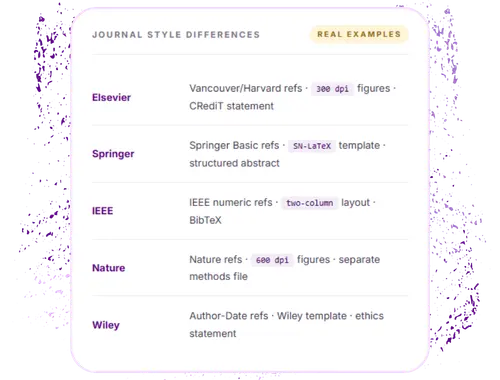
Elsevier journals each publish their own author guidelines, which vary by title. Specifically, we format manuscripts to flagship Elsevier publications including The Lancet, Cell, Trends series, Joule, and discipline-specific journals across chemistry, physics, biology, medicine, and engineering. In general, common requirements include double-spaced manuscript, continuous line numbering, structured or narrative abstract depending on title, CRediT contributor statement, and figures supplied as separate files at minimum 300 dpi.
3,000+ Journals · WoS Indexed
Springer Nature spans Nature portfolio titles (Nature, Nature Communications, Nature Methods, and subject-specific Nature journals) and the broader Springer journal catalogue. Notably, Nature portfolio journals follow the Nature referencing style and have strict structural requirements including separate methods file submission, integrated supplementary information format, and figures at 600 dpi for production. By contrast, Springer journals use the Springer Basic Reference Style and the SN-LaTeX template family.
1,600+ Journals · Multidisciplinary
Wiley journals span health sciences, life sciences, social sciences, humanities, and business. Typically, most Wiley journals use a Wiley-supplied template, with reference styles varying by discipline — Author-Date for many social science and humanities titles, numeric for medical titles. Furthermore, Wiley’s Submission Center requires specific file naming conventions, separate figure files, and journal-specific cover letter formats. In addition, many Wiley journals also require ethics and conflict-of-interest statements in a defined location within the manuscript.
200+ Journals & Conferences · Engineering
IEEE publishes journals (IEEE Transactions, IEEE Access) and conference proceedings (NeurIPS, ICCV, ICML in partner cases, and IEEE-hosted conferences) with strict template-based formatting. Specifically, the standard IEEE two-column layout, IEEE numeric referencing, BibTeX integration, and per-conference page limits all apply. Additionally, IEEE Author Center provides Word and LaTeX templates which we work in natively — including IEEEtran for LaTeX users.
2,700+ Journals · Multidisciplinary
Taylor & Francis (incorporating Routledge) covers humanities, social sciences, behavioural sciences, education, and STEM journals. Notably, reference styles vary widely by discipline — APA for psychology and education, Chicago Author-Date for many humanities, Vancouver for medical titles. Moreover, T&F’s ScholarOne submission system requires specific component file uploads, and many journals require structured author contribution and funding statements.
1,000+ Journals · Behavioural & Social
SAGE publishes across business, education, criminology, psychology, sociology, and medical fields. Generally, SAGE journals commonly use APA, Harvard, or Vancouver referencing depending on title. Additionally, most SAGE journals require an unblinded title page, anonymised main document for peer review, and a separate author biographies section. Furthermore, tables and figures are typically embedded at end of manuscript rather than inline.
70+ Medical Journals · MEDLINE Indexed
BMJ publishes high-impact clinical and biomedical journals including The BMJ, BMJ Open, Heart, Gut, and specialty titles. Importantly, all BMJ journals use the Vancouver referencing style, ICMJE recommendations for authorship and contributorship, and structured abstracts with required components (Objectives, Design, Setting, Participants, Interventions, Main outcome measures, Results, Conclusions). In addition, reporting guidelines like CONSORT, STROBE, and PRISMA are mandatory for relevant study designs.
400+ Journals · Open Access
MDPI journals span every major discipline and use a unified MDPI manuscript template available in Word and LaTeX. Specifically, reference style is ACS-derived numeric. Furthermore, the MDPI template enforces specific section structures, author contribution statements via CRediT, funding statements, institutional review board statements where applicable, and data availability declarations. Consequently, we work directly in the MDPI template for all submissions.
Our active style library covers 100+ publishers and grows every week. Send the author guidelines URL with your free quote — we add new journals at no extra cost.
Journal-specific formatting covers more than just the body of your paper. Below are the manuscript components we adjust within this service. For figure quality, citation rebuilding, equation cleanup, and submission packaging, see our dedicated research article formatting overview.
Title, running head, author names, affiliations, corresponding author, ORCID, word counts.
Structured or narrative format, word limit compliance, keyword formatting.
Heading hierarchy, paragraph spacing, in-text citation placement to journal style.
Sub-heading structure, sub-section numbering, formula and protocol presentation.
Separated or merged per journal convention; figure and table call-out formatting.
Formatted as separate section or merged into Discussion as journal style requires.
Funding sources, contributor recognition, ethics approvals formatted to house style.
Conflict of interest, ethics approval, data availability, CRediT contributor roles.
Numbered or lettered as journal requires; cross-references throughout manuscript verified.
From your first upload to receiving a journal-compliant manuscript — no back-and-forth, no surprise pricing, no missed guidelines.
Send your manuscript (.docx or .tex) and tell us your target journal. We accept manuscripts at any preparation stage — rough draft, complete draft, or revision version.
We review your manuscript against the target journal's current author guidelines and send a fixed-price quote with confirmed turnaround. No commitment required.
Your assigned PhD editor applies every guideline and delivers the journal-compliant manuscript within 24 to 72 hours. Ready to upload directly to the submission portal.
Journal-specific formatting is needed at multiple stages of the publication journey. Below are the most common reasons researchers come to us for help.
Your manuscript is research-complete and you've selected a target journal. In this case, we format the entire manuscript to that journal's guidelines from the ground up, so your first submission lands in compliance.
Your manuscript came back with reviewer comments and needs revision. Accordingly, we reformat the revised version to ensure all journal guidelines are still met after your changes — including any structural shifts the reviewers requested.
Your manuscript was rejected and you're submitting to a different journal. In that scenario, we reformat to the new target journal's specifications at a significant discount — never starting from scratch.
Your manuscript has been accepted but the production team has flagged formatting issues that must be fixed before publication. Quickly, we resolve every issue against the journal's production specifications.
The difference between generic academic formatting and journal-specific formatting is the difference between a manuscript that looks good and a manuscript that meets exact requirements. Importantly, editors check for the specifics, not the general impression. Therefore, only specialised, target-journal-aware formatting can prevent technical rejection.
Standard journal-specific formatting starts from $39 per manuscript with 72-hour delivery. Alternatively, express formatting is available at $69 per manuscript with 24-hour delivery for urgent deadlines. Please note, this pricing covers journal-specific formatting only — for the complete 5-component package (formatting plus citations, tables & figures, equations, and submission preparation), see our research article formatting overview. Furthermore, pricing varies based on manuscript word count, structural complexity, and target journal requirements. Request a free quote within 3 hours for exact cost before you commit.
Delivered within 72 hours of order confirmation
Delivered within 24 hours of order confirmation
Real feedback from researchers who formatted manuscripts for submission to specific journals through ManuscriptLab.

Free quote within 3 hours. PhD-qualified editors. Fixed-price billing. Full author guideline compliance for 100+ academic publishers worldwide.
Tell us a bit about your project and we’ll get back to you within 24 hours.
Tell us a bit about your project and we’ll get back to you within 24 hours.