Reviewers and editors often return papers with a single line of language feedback: “requires significant English editing” or “language quality limits readability.” For non-native English speakers, this feedback is one of the most frustrating outcomes in academic publishing. The research is solid, the analysis is rigorous, and the conclusions are defensible. However, language errors prevent reviewers from engaging with the work on its merits.
Furthermore, the most common errors are not random. They follow predictable patterns shaped by first language background. Urdu, Hindi, Arabic, Mandarin, Russian, Korean, and Spanish speakers each face slightly different challenges, but several mistakes appear across nearly all non-native writers. Once you know what these patterns are, you can fix them systematically.
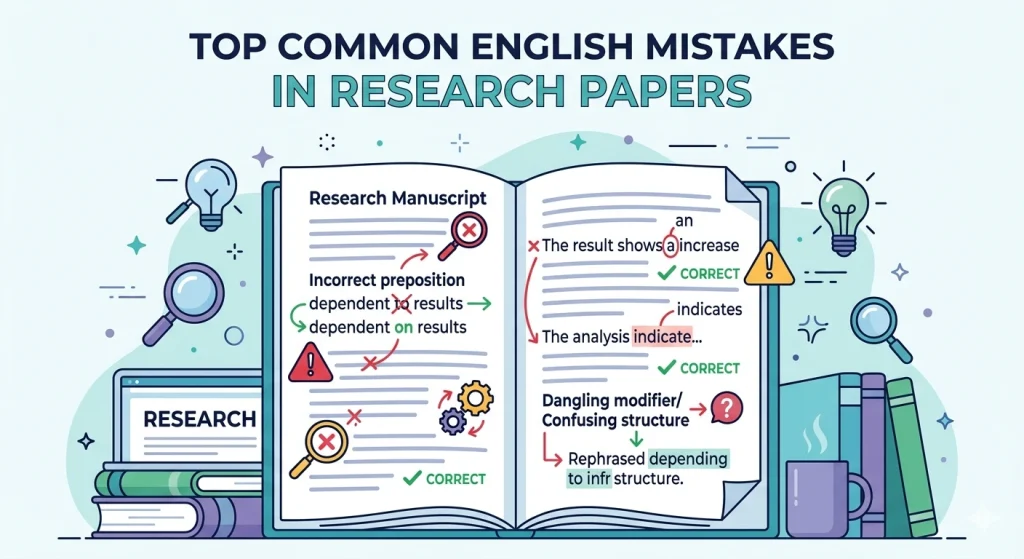
This guide covers the twelve most common English mistakes in research papers by non-native speakers. Each section explains the error, shows the wrong version, gives the correct version, and explains the rule briefly. By the end, you will have a clear list of issues to check before your next submission.
Why Language Mistakes Cost Papers
Before getting into the specific errors, it helps to understand why journals care so much about language. A reviewer’s job is to evaluate research, not to translate or interpret it. When sentences require effort to parse, the reviewer’s attention shifts away from your argument and toward your grammar. As a result, even strong findings start to look weaker.
Furthermore, language errors in the abstract and introduction can lead to immediate desk rejection. Editors often read no further than the first page before deciding whether to send a paper for peer review. If those pages contain repeated article errors, tense shifts, or awkward phrasing, the paper rarely advances.
The good news is that most of these errors come from a small number of patterns. Fixing them does not require perfect English. It requires knowing where to look.
The 12 Most Common Mistakes
1. Missing or Incorrect Articles (a, an, the)
This is the most common mistake among speakers of languages that do not use articles, including Urdu, Hindi, Arabic, Russian, Mandarin, Korean, and Japanese.
❌ Wrong: Results showed significant correlation between variables.
✓ Correct: The results showed a significant correlation between the variables.
The rule: Use the for specific items already mentioned or clearly identified. Use a or an for the first mention of a singular countable noun. Use no article for general or uncountable nouns when speaking broadly.
Quick test: if you can replace the noun with “the specific X I am talking about,” use “the.”
2. Tense Inconsistency Across Sections
Different sections of a research paper use different tenses. Many non-native writers shift tenses incorrectly within a single paragraph.
❌ Wrong: We collect data from 100 participants. The participants were students who study at university.
✓ Correct: We collected data from 100 participants. The participants were students who studied at the university.
The rule: Methods, Results, and most of the Discussion use the past tense (what you did, what you found). Established knowledge and general truths use the present tense (“Water boils at 100 °C”). When citing previous studies, use past tense or present perfect (“Smith found…” or “Studies have shown…”).
3. Singular vs Plural with Academic Nouns
Words like research, information, evidence, and literature are uncountable in English. They do not take a plural form, and they do not use a or an.
❌ Wrong: Researches show that students perform better with feedback. An information was collected from each participant.
✓ Correct: Research shows that students perform better with feedback. Information was collected from each participant.
The rule: If you want to refer to multiple studies, use studies or research findings, not researches. For information, use pieces of information or data points if you need a countable form.
Note on “data”: Traditionally data is plural (“the data are”). However, many journals now accept the singular form (“the data is”). Check your target journal’s style.
4. Wrong Prepositions
Prepositions in English rarely match their equivalents in other languages, and small errors here distract reviewers significantly.
❌ Wrong: This study discusses about the impact of social media on adolescents. The findings comprise of three themes.
✓ Correct: This study discusses the impact of social media on adolescents. The findings comprise three themes.
Common preposition errors to avoid:
- “discuss about” → “discuss” (no preposition)
- “comprise of” → “comprise” or “consist of”
- “research in adolescents” → “research on adolescents” or “research with adolescents”
- “different than” → “different from”
- “according to me” → “in my view” or “from my perspective”
5. “Between” vs “Among”
A small distinction, but reviewers notice.
❌ Wrong: The relationship between three variables was significant.
✓ Correct: The relationship among three variables was significant.
The rule: Use between for two items. Use among for three or more.
6. Subject-Verb Agreement with Complex Subjects
When the subject of a sentence is long or contains multiple nouns, writers sometimes match the verb to the wrong noun.
❌ Wrong: The number of participants who completed all stages of the study were limited.
✓ Correct: The number of participants who completed all stages of the study was limited.
The rule: The verb agrees with the head noun of the subject (in this case, “the number”), not with the closest noun (here, “stages”).
7. Direct Translation from Your Native Language
This is one of the most common but least obvious errors. Phrases that sound natural in your first language often translate into awkward or incorrect English.
❌ Wrong: From the point of view of methodology, the study has good rigor.
✓ Correct: Methodologically, the study is rigorous. Or: In terms of methodology, the study is rigorous.
The rule: When a phrase feels long or unnatural, check whether you are translating literally. English academic writing prefers shorter, more direct constructions.
8. Run-On Sentences and Overly Complex Structures
Many languages, including Urdu, Hindi, German, and Arabic, allow longer sentences than English does. Translating that structure directly into English produces sentences that lose the reader.
❌ Wrong: The study examined the relationship between social media usage and academic performance among undergraduate students at the university level in three different countries which were chosen because of their similar education systems however the results varied significantly across these contexts due to cultural and institutional factors.
✓ Correct: The study examined the relationship between social media usage and academic performance among undergraduate students. Three countries with similar education systems were selected for comparison. However, the results varied significantly across these contexts, due to cultural and institutional factors.
The rule: One main idea per sentence. If a sentence runs longer than 25 to 30 words, look for places to break it. Each break improves readability.
9. Redundancy and Wordiness
Many non-native writers use phrases their native language treats as natural pairs but that English considers redundant.
❌ Wrong: The final outcome of the study revealed several future plans for further research. Past history shows that each and every participant contributed.
✓ Correct: The outcome of the study revealed several plans for further research. History shows that every participant contributed.
Common redundancies to cut:
- “final outcome” → “outcome”
- “future plans” → “plans”
- “past history” → “history”
- “brief summary” → “summary”
- “combine together” → “combine”
- “completely eliminate” → “eliminate”
- “each and every” → “each” or “every”
10. Confusing Word Pairs
Several English word pairs sound similar but mean different things. Reviewers spot these immediately.
| Confused Pair | Correct Use |
|---|---|
| affect vs effect | Affect (verb): “The intervention affected outcomes.” Effect (noun): “The intervention had a positive effect.” |
| fewer vs less | Fewer for countable items: “fewer participants.” Less for uncountable: “less time.” |
| which vs that | That for restrictive (essential) clauses: “the data that we collected.” Which for non-restrictive (extra information): “the data, which we collected in 2024, showed…” |
| compose vs comprise | “The team is composed of five members.” “The team comprises five members.” Never use “comprised of.” |
11. Pronoun Reference Confusion
When you use “this,” “that,” “it,” or “they,” the reader must know exactly what noun the pronoun refers to.
❌ Wrong: The intervention reduced anxiety and improved sleep. This was significant.
✓ Correct: The intervention reduced anxiety and improved sleep. This combined effect was significant.
The rule: After “this” or “that,” add the noun whenever the reference could be ambiguous. Vague pronouns are one of the most common reasons reviewers ask for clarification.
12. Hedging Errors
Academic English uses careful hedging to express uncertainty. Non-native writers often hedge too much or too little.
❌ Too much hedging: It may possibly be suggested that the results could potentially indicate some kind of relationship.
❌ Too little hedging: The results prove that social media causes poor sleep.
✓ Right level: The results suggest a relationship between social media use and sleep quality.
The rule: Use “suggest,” “indicate,” “appear to,” or “may” when your evidence supports a claim but does not prove it conclusively. Avoid stacking hedges (“may possibly,” “could potentially”) and avoid claiming proof from correlational findings.
Mistakes Specific to Common First Languages
Different first languages produce slightly different error patterns. While there are exceptions, a few patterns appear consistently.
Urdu, Hindi, Bengali speakers often miss articles, use “the” too broadly, and write longer sentences than English convention prefers. Furthermore, direct translations of phrases like “according to my opinion” or “since long” appear frequently.
Arabic speakers often add unnecessary “the” before general nouns (“the life is difficult”) and use repetition for emphasis that English considers redundant.
Mandarin and Korean speakers often drop articles entirely, mix singular and plural inconsistently, and prefer sentence structures with less explicit subject use.
Spanish and Portuguese speakers often use false cognates (words that look similar but mean different things) and may use “actually” to mean “currently” rather than “in fact.”
Russian and other Slavic language speakers often drop articles, use passive voice heavily, and translate complex sentence structures directly.
Identifying your most likely error patterns is the first step. Furthermore, knowing your patterns lets you target your editing rather than guess at every sentence.
How to Catch These Errors in Your Own Writing
Once you know the patterns, you can build a self-editing routine that catches most issues before submission.
Read your paper aloud. This single technique catches more errors than any tool. If a sentence stumbles, it needs work.
Read backwards, sentence by sentence. Start from the last sentence and work toward the first. This breaks the flow that makes you skim over familiar errors.
Do focused passes. Read once for articles only. Then read again for tense consistency. Then for prepositions. Splitting the focus catches errors that disappear when you try to fix everything at once.
Use Grammarly, but do not trust it blindly. Grammar tools catch some basic errors but miss many academic-specific issues. They also sometimes flag correct usage. Treat them as a second pair of eyes, not as the final authority.
Read papers in your field. The fastest way to internalize academic English is to read the kind of writing you want to produce. Pay attention to how published authors handle articles, tenses, transitions, and hedging.
For a comprehensive grammar reference, the Purdue Online Writing Lab ESL resources cover most of the patterns above in detail. Furthermore, the University of Manchester academic phrasebank offers tested academic sentence templates for each section of a research paper.
When a Human Editor Makes the Difference
Self-editing catches many errors, but it has limits. After weeks of working on the same paper, you stop seeing the patterns. A trained academic editor catches what you cannot see, without changing your voice or your meaning.
The most useful service for non-native researchers is Copyediting, where our editors improve clarity, flow, and language while preserving your original meaning and academic voice. For papers that are nearly ready and only need a final language pass, Research Paper Proofreading catches typos, grammar slips, and small inconsistencies before submission. If you want either service applied to your manuscript, contact our team at ManuscriptLab.
Pre-Submission Language Checklist
Before submitting your paper, run through this checklist:
- [ ] Have you checked every “the,” “a,” and “an” for correctness?
- [ ] Are your verb tenses consistent within sections and appropriate to each section?
- [ ] Have you used “research,” “information,” and “evidence” as uncountable nouns?
- [ ] Have you checked common prepositions (“discuss,” “comprise,” “different from”)?
- [ ] Is every “between” used for two items and “among” for three or more?
- [ ] Does every verb agree with the head noun of its subject?
- [ ] Have you replaced direct translations with natural English phrasing?
- [ ] Are your sentences mostly under 30 words?
- [ ] Have you cut redundant phrases (“final outcome,” “future plans,” “past history”)?
- [ ] Have you checked affect/effect, fewer/less, which/that, compose/comprise?
- [ ] Does every “this,” “that,” and “it” have a clear noun reference?
- [ ] Is your hedging at the right level (not too much, not too little)?
If you can tick all of these, your paper is in much stronger shape than most non-native submissions.
Frequently Asked Questions
Is “data” singular or plural in academic writing? Traditionally plural (“the data are conclusive”). Many modern journals accept singular (“the data is conclusive”). Check your target journal’s style guide and stay consistent within the paper.
Should I write in active or passive voice? A mix. Use active voice when the agent matters (“We measured…”). Use passive voice when the action matters more than the agent (“The samples were analyzed…”). Newer journals lean toward more active voice.
Will Grammarly fix my paper? Grammarly catches basic issues but misses many academic-specific errors. Use it as a first pass, then do focused human passes for academic patterns it does not understand.
Do reviewers actually reject papers for language alone? Yes. Many journals desk-reject papers when language quality limits readability, especially in the abstract and introduction. Strong research with weak language often gets sent back with “requires significant English editing.”
How many revisions should I do before submission? At minimum, three: one for content, one for structure, and one for language. Add a fourth pass if you can wait a week between drafts to read with fresh eyes.
Conclusion
Writing strong academic English as a non-native speaker is a learnable skill, not a fixed limitation. The errors above account for the majority of language feedback non-native researchers receive. Once you can spot them in your own writing, the time and effort needed for revision drops sharply.
In summary, learn your most common patterns. Build a self-editing routine that targets them directly. Read widely in your field. Finally, when your paper matters most, work with a human editor who improves your language without flattening your voice.
Do those things consistently and your reviewers will start engaging with your research, not your grammar.