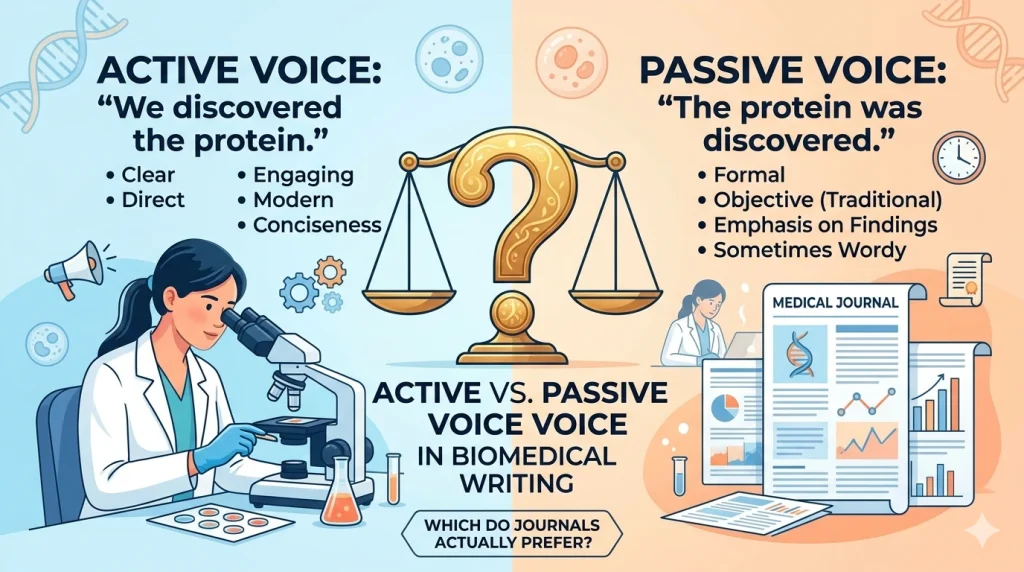
For decades, biomedical writing was synonymous with the passive voice. “The patient was treated.” “Samples were collected.” “Data were analyzed.” Generations of researchers learned that passive constructions sounded more objective, more scientific, and more appropriate for clinical reporting. As a result, many writers still default to the passive voice today, often without considering whether it actually serves the reader.
However, journal preferences have shifted. The American Medical Association Manual of Style, the British Medical Journal, NEJM, JAMA, The Lancet, Nature, Science, and PNAS now all favor the active voice in most contexts. Furthermore, recent corpus studies of biomedical journals show that even the most traditionally formal publications have moved toward active constructions, particularly in Introductions, Discussions, and Abstracts.
This guide explains what biomedical journals actually prefer in 2026, when active voice is the right choice, when passive voice still belongs, and how to make the shift in your own writing. Examples come from real biomedical contexts. By the end, you will have a clear, section-by-section method for deciding which voice to use in any biomedical paper.
Active vs Passive Voice: The Quick Definition
Before getting into journal preferences, here is the clean distinction:
- Active voice: The subject performs the action. “The physician administered the dose.”
- Passive voice: The subject receives the action. “The dose was administered by the physician.”
Most writers can identify the obvious cases. The trickier cases come from longer sentences where the action is buried in nominalizations (“The administration of the dose was performed…”). These nominalized passives are often the weakest sentences in biomedical writing, and they are the ones modern journals push hardest against.
What Major Biomedical Journals Actually Say
Here is what the leading journals state explicitly in their author guidelines and style references.
AMA Manual of Style (used by JAMA and most US biomedical journals): “Use active voice whenever possible.” This guidance has been in place across multiple editions.
British Medical Journal (BMJ): “Use active voice but avoid ‘we did’ or ‘we found’.” BMJ favors active voice while discouraging first-person stacked openings.
Nature journals: “Nature journals like authors to write in the active voice (‘we performed the experiment…’) as experience has shown that readers find concepts and results to be conveyed more clearly if written directly.”
Science: “Choose the active voice more often than you choose the passive, for the passive voice usually requires more words and often obscures the agent of action.” This guidance has appeared in Science’s style guide since 1968.
PNAS: Active voice is considered current best practice for both writing and editing.
The Lancet and NEJM: Both encourage active voice in author guidelines, though corpus studies show their Methods sections still carry higher passive usage than other sections, reflecting the tradition of describing procedures rather than agents.
In other words, no major biomedical journal requires passive voice. Furthermore, several have explicitly asked authors to reduce passive constructions for decades.
Why Active Voice Is Preferred
There are four practical reasons biomedical journals favor active voice over passive.
1. Active voice is shorter. Passive constructions add words: “was performed,” “was conducted,” “has been administered.” Word count matters when journals impose strict limits.
Passive (14 words): “It was observed by the researchers that there was an increase in heart rate.” Active (10 words): “Researchers observed an increase in heart rate among participants.”
2. Active voice clarifies responsibility. In clinical research, knowing who performed an action often matters. “The dose was adjusted” hides the decision-maker. “The attending physician adjusted the dose” makes the clinical responsibility clear.
3. Active voice is easier to read. Studies on reading comprehension consistently find that active constructions are processed faster, especially in dense technical writing where readers need to follow chains of cause and effect.
4. Active voice signals confidence. Passive constructions can hedge findings without intent. “The intervention was found to reduce symptoms” sounds less certain than “the intervention reduced symptoms.” In a field that values evidence-based clarity, that subtle hedge matters.
When Passive Voice Is Still the Right Choice
Despite the general preference for active voice, several legitimate uses of passive voice remain in biomedical writing.
1. When the Agent Is Unknown or Irrelevant
If you do not know who performed the action, or it does not matter, passive voice is correct.
“The samples were stored at minus 80 degrees Celsius for six months.”
In this sentence, who stored the samples is not the point. The storage conditions matter.
2. When the Object Is More Important Than the Subject
Sometimes the focus belongs on what was acted upon, not who did the acting.
“The novel biomarker was first identified in lung tissue.”
Here, the biomarker matters more than who identified it.
3. When Maintaining Topic Continuity
If a paragraph centers on a particular treatment or outcome, keeping that subject consistent across sentences improves flow, even if it means using passive voice in some.
“Tirzepatide was approved in 2022 for type 2 diabetes. The drug was later evaluated in obesity trials, where it showed substantial weight reduction. By 2024, it had been adopted as standard care in multiple guidelines.”
Changing to active voice mid-paragraph (“The FDA approved tirzepatide… Researchers later evaluated it…”) shifts the topic away from the drug itself.
4. In Methods Sections (Selectively)
Methods sections traditionally carry more passive voice than other sections. Corpus studies confirm this remains true, even at active-voice-leaning journals. The reason is practical: in a methods section, who performed each step is often less important than the procedure itself.
“Blood samples were drawn at baseline, week 4, and week 12.”
That said, modern style guides increasingly encourage active voice even in methods, particularly when responsibility matters or when a sentence becomes awkward in passive form.
Section-by-Section Guidance for Biomedical Papers
Different sections of a biomedical paper warrant different voice patterns. Here is what the evidence and current journal guidance suggest.
Abstract
Strong active voice preference. Recent corpus studies show abstracts carry the lowest passive frequency across all sections. Reviewers and editors read abstracts first, and clarity matters most here.
❌ Passive: “An increase in mortality was observed in patients treated with the experimental regimen.” ✓ Active: “Patients treated with the experimental regimen showed increased mortality.”
Introduction
Strong active voice preference. Introductions describe established knowledge and motivate the study. Active constructions communicate this more directly.
❌ Passive: “It has been demonstrated by several studies that early intervention reduces complications.” ✓ Active: “Several studies have demonstrated that early intervention reduces complications.”
Methods
Mixed. Active voice for actions where the agent matters (clinical decisions, randomization, ethical procedures). Passive voice acceptable for standardized procedures where the agent is implicit.
✓ Active where agent matters: “Two independent reviewers extracted data using a standardized form.” ✓ Passive where agent is implicit: “Samples were centrifuged at 3,000 rpm for 10 minutes.”
Results
Active voice preferred. Results describe what your data showed. Personifying the results (treating them as the subject) is widely accepted in biomedical writing.
✓ Active: “Mortality decreased by 18 percent in the treatment group.” ✓ Active with personification: “The analysis revealed a significant interaction effect.”
Discussion
Strong active voice preference. Discussions interpret findings and connect them to existing literature. Active voice keeps the argument moving forward.
❌ Passive: “These findings can be explained by the previously reported mechanism of action.” ✓ Active: “The previously reported mechanism of action explains these findings.”
Conclusion
Strong active voice preference. Conclusions make claims and state implications. Hedging through passive constructions weakens the closing impact.
❌ Passive: “It can be concluded that the intervention is effective in this population.” ✓ Active: “The intervention is effective in this population.”
How to Convert Passive to Active: A Practical Method
If you have an existing biomedical draft with too much passive voice, here is a systematic conversion approach.
Step 1: Search for the markers. The clearest passive markers are forms of “to be” followed by a past participle: was performed, were conducted, is observed, has been administered. Search your document for “was,” “were,” “been,” and “by the” to surface candidates.
Step 2: Identify the real agent. Ask: who or what actually did this? If the answer is clear and relevant, convert to active. If the agent is genuinely unknown or unimportant, the passive form is correct.
Step 3: Restructure the sentence. Move the agent to the subject position. Replace the passive verb with the active form.
Before: “The samples were analyzed by the laboratory team using high-performance liquid chromatography.” After: “The laboratory team analyzed the samples using high-performance liquid chromatography.”
Step 4: Check the flow. After converting individual sentences, re-read the paragraph. Sometimes one passive sentence belongs to maintain topic continuity. If converting a particular sentence breaks the flow, leave it as passive.
Step 5: Check word count. Active conversions typically reduce word count. This often helps when journals enforce strict limits.
Common Passive Voice Mistakes in Biomedical Writing
Several passive patterns appear in nearly every biomedical draft. Watch for these specifically.
- “It is well known that…” A vague, hedged passive opening. Replace with active citations to the specific studies.
- “It was observed that…” Almost always replaceable with “We observed…” or “Researchers observed…”
- “Has been shown to…” Convert to active where possible: “Studies show that…” or cite specific authors.
- “Was performed/conducted/carried out.” Look for the agent. Most of these can be tightened.
- Nominalized passives. Phrases like “the administration of the drug was performed” should become “we administered the drug” or “the physician administered the drug.”
What About First Person (“We” and “I”)?
Many writers avoid active voice because they were taught not to use first person in scientific writing. This advice is outdated. Most modern biomedical journals accept first-person constructions, particularly “we” for multi-author papers. Furthermore, journals like Nature explicitly encourage it.
That said, three rules apply:
- Use first person sparingly. “We” works well to describe your actions (“We recruited 142 patients”). It should not appear in every sentence.
- Avoid stacked openings. BMJ specifically advises against starting consecutive sentences with “we did” or “we found.” Vary your openings.
- Check your journal’s guidelines. A few specialty journals still prefer third-person constructions. Always confirm before submission.
For comprehensive guidance, the AMA Manual of Style is the authoritative reference for US biomedical journals, while the Nature author guidelines detail current voice preferences for the Nature family of journals.
A Quick Self-Audit Checklist
Before submitting any biomedical paper, run this check:
- [ ] Have you searched the draft for “was,” “were,” “been,” and “by the”?
- [ ] Have you converted passive constructions where the agent matters?
- [ ] Have you kept passive voice where the agent is genuinely unknown or unimportant?
- [ ] Have you reviewed your Abstract for active voice (where passive is least appropriate)?
- [ ] Have you reviewed your Discussion and Conclusion for active voice?
- [ ] Have you avoided “it was observed/shown/demonstrated” constructions?
- [ ] Have you avoided nominalized passives (“the administration of…”)?
- [ ] Have you checked your target journal’s specific voice guidance?
- [ ] Have you confirmed that first-person use, if any, matches journal expectations?
If you can tick most of these, your voice usage is in line with current journal expectations.
When Expert Editing Helps
Voice consistency is one of the patterns trained academic editors notice most quickly. After working on a single draft for months, most writers stop seeing their own passive constructions. Furthermore, biomedical journals expect a specific balance of active and passive voice across sections, and getting that balance right often requires familiarity with the journal in question.
The most useful service for biomedical voice and style issues is Copyediting, where our editors improve clarity, flow, and language while preserving your meaning and clinical accuracy. For papers requiring deeper structural and language work, Substantive Editing addresses voice alongside structure, logical flow, and overall coherence. If you want either service applied to your biomedical manuscript, contact our team at ManuscriptLab.
Frequently Asked Questions
Do biomedical journals reject papers for using too much passive voice? Not directly, but heavy passive use can trigger comments like “language quality limits readability” or “extensive editing recommended.” These comments often delay or block acceptance even when the science is strong.
Is passive voice still appropriate in methods sections? Yes, especially for standardized procedures where the agent is implicit. However, active voice is increasingly accepted even in methods, particularly when responsibility matters.
Can I use “we” in a biomedical paper? In most journals, yes. Nature, JAMA, BMJ, NEJM, and Lancet all accept first-person constructions. Use them sparingly and check the specific journal’s author guidelines.
Is active voice always better? No. Active voice is the default preference, but passive voice remains correct when the agent is unknown, unimportant, or when topic continuity demands it. Voice is a tool, not a rule.
What is the AMA Manual of Style’s position? The AMA Manual of Style instructs authors to use active voice whenever possible. This applies to JAMA and most US biomedical journals following AMA conventions.
Closing Note
The default in biomedical writing has shifted. Passive voice is no longer the marker of scientific rigor it once was. Modern journals, including the most prestigious in the field, now prefer active constructions for most sections, with passive voice reserved for cases where it genuinely serves the reader.
In summary, use active voice as your default. Keep passive voice for unknown or irrelevant agents, for topic continuity, and for standardized methods steps. Audit your Abstract, Introduction, Discussion, and Conclusion most carefully, since these are the sections where active voice matters most. Finally, check your target journal’s specific guidance before submission.
Do those things, and your writing will read the way modern biomedical journals expect.