Choosing the right citation style sounds simple, but it is one of the most common sources of confusion for students and researchers. The three dominant styles in academic writing are APA, MLA, and Chicago. Each one looks similar at a glance, yet they follow different rules for in-text citations, reference lists, formatting, and even punctuation. Submitting a paper in the wrong style can mean lost marks, professor pushback, or, at the journal level, a desk rejection before the work is even read.
Furthermore, the confusion is often made worse by online citation generators that produce inconsistent output, by instructor instructions that contradict departmental guidelines, and by older guides that still reference outdated editions. As a result, researchers spend hours formatting references and still get them wrong.
This guide explains the three styles clearly, with side-by-side examples and a simple decision framework. By the end, you will know exactly which style fits your discipline, how the three differ in practice, and what to check before you submit. The guide reflects the current editions: APA 7th edition (2020), MLA 9th edition (2021), and Chicago Manual of Style 18th edition (2024).
The Quick Answer: Which Style for Which Discipline
If you only need a fast answer, here is the standard mapping:
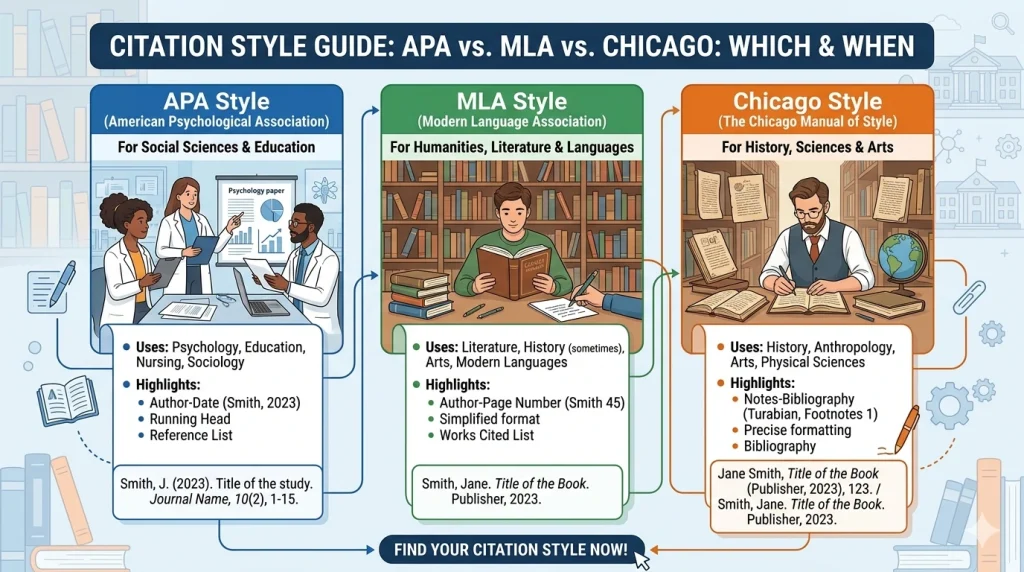
| Citation Style | Primary Disciplines |
|---|---|
| APA | Psychology, education, social sciences, nursing, business, communications, public health |
| MLA | Literature, languages, cultural studies, philosophy, religion (sometimes), humanities broadly |
| Chicago | History, art history, music, theology, some social sciences; also widely used in book publishing |
However, your institution or your specific journal may require something different. Always check the assignment brief, syllabus, or journal author guidelines before defaulting to a discipline norm.
Style 1: APA (American Psychological Association)
APA is the most widely used citation style in the social and behavioral sciences. The current version is the 7th edition, published in 2020 and still standard in 2026.
What APA Looks Like
APA uses an author-date in-text citation system. Citations include the author’s surname and the year of publication, with page numbers added for direct quotes.
In-text citation example:
Recent research suggests a link between social media use and sleep quality (Smith & Johnson, 2023).
Smith and Johnson (2023) found a clear association between pre-sleep screen time and sleep disruption.
Reference list entry example:
Smith, J. M., & Johnson, K. L. (2023). Social media and adolescent sleep quality: A longitudinal study. Journal of Health Psychology, 28(4), 245-267. https://doi.org/10.xxxx/xxxxx
Key APA 7 Features to Remember
- Reference list carries the title “References” and appears at the end of the paper.
- For three or more authors, use “et al.” even in the first citation.
- DOIs are formatted as full URLs (https://doi.org/…).
- Running heads are no longer required for student papers.
- The cover page includes the title, author, institution, course, instructor, and due date.
- Headings use a five-level hierarchy with specific formatting for each level.
When to Use APA
Use APA when you are writing in psychology, education, sociology, nursing, public health, business, or communications. Furthermore, most postgraduate research in the social sciences defaults to APA unless the journal specifies otherwise. If you are unsure, APA is the safest choice for empirical social science writing.
Style 2: MLA (Modern Language Association)
MLA dominates the humanities, particularly literature, languages, and cultural studies. The current version is the 9th edition, published in 2021.
What MLA Looks Like
MLA uses an author-page in-text citation system. There is no year in the in-text citation, because humanities scholarship often involves works whose publication date is less central than the textual reference. Page numbers, however, are essential, because close reading depends on guiding the reader to exact passages.
In-text citation example:
The narrator’s unreliability becomes apparent in the second chapter (Smith 47).
Smith argues that the narrator’s unreliability shapes the novel’s central theme (47).
Works Cited entry example:
Smith, John. The Unreliable Narrator in Modern Fiction. Oxford University Press, 2023.
Key MLA 9 Features to Remember
- The reference list carries the title “Works Cited,” not “References” or “Bibliography.”
- MLA uses a container system: every source sits within one or more containers (a journal, a website, a database), and each container has its own publication information.
- No comma between the author and page number in in-text citations (Smith 47, not Smith, 47).
- Headings and page formatting are minimal compared to APA.
- MLA 9 maintains the same citation format as MLA 8 but adds clearer guidance on digital and AI-generated sources.
When to Use MLA
Use MLA for any writing in literature, languages, cultural studies, film studies, or composition. Most undergraduate English courses default to MLA. Additionally, many humanities journals, particularly in literary studies, require MLA formatting.
Style 3: Chicago (Chicago Manual of Style)
Chicago is the most flexible of the three styles because it offers two distinct documentation systems. The current version is the 18th edition, published in September 2024.
The Two Chicago Systems
Notes and Bibliography (NB): Common in history, art history, theology, and other humanities disciplines. Writers cite sources in footnotes or endnotes, with a full bibliography at the end of the paper.
Author-Date: Used primarily in the natural sciences and some social sciences. The format resembles APA in structure, with parenthetical in-text citations and a reference list at the end.
What Chicago Notes and Bibliography Looks Like
Footnote example:
- John Smith, The Unreliable Narrator in Modern Fiction (Oxford University Press, 2023), 47.
Bibliography entry example:
Smith, John. The Unreliable Narrator in Modern Fiction. Oxford University Press, 2023.
What Chicago Author-Date Looks Like
In-text citation example:
The narrator’s unreliability becomes apparent in the second chapter (Smith 2023, 47).
Reference list entry example:
Smith, John. 2023. The Unreliable Narrator in Modern Fiction. Oxford University Press.
Key Chicago 18 Features to Remember
- Choose between Notes and Bibliography or Author-Date depending on discipline; do not mix them.
- The 18th edition (2024) updated guidance on digital sources, AI-generated content, and inclusive language.
- Chicago is the standard for most professional book publishing, even outside the humanities.
- Turabian (the student version of Chicago) follows the same rules but simplifies them for student papers.
When to Use Chicago
Use Chicago Notes and Bibliography for history, art history, theology, and music. Use Chicago Author-Date for natural sciences or some social sciences when the journal specifies Chicago. In addition, if you are writing a book manuscript for a university press, Chicago is almost always the expected style.
Side-by-Side Comparison: The Same Citation in All Three Styles
To make the differences concrete, here is the same source cited in each style.
Source: A 2023 book by John Smith titled The Unreliable Narrator in Modern Fiction, published by Oxford University Press.
APA 7:
In-text: (Smith, 2023) Reference: Smith, J. (2023). The unreliable narrator in modern fiction. Oxford University Press.
MLA 9:
In-text: (Smith 47) Works Cited: Smith, John. The Unreliable Narrator in Modern Fiction. Oxford University Press, 2023.
Chicago 18 (Notes and Bibliography):
Footnote: John Smith, The Unreliable Narrator in Modern Fiction (Oxford University Press, 2023), 47. Bibliography: Smith, John. The Unreliable Narrator in Modern Fiction. Oxford University Press, 2023.
Chicago 18 (Author-Date):
In-text: (Smith 2023, 47) Reference: Smith, John. 2023. The Unreliable Narrator in Modern Fiction. Oxford University Press.
Notice three things from this comparison: APA emphasizes year, MLA emphasizes page, and Chicago can do either depending on which system you choose. As a result, the same source looks different in each style, and these differences carry real meaning in their respective disciplines.
How to Decide Which Style to Use
Use this short decision sequence whenever you start a new assignment or submission:
- Check the instructions first. Your professor, syllabus, or journal author guidelines will usually specify the style. This overrides everything else.
- If the instructions do not specify a style, default to your discipline norm. Use the table at the top of this guide.
- For journals, check recent published articles. Even within a discipline, journals vary. Reading two or three recent articles will show you the formatting expected.
- Confirm the edition. APA 7, MLA 9, and Chicago 18 are the current versions. Older editions are no longer accepted by most institutions.
- Stay consistent throughout the paper. Mixing styles (or mixing Chicago systems) is one of the fastest ways to lose credibility with a reader.
Common Citation Mistakes Across All Three Styles
Several mistakes appear repeatedly in student and researcher writing, regardless of style.
Inconsistent formatting. Switching between APA-style and MLA-style references in the same paper, often because the writer copied citations from different sources without normalizing them.
Outdated editions. Using APA 6 (still common in older guides) when the assignment calls for APA 7. Similarly, MLA 8 instead of MLA 9, or Chicago 17 instead of Chicago 18.
Generator errors. Automated citation tools often produce incorrect output, especially for chapters in edited books, online sources, and multi-author works. Always check generated citations against the official style guide.
Missing page numbers. APA and Chicago require page numbers for direct quotes. MLA requires them for all in-text citations.
Incorrect title capitalization. APA uses sentence case for article and book titles. MLA and Chicago use title case. Mixing these is one of the most common errors.
Wrong reference list title. APA uses “References,” MLA uses “Works Cited,” and Chicago uses “Bibliography” (Notes and Bibliography) or “References” (Author-Date).
How to Format References Efficiently
The fastest way to manage citations is to use a reference manager such as Zotero, Mendeley, or EndNote. These tools store your sources, generate citations in any major style, and update the bibliography automatically as you write.
However, do not trust them blindly. Generators make errors, especially for online sources, chapters in edited books, and government documents. Therefore, always verify generated citations against the official style guide before submission.
For authoritative current guidance, the Purdue Online Writing Lab maintains free, regularly updated guides for all three styles, and the APA Style website provides the official source for APA 7 formatting questions.
When Citation Styling Becomes a Submission Issue
Citation errors are one of the most common reasons papers come back with revision requests. Reviewers and editors expect consistent, current, and discipline-appropriate citations throughout the manuscript. A paper with mixed styles, outdated editions, or formatting that does not match the target journal signals carelessness, and that perception affects how the rest of the paper is read.
The service that directly addresses this is Manuscript Formatting, where our editors format your references, in-text citations, figures, tables, and overall layout to match the specific style and submission guidelines of your target journal. If you want your citations and formatting checked before submission, contact our team at ManuscriptLab.
Pre-Submission Citation Checklist
Before submitting any academic paper, run through this checklist:
- [ ] Have you confirmed which style your assignment, course, or journal requires?
- [ ] Are you using the current edition (APA 7, MLA 9, or Chicago 18)?
- [ ] Is your reference list titled correctly (References, Works Cited, or Bibliography)?
- [ ] Do your in-text citations match the style’s format exactly?
- [ ] Have you included page numbers where required?
- [ ] Have you used the correct title capitalization for the style?
- [ ] Have you verified every generator-produced citation against the official guide?
- [ ] Is every in-text citation matched by a reference list entry, and vice versa?
- [ ] Is the formatting consistent throughout the paper?
If you can tick all of these, your citations are submission-ready.
Frequently Asked Questions
Is APA 7 still current in 2026? Yes. APA 7 was published in 2020 and remains the current standard. No APA 8 has been announced.
Is MLA 9 still current in 2026? Yes. MLA 9 was published in 2021 and is still the standard. The 8th edition is no longer used.
Is Chicago 18 different from Chicago 17? Yes. Chicago 18 was published in September 2024 with updated guidance on digital sources, AI-generated content, and inclusive language. If you are writing in Chicago, use the 18th edition.
Can I mix citation styles in one paper? No. Stick to one style throughout. Mixing styles is one of the most common reasons reviewers and instructors flag papers.
Should I use a citation generator? Yes, but verify the output. Tools like Zotero, Mendeley, and EndNote save time, but they make formatting errors that you need to catch manually.
What about citing ChatGPT or other AI tools? APA 7, MLA 9, and Chicago 18 all now include guidance for citing AI-generated content. Generally, you treat the AI tool as the source and disclose its use in your methodology or acknowledgements section.
Conclusion
Citation styles can feel like a barrier between your research and a clean submission, but the rules are not as complicated as they appear. Choose the style your discipline or journal requires. Use the current edition. Stay consistent. Verify generator output. Finally, run the pre-submission checklist before you hit submit.
Do those things and your citations will meet professional standards in any of the three major styles.