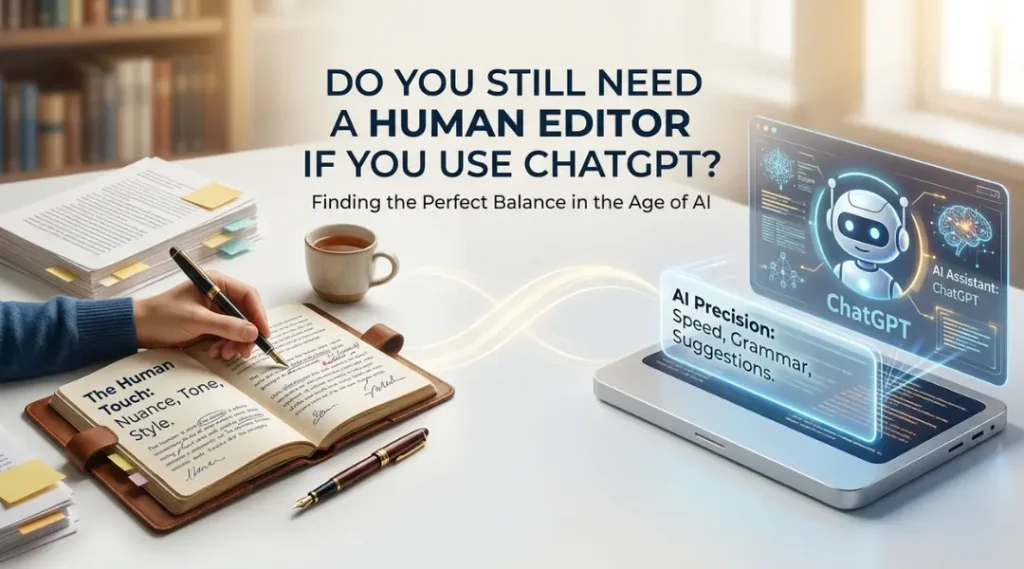
AI writing tools have exploded in popularity. ChatGPT, Gemini, Claude, Jasper. There are now dozens of tools that can produce a 1,500-word article in under 60 seconds. So it is only natural to ask the question: if AI can write this fast and this fluently, do you still need a human editor?
The short answer is yes. Absolutely yes.
However, that answer deserves more than a quick dismissal of AI. The truth is nuanced, and understanding it will make you a smarter writer, a better publisher, and, if you are an academic or professional, someone whose work actually gets taken seriously.
Let’s break it all down.
What ChatGPT Actually Does Well
Before we talk about its limits, it is worth being honest about what AI writing tools genuinely do well.
Speed and volume. ChatGPT can generate a first draft in seconds. For bloggers, content marketers, and researchers who need a starting point, this is genuinely useful. It eliminates the dreaded blank page.
Structure and clarity. AI is quite good at organizing information logically. It knows how to build an introduction, use transitions, and write a coherent paragraph.
Grammar and basic correctness. Spelling errors? Rarely. Subject-verb agreement issues? Almost never. On the surface, AI-generated text looks clean.
Ideation and outlines. Ask ChatGPT to brainstorm subheadings, generate FAQ sections, or suggest angles for a topic. It does this remarkably well.
So yes, ChatGPT is a powerful first-draft tool. Nobody serious is arguing otherwise.
But here is where things get complicated.
What ChatGPT Cannot Do, No Matter How Good It Gets
1. It Cannot Understand Your Audience the Way You Do
AI generates text based on patterns from massive amounts of existing content. It does not know your specific reader. It does not know whether your audience is a group of PhD researchers who hate oversimplification, or a general public audience that needs jargon explained clearly.
A human editor does know this. They adjust tone, vocabulary, and depth based on who is actually going to read the piece. That is not a small thing. It is arguably the most important thing in writing.
2. It Confidently Gets Facts Wrong
This is the most dangerous flaw in AI writing and one that too many people underestimate.
ChatGPT hallucinates. In other words, this is the term used when AI generates plausible-sounding but completely fabricated information: fake citations, wrong statistics, misattributed quotes, outdated data presented as current fact.
If you are writing a blog post about baking cookies, a hallucinated fact may go unnoticed. If you are writing an academic paper, a grant proposal, a medical article, or a legal brief, a single fabricated citation can destroy your credibility, or worse, cause real harm.
A human editor catches these errors. They fact-check, verify sources, and cross-reference claims. AI cannot do this reliably for its own output.
3. It Has No Voice. It Borrows Yours (Poorly)
Every good writer has a voice. A rhythm. A personality that shows up in their sentences. It is the reason readers keep coming back to certain authors, journalists, or researchers.
AI content is statistically averaged. It is the writing equivalent of beige. Even when you prompt ChatGPT to “write in a conversational tone” or “sound like [author name]”, the result tends to feel generic, slightly flat, and curiously similar to every other AI-generated piece on the internet.
Human editors do not just fix errors. More importantly, they amplify voice. They ask: does this sentence sound like you? Does this paragraph feel alive? That is editorial instinct, something no language model has developed.
4. It Cannot Apply Contextual Judgment
Imagine you are writing a research article about a sensitive topic like mental health, political conflict, or cultural identity. ChatGPT will write something technically coherent. But it will often miss the contextual weight of certain word choices, framings, or omissions.
A human editor, especially a specialist in your field, brings lived knowledge and disciplinary judgment to the text. They know what language is acceptable in your field and what will get you criticized. Furthermore, they understand the political terrain of your subject and can sense when something feels off, even if they cannot immediately explain why.
This kind of judgment is irreplaceable.
5. It Cannot Edit for Logical Consistency Across a Long Document
ChatGPT works in context windows. Ask it to write a 10,000-word dissertation chapter and it will either truncate, forget earlier sections, or contradict itself across the document.
Even for shorter pieces, AI has no memory of what it wrote three paragraphs ago in the same way a human does. As a result, a human editor reads the whole document as a connected argument. They notice when your conclusion contradicts your introduction. They catch when you define a term one way in section two and a different way in section five.
Structural coherence across a long document is a distinctly human editorial skill.
The Real Risk: Publishing AI Content Without Editing
Here is what the data actually shows.
Research from mid-2025 found that human-written and human-edited articles generate 5.44x more traffic and hold reader attention 41% longer than purely AI-generated content. Readers are increasingly trained to detect robotic writing — and when they do, they leave.
From a search engine perspective, Google’s helpful content guidelines are clear: they do not ban AI content, but they penalize low-quality, unedited AI content aggressively. Sites that published thousands of unedited AI articles have seen traffic drop from millions of visitors to near zero after manual penalties.
And for academic or professional publishing, the stakes are even higher. Journals and publishers are now using AI detection tools and submitting unedited AI-generated work is increasingly treated as a form of academic misconduct.
The risk is not theoretical. It is documented, measurable, and growing.
The Smart Approach: AI as a Tool, Not a Replacement
The writers and researchers who are winning right now are not the ones who abandoned AI, or the ones who blindly publish whatever AI produces. Instead, they are the ones who use AI intelligently and then apply rigorous human editing.
Here is what that workflow looks like in practice:
Step 1: Use ChatGPT for the first draft.
Generate your structure, key points, and initial paragraphs. Let AI do the heavy lifting of getting words on the page.
Step 2: Fact-check everything.
Every statistic, every citation, every proper noun. Do not assume AI got it right. It frequently did not.
Step 3: Rewrite for voice and tone.
Read it out loud. Does it sound like you? Does it sound like something a real person wrote? If not, rewrite the flat sections in your own words.
Step 4: Have a human editor review it.
Especially for anything high-stakes: academic papers, journal submissions, grant proposals, long-form professional content. An editor will catch what you are too close to the material to see yourself.
Step 5: Run a final structural check.
Does the argument flow logically from beginning to end? More importantly, does the conclusion actually follow from the evidence you presented? If anything contradicts itself, fix it before you publish.
This hybrid workflow is not a compromise. It is genuinely the best of both worlds: speed from AI, quality and credibility from human judgment.
When Human Editing Is Non-Negotiable
There are certain contexts where skipping human editing is simply not an option:
- Academic manuscripts and journal submissions: peer reviewers are experts. They will notice AI-generated phrasing, hallucinated citations, and logical gaps immediately.
- Grant proposals: funders read hundreds of proposals. Flat, generic AI writing is easy to spot and easy to reject.
- Medical, legal, and scientific content: factual errors carry real-world consequences.
- Any content published under your professional name: your reputation is your most valuable long-term asset.
In all of these cases, human editing is not a luxury. It is a professional obligation.
Frequently Asked Questions
Can ChatGPT edit its own writing?
You can ask it to revise, and it will produce a different version but it has no real evaluative judgment about what was wrong with the original. It is pattern-matching, not reasoning. Human editing involves understanding, not just revision.
Does Google penalize AI-generated content?
Google does not penalize AI content by default. It penalizes low-quality content which unedited AI output often is. Human-edited AI content that provides genuine value can and does rank well.
How do I know if my AI content sounds too robotic?
Read it aloud. If it sounds like a corporate manual or a Wikipedia article written by a committee, it needs human editing. You can also use tools like Hemingway Editor to assess readability, but the most reliable test is simply: would a real person enjoy reading this?
Is AI editing software a substitute for a human editor?
No. Grammar checkers and AI editing tools (like Grammarly) are useful for surface-level corrections. They cannot assess argument quality, verify facts, match your disciplinary tone, or strengthen your voice. A human editor does all of this.
So, What’s the Answer?
ChatGPT is a remarkable tool. It has genuinely changed how content is produced, and ignoring it would be foolish. But it is a first-draft machine fast, fluent, and fundamentally flawed in ways that matter.
Human editors bring what AI cannot: judgment, expertise, voice, contextual sensitivity, and accountability. In a world where everyone is using AI to generate content, human editing is not becoming less important it is becoming the differentiator between forgettable content and content that actually builds trust, ranks, and lasts.
Use ChatGPT to write faster. Use a human editor to write better.
At ManuscriptLab, we specialize in professional editing for academic manuscripts, research papers, journal submissions, and long-form professional content. Whether you are working from scratch or refining an AI-assisted draft, our editors bring the expertise and attention your work deserves.