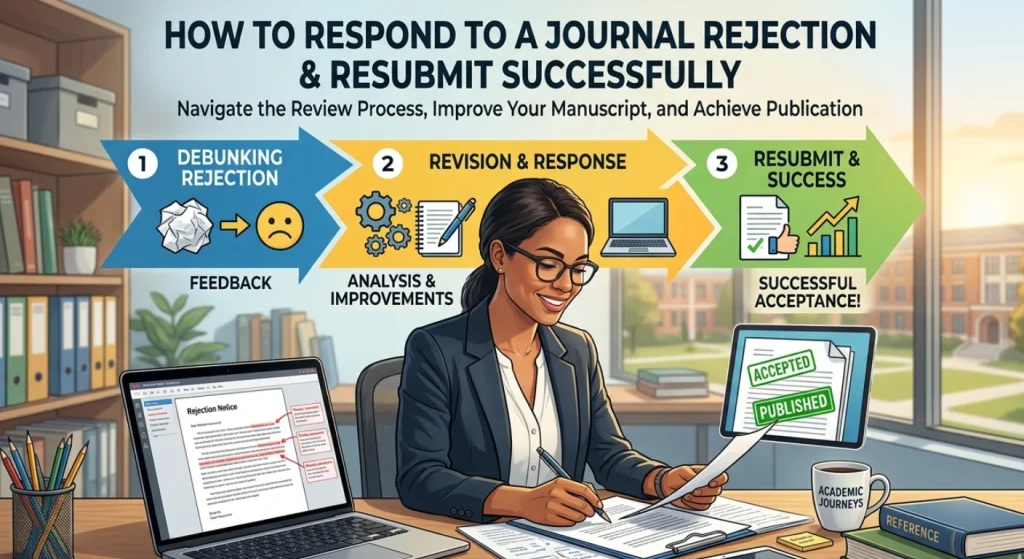
Journal rejection is one of the most common experiences in academic publishing, and one of the least openly discussed. Top journals reject between 70 and 95 percent of submissions, meaning most papers face rejection at least once before acceptance. Furthermore, even mid-tier journals reject the majority of submissions. As a result, every researcher who publishes regularly has stood where you are now: looking at a rejection email and wondering what to do next.
This guide walks through what to do after a journal rejection. It covers how to read the rejection letter properly, how to decide between appealing and resubmitting elsewhere, how to choose the next journal, how to revise the paper based on the feedback you received, and how to give the next submission the best possible chance of acceptance. By the end, you will have a clear, methodical process to turn a rejected paper into a published one.
The Types of Rejection You Might Receive
Not all rejections mean the same thing. The first step is to identify which type you have received, because the right response depends on it.
1. Desk Rejection (No Peer Review)
The editor reviewed the paper and rejected it before sending it for peer review. Common reasons include scope mismatch, weak research question, methodology concerns, formatting issues, or writing quality problems. Desk rejections usually arrive within one to four weeks.
What this means: The editor saw something specific that made the paper unsuitable for their journal. However, it does not mean the research is bad. Often, it just means the paper landed at the wrong journal or had preventable issues. For a full breakdown of why this happens, see our guide on why papers get desk rejected and how to fix it.
2. Rejection After Peer Review
Reviewers read the paper and recommended rejection. The decision letter usually includes reviewer comments explaining their concerns.
What this means: Reviewers identified specific issues with the research, the analysis, the framing, or the contribution. These comments are valuable. They tell you exactly what needs improvement before the paper reaches the next journal.
3. Reject and Resubmit
The journal will not accept the paper in its current form, but the editor invites you to resubmit a substantially revised version. This is somewhere between rejection and major revisions.
What this means: The work has merit but needs significant rework. Treat it as a serious revision opportunity, not a closed door. Reject and resubmit decisions, when handled well, often lead to acceptance.
4. Out of Scope Rejection
The editor determined that your paper does not fit the journal’s focus, even if the research itself is sound.
What this means: You need a better-fit journal. The research is not the problem. The match is.
Step 1: Read the Rejection Letter Carefully Three Times
The most common mistake after rejection is reacting emotionally on the first read. Do not do that. Instead, read the decision letter three separate times, with a gap between each read.
First read (just absorb). Read the letter and any reviewer comments without writing anything. Let the initial frustration pass. Walk away for a few hours.
Second read (categorize). Read again with a notebook open. Identify the specific reasons cited. Mark each one: fundamental issue, specific weakness, scope problem, or formatting concern.
Third read (plan). Now plan what you will do. Decide whether to appeal, resubmit elsewhere, or shelve the paper.
Furthermore, watch the tone of the rejection letter. Editors sometimes signal whether a paper has potential at another journal. Phrases like “your work may be of interest to a more specialized journal” or “the topic is important but better suited to” are useful clues about where to send the paper next.
Step 2: Decide Whether to Appeal
Appealing a rejection rarely succeeds, but in specific cases it makes sense. Consider an appeal only when one of the following applies:
- A reviewer made a clear factual error that materially affected the decision (for example, misreading your methods).
- A reviewer accused your paper of something verifiably untrue (such as duplicate publication or plagiarism).
- The editorial decision relied on a single reviewer’s negative opinion that contradicts your data.
Do not appeal because:
- You disagree with the reviewer’s interpretation.
- You think the reviewer did not appreciate the contribution.
- You believe the reviewer was too harsh.
If you do appeal, be brief, factual, and respectful. Address only the specific factual error or accusation. Avoid arguing about interpretive disagreements. Furthermore, recognize that most appeals are not granted, and even successful appeals usually delay publication by months. In most cases, resubmitting to a better-fit journal is faster.
Step 3: Decide Whether to Revise Before Resubmitting
This is the most important decision after rejection. Some authors fire the paper off to the next journal without revision. That is almost always a mistake.
Always revise if:
- Reviewers identified specific weaknesses you can address.
- A reviewer pointed out missing literature, methodology issues, or unclear framing.
- The desk rejection letter mentioned specific concerns.
- You have learned something new about your data since submission.
Quick lighter revisions are appropriate if:
- The rejection was strictly about scope mismatch.
- No substantive weaknesses were raised.
- You have a clearly better-fit journal in mind.
Even when the rejection is purely about fit, take time to review your paper with fresh eyes. The pause between submissions is the ideal moment to catch issues you missed during the original drafting.
Step 4: Choose the Right Next Journal
This is where most researchers lose months. Picking the next journal poorly leads to another rejection cycle. A systematic approach takes less time than it appears.
Build a Shortlist of 3 to 5 Journals
Start broader than your first choice. Use:
- Journal Finder tools such as Elsevier Journal Finder, Springer Nature Journal Suggester, JANE (Journal/Author Name Estimator), and Wiley’s tool.
- Reference list analysis. Look at which journals you cited most often in your paper. Those are often natural fits.
- Recent papers in your subfield. Search PubMed, Web of Science, or Scopus for papers published in the last 12 months on your topic. Note which journals appear most often.
Evaluate Each Candidate
For each journal on your shortlist, check:
| Factor | What to Check |
|---|---|
| Scope match | Does the “Aims and Scope” page describe your research? |
| Recent articles | Do recent issues publish work like yours? |
| Impact factor | Realistic for your work? Aim slightly below your previous target if rejected at the top. |
| Acceptance rate | If listed, factor this into your timeline. |
| Review speed | Average time to first decision matters for your timeline. |
| Open access policy | Required by your funder? Check fees and licensing. |
| Reporting guidelines | Does the journal require CONSORT, STROBE, or PRISMA compliance? |
Furthermore, check whether your paper aligns with the journal’s preferred article types (original research, short report, brief communication, case study). A mismatch between article type and journal expectations is a common reason for second-round desk rejection.
Avoid the Common Mistakes
- Choosing a lower journal “just to publish.” Lower-tier journals still reject papers regularly, and predatory journals damage your career. Quality match matters more than perceived rank.
- Submitting to a journal with no recent relevant articles. If the journal has not published your kind of work recently, it is unlikely to start now.
- Skipping the author guidelines. Each journal has specific formatting and structural requirements. Submitting without reformatting wastes time on both sides.
Step 5: Revise the Paper Based on Feedback
Even if the rejecting journal will not see the revised version, the reviewer feedback you received is gold. Use it.
Start with Reviewer Comments
Go through each reviewer comment and categorize:
- Comments that point to genuine weaknesses. Fix these.
- Comments suggesting additional analyses. Decide whether they strengthen the paper. If yes, do them. If no, document why not.
- Comments based on misunderstanding. This usually means your writing was unclear. Rewrite the relevant sections.
- Comments you disagree with. Reflect carefully. If you still disagree after reflection, leave that aspect unchanged but consider whether to clarify or strengthen your reasoning in the text.
Reformat for the New Journal
This step is non-negotiable. Each journal has its own:
- Word count limits (main text, abstract, sometimes per section).
- Reference style (Vancouver, APA, MLA, or journal-specific variants).
- Abstract structure (structured vs unstructured, specific subheadings).
- Figure and table format requirements.
- Required statements (data availability, ethics, conflict of interest, AI use disclosure).
Submitting in the wrong format signals carelessness to the new editor. As a result, this single oversight can lead to immediate desk rejection at the second journal.
Strengthen the Cover Letter
Your cover letter to the new journal should:
- Briefly state the main finding in plain language.
- Explain why the paper fits this specific journal. Mention recent relevant articles if possible.
- Confirm it is not under review elsewhere and has not been previously published.
- Disclose prior submission only if required by the journal. Most do not require this.
Keep the cover letter to one page. Address it to the editor by name when possible.
Step 6: Submit and Move On
Once you have submitted to the next journal, start the next project. Do not refresh your inbox waiting for a decision. Reviews take weeks to months, and constant checking will only frustrate you.
If the next decision is also rejection, repeat this process. Most published papers go through multiple rejections before acceptance. The researchers who publish most successfully are not the ones who never get rejected. Instead, they are the ones who treat rejection as data, learn from each one, and resubmit smarter.
A Realistic Timeline for the Resubmission Process
Here is what a realistic resubmission timeline looks like:
| Stage | Time Required |
|---|---|
| Reading rejection letter, deciding on action | 1 to 3 days (after a 24-hour pause) |
| Selecting next journal, checking guidelines | 3 to 7 days |
| Revising paper based on reviewer comments | 2 to 6 weeks (varies by depth of revisions) |
| Reformatting for new journal | 3 to 7 days |
| Final review and submission | 2 to 5 days |
| Total from rejection to resubmission | 5 to 10 weeks typically |
Shortcutting any of these stages usually leads to faster rejection at the next journal. Furthermore, the time spent on careful revision is the single highest-return investment you can make after rejection.
Common Mistakes to Avoid
After supporting many researchers through resubmissions, the same mistakes come up repeatedly:
- Resubmitting immediately without revision. Reviewers at the next journal will often raise the same issues.
- Submitting to the wrong tier. Aim realistically. A top journal that rejected you twice is unlikely to accept the third time.
- Ignoring reviewer comments. Even if you cannot use them at the rejecting journal, they almost always improve the paper.
- Reformatting at the last minute. Reformatting takes longer than expected and rushed reformatting introduces errors.
- Not disclosing prior submission if asked. Some journals require this. Always check author guidelines.
- Appealing without grounds. Appeals based on disagreement rather than factual error waste time and damage your standing with the editor.
- Choosing predatory journals. Always verify the journal through Think. Check. Submit. or the Directory of Open Access Journals before submitting.
A Pre-Resubmission Checklist
Before submitting your paper to the next journal, run through this checklist:
- [ ] Have you read the rejection letter three times across at least 24 hours?
- [ ] Have you addressed each substantive reviewer comment?
- [ ] Have you confirmed the new journal is a strong scope match?
- [ ] Have you read three to six recent issues of the new journal?
- [ ] Have you reformatted the manuscript to the new journal’s specifications?
- [ ] Have you updated the reference style if required?
- [ ] Have you adjusted the abstract format if the new journal requires a different structure?
- [ ] Have you written a cover letter specific to the new journal?
- [ ] Have you confirmed all required statements (ethics, data availability, AI disclosure) are present?
- [ ] Have you done a final language pass to catch issues that may have surfaced during revision?
If you can tick all of these, your resubmission is ready.
When Professional Editing Helps After Rejection
The period after rejection is often when professional editing makes the largest difference. A trained editor reviews your manuscript against the same criteria journal editors use, catches the issues reviewers raised on the first round, and ensures the paper is fully aligned with the new journal’s requirements before resubmission.
The two services that most directly support resubmission are Peer Review, where our editors review your revised manuscript with the same standards a journal reviewer applies, and Journal Selection, where we help match your paper to journals based on scope, indexing, and realistic acceptance probability. If you want a pre-resubmission review or help choosing your next journal, contact our team at ManuscriptLab.
For broader guidance on the publishing process, the Committee on Publication Ethics (COPE) resources provide trusted reference material on appeals, complaints, and post-rejection conduct. Furthermore, Think. Check. Submit. offers a checklist to verify any journal’s legitimacy before submission.
Frequently Asked Questions
How long should I wait before resubmitting after rejection? At least one to two weeks for the revision and reformatting process. Resubmitting the same day signals you did not engage with the feedback.
Can I resubmit the same paper to the same journal? Generally no, unless the journal offered a “reject and resubmit” decision. Submitting a rejected paper back to the same journal without invitation usually leads to immediate dismissal.
Should I mention the prior rejection in my cover letter to the new journal? Only if the new journal specifically asks. Most do not, and bringing it up unprompted creates an unnecessary negative framing for your submission.
How many rejections is too many before giving up on a paper? There is no fixed number. Research that is sound will eventually find a home. However, after three rejections with similar feedback, consider whether the paper needs fundamental rethinking rather than another journal submission.
Should I share reviewer comments with my coauthors? Yes. All coauthors should see the feedback and contribute to the response strategy. Hiding negative feedback damages collaboration.
Is it ethical to address rejection feedback when resubmitting elsewhere? Yes. Reviewer comments at one journal are confidential to that review, but the improvements you make to your paper are yours. Use the feedback freely to strengthen the manuscript.
Closing Note
Journal rejection is part of academic publishing, not an obstacle to it. Almost every important paper has been rejected somewhere before reaching its eventual journal. The researchers who publish most successfully are not the ones who avoid rejection. Instead, they are the ones who treat each rejection as feedback, revise carefully, choose the next journal wisely, and resubmit with more strength than the first time.
In summary, read the rejection letter three times before acting. Decide carefully whether to appeal, resubmit, or shelve. Choose the next journal based on scope match, not just impact factor. Revise the paper using reviewer feedback. Reformat completely for the new journal. Finally, run the pre-resubmission checklist before you upload anything.
Do those things and your paper will reach acceptance faster than the rejection email made you fear.