Chapter 1 is the section supervisors return to most often during a thesis review, and it is also the section students rewrite the most times before submission. The reason is simple: Chapter 1 sets up everything that follows. If the research problem is unclear, if the rationale feels weak, or if the objectives do not align with the rest of the thesis, the entire document suffers. Furthermore, examiners read Chapter 1 first, and their first impression often shapes how they read the chapters that follow.
If your supervisor has returned your Chapter 1 with comments like “the research gap is not clear,” “your objectives do not match your research questions,” or “the rationale needs more depth,” you are not alone. These are the most common Chapter 1 issues across disciplines, and they all trace back to the same underlying problem: most students write Chapter 1 without a clear internal structure.
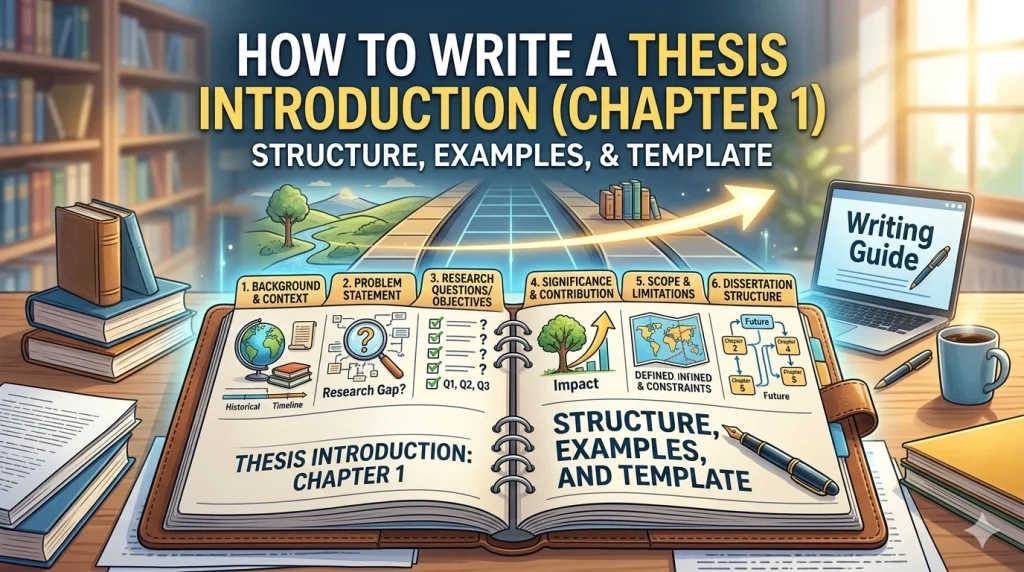
This guide walks through the seven standard components of a strong thesis introduction, with examples and templates you can adapt for any discipline. By the end, you will have a clear method for writing a Chapter 1 that holds up to supervisor review and prepares examiners for the rest of your thesis.
What Chapter 1 Actually Does
Before getting into structure, it helps to be clear on what Chapter 1 is for. A thesis introduction has three jobs:
- Establish the topic. Tell the reader what your research is about and why it matters.
- Justify the research. Show the gap in current knowledge that your work fills.
- Preview the thesis. State what you set out to find, how you went about it, and what the rest of the document covers.
It is not a literature review (Chapter 2 handles that in depth). It is not a methodology section (Chapter 3 covers that). Furthermore, it is not a summary of your findings (that belongs in your final chapter). Chapter 1 sets up the whole document by framing the problem and previewing the journey.
The 7-Part Structure of a Strong Thesis Introduction
Almost every successful Chapter 1 follows the same seven-part architecture. Universities and disciplines vary slightly on order and emphasis, but the components themselves are consistent.
1. Background and Context (1 to 3 pages)
Start broad, then narrow. Begin with the wider context of your topic, then move toward the specific issue your thesis addresses.
Template:
“Over the past two decades, [broad topic] has emerged as a significant area of research in [field]. Recent developments such as [development 1] and [development 2] have shifted attention toward [narrower topic]. Within this context, [specific issue your thesis addresses] has become particularly relevant.”
This section orients the reader who may not be a specialist in your subfield. It should establish why anyone outside your immediate area should care about the topic.
Common mistake: Starting too broad. “Education is an important part of human society” tells the reader nothing. Start with a concrete, current development in your specific area.
2. Statement of the Research Problem (1 to 2 pages)
This is where you state, clearly and directly, the problem your thesis addresses. The research problem is not the same as the topic. It is the specific tension, contradiction, or gap that drives your research.
Template:
“Despite growing attention to [topic], [specific problem] remains insufficiently addressed. Existing research has focused on [what has been studied], yet [what has not been studied] continues to be overlooked. This gap is significant because [why it matters].”
A well-stated research problem does three things: it identifies the gap, justifies its importance, and signals what your thesis will contribute.
Common mistake: Stating the topic instead of the problem. “This thesis is about social media and sleep quality” describes the topic. “Despite increasing concern about adolescent sleep deprivation, the role of pre-sleep social media use in different age groups remains poorly understood” states the problem.
3. Research Aim and Objectives
The aim is the overall purpose of your thesis, stated as a single sentence. Objectives are the specific steps you take to achieve the aim, typically three to five concrete actions.
Template for aim:
“The aim of this study is to examine [the relationship/effect/process] between [variables/concepts] in the context of [setting].”
Template for objectives:
“To achieve this aim, the study pursues the following objectives:
- To [investigate/examine/explore] [specific aspect 1]
- To [analyze/compare/identify] [specific aspect 2]
- To [evaluate/develop/recommend] [specific aspect 3]”
Common mistake: Confusing aim with objectives, or writing objectives that do not align with the eventual chapters. Each objective should map to a piece of work your thesis actually does. Furthermore, the objectives should connect logically to your research questions.
4. Research Questions (or Hypotheses)
Research questions translate your objectives into specific, answerable questions. Hypotheses do the same for quantitative work that tests predictions.
Template for questions:
“This thesis addresses the following research questions: RQ1: [Specific question related to objective 1] RQ2: [Specific question related to objective 2] RQ3: [Specific question related to objective 3]”
Template for hypotheses:
“Based on the theoretical framework, the following hypotheses are tested: H1: [Predicted relationship between variables] H2: [Predicted relationship between variables]”
Common mistake: Questions that are too broad to answer (“What is the impact of technology on society?”) or questions that do not match the objectives. Each question should be answerable through the work your thesis actually does.
5. Significance of the Study (Rationale)
This section answers the question every examiner asks: why does this thesis matter? You need to convince the reader that your work contributes something useful to the field, to practice, or to policy.
A strong significance section covers three dimensions:
- Theoretical significance: How does your work extend, refine, or challenge existing theory?
- Empirical significance: What new data, insights, or evidence does your work produce?
- Practical significance: Who can use your findings, and how?
Template:
“This study contributes to the field in three ways. Theoretically, it extends [existing framework] by [specific contribution]. Empirically, it provides new evidence on [specific context or population] previously underrepresented in the literature. Practically, it offers actionable insights for [specific audience] working in [setting].”
Common mistake: Claiming significance without substance. “This study will help society” means nothing. Specify who will use the findings, in what context, for what purpose.
6. Scope and Delimitations
Tell the reader what your thesis covers and, just as importantly, what it does not cover. This protects you from the criticism “you should have studied X” when X was deliberately outside your scope.
Template:
“This thesis focuses on [specific population, setting, and time period]. It examines [specific aspects] while excluding [aspects outside scope]. The study does not address [related but separate questions], which remain important areas for future research.”
Common mistake: Confusing delimitations (boundaries you chose) with limitations (constraints beyond your control, which belong in your final chapter). Delimitations are decisions. Limitations are realities.
7. Thesis Structure Overview
End Chapter 1 with a short roadmap of the chapters that follow. This prepares the reader for the journey and reinforces the logic of your thesis structure.
Template:
“The thesis is organized into [number] chapters. Chapter 2 reviews the existing literature on [topic] and identifies the theoretical framework guiding the study. Chapter 3 describes the research methodology, including the design, sample, and analytical approach. Chapter 4 presents the findings. Chapter 5 discusses the findings in relation to the literature. Chapter 6 concludes by summarizing the contributions, acknowledging limitations, and suggesting directions for future research.”
Keep this short. One paragraph per chapter is enough.
How Long Should Chapter 1 Be?
The standard rule across most universities:
| Thesis Type | Suggested Chapter 1 Length |
|---|---|
| Master’s thesis | 8 to 15 pages |
| PhD thesis | 15 to 30 pages |
| Professional doctorate | 20 to 35 pages |
These are guidelines, not rules. Some disciplines and universities require more or less. Furthermore, your supervisor’s expectations override generic norms. Always check your department’s thesis handbook.
A Worked Example: Chapter 1 Opening
Here is how the first two components might read in a hypothetical thesis:
Over the past decade, smartphone ownership among adolescents has expanded rapidly, with global penetration exceeding 80 percent in most high-income countries. This expansion has coincided with growing concerns about sleep quality in this age group, particularly in relation to pre-sleep screen exposure. While early research focused on overall screen time, recent studies have shifted attention toward the specific activities adolescents engage in before bed, with social media use emerging as a primary area of concern.
Despite this growing attention, several aspects of the relationship between social media use and adolescent sleep remain insufficiently understood. Existing research has predominantly examined high-income Western contexts, while sleep behavior in low- and middle-income countries has received considerably less attention. Furthermore, most studies have treated adolescents as a single age group, overlooking developmental differences across early, middle, and late adolescence. These gaps are significant because cultural context and developmental stage are known to shape both screen use patterns and sleep regulation.
The aim of this thesis is to examine the relationship between pre-sleep social media use and sleep quality among adolescents in Pakistan, with attention to age-specific differences. To achieve this aim, the study pursues three objectives: first, to characterize patterns of pre-sleep social media use across three age groups; second, to assess the association between social media use and sleep quality; third, to identify the developmental factors that moderate this association.
Notice how the example moves from broad (smartphone penetration globally) to narrow (Pakistani adolescents across age groups), states the gap clearly, and connects the aim and objectives logically.
Common Mistakes Across All Disciplines
After supervising and editing hundreds of theses, the same issues come up regardless of field:
- Treating Chapter 1 as a literature review. It is not. Save deep engagement with sources for Chapter 2.
- Stating the topic instead of the problem. A topic (“AI in healthcare”) is not a research problem (a specific gap or tension that drives investigation).
- Objectives that do not align with research questions. Each question should answer at least one objective.
- Vague significance statements. “This study is important” is not significance. Specify what, for whom, and why.
- Confusing delimitations with limitations. Delimitations belong in Chapter 1 (deliberate choices). Limitations belong in your final chapter (constraints).
- Starting too broadly. “Since the dawn of human civilization…” kills examiner attention immediately.
- No clear research gap. If your work does not address a gap, why are you doing it? The gap must be visible by the second page.
If you fix these seven issues alone, your Chapter 1 will already be stronger than most submissions.
Writing Style and Tense
A few quick rules on style:
- Use present tense for established knowledge and your thesis claims. “Social media affects sleep quality.” “This thesis examines…”
- Use past tense when referring to specific previous studies. “Smith (2023) found that…”
- Use future tense sparingly. Chapter 1 in a final thesis describes what the thesis does, not what it will do. Phrases like “the next chapter will discuss” are acceptable.
- Write in formal academic English. Avoid contractions, colloquialisms, and overly casual transitions.
- Use the first person where your university allows it. Many disciplines now accept “I” or “we” for stating your aim and approach.
For broader guidance on academic style and conventions, the Manchester Academic Phrasebank offers tested sentence templates for each part of a thesis introduction. Furthermore, the Purdue Online Writing Lab thesis writing guide provides comprehensive structural advice for graduate writers.
How to Approach Writing Chapter 1
Most students write Chapter 1 first and then keep revising it as the rest of the thesis develops. A more efficient approach:
Write a draft early, but expect to revise it last. Your understanding of the research problem deepens as you work on Chapters 2 and 3. Chapter 1 that perfectly matches the rest of the thesis usually comes together near the end of the writing process.
Draft each of the seven components as a separate document first. Trying to write Chapter 1 as a flowing essay from scratch overwhelms most writers. Drafting each component separately gives you smaller, more manageable pieces to work with.
Show drafts to your supervisor early. Chapter 1 problems compound. A misaligned research question in your draft becomes a misaligned hypothesis, a misaligned analysis, and ultimately a misaligned thesis. Catch issues early.
Cross-check alignment. Once your full draft is done, lay your aim, objectives, research questions, and chapter contributions side by side. Each should clearly connect to the next. If anything feels disconnected, fix it before submission.
When Chapter 1 Needs Expert Editing
Chapter 1 is the most consequential chapter of your thesis. Examiners use it to set their expectations for the entire document. A clear, well-structured introduction signals a competent researcher. Furthermore, a weak Chapter 1 makes even strong subsequent chapters work harder for examiner attention.
The most useful service for thesis introductions is Substantive Editing, where our editors review your chapter for structural flow, alignment between aim and objectives, clarity of the research problem, and overall coherence. For PhD candidates specifically, our PhD Thesis editing service covers Chapter 1 alongside the full thesis. If you want a professional review of Chapter 1 before your next supervisor meeting or submission, contact our team at ManuscriptLab.
Pre-Submission Checklist
Before submitting Chapter 1 to your supervisor or examiner, run through this checklist:
- [ ] Does the chapter open with concrete context, not generic statements?
- [ ] Is the research problem clearly stated by the second page?
- [ ] Is the research gap visible and justified?
- [ ] Are your aim and objectives clearly distinguished?
- [ ] Do your research questions match your objectives?
- [ ] Does your significance section cover theoretical, empirical, or practical contributions specifically?
- [ ] Have you distinguished delimitations from limitations?
- [ ] Does the chapter end with a clear roadmap of the thesis structure?
- [ ] Is the chapter length appropriate for your thesis type and discipline?
- [ ] Are tense and voice consistent throughout?
- [ ] Have you cross-checked alignment between aim, objectives, research questions, and chapter contributions?
If you can tick all of these, Chapter 1 is ready for supervisor review.
Frequently Asked Questions
Should I write Chapter 1 first or last? Draft it first, but expect to revise it throughout. The final version usually comes together late in the writing process, once the rest of the thesis is clearer.
Can I have more or fewer than three objectives? Yes. Most theses have three to five objectives. Fewer than three usually signals an under-developed thesis. More than five usually signals scope creep.
Do I need both research questions and hypotheses? Usually no. Research questions are common in qualitative and mixed methods work. Hypotheses are common in quantitative work that tests predictions. Some theses use both, but most use one.
How is a Master’s Chapter 1 different from a PhD Chapter 1? PhD Chapter 1 demonstrates deeper engagement with the field, a more rigorous research gap, and a clearer theoretical contribution. Master’s Chapter 1 covers the same components but at lower depth.
What if my discipline uses a different structure? The seven components above are widely accepted, but some disciplines (such as engineering, computer science, or certain humanities fields) have specific structural conventions. Check your department’s thesis handbook first.
Conclusion
Chapter 1 is where your thesis either earns examiner trust or loses it. The good news is that strong Chapter 1 writing follows a clear structure, and most issues come from missing one of the seven standard components.
In summary, start with concrete context, not generic statements. State the research problem clearly. Align your aim, objectives, and questions. Specify your significance. Distinguish delimitations from limitations. Finally, end with a clean roadmap.
Do those things, and Chapter 1 becomes the strong foundation the rest of your thesis builds on.