Skip to content
Academic Typesetting Services

Academic manuscripts typeset for print, EPUB, and press.

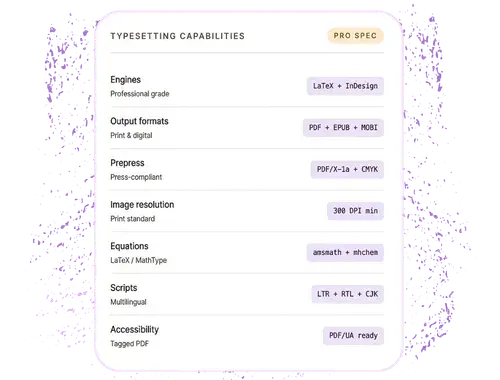
A well-written manuscript still needs to be arranged on the page before it becomes a book, thesis, or journal article. That is where ManuscriptLab comes in. Our academic typesetting service transforms raw manuscripts into publication-ready output using LaTeX, Adobe InDesign, and Affinity Publisher. We handle micro-typography (kerning, leading, hyphenation), long-document behaviour (widows, orphans, baseline grids), and prepress compliance (CMYK, embedded fonts, PDF/X). Whether you are preparing an academic book, a thesis for binding, a journal article, or a STEM textbook with heavy equations, our PhD qualified typesetters deliver print-ready files so that your work reaches readers in the form it deserves.

Typesetting Capabilities
What This Service Is

What is academic typesetting, exactly?

The craft of arranging type on the page so your research reads clearly and prints flawlessly.

Dr. Sarah Mitchell, PhD

Senior Thesis Editor · ManuscriptLab

Micro-typography done right

Kerning, tracking, leading, ligatures, hyphenation, justification. Every space between every letter calibrated so your pages read smoothly without visual noise, rivers, or distracting breaks.

Long-document behaviour controlled

Widows, orphans, baseline grid alignment, cross-reference accuracy across hundreds of pages. Running heads, folios, chapter openers, and front and back matter all behaving consistently throughout the entire volume.

Prepress and press-ready output

CMYK color conversion, 300 DPI image compliance, embedded fonts, bleed and trim marks, PDF/X-1a compliance. Files that print correctly on the first run rather than returning from the printer with rejected proofs.

Quick Comparison
Typesetting vs formatting
Style Compliance

Formatting

Page Composition

Typesetting

Formatting makes your work compliant. Typesetting makes it beautiful and press-ready. Many academic authors benefit from both. For style compliance alone, see our thesis formatting service.

Content Types We Typeset

Five academic content types, each with its own typesetting discipline.

Different academic content demands different typesetting approaches. Specifically, we handle the five content types below as distinct specialities with dedicated technical workflows.

BOOKS

Academic Books

Scholarly monographs, academic trade books, edited collections. Running heads, chapter openers, back-of-book indexes, consistent typographic voice across 200 to 500 pages.

THESIS

Theses & Dissertations

PhD theses and Master's dissertations with university-specific binding specifications, declaration pages, front matter, and submission-portal compliant PDFs.

Journal

Journal Articles

Single journal articles or complete journal issues with publisher house styles, two column layouts, abstract formatting, author block and affiliation placement.

STEM

STEM Textbooks

Mathematics, physics, chemistry, engineering, computer science. Heavy equations, chemistry structures, algorithm blocks, data tables, scientific illustrations with precise numbering.

Multi

Multilingual Works

Right-to-left scripts (Arabic, Urdu, Hebrew), CJK scripts (Chinese, Japanese, Korean), Devanagari, Tamil. Mixed-script documents with proper text direction and font fallback.

Typesetting Engines

Three professional engines, chosen for your project.

Professional typesetting runs on three major engines. Importantly, we select the engine that matches your content type and source files rather than forcing one approach on every project.

EngineBest ForStrengthsSource Files Accepted
LaTeXSTEM content, long academic documents, theses, textbooks with equationsPerfect equation rendering, consistent cross-referencing, automatic bibliography, Knuth-Plass line breaking.tex, .bib, Overleaf projects, Markdown, Word (converted)
InDesignCommercial academic books, journals, image-rich layouts, visually designed pagesPixel-precise visual control, master pages, advanced OpenType features, direct prepress workflowWord (.docx), .indd packages, Google Docs, PDF with source
AffinityModern alternative to InDesign without subscription lock-in, growing publisher adoptionNative file format, IDML import from InDesign, professional output, one-time purchase model.afpub, .idml, Word, PDF
XeLaTeXMultilingual projects, non-Latin scripts, OpenType font requirementsNative Unicode support, system font access, right-to-left and CJK composition, polyglossia package.tex with Unicode, Overleaf, Markdown with language metadata
Technical Elements

Every typographic element composed with precision.

Typesetting covers hundreds of small technical decisions that collectively make the difference between amateur and professional output. Below are the core elements we attend to in every project.

Font Selection & Pairing

Serif body text paired with complementary display and sans fonts. Font licensing verified, OpenType features enabled including ligatures, old-style figures, and small caps.

Kerning & Tracking

Spacing between individual letter pairs (kerning) and across runs of text (tracking) adjusted for readability. Headings and body text treated with different tracking strategies.

Leading & Baseline Grid

Line spacing (leading) calibrated for your font and measure. Baseline grid ensures text on facing pages aligns horizontally for a professional spread appearance.

Widow & Orphan Control

Single words or lines left stranded at page breaks eliminated. Paragraph breaking rules set to prevent single-line widows at the top of pages and orphan openings at the bottom.

Hyphenation & Justification

Hyphenation dictionaries applied for your language with limits on consecutive hyphens. Justified text set to avoid rivers, excessive letter spacing, and awkward word spacing.

Running Heads & Folios

Running headers with chapter titles, section titles, or author name per page. Folios (page numbers) positioned consistently with correct suppression on chapter openers and blank pages.

Image Placement & DPI

Images placed at 300 DPI minimum at print size, converted to CMYK color space. Figure numbering and captions positioned consistently, cross references verified from main text.

Front & Back Matter

Title page, copyright, dedication, acknowledgements, preface, foreword, table of contents, list of figures, list of tables. Appendices, glossary, bibliography, and index all typeset consistently with main matter.

Common Pain Points

The typesetting problems we hear every week.

Below are the most common typesetting problems academic authors bring to us. If any of these sound familiar, we handle them as routine work.

My KDP submission keeps getting rejected for bleed and trim issues.

What we do: Rebuild your file with correct trim size, 0.125 inch bleed, embedded fonts, and PDF/X-1a output. KDP-ready on the first upload.

My equations rendered perfectly in LaTeX but look awful in Word for my publisher.

What we do: Convert LaTeX source into a proper typeset manuscript keeping equations as native typeset mathematics rather than lossy image conversions.

My thesis table of contents does not match my chapter page numbers.

What we do: Rebuild heading styles as proper Word or LaTeX structures, generate the TOC automatically from them, verify every page number against actual content.

My images came out pixelated and dark after print.

What we do: Verify every image is 300 DPI minimum at print size, convert RGB to CMYK with appropriate ICC profile, deliver a prepress-approved PDF/X file.

My Arabic citations break my English LaTeX document.

What we do: Rebuild the project in XeLaTeX with polyglossia package. Right-to-left scripts composed correctly within left-to-right main text.

My publisher wants InDesign files but I only have Word.

What we do: Convert your Word manuscript into a properly typeset InDesign project with master pages, paragraph styles, and the complete .indd package your publisher needs.

Send Your Manuscript & Target Output

We return a free quote within 3 hours covering full cost, chosen typesetting engine, and confirmed delivery timeline. Moreover, we accept your manuscript at any preparation stage and recommend the right engine for your content type.

How It Works

How our typesetting service delivers in 3 simple steps.

From your first upload to receiving a print-ready manuscript. Importantly, no back and forth, no surprise pricing, no compromise on typographic quality.

01

Upload & Specify Output

Send your manuscript and specify target output: print book (trim size, binding), journal article (publisher style), thesis (university handbook), or digital (EPUB specifications). Attach any style guides.

02

Free Quote & Engine Choice

Within 3 hours we send a fixed-price quote, confirm the typesetting engine (LaTeX, InDesign, or Affinity), and timeline. Furthermore, we send a sample page spread on request before you commit.

03

Press-Ready Files Delivered

Your typesetter composes every page, applies micro-typography, verifies prepress compliance, and delivers print-ready PDF, reflowable EPUB, plus editable source files in your chosen engine.

Why Specialised Matters

Why generic templates fail academic typesetting.

Downloadable templates and online book formatters produce documents that look acceptable on screen but fail at the printer. Importantly, professional typesetting addresses the technical layer templates cannot touch.

Template & DIY Typesetting

ManuscriptLab Typesetting

Transparent Pricing

Affordable academic typesetting with no hidden fees.

Standard typesetting starts from $89 for shorter academic manuscripts with regular delivery, covering engine selection, composition, micro-typography, and prepress compliance. Alternatively, express service starts from $139 with priority turnaround. Please note, pricing varies based on page count, content complexity (equations, tables, figures), language, and target output formats. Longer books (300+ pages) and specialised STEM content may require custom quotes. Furthermore, for related style compliance work see our thesis formatting service starting from $89. Request a free quote within 3 hours for your specific project.

Standard

Academic Typesetting

89$per starting, varies by scope

Regular delivery based on page count and complexity

Express

Priority Typesetting

139$per starting, varies by scope

Express delivery for urgent publication deadlines

Client Feedback

What authors say about our typesetting work.

Real feedback from academic authors who used ManuscriptLab to typeset their books, theses, and journal articles for publication worldwide.

Need Help?

FAQs about our typesetting service.

Common questions answered to help you understand exactly how our academic typesetting service works.

What is typesetting?
Typesetting is the technical craft of arranging text and visual elements on a page so that the final book, thesis, or journal reads clearly and prints correctly. It covers font selection, spacing between letters (kerning), spacing between lines (leading), paragraph justification, hyphenation, baseline grid alignment, widow and orphan control, running heads, page numbering, and image placement. Specifically, typesetting transforms a raw manuscript into a professional, publication-ready document.
What is the difference between formatting and typesetting?
Formatting applies style guide rules such as margins, citation style, and heading hierarchy to a manuscript. Typesetting goes further: it treats the page itself as a visual composition, controlling micro-typography (kerning, tracking, leading, ligatures) and prepress elements (bleed, trim, CMYK, embedded fonts) so the result prints and reads at a professional publication standard. Importantly, formatting makes a document compliant. Typesetting makes it beautiful and press-ready.
Which typesetting software do you use?
We work with the three leading professional typesetting systems: LaTeX (industry standard for STEM, equations, and long academic documents), Adobe InDesign (industry standard for commercial book publishing, journals, and visually complex layouts), and Affinity Publisher (modern alternative to InDesign for professional output). Furthermore, we choose the engine based on your content type, source files, and target output.
When should I choose LaTeX typesetting over InDesign?
Choose LaTeX when your work includes substantial mathematical equations, chemistry notation, computer science algorithms, extensive bibliographies, or long structured documents like theses and textbooks. LaTeX excels at consistency across hundreds of pages, automatic cross-referencing, and perfect equation rendering. Alternatively, choose InDesign for commercial books, journals with varied page layouts, image-heavy content, or when you need pixel-precise visual control over every page.
Do you prepare files for Kindle Direct Publishing and IngramSpark?
Yes. We prepare print-ready PDF files that meet Kindle Direct Publishing (KDP) paperback requirements, IngramSpark distribution specifications, and Draft2Digital standards. Specifically, this includes correct trim size, bleed where required, embedded fonts, CMYK color space for print, and PDF/X-1a compliance. Furthermore, reflowable EPUB files for Kindle and other e-readers are also supported for digital distribution.
Can you typeset STEM content with equations and chemistry?
Yes. STEM typesetting is one of our core specialities. We handle mathematical equations in LaTeX using the amsmath package, chemistry structures using mhchem or ChemFig, physics notation, computer science algorithms, and complex data tables. For InDesign projects, we integrate MathType or render equations as high-resolution vector graphics. Specifically, this is critical for mathematics, physics, chemistry, engineering, and medical textbook typesetting.
Do you typeset multilingual and non-Latin scripts?
Yes. We typeset Arabic, Urdu, Persian, Hebrew (right-to-left scripts), Chinese, Japanese, Korean (CJK scripts), Devanagari (Hindi, Sanskrit), Tamil, Thai, and other non-Latin writing systems. For LaTeX projects we use XeLaTeX or LuaLaTeX with appropriate language packages. For InDesign, we work with the Middle Eastern or World-Ready composer version. Furthermore, mixed-script documents (English with Arabic citations, for example) are also supported.
What is prepress and why does it matter?
Prepress is the final preparation of files for commercial printing. It covers converting RGB images to CMYK color space, ensuring images are 300 DPI minimum at print size, embedding all fonts in the PDF, adding bleed and crop marks, generating PDF/X-1a or PDF/X-4 compliant output, and verifying page dimensions match the printer’s trim size. Importantly, prepress compliance is why professional typesetters are hired. A typesetting error at this stage can cost hundreds in reprint fees.
How long does typesetting take?
Standard typesetting typically takes 7 to 14 working days for a 200 to 400 page academic book, 5 to 10 working days for a Master’s or PhD thesis, and 3 to 7 working days for a journal article or short monograph. Notably, express service compresses these timelines. Complex content with heavy equations, multilingual text, or image-rich layouts may take longer. We confirm exact timing in your free quote within 3 hours.
How much does typesetting cost?
Standard typesetting starts from $89 for shorter academic manuscripts with regular delivery. Express service starts from $139 with priority delivery. Pricing varies based on page count, content complexity (equations, tables, figures), language, and target output formats. Longer books and specialised STEM content may require custom quotes. Request a free quote within 3 hours for exact cost.
What file formats do you accept and deliver?
We accept source files in Microsoft Word (.docx), LaTeX (.tex with .bib), Google Docs, Overleaf projects, Markdown, OpenOffice (.odt), and plain text. Furthermore, we deliver print-ready PDF (PDF/X-1a or PDF/X-4), reflowable EPUB, Kindle-compatible MOBI or AZW3, and the editable source files in your chosen typesetting engine (InDesign .indd package or LaTeX source). Specifically, you receive files ready for both printing and digital distribution.
Can you create a complete book cover as well?
Our typesetting service focuses on book interiors. For covers, we can prepare a technical cover file (correct spine width calculation, bleed, barcode placement, ISBN area) if you supply the cover artwork. For original cover design, we recommend pairing our typesetting with a dedicated book cover designer. Furthermore, we can advise on sourcing cover designers whose work complements academic publications.
Do you handle index and bibliography generation?
Yes. Back-of-book indexes are generated using LaTeX makeindex or InDesign index features, with professional index entry curation on request. Bibliographies are generated using BibTeX, biblatex, EndNote, or manual rebuilds, applied in any required citation style including APA, MLA, Harvard, Chicago, Vancouver, IEEE, and OSCOLA. Furthermore, cross references, table of contents, list of figures, and list of tables are all generated automatically.
Do you provide accessible or tagged PDF output?
Yes. We produce PDF/UA (Universal Accessibility) compliant tagged PDFs on request. Specifically, this includes semantic tagging for screen readers, alternative text for images, proper reading order, bookmarks for navigation, and language metadata. Accessibility compliance is increasingly required by university repositories, government publishers, and open access journals. Importantly, we recommend this for all publicly deposited theses.
Is my manuscript kept confidential during typesetting?
All manuscripts are handled with strict confidentiality. We sign Non Disclosure Agreements (NDAs) on request before you send any files. Furthermore, every typesetter on our team is bound by confidentiality terms regarding your unpublished research, original ideas, and any sensitive content including unpublished data, pre-print findings, and proprietary material.
🚀 Publish With Confidence

Your academic work deserves professional typesetting.

Free quote within 3 hours. PhD qualified typesetters. Fixed price billing. LaTeX, InDesign, and Affinity Publisher for academic books, theses, journals, and textbooks worldwide.

Get a Custom Quote

Tell us a bit about your project and we’ll get back to you within 24 hours.

Get a Custom Quote

Tell us a bit about your project and we’ll get back to you within 24 hours.