Skip to content
Indexing & Reference Formatting

Back-of-book indexes and reference libraries, prepared with editorial judgement.

A scholarly book without a professional index is a research tool missing its navigation. A bibliography with inconsistent citations undermines the credibility of its author. That is where ManuscriptLab comes in. Our indexing and reference formatting service produces comprehensive back-of-book indexes, cleans reference manager libraries, and normalises bibliographies for scholarly monographs, academic textbooks, and edited collections. Whether you are an individual author under contract with Oxford, Cambridge, Chicago, or Routledge, or a publisher producing multiple academic titles per year, our PhD qualified indexers and reference specialists deliver press-ready back matter so that readers can find every argument, name, and source in your book.
Indexing & Reference Formatting
What This Service Is

What is indexing and reference formatting, exactly?

The back matter that turns a scholarly book into a working research tool.

Dr. Sarah Mitchell, PhD

Senior Thesis Editor · ManuscriptLab

Professional editorial indexing

Indexing is editorial judgement work, not keyword extraction. Our indexer reads the entire book, identifies what readers will look for, and builds a comprehensive back-of-book index with topic entries, subheadings, names, cross references, and verified page locators.

Reference library cleanup and conversion

EndNote, Zotero, Mendeley, and BibTeX libraries cleaned, deduplicated, and converted to your required citation style. Every entry verified, every DOI resolved, every author name standardised across the full bibliography.

Press-ready back matter delivery

Complete back-of-book index and formatted bibliography delivered ready for your publisher's production editor. LaTeX, InDesign, or Word output matched to your typesetting workflow, with editable source files for future reprints and series extensions.

Quick Comparison
into a working research tool.
Reader Navigation

Indexing

Citation Management

Reference Formatting

Scholarly books need both. Our service covers indexing and reference formatting as integrated back-matter production, so your book arrives at the press with complete, verified, professionally prepared back matter.

Book Types We Index

Five academic book types, each with its own indexing approach.

Different academic books need different index structures and reference formatting workflows. Specifically, we handle the five book types below as distinct specialities with dedicated indexing approaches.

Mono

Scholarly Monographs

Single-author academic books with comprehensive combined index covering topics, names, subjects, and often legal or biblical references. Hundreds of bibliography entries verified and formatted.

TEXT

Academic Textbooks

Undergraduate and graduate textbooks with pedagogical indexes including key term lists, learning objective indexes, and chapter-end reference sections tailored to student navigation patterns.

EDIT

Edited Collections

Multi-author volumes with integrated combined index across chapters, plus normalised reference formatting that unifies different contributor citation styles into a single volume-level bibliography.

HAND

Research Handbooks

Comprehensive reference handbooks with deep hierarchical indexes covering an entire research field. Cross-chapter indexing with extensive see also references and subject-expert vocabulary.

SERIES

Multi-Volume Series

Book series requiring consistent indexing conventions across volumes. Series-wide name indexes, cumulative subject indexes, and unified bibliography style across every title in the series.

Indexing & Reference Tools

Four professional tools, chosen for your workflow.

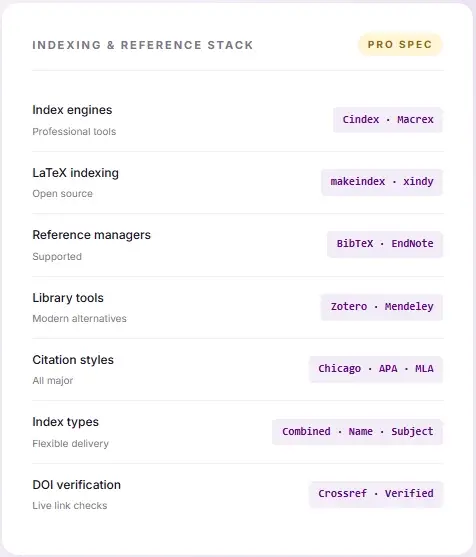
Professional back-of-book indexing runs on different engines depending on your typesetting workflow. Importantly, we select the right tool so the final index integrates cleanly with your book production.

ToolBest ForStrengthsWorkflow Integration
Cindex / MacrexProfessional indexing from typeset PDF, standalone back-of-book indexes for any typesetting workflowFull editorial control, flexible output formats, industry standard for professional indexers worldwideOutput as RTF, Word, or formatted text for direct typesetter integration
makeindex / xindyLaTeX books with embedded index markup, STEM monographs, mathematically typeset textbooksNative LaTeX integration, automatic page locator generation, xindy adds multilingual sortingCompiled directly into LaTeX document, updates automatically with source changes
InDesign IndexInDesign-typeset books, humanities monographs, university press book workflowsIndex entries tagged during typesetting, automatic page locator updates, direct output to book layoutIndex generated inside InDesign file, updates with repagination, integrates with typesetter
BibTeX / biblatexReference formatting for LaTeX books, bibliography generation and style conversionFull bibliographic control, every major citation style supported, automatic bibliography generationCompiled with LaTeX document, consistent style application, library reusable across projects
Production Elements

Every back-matter element handled with precision.

Professional back-matter production covers dozens of technical elements beyond basic index entry extraction. Below are the core elements included in every indexing and reference formatting project.

Topic Entries & Subheadings

Main topic entries with hierarchical subheadings capturing how readers will search. Editorial judgement applied to subheading depth, phrasing, and ordering to balance thoroughness with usability.

Name Index Entries

Personal and institutional names indexed with correct alphabetisation. Prefixes handled correctly (de, van, von), initials expanded where identifiable, Chinese and Arabic naming conventions respected.

Subject Term Hierarchy

Subject terms arranged in hierarchical relationships matching your book's conceptual structure. Broad topics with narrower subheadings, consistent terminology across entries, reader-focused rather than author-focused.

Cross References

See references (pointing to preferred terms) and see also references (pointing to related entries) added with editorial judgement. Enough to help readers navigate, restrained enough to avoid clutter.

Page Locator Verification

Every page number in the index verified against final typeset proofs. Page ranges correctly notated (45-67 vs 45, 46, 47), passim notation used appropriately for diffused discussions.

Bibliography Generation

Complete bibliography generated from reference manager or manual rebuild. Citation style (Chicago, APA, MLA, Harvard, Vancouver) applied consistently, every entry formatted to publisher specification.

DOI & Link Verification

Every DOI resolved through Crossref to verify reference accuracy. Broken links flagged, incorrect DOIs corrected, DOI format standardised per citation style requirements (https://doi.org/... format).

Reference Library Cleanup

EndNote, Zotero, Mendeley, or BibTeX library audited and cleaned. Duplicates removed, incomplete entries filled, author name formats standardised, library delivered as reusable asset for future projects.

Common Pain Points

The back-matter problems academic authors bring to us.

Below are the most common indexing and reference problems academic authors raise with us. If any of these sound familiar, we handle them as routine work.

My index entries do not match my final typeset page numbers.

What we do: Rebuild index from final typeset PDF, verify every page locator against actual content, flag missing entries, and deliver a camera-ready index that resolves correctly throughout the entire book.

My bibliography has 400 entries in 15 different citation styles from co-authors.

What we do: Normalise every reference to a single consistent citation style per your publisher's requirements. Author name conventions standardised, journal abbreviations unified, DOI format checked across all entries.

My publisher wants a comprehensive index but I have no time to make one myself.

What we do: Complete back-of-book index produced by professional indexer from typeset PDF in 7 to 14 working days. Comprehensive topic, name, and subject coverage with cross references and verified locators.

My edited collection has 20 contributor bibliographies all needing unification.

What we do: Merge contributor bibliographies into a single volume-level reference list in your publisher's citation style. Duplicates identified and consolidated, chapter-specific entries preserved where required.

My EndNote library is a mess after 10 years of adding entries.

What we do: Full library audit and cleanup. Duplicates removed, incomplete entries filled from Crossref, author name formats standardised, custom fields unified, library delivered clean and reusable for future projects.

I need to convert my Harvard references to Chicago but the bibliography is huge.

What we do: Complete citation style conversion across the entire reference list. Every entry rebuilt per target style conventions, in-text citations updated to match, library delivered in both styles for flexibility.

Send Your Typeset PDF & Reference Library

We return a free quote within 3 hours covering full cost, index scope, and confirmed delivery timeline. Moreover, we accept your book at any stage and match the indexer to your subject specialism.

How It Works

How our back-matter service delivers in 3 simple steps.

From your first upload to receiving press-ready back matter. Importantly, no back and forth confusion, no surprise pricing, no compromise on editorial quality.

01

Upload & Scope Definition

Send your typeset PDF and reference manager library along with your publisher's indexing and citation requirements. Specifically, mention your contract press and discuss index structure (combined, name, subject) before work begins.

02

Free Quote & Approach

Within 3 hours we send a fixed-price quote, confirm the indexing approach (depth, structure, tools), and timeline. Furthermore, we discuss any special requirements for name indexes, legal citations, or specialist indexes before committing.

03

Index & References Delivered

Professional indexer produces the back-of-book index, reference specialist formats the bibliography, and both deliver press-ready output. Editable source files, cleaned reference library, and final index in your publisher's required format.

Why Specialised Matters

Why automated indexing never produces a professional index.

Software-based keyword extraction and automated indexing tools produce concordances, not indexes. Importantly, professional indexing is editorial judgement work that software cannot replicate.

Automated & DIY Indexing

ManuscriptLab Back Matter

Transparent Pricing

Two engagement models for every academic author or publisher.

Per-book pricing suits individual academic authors with a single contracted title needing indexing or reference formatting. Alternatively, partnership pricing with volume contracts suits university presses, academic publishers, and learned societies producing multiple titles per year. Importantly, all partnership pricing is set through consultation to match your publication volume and back-matter complexity. Furthermore, every engagement begins with a free scope discussion so you can evaluate fit before committing.

Per Book

Standard Back-Matter Service

99$starting per book

7 to 14 working days depending on length and scope

Partnership

Publisher Volume Agreement

Custom SLA matched to your publication schedule

Author Feedback

What academic authors say about our indexing work.

Real feedback from academic authors and publishers who commissioned ManuscriptLab to produce back-of-book indexes and format bibliographies for scholarly monographs, textbooks, and edited collections worldwide.

Need Help?

FAQs about our indexing service.

Common questions answered to help you understand exactly how our book indexing and reference formatting service works for academic authors and publishers.

What is book indexing?
Book indexing is the professional creation of a back-of-book index that helps readers locate topics, names, and subjects within your book. A good index covers topic entries with subheadings, personal and institutional names, subject terms with cross references (see and see also), page ranges for extended discussions, and alphabetical arrangement following publisher conventions. Importantly, indexing is editorial judgement work, not keyword extraction. A professional indexer reads the book carefully to decide what readers will look for.
What is the difference between indexing and reference formatting?
Indexing creates the back-of-book index, a reader-facing navigation tool listing topics, names, and subjects with page locators. Reference formatting manages the bibliography and in-text citations, applying consistent citation style across hundreds of references, cleaning reference manager libraries, and verifying one-to-one correspondence between text and bibliography. Furthermore, scholarly monographs typically need both services as sequential production stages.
Which indexing software do you use?
We work with the leading professional indexing tools matched to your source files. LaTeX makeindex and xindy for LaTeX-based books, Adobe InDesign index features for InDesign-typeset books, and specialist indexing software (Cindex, Macrex, SKY Index, Index-Manager by Thomas Sidow) for professional indexer workflows. Specifically, we select the right tool for your typesetting engine so the final index integrates cleanly with your book production.
Do you work with EndNote, Zotero, and Mendeley?
Yes. We work directly with EndNote, Zotero, Mendeley, and BibTeX reference manager files. Specifically, we clean up your existing library, remove duplicates, fix incomplete entries (missing DOIs, wrong author formats, truncated titles), merge entries from multiple sources, and apply the required citation style to your entire library. Furthermore, the cleaned library is delivered alongside your formatted bibliography for use in future projects.
Which citation styles do you support?
We work with every major academic citation style including the Chicago Manual of Style (notes-bibliography and author-date), APA 7, MLA 9, Harvard (multiple variants), Vancouver, IEEE, AMA, ACS, OSCOLA for law, and any publisher-specific house style. Importantly, we can convert between styles if your publisher has changed requirements or if you are adapting book chapters into journal articles after publication.
How do you create a back-of-book index?
Professional indexing is editorial judgement work. Our indexer reads the entire book carefully, identifies topics, names, and subjects readers will look for, applies editorial judgement to subheading hierarchy, adds cross references (see and see also), verifies page locators against the final typeset proofs, and arranges entries alphabetically per publisher conventions. Specifically, this is very different from software-based keyword extraction, which produces concordances rather than indexes.
Can you work from typeset PDF or do you need source files?
Both. We can index from final typeset PDF (the professional standard, since locators are stable), from LaTeX source with makeindex markup embedded, or from InDesign files with index entries tagged during typesetting. Importantly, indexing from typeset PDF is the most common approach for scholarly monographs because page numbers do not change after indexing begins. Furthermore, we also handle hybrid workflows where author-supplied index markup is verified against final pagination.
Do you handle multi-author edited collections?
Yes. Edited collections typically need a single integrated index covering all chapters, even though chapters come from different contributors. Specifically, our indexer reads the entire volume, identifies topics and names across all chapters, and produces a comprehensive combined index. Furthermore, reference formatting for edited collections includes normalising citation styles across contributors and merging per-chapter bibliographies into a volume-level reference list where required.
Can you verify every citation against the bibliography?
Yes. Citation verification is a core part of our reference formatting service. Specifically, we check every in-text citation against the bibliography for one-to-one correspondence, verify author names and dates match between text and reference list, flag missing references and orphan bibliography entries, check DOIs resolve correctly, and apply consistent citation style throughout. Importantly, this is critical for scholarly monographs with hundreds of references.
How long does indexing take?
Standard back-of-book indexing typically takes 7 to 14 working days for a 200 to 400 page academic book, depending on content complexity and index depth. Specifically, professional indexing pace averages 30 to 50 pages per day per indexer depending on subject density and the level of subheading hierarchy required. Furthermore, reference formatting and citation verification typically runs in parallel with indexing. We confirm exact timing in your free quote within 3 hours.
How much does indexing and reference formatting cost?
Standard indexing and reference formatting starts from $99 for shorter academic manuscripts with regular delivery. Longer books, STEM content with specialist terminology, edited collections requiring multi-chapter integration, and partnership agreements with academic publishers are quoted individually based on scope. Furthermore, publisher partnership pricing is set through consultation to match your publication schedule and volume. Request a free quote within 3 hours for exact cost.
Can you convert my references from one citation style to another?
Yes. Citation style conversion is a standard part of our reference formatting work. Specifically, we convert between Chicago, APA, MLA, Harvard, Vancouver, IEEE, OSCOLA, and other styles while preserving every reference’s bibliographic accuracy. Furthermore, we rebuild your reference manager library in the new style, verify every entry resolves correctly, and deliver both the converted bibliography and the editable reference manager library.
Do you produce name index, subject index, and combined indexes?
Yes. We produce single combined indexes (topics, names, and subjects together, standard for scholarly monographs), separate name indexes (personal and institutional names only), separate subject indexes (topics and themes only), and specialist indexes (biblical references, legal citations, geographic locations). Specifically, we discuss index structure during the design brief so the final index matches your publisher’s conventions and your readers’ expected use patterns.
How do you handle cross references in the index?
Cross references use two conventions. See references point readers from a term they might search to the preferred term used in the index (for example, ‘cinema. See film’). See also references point readers from one entry to related entries (for example, ‘democracy, 45-67. See also authoritarianism, elections’). Importantly, our indexer uses editorial judgement to add cross references that help readers find material without over-cluttering the index.
Is my manuscript kept confidential during indexing?
All book manuscripts and reference libraries are handled with strict confidentiality. We sign Non Disclosure Agreements (NDAs) on request before you send any files. Furthermore, every indexer and reference specialist on our team is bound by confidentiality terms regarding your unpublished research, original ideas, and any sensitive content including pre-publication findings, embargoed material, and proprietary data.
🚀 Publish With Confidence

Your academic book deserves university press standard typesetting.

Free quote within 3 hours. Free sample chapter spread in your publisher’s house style. PhD qualified typesetters. LaTeX, InDesign, and Affinity Publisher for scholarly monographs, textbooks, and edited collections worldwide.

Get a Custom Quote

Tell us a bit about your project and we’ll get back to you within 24 hours.

Get a Custom Quote

Tell us a bit about your project and we’ll get back to you within 24 hours.