Formatting mistakes kill manuscripts faster than bad arguments. Editors reject solid research every single day because the citations don’t match the required style, the headers are wrong, or the reference list looks like a mess.
If you have ever experienced that fear of writing (and editing) your paper and having an impending deadline looming and not knowing which style your journal requires (APA or Chicago), you will be delighted with this book. This book discusses these four citation methods (APA, Chicago, Harvard, and MLA) in common, straightforward language without all the academic jargon that makes normal design layouts of guides impossible to read. You may be asking yourself where to place the MLA citation system in this discussion because many writers are always mixing up these four systems.
Formatting your manuscript is not busywork; it allows editors, reviewers, and readers to see that you respect the conventions used within your discipline; if you incorrectly format your manuscript, your great research can appear as though it were careless; if you have correctly formatted your manuscript, it will appear that the paper has been written specifically for use in the journal to which you are submitting it.
Why Formatting Style Actually Matters in Academic Writing
Every citation style exists to solve one problem: giving credit without disrupting the reader’s flow. According to the Wikipedia entry on APA style, the American Psychological Association first standardized its format in 1929 to create consistency across psychology journals. That same logic drives every style guide still in use today.
Reviewers notice inconsistent formatting immediately. A mismatched reference list or a missing running head signals that the author didn’t proofread carefully — and that assumption bleeds into how they judge your actual arguments.
This is exactly the gap our manuscript formatting service at Manuscript Lab closes for researchers submitting to journals with strict style requirements.
APA Style: Structure, In-Text Citations, and Best Use Cases
APA (American Psychological Association) style dominates psychology, education, nursing, and most social sciences. It uses the author-date system, meaning every in-text citation includes the author’s surname and publication year — for example, (Smith, 2021).
Key APA structural rules include:
- A running head and page number on every page (7th edition dropped the running head requirement for student papers, but professional papers still need it)
- A title page with the paper’s title, author name, and institutional affiliation
- An abstract capped around 250 words
- A references page listing sources alphabetically by surname
APA citations rely heavily on digital object identifiers (DOIs), which matters more now that most journals publish online. If you’re formatting a thesis or dissertation, our thesis formatting assistance page walks through APA’s exact spacing and heading-level requirements.
Writers frequently ask whether they can use an apa citation generator to save time. The honest answer: generators are useful for basic entries, but they frequently mishandle edited books, government reports, and sources with multiple authors. Always cross-check generator output against the official APA manual before submission.
Chicago Style: Two Systems in One Manual
Chicago style splits into two distinct citation systems, and confusing them is one of the most common manuscript errors we see.
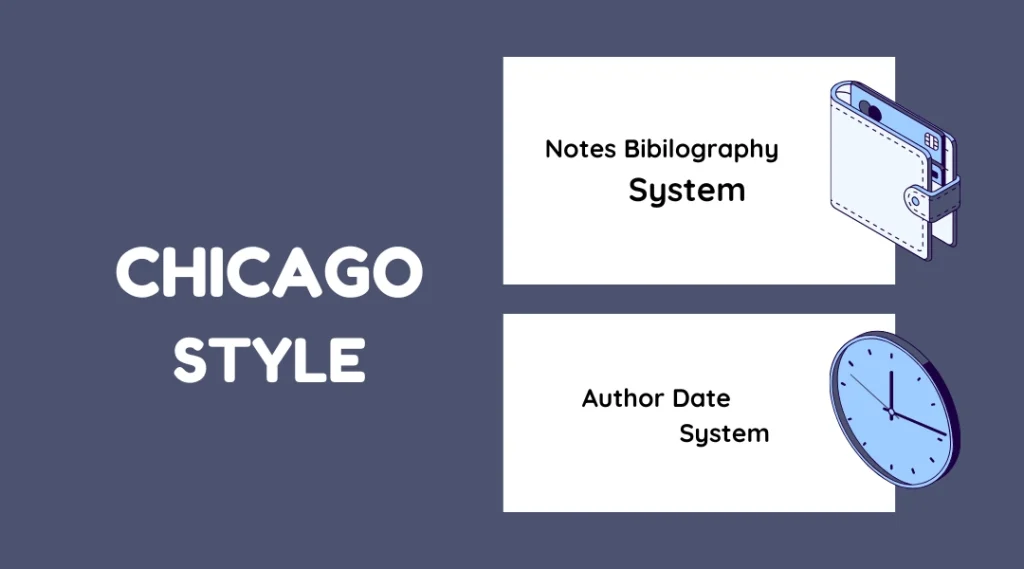
Notes-Bibliography System — used heavily in history, art, and humanities. Writers insert a footnote or endnote number after each cited claim, then list full sources in a bibliography.
Author-Date System — used in sciences and social sciences, functioning similarly to APA with parenthetical citations like (Smith 2021, 45).
The Chicago Manual of Style Wikipedia page notes that the manual has been continuously updated since 1906, making it one of the oldest active style guides in American publishing.
Chicago’s footnote system allows more narrative flexibility than APA. Writers can add commentary within footnotes, something strictly prohibited in APA’s cleaner, more clinical citation format.
Chicago vs APA: The Differences That Actually Trip Writers Up
The Chicago vs APA comparison confuses even experienced academics, mainly because both systems overlap in disciplines like sociology and political science.
| Feature | APA | Chicago (Author-Date) | Chicago (Notes-Bib) |
| In-text citation | (Author, Year) | (Author Year) | Footnote number |
| Reference list name | References | Reference List | Bibliography |
| Title page | Required, structured | Optional | Optional |
| Common field | Psychology, Education | Social Sciences | History, Humanities |
| Footnotes allowed | Rare | Sometimes | Standard practice |
Notice that Chicago’s author-date variant looks almost identical to APA on the surface, but the punctuation inside parentheses differs — Chicago drops the comma, APA keeps it. That single comma has failed manuscripts during formal review.
If your manuscript keeps bouncing between reviewer comments about citation mismatches, our citation consistency check service catches these small but costly errors before submission.
Harvard Style: The Author-Date System Most Commonly Used Outside the US
Harvard referencing dominates in the UK, Australia, and much of Europe, particularly in business, economics, and law programs. Unlike APA, Harvard has no single official governing body — it exists as a family of similar conventions rather than one fixed manual.
According to Wikipedia’s overview of Harvard referencing, universities often publish their own Harvard style variations, meaning “Harvard style” at Oxford might differ slightly from “Harvard style” at Melbourne.
Core Harvard conventions include:
- In-text citations formatted as (Author Year: Page)
- A “Reference List” or “Bibliography” alphabetized by surname
- No footnotes required for citation purposes
- Flexible formatting for online and multimedia sources
Because Harvard style varies by institution, always check your university’s specific style handbook rather than assuming one universal Harvard format applies. This is precisely why our university-specific formatting review exists — generic Harvard templates often miss institution-specific rules.
Where MLA Fits Into the Formatting Conversation
MLA (Modern Language Association) style rarely appears in scientific manuscripts, but it dominates literature, languages, and cultural studies. Writers submitting cross-disciplinary work sometimes need to switch between APA and MLA within the same semester, which causes real confusion.
The mla format relies on author-page citations rather than author-date — for example, (Smith 45), no comma, no year. This single difference from APA and Harvard trips up more students than any other formatting rule.
The first page of an MLA document should have the MLA header in the top left-hand corner that contains the student’s name, instructor’s name, course name, and date. These four items must be stacked vertically and in single-space format. There is also no title page in the MLA writing style. Additionally, instead of using the word “References”, MLA requires the use of “Works Cited”.
All MLA formatted google docs need to be prepared with 2x space, 1″ margins and a hanging indent for the Works Cited page since google docs does not do that automatically. Failing to create a hanging indent is responsible for the majority of errors in MLA Docs submitted by students.
The MLA Style Center provides confirmation of all above information, and revises their formats each time a new edition comes out.
APA vs Chicago vs MLA: A Side-By-Side Snapshot
Comparing apa vs chicago vs mla side by side clarifies which discipline expects which system.
| Style | Discipline | Citation Format | Source List Title |
| APA | Psychology, Education, Sciences | (Author, Year) | References |
| Chicago | History, Humanities, Social Sciences | Footnote or (Author Year) | Bibliography |
| MLA | Literature, Languages, Arts | (Author Page) | Works Cited |
| Harvard | Business, Law, UK Institutions | (Author Year) | Reference List |
Notice how citation punctuation is the smallest visual difference but the most frequent rejection reason. A missing comma or an extra space genuinely changes which style your paper appears to follow.
Academic Integrity and Formatting: Why This Isn’t Just Cosmetic
Formatting mistakes can often be confused for citation manipulation; a violation of academic integrity law. Because of this, the Office of Research Integrity (an agency of the Federal Government) has put out guidelines stating that accurate consistent citations provide transparency in research and eliminate the likelihood of being charged with unintentional plagiarism.
Not only does sloppy formatting look unprofessional, it also can make it difficult for readers to determine whether or not credit was given to the original source. This is even more important today than in years past as more journals use automated plagiarism detection software and citation review processes before any human review.
For authors who use an APA citation generator, it is essential to verify each entry against integrity guidelines because there is no way for automated citation generators to know whether or not a particular citation is misrepresenting the original source.
If your manuscript needs a full compliance pass before submission, our pre-submission formatting audit checks citations against both style rules and integrity standards simultaneously.
Choosing the Right Style for Your Manuscript
Your discipline usually decides your style, not personal preference. Check your target journal’s author guidelines first — most journals state their required style explicitly on their submission page.
When guidelines stay silent, default to your field’s convention: APA for psychology and education, Chicago for history and humanities research, Harvard for UK-based business and law submissions, and MLA for literature and language studies.
Never assume one style guide’s rules transfer directly to another. Even experienced researchers get penalized for blending Chicago footnotes into an APA-formatted paper, or applying MLA’s page-based citations where Harvard’s year-based system is required.
Final Thoughts on Mastering Manuscript Formatting
Formatting styles aren’t arbitrary bureaucracy — they’re a shared language that lets researchers across the world reference each other’s work consistently. Mastering the differences between APA, Chicago, Harvard, and MLA protects your credibility before a single reviewer reads your argument.
If you’re still unsure which style your manuscript needs, or you want a professional check before submission, our full manuscript editing package reviews formatting, citations, and academic integrity in one pass.
Recommended Reference Books:
- Publication Manual of the American Psychological Association (7th Edition), American Psychological Association
- The Chicago Manual of Style (17th Edition), University of Chicago Press