The discussion section separates strong research from merely published research. Many manuscripts get rejected not because the data is weak, but because researchers fail to interpret their findings with the clarity and context that journals demand. Your discussion section is where you transform raw data into meaningful contribution to your field.
This guide walks you through building an effective discussion section that editors and peer reviewers recognize as genuinely insightful.
What Is the Discussion Section of a Research Paper?
The discussion portion serves as an interpretive mainstay of one’s research. In the same way that the results section merely reports on results incidentally occurring, the purpose of the discussion is to explain the significance of the various findings.
This section of your paper both links findings to past research and places your own findings in the context of what other researchers have been conducting research on in their area (e.g., the larger academic community).
Many researchers make the mistake of confusing the discussion with the conclusion, but this distinction matters. The discussion identifies the implications, limitations, and context for what you have found through your research, while the conclusion wraps things up and provides direction for future research. The discussion portion of your paper does most of the heavy lifting in terms of interpreting the meaning of the data/underlying information presented in the results section.
In accordance with the academic writing guidelines from the American Psychological Association, a well-crafted discussion links your results to existing theories (e.g., providing evidence that either reinforces or contradicts existing theories), addresses limitations in the design of your study, and places your study in the context of what is currently known. Transparency creates credibility versus decreased credibility.
The discussion section of your paper should address basic questions: What do the results mean? What connection do the results have to what other researchers’ have been studying? Where do the results/information you present place you in the current body of research? Where do you go from here?
How Long Should a Discussion Section Be for Your Manuscript?
Length varies across disciplines, but patterns emerge when you examine published research across fields. A how long discussion section for manuscript depends on several variables: your field, journal guidelines, study complexity, and dataset scope.
Standard Guidelines by Discipline:
| Discipline | Typical Word Count | Proportion of Paper | Key Consideration |
| Life Sciences | 800–1,500 words | 25–35% of total | Multiple pathways to interpret data |
| Medicine/Clinical Research | 1,000–1,800 words | 30–40% of total | Clinical implications and limitations required |
| Psychology | 700–1,200 words | 20–30% of total | Theory integration essential |
| Engineering | 500–1,000 words | 15–25% of total | Technical implications focused |
| Education | 600–1,100 words | 25–35% of total | Pedagogical context important |
| Social Sciences | 800–1,400 words | 28–35% of total | Societal implications emphasized |
Your journal’s author guidelines usually specify target ranges. When they don’t, check recently published articles in your target journal. Your discussion should never feel rushed or inflated. At 25–35% of your total manuscript length, you have room to develop ideas without redundancy.
For a scientific journal manuscript of 5,000 words, allocate roughly 1,250–1,750 words for your discussion. A lab report discussion section varies more widely—from 500 words for undergraduate work to 1,500+ for graduate-level research.
The key: write until you’ve thoroughly addressed your findings, then stop. Padding weakens authority; brevity suggests underthinking.
How to Write a Discussion Section for a Research Paper: The Core Framework
The effective design of a discussion section is based on a purposeful structure. Start with the most general topic and move through your findings to the more specific areas of limitations/implications. This design also follows the way that readers’ brains process information (table of contents → Analysis).
Part One: Context & Importance
The first part of your discussion section reaffirms the significance of your study (i.e., answer to research question). Include your main research question and give a very brief overview of what you studied. Do not copy from the introduction; you are framing the analysis that will follow.
An effective way of beginning your discussion section is by connecting to an ongoing scholarly debate in the field where your work is contributing. Instead of stating, “The purpose of this study is X,” state, “There is considerable research debating the relationship between X & Y, with many competing models producing divergent outcomes. Our findings support [Name]’s mechanism for achieving X…”
By doing this, you are establishing your work as part of the current scholarly conversation instead of an independent investigation.
Step 2: Interpret Your Primary Findings
In each section, you want to present your findings first, then interpret them taking a closer look at how they relate to past studies: do they confirm what you expected? Do they contradict past research? Were they outside of what you predicted, and if so, do they show a different trend than other studies? When writing a discussion section when writing a research paper, show the comparison after the interpretation. Make sure to help your reader understand how you came to your conclusion or findings. If your hypothesis was not supported, give an explanation for this and if possible, relate it to existing theories or methods.
Make sure that your evidence demonstrates or suggests an evident conclusion, so it is not actually definitive. This formatting will be important for reviewers in determining your precision and caution for establishing what conclusion was shown through data.
Step 3: Address Secondary and Unexpected Findings
Primary results should be the focus of the article, but if secondary results contradict the primary results, they must be discussed in detail. If the findings are related to the central findings, they should be discussed in detail as well. If the secondary finding is not related enough to warrant in-depth discussion, a brief acknowledgement that it’s an important finding should be included.
Surprising results are not a failure, but rather an opportunity for researchers to learn and revise their ideas and hypotheses. Discussing your surprising results in an honest manner reflects the methodological rigor and intellectual honesty of your work.
Step 4: Compare Your Results to Existing Literature
Successfully fulfilling all of the above shows that you have read and thought extensively in your area of study. Cite at least 15 to 25 relevant studies that you have found to be relevant to your findings. Describe how your findings converge with existing literature published by [Author] with the following example: “Our findings are consistent with the existing meta-analysis conducted by [Author].” You may also want to identify conflicting results: “In contrast to [Author], we did not find a correlation between *X* and *Y*; the differences in sample characteristics, measurement methods, etc. may account for this discrepancy.”.
Doing this will demonstrate that you are making a credible contribution toward advancing or challenging the current consensus in this field. It places your research in the context of other researchers’ contributions.
Key Components Every Effective Discussion Section Needs
The architecture matters, but specific components make discussions truly authoritative. Missing any of these weakens your overall argument.
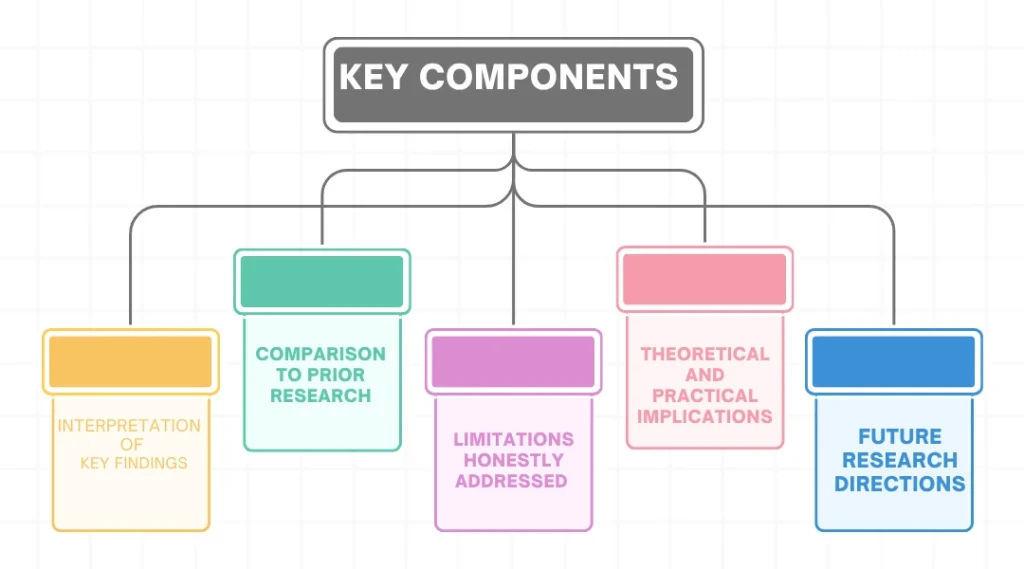
Interpretation of Key Findings
Explain what your data reveals. Don’t restate results; interpret them. When findings confirm theory, explain the mechanism. When findings diverge from predictions, propose explanations grounded in methodology or context.
Comparison to Prior Research
Show how your work fits the research landscape. Do your findings support, extend, or challenge existing understanding? Quality discussions reference 15–25 studies and synthesize patterns across the literature.
Limitations Honestly Addressed
Reviewers expect limitations. Addressing them yourself—before critics point them out—builds credibility. Distinguish between limitations inherent to your methodology (sample size, measurement approach) and those reflecting broader research gaps. More importantly, explain how limitations affect interpretation. A small sample doesn’t invalidate findings; it suggests results need replication in larger populations.
Many researchers fear discussing limitations. Actually, transparent discussion of constraints demonstrates maturity. It shows you understand your work’s boundaries and can contextualize findings appropriately.
Theoretical and Practical Implications
What do your findings mean for theory? How might they inform practice? If you conducted basic research, emphasize theoretical implications. If applied research, emphasize practical applications. Discuss both, but weight them appropriately for your field and research type.
Future Research Directions
End this component with concrete suggestions for future work. Not vague statements (“More research is needed”) but specific questions: “Future studies should examine whether this relationship holds across [specific population] using [specific methodology].”
Common Mistakes That Weaken Discussion Sections
Recognizing pitfalls helps you avoid them. Strong writers know where discussions typically falter.
Repeating Results Instead of Interpreting Them
Your results section reports findings. Your discussion explains meaning. Restating findings wastes words and signals limited thinking. Transform results into interpretation: shift from “Participants in the intervention group scored higher (M=45.3) than controls (M=38.2)” to “Higher scores in the intervention group suggest the treatment enhanced [specific mechanism], consistent with [theoretical framework].”
Overstating Certainty
Data supports conclusions; it doesn’t prove them. Phrases like “This definitively shows” or “The evidence proves” overstate what research can claim. Replace absolute language with appropriately cautious statements: “These findings suggest,” “Results are consistent with,” “Evidence indicates.”
Ignoring Contradictory Findings
Reviewers notice when you conveniently overlook results that complicate your narrative. Address them directly. Honest discussion of contradictions strengthens rather than weakens credibility.
Introducing New Data or Results
Your discussion references findings from your results section. If you analyze data you haven’t previously reported, move that analysis to results. The discussion section is interpretation territory, not new analysis.
Disconnecting from Your Research Question
Every discussion point should connect, however loosely, to your original research question. Tangents about related-but-distinct topics dilute focus and frustrate reviewers.
Discussing limitations without context
Naming limitations isn’t enough. Explain how each limitation affects interpretation. “Our sample was primarily white and educated” matters less than “Our predominantly white, educated sample may limit generalizability to diverse populations; future research should examine whether findings replicate across demographic groups.”
How to Write the Discussion Section of a Research Paper: The Discipline-Specific Approach
Writing style adapts to disciplinary conventions. A discussion section of lab report emphasizes technical precision and hands-on implications. A psychology discussion balances theoretical nuance with practical application. A medicine discussion prioritizes clinical relevance alongside statistical findings.
For Life Sciences and Biology
Emphasize mechanisms. Explain the biological processes your findings illuminate. Connect results to cellular, molecular, or organismal-level understanding. Reference pathway analysis and mechanistic models. Your discussion should make clear how findings advance molecular understanding.
For Medical and Clinical Research
Ground discussions in clinical significance. Statistical significance doesn’t equal clinical significance. A drug that reduces symptoms by 15% statistically might matter little clinically; one that reduces hospitalizations matters enormously. Discuss both statistical and practical significance. Address patient populations explicitly. Will findings apply broadly or to specific subgroups?
For Psychology and Social Sciences
Theory integration matters intensely. Connect findings to established theoretical frameworks. Do results support one model over competing alternatives? Discuss the mechanisms linking variables. Psychological research typically requires deeper theoretical engagement than some fields.
For Education Research
Emphasize pedagogical implications. How might findings improve teaching and learning? Discuss scalability and implementation. Education research often bridges basic and applied science, so discussions benefit from addressing both theoretical understanding and practical classroom applications.
The Lab Report Discussion Section: Adapted for Academic Training
When you write a discussion section of lab report—whether undergraduate or graduate—the expectations differ slightly from published research. Lab report discussions remain rigorous but acknowledge the learning context.
Your lab discussion should:
- Interpret results clearly without overstating certainty
- Reference course material and assigned readings showing engagement with theory
- Acknowledge experimental limitations honestly, especially procedural constraints
- Connect findings to learning objectives showing how the work advanced your understanding
- Discuss error sources and their impact on results
- Propose improvements for future iterations
Lab reports typically run 3–5 pages for undergraduate work and 5–10 pages for graduate research. The proportion relative to total length remains similar to published research: roughly 25–35% of overall document length.
Practical Writing Techniques for Stronger Discussions
Beyond structure and content, how you write matters. Word choice, sentence construction, and paragraph organization affect how effectively your discussion communicates.
Use Active Voice Strategically
Active voice (“We found that stress reduced performance”) engages readers more directly than passive voice (“Performance was reduced by stress”). Aim for roughly 60% active voice. Some passive constructions work well when emphasizing the finding over the researcher: “The relationship was confirmed across three independent samples” focuses attention on the result.
Build Coherence Through Signposting
Guide readers through your logic using transition phrases: “This pattern aligns with,” “In contrast,” “Building on this finding,” “These results extend.” Clear signposting helps readers follow your argument rather than getting lost in dense interpretation.
Vary Sentence Structure
Short, direct sentences state main ideas: “Our findings challenge this assumption.” Longer sentences develop complex ideas: “The mechanism we propose—involving dopaminergic pathways activated by anticipation rather than reward receipt—reconciles these seemingly contradictory findings by suggesting that previous research examined different temporal windows of the same underlying process.”
Alternating sentence length maintains reader engagement and prevents monotony.
Use Precise, Specific Language
Vague discussions weaken authority. Instead of “other researchers have found similar results,” specify: “Meta-analyses by Chen et al. (2021) and Rodriguez (2022) report effect sizes ranging from r = 0.34 to r = 0.52, consistent with our observed r = 0.41.”
Precision signals mastery and grounds claims in evidence.
Linking Your Discussion to Internal and External Resources
Strong discussions reference contextual knowledge. When discussing how researchers approach discussions, consult resources like writing guidelines from the National Institutes of Health, which emphasize clear communication of research implications. For additional perspective on discussion structure, the American Journal of Public Health publishing guidelines provide discipline-specific examples.
For methodology discussions, peer-reviewed methodology journals indexed on PubMed offer detailed exploration of statistical and design considerations. These external resources provide gold-standard examples.
Within Manuscript Lab’s content ecosystem, our guide to research paper structure explains how discussion sections fit within broader manuscript architecture. Our article on writing compelling results sections shows how to report findings your discussion will interpret. The piece on addressing reviewer feedback helps you strengthen discussions during revision. Our resource on avoiding plagiarism in academic writing ensures your synthesis of others’ work remains ethical and properly attributed. Our comprehensive editing checklist includes specific items for discussion section quality control.
Revision Strategies for Discussion Sections
First drafts rarely achieve excellence. Strategic revision strengthens discussions substantially.
First Pass: Content and Logic
Read your discussion asking: Does every paragraph address my research question? Have I interpreted findings rather than simply restating them? Do I acknowledge limitations honestly? Have I properly contextualized my work? This pass might require substantial reorganization.
Second Pass: Clarity and Precision
Read for sentence-level clarity. Eliminate vague language. Strengthen weak verbs. Replace “somewhat related” with “significantly predicted” or “modestly correlated”—precision matters.
Third Pass: Consistency and Flow
Ensure transitions between paragraphs flow logically. Check that tone remains consistent. Verify that your argument arc builds coherently from opening context to closing implications.
Fourth Pass: Technical Standards
Verify all citations are accurate and complete. Check that terminology matches terminology in your field. Ensure tense consistency (past tense for completed research, present for established knowledge or theory).
Reference Books for Further Study
- “Successful Scientific Writing: A Step-by-Step Guide for Biomedical Scientists” by Janice R. Matthews and David M. Matthews – This comprehensive guide provides detailed instruction on discussion section construction, including discipline-specific examples and revision strategies tailored for biomedical and life science writing.
- “Writing Science: How to Write Papers That Get Cited and Proposals That Get Funded” by Joshua Schimel – Schimel emphasizes discussion sections as the interpretive core of research communication, offering practical techniques for translating results into compelling narratives that advance scientific understanding and engage reviewers meaningfully.