If you are preparing an academic paper and have been told to use Harvard referencing, it can be tempting to assume that MLA is essentially the same system with a different name. Both styles use in-text citations and a source list at the end of a paper, so the similarities are easy to notice.
However, Harvard referencing and MLA are different academic citation systems with different rules for in-text citations, bibliographic entries, source organization, and document formatting. Using MLA when your department requires Harvard or combining elements of both can make an otherwise strong paper appear poorly edited and may result in a formatting correction or loss of marks.
Harvard is an author-date referencing approach commonly used across many disciplines, particularly in the social sciences, business, education, and some sciences. MLA, maintained by the Modern Language Association, is strongly associated with literature, languages, humanities, and cultural studies. The MLA Style Center specifies a distinct system based on author or title information and, where relevant, a location marker such as a page number.
This guide explains Harvard referencing vs MLA, including their major differences, in-text citation rules, reference-list conventions, paper-formatting requirements, and practical examples.
💡 Need expert help with your paper?
Transform your manuscript with ManuscriptLab’s professional editing & formatting services.
Harvard Referencing vs MLA: What Is the Main Difference?
The simplest distinction is this:
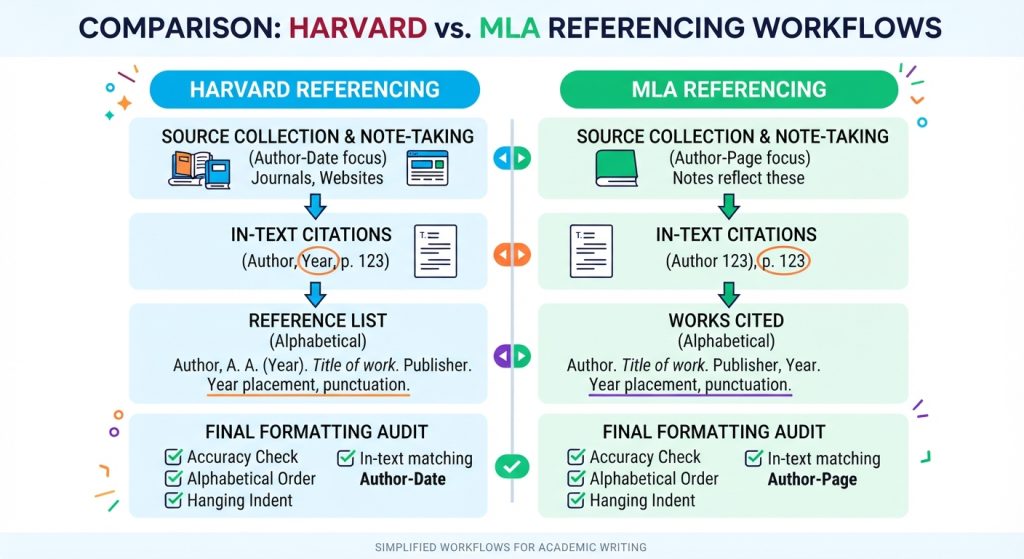
Harvard referencing emphasizes the author and publication year, whereas MLA generally emphasizes the author and the location of the cited material.
For example, a Harvard in-text citation might appear as:
(Smith, 2024, p. 18)
An MLA citation for the same source would normally be:
(Smith 18)
The year is central to the Harvard author-date system because it helps readers identify the relevant publication in the reference list. MLA, by contrast, normally uses the author’s surname and a page number or another appropriate location marker. The MLA Style Center specifically explains that an in-text citation should direct readers to the corresponding entry in the works-cited list and, when possible, to the relevant passage in the source.
There is another important distinction: Harvard is not one universally standardized style. Universities and publishers may use different Harvard variants, with variations in punctuation, capitalization, author formatting, and treatment of online sources. Current referencing guidance such as Cite Them Right distinguishes Harvard as an author-date system while also providing separate guidance for MLA and other referencing systems.
Therefore, always check your institution’s or journal’s prescribed Harvard guide before formatting a paper.
Quick Comparison: Harvard vs MLA
| Feature | Harvard Referencing Style | MLA Style |
| Primary system | Author-date | Author/location |
| Typical in-text citation | (Smith, 2024, p. 18) | (Smith 18) |
| Publication year in text | Usually included | Usually omitted |
| End-of-paper source list | Reference list | Works Cited |
| Common disciplines | Social sciences, business, education, sciences | Literature, languages, humanities |
| Page number | Commonly included for quotations; rules vary | Included when available/relevant |
| Source-list organization | Usually alphabetical by author surname | Alphabetical by author’s surname or entry element |
| Formatting standard | Depends on institution/Harvard variant | MLA-specific formatting rules |
| Main authority | Institutional or publisher-specific guide | Modern Language Association |
The table demonstrates why an academic citation comparison should consider more than the appearance of parentheses. The underlying documentation systems are different.
1. Understand the Harvard In-Text Citation Format
Harvard uses an author-date structure. The basic pattern is:
(Author, Year)
For a quotation or a specific passage, a page number is commonly added:
(Author, Year, p. 25)
For multiple pages:
(Author, Year, pp. 25–27)
For example:
Recent studies demonstrate a substantial change in research communication (Taylor, 2025).
For a direct quotation:
“Research communication has changed substantially” (Taylor, 2025, p. 42).
You can also integrate the author’s name into the sentence:
Taylor (2025, p. 42) argues that research communication has changed substantially.
The key principle is that the in-text citation should connect clearly to the corresponding entry in the reference list.
Harvard: Why the Year Matters
The publication year is a defining component of the Harvard system. It helps readers distinguish between multiple works by the same author and gives immediate chronological context.
For example:
(Brown, 2022)
and
(Brown, 2025)
refer to different publications.
If you cite several works by the same author from the same year, your prescribed Harvard variant may require letter designations such as:
(Brown, 2025a)
(Brown, 2025b)
Do not apply this rule automatically across all institutions. Audit your university’s Harvard referencing style guide before finalizing the reference list.
2. Apply MLA In-Text Citation Rules Correctly
MLA uses a different logic.
The standard MLA in-text citation generally identifies the author and, when useful, the page or another location marker:
(Smith 18)
Notice what is absent: the publication year.
If the author’s name already appears in the sentence, MLA normally does not require you to repeat it in parentheses:
Smith argues that digital publishing has transformed scholarly communication (18).
The MLA Style Center emphasizes avoiding redundant information in in-text citations.
If there is no page number, MLA does not require you to invent one. Depending on the source, another location indicator may be appropriate, or the citation may simply identify the author.
For an authorless work, MLA can use the title or a shortened form of the title to connect the citation with the corresponding works-cited entry.
MLA In-Text Citation Rules: Key Principle
Do not force Harvard’s year-based system into MLA.
Incorrect hybrid:
(Smith, 2024, p. 18)
Typical MLA:
(Smith 18)
Likewise, do not remove the publication year from a Harvard citation merely because MLA does not normally use it.
3. Compare Harvard Reference Lists and MLA Works Cited Pages
The terminology itself signals an important difference.
Harvard normally uses a:
Reference List
MLA uses:
Works Cited
These terms should not be treated as interchangeable.
A Harvard reference list generally contains the sources cited in the text, formatted according to the applicable Harvard variant.
An MLA works-cited list contains the works cited in the paper and follows MLA’s system of bibliographic elements.
The MLA Style Center explains that MLA works-cited entries are built using a template of core elements, including information such as author, title, publication details, and other relevant source information.
Example: Book Citation
Suppose you are citing a book by Jane Smith published in 2024.
A Harvard-style reference might look broadly like:
Smith, J. (2024) Academic Writing and Research Methods. London: Academic Press.
An MLA entry would use a different structure:
Smith, Jane. Academic Writing and Research Methods. Academic Press, 2024.
The exact Harvard punctuation and publication-place requirements can vary by institutional guide. MLA’s current approach, meanwhile, is based on its established template of core elements.
Example: Journal Article
A Harvard reference may be structured along the lines of:
Smith, J. (2024) ‘Research integrity in contemporary publishing’, Journal of Academic Research, 18(2), pp. 100–115.
An MLA entry would typically reorganize the information:
Smith, Jane. “Research Integrity in Contemporary Publishing.” Journal of Academic Research, vol. 18, no. 2, 2024, pp. 100–115.
The differences are not cosmetic. Author order, year placement, quotation marks, italics, volume/issue presentation, and page-range formatting all matter.
4. Harvard vs MLA Bibliography Format for Online Sources
Online sources create some of the most common citation errors because students often assume that a URL is sufficient.
It is not.
Your citation must provide enough bibliographic information for a reader to identify and locate the source.
MLA’s guidance for online works can include the author, title of the work, title of the website as container, publication details, and information about where the work was accessed.
Harvard systems similarly require structured information, although the precise sequence and punctuation depend on the relevant Harvard guide.
Common Online-Citation Mistakes
Avoid:
- Citing only the website URL
- Omitting the author when one is available
- Confusing the website title with the article title
- Copying APA formatting into Harvard
- Using MLA’s works-cited format in a Harvard reference list
- Adding access dates when your prescribed guide does not require them
- Omitting access dates when your institutional Harvard variant requires them
How to cite sources in Harvard style should therefore begin with identifying the exact Harvard variant required by your institution.
5. Learn How to Format an MLA Paper
Citation style and paper formatting are related but not identical.
A paper can contain correctly formatted MLA citations while still having problems with document presentation.
The MLA Style Center’s research-paper guidance specifies conventions such as one-inch margins, double spacing, and a works-cited page with hanging indentation. Its formatting guidance also illustrates the placement of page numbers and other document elements.
Core MLA Formatting Requirements
For a conventional MLA research paper, check the following:
- Use 1-inch margins.
- Double-space the document.
- Use a readable standard font; MLA’s current guidance permits flexibility rather than requiring one universal typeface.
- Indent the first line of each paragraph by 0.5 inch.
- Maintain consistent page numbering.
- Format headings and titles according to MLA guidance.
- Start the Works Cited section on a new page.
- Alphabetize entries appropriately.
- Apply a 0.5-inch hanging indent to subsequent lines of each works-cited entry.
- Double-space the entire works-cited list.
The MLA Style Center specifically describes the works-cited page as beginning on a new page, with entries flush left on the first line and subsequent lines indented by half an inch.
What About Harvard Paper Formatting?
This is where many students make an important mistake: Harvard is primarily a referencing system, not a universal document-formatting package.
Your university may specify:
- 12-point Times New Roman
- 1.5 or double line spacing
- 1-inch or 2.54-cm margins
- specific title-page requirements
- page numbering conventions
- heading hierarchies
- institutional cover sheets
Do not assume that MLA’s document-formatting rules automatically apply to Harvard assignments.
Always prioritize the assignment brief, department handbook, journal author instructions, or institutional referencing guide.
6. Audit the Difference Between a Reference List and Works Cited Page
The distinction between a reference list vs Works Cited page is straightforward but important.
Harvard Reference List
A Harvard reference list generally provides the full bibliographic details for sources cited in the paper.
The list is normally arranged alphabetically by author surname.
MLA Works Cited
An MLA works-cited page provides entries for the works cited in the paper.
The MLA system also uses alphabetical organization and a hanging-indent structure.
The crucial point is consistency:
Every in-text citation should correspond to an appropriate full entry, and every source included in the final list should be cited according to the rules of the selected style.
A citation-management tool can help identify missing matches, but automated output still requires editorial checking.
7. Avoid Mixing Harvard and MLA
The most damaging referencing error is often not choosing the “wrong” style initially. It is combining two styles in the same manuscript.
Consider this example:
Smith (2024) argues that literary analysis requires systematic interpretation (18).
This sentence contains elements associated with both systems.
Harvard would typically expect the year to remain part of the author-date citation, while MLA would not normally use the publication year in that position.
Similarly, a paper could contain:
(Smith, 2024, p. 18)
alongside:
(Jones 25)
That creates an inconsistent citation system.
Use One Style From Start to Finish
Select the required style before you begin formatting the bibliography.
Then audit:
- In-text citations
- Reference-list entries
- Book titles
- Article titles
- Publication years
- Page ranges
- URLs or DOI information
- Capitalization
- Punctuation
- Alphabetical ordering
- Hanging indents
- Document formatting
This final consistency audit is particularly important for dissertations, theses, journal manuscripts, and long-form academic projects where dozens or hundreds of references may be involved.
8. Understand Why Academic Referencing Styles Differ
Academic referencing styles evolved to solve different documentation problems and disciplinary expectations.
MLA was developed for scholarly communication in fields where authors frequently discuss texts, editions, passages, translations, literary works, and cultural artifacts. Its author/location approach makes it easy to direct readers toward specific passages. The MLA Style Center explicitly emphasizes connecting an in-text reference to the corresponding works-cited entry while minimizing unnecessary interruption to the prose.
Harvard’s author-date model provides immediate publication context. That is particularly useful in research environments where the chronology of scholarship matters.
Neither style is inherently “more academic.”
The correct style is the one required by your institution, journal, publisher, or discipline.
For journal submissions, follow the journal’s author guidelines even if they differ from the citation style you used during your degree.
Harvard vs MLA: Practical Decision Guide
| If your assignment requires… | Use |
| Author + publication year | Harvard |
| Author + page/location without publication year | MLA |
| A “Reference List” | Harvard |
| A “Works Cited” page | MLA |
| A university-specific Harvard guide | That exact Harvard variant |
| MLA Handbook/MLA Style Center rules | MLA |
| Journal-specific referencing instructions | The journal’s required style |
| Unclear instructions | Ask your supervisor, tutor, editor, or department |
Also read: Professional Manuscript Editing and Formatting Services
9. Use the Correct Authority for Your Referencing Style
Do not build an academic manuscript from random citation-generator examples.
For MLA, consult the MLA Style Center, the official guidance platform of the Modern Language Association. Its resources cover in-text citations, works-cited entries, formatting, and source-specific examples.
For Harvard, consult the exact guide specified by your institution. Cite Them Right is another widely used resource that provides guidance for Harvard and other referencing systems and emphasizes that users should follow the style recommended by their tutor or institution.
This distinction matters because “Harvard style” does not always produce one identical citation string across every university.
10. Build a Reliable Referencing Workflow
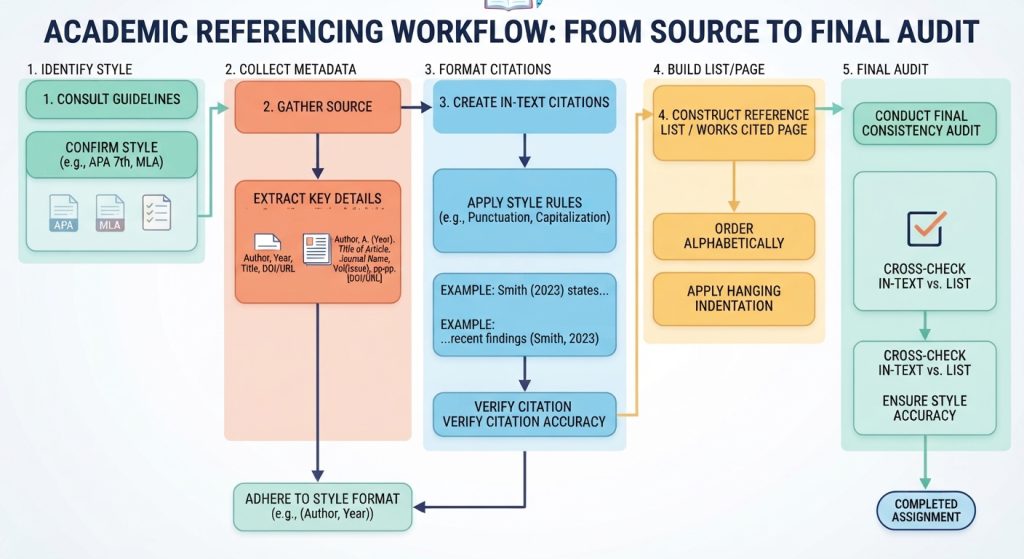
The safest way to manage Harvard or MLA citations is to standardize your workflow before writing the final draft.
Step 1: Identify the Required Style
Check the assignment instructions, journal author guidelines, dissertation handbook, or publisher requirements.
Step 2: Create a Master Source Library
Record:
- Author(s)
- Publication year
- Full title
- Journal or book title
- Volume and issue
- Page range
- Publisher
- DOI
- URL
- Access date where required
Step 3: Insert Citations While Writing
Do not postpone every citation until the end.
Late-stage citation insertion increases the risk of:
- Missing sources
- Incorrect page numbers
- Uncited quotations
- Duplicate references
- Inconsistent author names
Step 4: Generate the Preliminary Reference List
Use a reference manager if appropriate, but treat automatically generated citations as a starting point—not as a final authority.
Step 5: Perform a Manual Style Audit
Compare representative citations against the official style guide.
Check at least:
- One book
- One journal article
- One website
- One chapter
- One multiple-author source
- One source without a date
- One source with a DOI
Step 6: Run a Citation-to-Reference Cross-Check
Every cited source should have an appropriate corresponding entry.
Then check the reverse:
Is every source in the reference list actually cited in the manuscript?
For MLA, verify the same principle between in-text references and the Works Cited page.
Common Pitfalls When Comparing Harvard and MLA
Treating Harvard as a single universal style
Harvard has multiple institutional variants. Always check the required guide.
Adding publication years to MLA citations
MLA normally does not use the publication year as a standard component of the parenthetical citation.
Removing years from Harvard citations
Doing so can break the author-date structure.
Calling an MLA Works Cited page a Harvard bibliography
Use the terminology and structure required by the selected system.
Copying citation-generator output without checking it
Generators can apply incorrect assumptions about source type, capitalization, authorship, or style variant.
Formatting the entire paper according to citation rules alone
Referencing style and document-formatting requirements are related but distinct. A department may impose formatting rules beyond the citation system.
Failing to distinguish quotation from paraphrase
Both require appropriate attribution. A paraphrase still represents another author’s intellectual contribution and therefore needs citation.
Pre-Submission Referencing Checklist
Before submitting an academic paper, dissertation chapter, or manuscript, complete this audit:
- Confirm whether the required style is Harvard, MLA, or another system.
- Confirm the exact Harvard variant if Harvard is required.
- Use one referencing system consistently.
- Check every in-text citation against the official style guide.
- Verify author names and publication years.
- Add page numbers or other location markers where required.
- Confirm that every quotation is accurately cited.
- Confirm that paraphrased material is cited.
- Check the reference list or Works Cited terminology.
- Verify alphabetical ordering.
- Apply hanging indents where required.
- Check italics, quotation marks, capitalization, and punctuation.
- Verify DOI and URL information.
- Check whether access dates are required.
- Cross-check every in-text citation against the final source list.
- Remove uncited or accidentally duplicated entries.
- Apply the required paper-formatting specifications separately from citation rules.
- Complete a final proofreading and formatting audit.
Conclusion
So, is Harvard referencing the same as MLA? No.
Although both systems document sources through in-text citations and a final list of sources, their underlying conventions differ. Harvard uses an author-date framework, while MLA generally uses the author’s name and a relevant location marker. Harvard normally ends with a reference list, whereas MLA uses a Works Cited page. Their source-entry structures and document-formatting conventions also differ.
The most important rule is not to choose the style you find most familiar. Use the style required by your university, journal, publisher, or supervisor, and apply that system consistently from the first citation to the final reference entry.
If your paper contains a large reference library or complex source types, perform a dedicated citation and formatting audit before submission. Professional academic editing and manuscript formatting support from ManuscriptLab can help ensure that your document is consistent, publication-ready, and aligned with the required style.