Artificial intelligence has become an essential tool for researchers, students, and content creators. Tools powered by large language models can summarize papers, generate drafts, and assist with literature reviews. However, one major challenge researchers face today is the AI hallucination problem.
Understanding what does hallucination mean in AI, why it happens, and how to prevent AI hallucinations is critical if you rely on AI for research writing.
In this guide, we’ll explore what causes AI hallucinations, types of AI hallucinations, real examples, hallucination rates, and practical strategies to avoid them.
What Does Hallucination Mean in AI?
An AI hallucination occurs when an artificial intelligence system generates incorrect, fabricated, or misleading information that appears convincing.
Unlike simple errors, hallucinations often sound factual and authoritative. This makes them particularly dangerous in academic and research writing, where accuracy is essential.
For example, an AI model might:
- Invent a non-existent research paper
- Fabricate statistics or citations
- Misinterpret a scientific concept
- Provide confident but incorrect explanations
According to research published by organizations like Stanford and OpenAI, hallucinations occur because AI models predict words based on patterns rather than verifying facts. You can explore more about responsible AI research from the Stanford AI Lab
Example of AI Hallucination
To understand the issue clearly, let’s look at a common example of AI hallucination in research writing.
Example Scenario
A researcher asks AI:
“Provide sources for the impact of microplastics on human hormones.”
The AI might respond with something like:
“Smith & Johnson (2019). Microplastic Endocrine Disruption in Human Bloodstreams. Journal of Environmental Medicine.”
The problem?
- The paper does not exist
- The journal may be fabricated
- The citation looks completely legitimate
This is a classic AI hallucination effect, where the system produces plausible but false information.
What Causes AI Hallucinations?
Understanding what causes AI hallucinations helps researchers mitigate the risk.
Several factors contribute to hallucinations in AI models.
1. Training Data Limitations
AI models are trained on large datasets, but they do not have complete knowledge of every fact.
When information is missing, the model may generate a plausible guess instead.
2. Probability-Based Generation
AI does not “know” facts the way humans do. Instead, it predicts the most statistically likely next word.
This means accuracy is not guaranteed.
3. Ambiguous Prompts
Vague or unclear prompts can increase hallucination risk.
Example:
❌ Explain the latest research in quantum bioinformatics.
If such research barely exists, AI might invent information.
4. Lack of Real-Time Verification
Many models do not verify information against live databases unless integrated with search tools.
5. Overconfidence in Language Models
AI systems are designed to produce fluent and confident responses, even when uncertain.
This leads to the AI hallucination effect — where incorrect information appears highly credible.
AI Hallucination Rates
One of the most important questions researchers ask is: how common are AI hallucinations?
Recent studies provide useful insights.
Reported Hallucination Rates
| AI Model | Estimated Hallucination Rate |
| Early GPT models | 15–25% |
| Modern LLMs | 5–15% |
| Specialized research models | 3–10% |
According to research summarized by MIT Technology Review, hallucinations remain one of the biggest limitations of generative AI systems.
Even with improvements, AI hallucination rates remain significant, especially in complex academic topics.
Types of AI Hallucinations
Not all hallucinations are the same. Researchers typically identify several types of AI hallucinations.
1. Fabricated Citations
The AI invents papers, journals, or authors.
Example:
- Non-existent research articles
- Fake DOI numbers
2. Factual Hallucinations
Incorrect statements presented as facts.
Example:
Claiming a drug was approved in a year when it was not.
3. Logical Hallucinations
The information may contain real facts but incorrect reasoning.
4. Contextual Hallucinations
AI misunderstands the context and provides irrelevant or misleading answers.
5. Data Hallucinations
The AI generates statistics or numbers that were never published.
Recognizing these types of AI hallucinations is crucial when using AI tools for research writing.
The AI Hallucination Effect in Research Writing
The AI hallucination effect refers to the way AI-generated misinformation can propagate into academic or professional work.
This can create serious problems such as:
- Incorrect citations in academic papers
- Misleading data in reports
- Loss of credibility for researchers
- Ethical concerns in academic publishing
Several universities have already warned students about blindly trusting AI-generated references.
How to Prevent AI Hallucinations in Research Writing
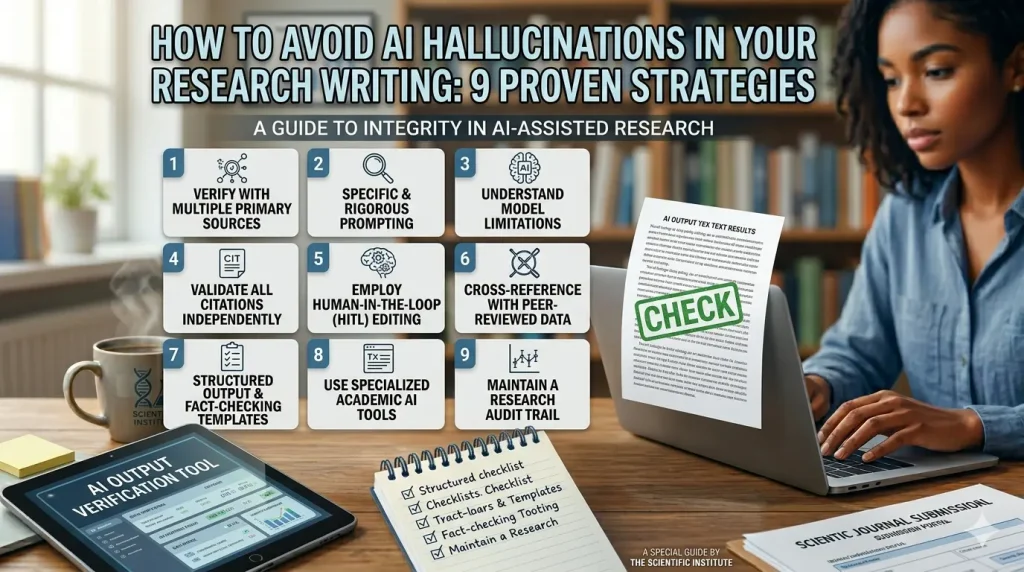
Now let’s focus on the most important part: how to prevent AI hallucinations.
1. Always Verify Sources
Never trust AI-generated citations without verification.
Check:
- Google Scholar
- PubMed
- Scopus
- Official journals
2. Use AI for Drafting, Not Final Facts
AI works best for:
- Brainstorming ideas
- Summarizing content
- Structuring articles
But final research validation must always be human-reviewed.
3. Ask AI for Source Links
Instead of asking for citations alone, request direct links to papers or databases.
Example prompt:
“Provide peer-reviewed sources with DOI links.”
4. Cross-Check With Academic Databases
Reliable sources include:
- Google Scholar
- PubMed
- ScienceDirect
5. Break Down Complex Prompts
Large or complicated questions increase hallucination risk.
Instead of:
❌ “Explain all research on climate AI models.”
Try:
✔ “List peer-reviewed studies on climate prediction using machine learning.”
6. Use Multiple AI Tools
Compare answers across tools to identify inconsistencies.
7. Ask AI to Indicate Uncertainty
Prompt example:
“If you are unsure about the answer, clearly say so.”
8. Request Evidence-Based Responses
Example prompt:
“Provide statements only if supported by peer-reviewed sources.”
9. Use AI With Retrieval Systems
Some AI tools combine language models with real-time search or academic databases, significantly reducing hallucinations.
Best Practices for Using AI in Academic Research
Researchers should adopt responsible AI practices.
Recommended Workflow
- Use AI to generate an outline
- Conduct manual literature searches
- Verify every citation
- Use reference managers like Zotero or Mendeley
- Run plagiarism and fact checks
This workflow ensures AI remains a helpful assistant rather than a source of misinformation.
FAQs About AI Hallucinations
1. What does hallucination mean in AI?
AI hallucination refers to when an AI system generates false or fabricated information while presenting it as accurate.
2. What causes AI hallucinations?
Common causes include training data limitations, probability-based text generation, vague prompts, and lack of real-time fact verification.
3. What are the most common types of AI hallucinations?
The most common types include fabricated citations, factual hallucinations, logical hallucinations, contextual hallucinations, and data hallucinations.
4. What are typical AI hallucination rates?
Hallucination rates vary by model but generally range between 5% and 25% depending on the task and complexity of the topic.
5. Can AI hallucinations be completely eliminated?
No. AI hallucinations cannot be fully eliminated yet, but they can be significantly reduced through verification, better prompts, and human oversight.
6. How can researchers detect AI hallucinations?
Researchers should verify:
- Citations and DOIs
- Published sources
- Statistical data
- Journal credibility
Cross-checking with Google Scholar or academic databases is the most reliable method.
Conclusion
AI has revolutionized research writing, but it comes with challenges. Understanding AI hallucination, what causes AI hallucinations, and how to prevent AI hallucinations is essential for maintaining academic integrity.
While AI hallucination rates are gradually decreasing, researchers must remain cautious. Always verify sources, cross-check data, and use AI as a support tool rather than a primary source of truth.
By applying the strategies discussed in this guide, you can safely harness the power of AI while avoiding the risks associated with the AI hallucination effect. If you need expert support in reviewing and verifying your AI-assisted research, ManuscriptLab can help you ensure your work meets the highest standards of academic integrity.