Writing a strong research paper, thesis, or article requires more than good ideas. It also demands clarity, accuracy, and polished language. This is where proofreading and editing play a crucial role.
However, many writers often confuse editing vs proofreading or assume they are the same process. In reality, proofreading vs editing involves two different stages of improving a document.
Understanding the difference between editing vs. proofreading can help researchers, students, and professionals prepare manuscripts that meet academic and publishing standards.
In this guide, we will explain what proofreading and editing involve, how they differ, and when each service should be used.
What Is Proofreading?
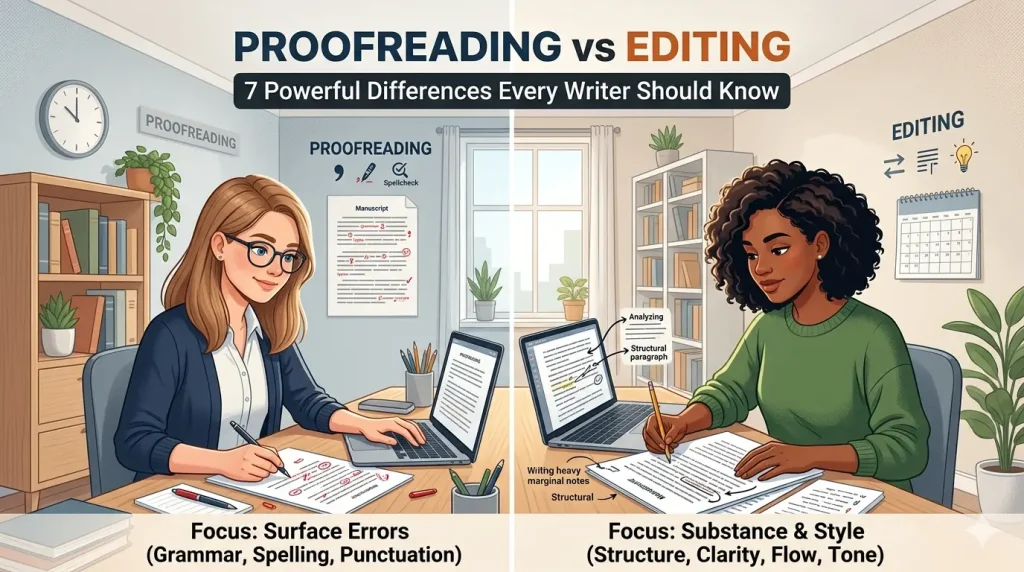
Proofreading is the final stage of the writing process. It focuses on correcting small errors that remain after editing has already been completed.
The main purpose of proofreading is to ensure that the document is free from surface-level mistakes before publication or submission.
Common Tasks in Proofreading
A proofreader typically checks for:
- Spelling errors
- Grammar mistakes
- Punctuation errors
- Typographical errors
- Formatting inconsistencies
- Minor sentence corrections
For example, a proofreader may correct:
- Incorrect punctuation
- Misspelled words
- Extra spaces or formatting problems
Proofreading does not significantly change the structure or meaning of the content. Instead, it ensures the final document is clean and professional.
You can learn more about professional proofreading practices from the Chartered Institute of Editing and Proofreading (CIEP), which provides detailed standards and guidelines followed by professional editors and proofreaders worldwide.
What Is Editing?
Editing occurs before proofreading and involves a deeper improvement of the text.
Editing focuses on improving the quality, clarity, organization, and structure of the writing.
Common Tasks in Editing
An editor may:
- Improve sentence clarity
- Reorganize paragraphs
- Strengthen arguments
- Remove repetition
- Improve academic tone
- Ensure logical flow of ideas
Unlike proofreading, editing may involve rewriting sentences or restructuring entire sections of a document.
For example, an editor might change:
❌ The study results was showing many important findings.
✔ The study results revealed several significant findings.
Editing improves readability and ensures that the writing communicates ideas effectively. The Purdue Online Writing Lab (OWL) offers excellent guidance on academic writing standards that editors typically apply when reviewing research manuscripts.
Editing vs Proofreading: Key Differences
Understanding editing vs proofreading is essential for choosing the right service.
Below is a comparison that explains the difference clearly.
| Feature | Editing | Proofreading |
| Stage of writing | Earlier stage | Final stage |
| Focus | Content clarity and structure | Grammar and spelling |
| Changes made | May rewrite sentences | Minor corrections only |
| Purpose | Improve overall quality | Remove surface errors |
| Scope | Large changes possible | Small fixes only |
In simple terms:
- Editing improves the writing
- Proofreading perfects the writing
Both are essential but serve different purposes.
Proofreading vs Editing in Academic Writing
In academic writing, understanding proofreading vs editing is particularly important.
Research papers must meet high standards for:
- Clarity
- Accuracy
- Logical arguments
- Proper grammar
- Consistent formatting
Editors often review:
- Research argument clarity
- Methodology explanation
- Literature review structure
Proofreaders then perform the final check to ensure the manuscript is ready for submission.
Many academic publishers recommend editing before submission. For example, Elsevier’s author guidelines highlight the importance of language editing before journal submission to improve the chances of acceptance. Similarly, Springer’s editorial policies recommend that non-native English speakers in particular seek professional editing support before submitting their manuscripts.
When Should You Use Editing?
Editing is most useful when:
- You have completed a first or second draft
- Your writing needs structural improvement
- Your arguments need clarification
- English is not your first language
- The manuscript needs academic tone improvement
Editing helps ensure that the content communicates ideas clearly and logically.
When Should You Use Proofreading?
Proofreading should only be used after editing is complete.
Proofreading is appropriate when:
- The document is finalized
- Only small errors remain
- Formatting needs checking
- The manuscript is ready for submission
For example, proofreading is ideal before submitting:
- Journal articles
- Theses or dissertations
- Research proposals
- Academic essays
Using proofreading alone without editing may leave deeper writing issues unresolved.
Editing vs. Proofreading for Journal Submission
For researchers preparing manuscripts for journal publication, understanding editing vs. proofreading is critical.
Journal reviewers expect manuscripts that are:
- Clearly written
- Logically structured
- Free from grammar mistakes
- Professionally formatted
A recommended workflow is:
- Write the first draft
- Perform editing to improve clarity
- Conduct proofreading before submission
Following this sequence significantly increases the chances of acceptance. The Committee on Publication Ethics (COPE) also emphasizes that well-prepared, clearly written manuscripts reflect higher standards of academic integrity and are more likely to pass editorial review.
Common Mistakes Writers Make
Many writers misunderstand proofreading vs editing, which leads to common mistakes.
Mistake 1: Using Proofreading Instead of Editing
If the writing structure is weak, proofreading alone cannot fix the problem.
Mistake 2: Skipping the Final Proofreading Stage
Even well-edited papers can contain small errors.
Mistake 3: Doing Both Too Quickly
Editing and proofreading require careful attention and should not be rushed.
Avoiding these mistakes can improve the overall quality of academic writing.
How ManuscriptLab Can Help Improve Your Writing
For researchers and authors preparing academic manuscripts, professional support can make a significant difference.
ManuscriptLab provides specialized services to help writers understand and benefit from both proofreading vs editing.
1. Professional Editing Services
ManuscriptLab editors improve:
- Clarity and structure
- Logical flow of ideas
- Academic tone
- Argument strength
This ensures that your manuscript communicates research findings effectively.
2. Expert Proofreading
Our proofreading services focus on eliminating:
- Grammar mistakes
- Spelling errors
- Punctuation issues
- Formatting inconsistencies
This final step ensures that your manuscript is ready for submission.
3. Journal Submission Preparation
ManuscriptLab helps authors prepare manuscripts that meet journal standards by:
- Checking formatting
- Ensuring proper citation style
- Reviewing language quality
4. Academic Writing Support
Our team has experience working with researchers across multiple disciplines, helping improve manuscripts for theses, dissertations, and journal articles.
By combining editing vs proofreading services, ManuscriptLab ensures that your work meets the highest academic standards.
Frequently Asked Questions (FAQs)
1. What is proofreading?
Proofreading is the final stage of document review that focuses on correcting spelling, grammar, punctuation, and formatting errors.
2. What is the difference between editing vs proofreading?
Editing vs proofreading differs in scope. Editing improves structure and clarity, while proofreading corrects minor surface errors in the final document.
3. Should editing or proofreading come first?
Editing should always come first. Proofreading should be done only after the editing process is complete.
4. Is proofreading vs editing important for academic papers?
Yes. Academic papers must be both well-structured and error-free. This requires both editing and proofreading.
5. Can proofreading fix writing problems?
No. Proofreading corrects minor errors but does not fix deeper issues like weak arguments or unclear structure.
6. Why do journals recommend editing before submission?
Editing improves clarity and readability, making it easier for reviewers to evaluate the research.
Conclusion
Understanding proofreading vs editing is essential for producing high-quality academic and professional writing. While editing vs proofreading may seem similar, they serve different purposes in the writing process.
Editing improves the structure, clarity, and quality of the content, while proofreading ensures the final document is free from grammar and formatting errors.
For authors preparing manuscripts for publication, using both services can significantly improve the chances of acceptance.
With professional support from ManuscriptLab, researchers can benefit from expert editing vs. proofreading services that enhance writing quality and prepare manuscripts for successful submission.