If you’ve ever submitted a manuscript to a literary agent, publisher or academic journal, chances are high that you’ve noticed the sometimes cryptic formatting guidelines (1″ margins, Times New Roman 12pt, double spaced lines). These are not arbitrary rules; they are the technical building blocks that differentiate between a professional quality manuscript and an amateur quality manuscript collecting dust in a drawer!
Many writers will treat technical specifications as an afterthought; simply a box to check off before pressing the submit button. However, the truth of the matter is that poor technical specifications will be the reason your manuscript gets rejected before an editor reads the first paragraph. The reason formatting matters is because it lets literary agents/publishers/peer reviewers know that you understand the industry and respect standards. You’re not cutting corners.
This guide will discuss all aspects of the technical specifications for a manuscript; we will break down margins, fonts, line spacing, and how the digital world creates new processes for formatting manuscripts. No matter if your manuscript is an academic paper, a novel or a journal article, by following the technical specifications outlined in this guide, you are more likely to have your work conform to the standard expected by professionals.
What Is a Manuscript and Why Technical Specs Matter
To begin, let’s go over what exactly is a manuscript? A manuscript is a fully complete and unpublished document of written work that can be submitted to publishers, agents, or academic institutions. The manuscript is a direct intersection between content (written work) and presentation (how the written work is presented). At times, you might have incredible prose; however, it will not represent as much if it is formatted incorrectly like a ransom note.
Technical specification standards refer to the formatting requirements that manuscripts must follow. These standards can be seen as the grammar of document design. Therefore, just as grammar is used to ensure a reader understands the words within the document, technical specifications are used to ensure that the document meets specific standards for its intended audience (readability), is designed in a professional manner, and is compliant with current industry standards.
Why are Technical Specs Important? Many publishers process hundreds of manuscripts each month. Technical Specification Standards have been created and followed by publishers because they:
1. Ensure continuity throughout all submitted manuscripts making them easier for the publisher to evaluate fairly.
2. Ensure that the documents remain readable throughout multiple rounds of editing and revisions.
3. Make it easy for publishers to print manuscripts professionally, without having to recreate the document formatting due to improper formatting.
4. Provide a professional level of respect for the professional reviewers evaluating the document.
Please note that according to the Modern Language Association, appropriate manuscript formatting indicates professionalism and a demonstration of respect for the submission process. Any agent or publisher is going to spend much time evaluating your submitted work; therefore; formatting your manuscript appropriately indicates that you have also spent the same amount of effort formulating your manuscript.
Understanding Margin Requirements for Professional Manuscripts
Margins are far more than empty white space. They’re functional design elements that publishing professionals depend on.
Standard Margin Specifications
The industry standard for most manuscripts is one inch on all sides—top, bottom, left, and right. This applies whether you’re submitting a 50,000-word novel or a 5,000-word short story. This specification emerged for practical reasons: one-inch margins accommodate editorial notes, revision marks, and binding requirements without compromising readability.
Some academic and technical submissions require different margins. The American Psychological Association (APA) guidelines recommend one-inch margins for all edges in academic papers. The Chicago Manual of Style permits slightly adjusted margins for printed books but maintains the one-inch standard for manuscripts in submission.
Why This Matters
A manuscript with inconsistent margins signals carelessness. Publishers see margin variations as a red flag—if you can’t maintain basic formatting, how carefully did you edit the content? One writer we worked with had half-inch margins on the left (to “make it look thicker”) and one-inch margins elsewhere. The agent rejected it without reading past page one.
Proper margins also ensure readability on printed pages. Agents often print submissions to read on their commute. Narrow margins create eye strain. Excessive margins waste paper and feel unprofessional. One inch represents the optimal balance for human reading.
Digital vs. Print Considerations
The one-inch margin standard translates directly from printed documents to digital PDFs. When you’re preparing a blank manuscript paper or digital document, maintain consistent margins across all pages. This consistency matters when manuscripts move through revision cycles, get printed for editorial meetings, or are reformatted for publication.
Font Selection: The Science Behind Typeface Standards
Font selection represents the visible face of your manuscript. The right font ensures readability; the wrong one creates friction between reader and text.
The Industry Standard: Times New Roman, 12pt
Times New Roman, 12-point, remains the default specification for manuscript submissions across publishing houses. This isn’t arbitrary. Times New Roman is:
- Serif-based, which aids readability in printed formats
- Universally available across all operating systems and software
- Professionally established since its creation for The Times newspaper
- Optimized for manuscript length, where 12pt provides adequate text density without sacrificing legibility
When you submit a manuscript in 12pt Times New Roman, you’re using the same font that professional editors, agents, and publishers expect. It’s the neutral, professional choice that doesn’t distract from content.
When to Use Alternative Fonts
Some genres and submission types allow font flexibility. Technical spec document templates for academic publishing might specify:
| Document Type | Preferred Font | Size | Rationale |
| Literary Fiction | Times New Roman | 12pt | Industry standard; maximizes readability |
| Academic Papers | Times New Roman or Cambria | 12pt | Established in style guides (APA, Chicago, MLA) |
| Screenplays | Courier New | 12pt | Monospace font; establishes one page = one minute of screen time |
| Children’s Books | Verdana or Georgia | 12-14pt | Sans-serif; better for younger readers |
| Science Fiction/Fantasy | Times New Roman | 12pt | Standard applies; font doesn’t indicate genre |
Critical guideline: Never use Comic Sans, Papyrus, or decorative fonts for manuscript submissions. These fonts undermine credibility instantly. They signal either inexperience or disrespect for submission standards.
Font Consistency and Readability
Maintain a single font throughout your manuscript. Switching between fonts—even subtly—creates visual inconsistency that distracts readers. Some writers use different fonts for narrative versus dialogue, thinking it improves clarity. It doesn’t. It creates amateur presentation.
The font choice influences how long readers can engage with your text before fatigue sets in. Serif fonts like Times New Roman are designed for extended reading. Sans-serif fonts work well for headers and digital interfaces but tire the eye during 300-page reading sessions.
Line Spacing Guidelines: Single, Double, and Everything Between
Line spacing represents the vertical distance between lines of text. This specification dramatically affects manuscript readability and industry acceptance.
Double Spacing: The Manuscript Standard
Manuscripts submitted for publication use double spacing (2.0 line spacing). This means the space between one line and the next equals the height of a single line of text.
Double spacing serves multiple purposes:
- Provides room for editorial marks and revision notes during the review process
- Reduces visual density, preventing eye strain during extended reading
- Facilitates printing without spacing compression issues
- Establishes industry recognition as the professional manuscript format
When an agent or publisher requests a manuscript, they expect double spacing. Single spacing signals either inexperience or intentional deviation from standards.
Special Cases and Exceptions
Academic papers sometimes use different spacing specifications:
- MLA format typically requires double spacing throughout
- APA style, manuscripts must be double-spaced but can differ from previously published articles’ standards.
- Chicago Manual of Style should also use double spacing.
There are some guidelines for writing academic papers that say you can use 1.5 space for your manuscript. These guidelines are an attempt to achieve a balance between providing a readable document and conserving paper, however, you should always check specific submission guidelines as they will take priority over general submission standards.
Use of spacing will affect pagination. A 50,000-word novel submitted as a double-spaced manuscript will generally be published as a 200-250 page novel; however, if the same manuscript is submitted as single-spaced, it would be approximately 130-150 pages. Publishers will typically use page count/manuscript length as a very early measure of how to plan production. Submitting single-spaced manuscripts may also give the publisher the impression that your manuscript has been purposely condensed.
Please do not use line spacing adjustments to reduce page count artificially; agents and publishers can quickly detect this and will see it as an attempt to conceal length, which generally will backfire against you.
Blank Manuscript Paper vs. Digital Formatting: Which Should You Use?
The rise of digital submissions has complicated manuscript preparation. Should you submit on traditional blank manuscript paper, or does digital formatting suffice?
Understanding Blank Manuscript Paper
Blank manuscript paper—also called manuscript sheets—is specialized paper designed with built-in margins and line formatting guides. Writers traditionally used these for handwritten or typewritten manuscripts. The guidelines printed on the paper ensure consistent margins and spacing without manual adjustment.
Modern blank manuscript paper typically includes:
- Pre-printed margins (usually one inch)
- Line guides for consistent spacing
- Header areas for page numbers and author information
- Standardized dimensions (typically 8.5″ × 11″)
When Blank Manuscript Paper Makes Sense
Digital submission has largely replaced physical manuscript paper. However, some situations still call for traditional manuscript sheets:
- Handwritten submissions to small literary magazines or contests
- Submissions to older institutions with explicit manuscript paper requirements
- Writers who work best with physical paper during composition
Most professional agents and publishers now request digital submission in .doc, .docx, or .pdf format. They’ve moved beyond physical manuscript paper because digital formats allow better tracking, easier sharing, and automated processing.
Digital Formatting Standards
When preparing digital manuscripts, replicate the technical specifications that physical manuscript paper enforced:
- Set one-inch margins on all sides
- Use appropriate font (typically Times New Roman, 12pt)
- Maintain double spacing throughout
- Include page numbers and header information
- Save in universally compatible format
Book manuscript format standards increasingly center on digital delivery. Even publishers who print final books request digital manuscripts for the submission and editing process.
Technical Spec Document Templates: Building Your Foundation
Starting from scratch feels overwhelming. That’s where technical spec document templates become essential tools.
A quality template should include:
Header Elements:
- Author name (top left corner)
- Word count (top right corner)
- Contact information (first page only)
Formatting Specifications:
- One-inch margins pre-set
- Font: Times New Roman, 12pt (formatted throughout)
- Line spacing: Double (2.0)
- Paragraph spacing: 0 points before/after (to maintain double spacing)
Page Layout:
- Page numbers in header or footer (starting after title page)
- Chapter breaks with proper spacing
- Consistent heading styles
Building vs. Downloading Templates
You can build your own template in Microsoft Word, Google Docs, or similar software:
- Open a blank document
- Set margins: File → Page Setup → Margins (1 inch all sides)
- Select all text (Ctrl+A)
- Change font to Times New Roman, 12pt
- Set line spacing to double (Format → Paragraph → Line spacing → Double)
- Save as template for future manuscripts
Alternatively, many organizations provide free templates:
- The Science Fiction and Fantasy Writers of America (SFWA) offers templates for genre writers
- Academic institutions provide templates aligned with their preferred style guide
- Professional manuscript services offer templates designed for submission
The advantage of templates is consistency. Once you’ve configured your technical specifications, every page maintains the same formatting without manual adjustment. This eliminates the formatting errors that plague manuscripts prepared without templates.
Common Technical Mistakes That Damage Your Manuscript’s Credibility
Even experienced writers slip up on technical specifications. These errors appear frequently in manuscript submissions:
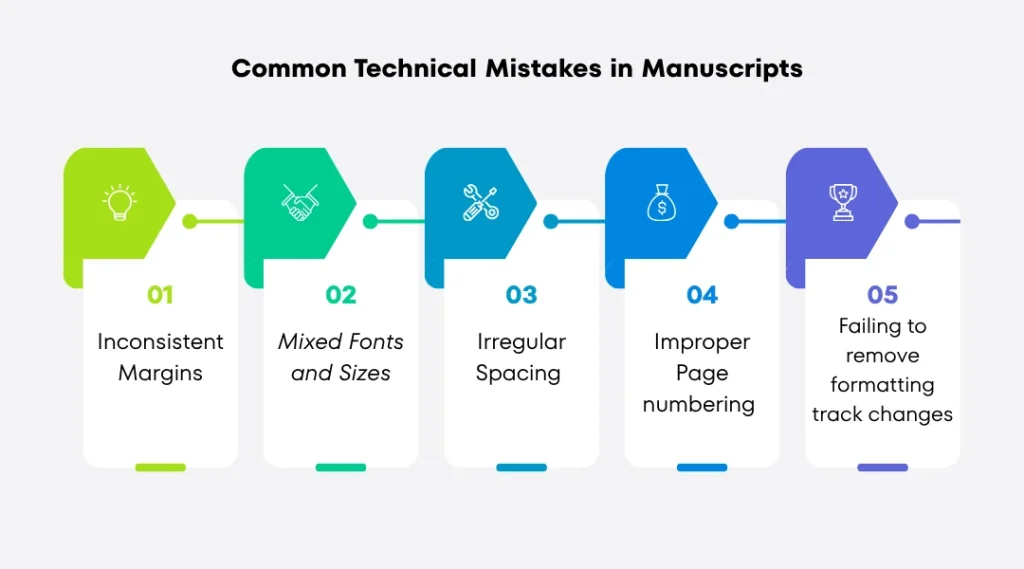
Mistake #1: Inconsistent Margins
Writers often create visual effects by adjusting margins per page. Wider margins on chapter openings. Narrower margins to fit text. This inconsistency immediately signals unprofessionalism.
Fix: Use consistent one-inch margins throughout. Allow your content—not formatting tricks—to create visual impact.
Mistake #2: Mixed Fonts and Sizes
The temptation to use different fonts for emphasis is strong. A slightly larger font for chapter titles. Italics for thoughts. Smaller font for footnotes.
Fix: Maintain Times New Roman, 12pt throughout the body. Use formatting (bold, italics) for emphasis, not font changes.
Mistake #3: Irregular Spacing
Extra spaces between paragraphs. Single-spaced sections for “emphasis.” Varying line spacing throughout.
Fix: Maintain double spacing consistently. Use paragraph formatting (spacing before/after) rather than manual line breaks.
Mistake #4: Improper Page Numbering
Page numbers appearing on the title page. Numbering starting from the introduction instead of chapter one. Inconsistent page number placement.
Fix: Begin numbering on the first content page (after title page). Place numbers consistently (top right or bottom center, typically).
Mistake #5: Failing to Remove Formatting Track Changes
Manuscripts revised in track changes mode often retain formatting marks and revision notation. Submitting with visible track changes makes the manuscript look unfinished.
Fix: Accept all changes before submission. Remove all tracked changes, comments, and formatting marks (Show/Hide formatting button in Word).
How Technical Specifications Affect the Publishing Process
Understanding why these specifications matter beyond surface-level compliance deepens your respect for the standards.
The Editorial Review Stage
When your manuscript arrives at a publisher or agent, it enters the editorial review process. First readers—often interns or junior editors—screen hundreds of submissions weekly. They’re looking for immediate red flags.
Poor technical specs create friction. Single spacing requires immediate reformatting. Inconsistent margins suggest carelessness. Non-standard fonts distract from content evaluation. A manuscript that violates basic technical specifications gets lower priority than one that follows standards.
Editors have explicitly stated: proper formatting increases your manuscript’s chances of thorough evaluation. It doesn’t guarantee acceptance, but improper formatting guarantees it won’t receive fair consideration.
The Production Phase
If your manuscript is accepted, technical specifications become critical for production. Publishers use standardized manuscripts to:
- Calculate final page count for printing quotes
- Plan typography and design for the published book
- Set production timelines based on formatting complexity
- Manage design costs by reducing reformatting work
A manuscript that arrives in proper technical specs moves through production faster and costs less to produce. Publishers pass these savings on—or allocate resources to marketing instead of corrections.
The Author’s Reputation
Submitting manuscripts with proper technical specifications establishes your professional reputation. Agents remember writers who respect standards. They’re more likely to represent you because you demonstrate professionalism and attention to detail.
Conversely, submitting non-standard manuscripts damages your reputation in a surprisingly small industry. Agents talk. If you’re known for sloppy submissions, future agents will expect less care in your writing.
Technical Specs Across Different Manuscript Types
Different manuscript categories sometimes require adjusted specifications. Understanding these variations prevents costly submission errors.
Novel Manuscripts
Standard specifications apply:
- One-inch margins
- Times New Roman, 12pt
- Double spacing throughout
- Standard page numbering
Word count varies by genre: literary fiction typically 70,000-100,000 words; fantasy/sci-fi often 90,000-120,000 words; romance 50,000-100,000 words.
Short Story Collections
Short stories follow standard specifications but include:
- Clear section breaks between stories
- Consistent title formatting
- Separate author bio if included
Academic Manuscripts
Academic papers follow disciplinary style guides:
- APA format for psychology, education, social sciences
- Chicago Manual of Style for history, humanities
- MLA for literature and languages
Each guide specifies margins, fonts, spacing, and citation format. Consult your institution’s preference or the journal’s submission guidelines.
Children’s Books
Children’s manuscripts are unique:
- Font size may be 14pt for easier reading
- Line spacing follows the same double-spacing standard
- Word count varies dramatically by age group (board books: 100-300 words; middle grade: 20,000-50,000 words; YA: 50,000-80,000 words)
Screenplays
Screenplays have distinct technical specifications:
- Courier New, 12pt (the monospace standard)
- 1-inch margins (left margin typically 1.5 inches)
- Single spacing with specific formatting for scenes, dialogue, action
- Specialized formatting software often required (Final Draft, Celtx)
Modern Digital Considerations for Technical Specs
Digital submission and reading have introduced new considerations for manuscript technical specifications.
PDF vs. Word Documents
Publishers request submission in specific formats:
- Word documents (.docx) allow editorial annotation and track changes during revision
- PDF files prevent accidental formatting changes but are harder to edit
- Google Docs enable collaborative feedback but sometimes introduce formatting issues
Check specific submission guidelines for format requirements. Never submit in proprietary formats (.pages, .odt) unless explicitly requested.
Screen Reading vs. Print Reading
Digital reading displays manuscripts differently than printed pages. Double spacing that looks appropriate in print can feel excessive on screen. However, maintain specifications regardless—agents often print digital submissions for reading. Your technical specs must work across all reading mediums.
Accessibility Considerations
Modern technical specifications increasingly consider accessibility:
- Sans-serif fonts are sometimes recommended for digital-first reading
- Higher contrast colors improve readability for vision-impaired readers
- Consistent formatting enables screen reader compatibility
However, manuscript submission standards haven’t fully shifted to these recommendations. Follow traditional specifications unless explicitly instructed otherwise.
Reference Table: Technical Specs at a Glance
Here’s a quick-reference table summarizing manuscript technical specifications:
| Specification | Standard Manuscript | Academic Paper | Screenplay |
| Margins | 1 inch all sides | 1 inch all sides | 1 inch (1.5″ left) |
| Font | Times New Roman | Times New Roman / Cambria | Courier New |
| Font Size | 12pt | 12pt | 12pt |
| Line Spacing | Double (2.0) | Double (2.0) | Single (1.0) |
| Page Numbers | Header or footer (after title page) | Header or footer | Right margin, upper area |
| Alignment | Left-aligned | Left-aligned | Specific formatting rules |
| Paragraph Spacing | 0 pt before/after | 0 pt before/after (double spacing) | Varies by element |
| Header/Footer | Author name, word count (first page only) | Depends on style guide | Scene headings, page numbers |
Best Practices for Manuscript Technical Preparation
Follow these practices to ensure your manuscript meets professional standards:
Before Submission:
- Format your entire manuscript using a template or careful manual formatting
- Review margins on every page (spot-check randomly)
- Verify font consistency throughout
- Check line spacing—it should appear uniform
- Test page numbering on multiple pages
- Remove all track changes and comments
- Save in requested format and test opening on another device
- Print a sample to verify specifications translate to paper
Final Quality Check:
- Read on both screen and paper
- Have someone else review formatting
- Check that headers and footers appear correctly
- Verify margins don’t cut off text
- Confirm page count matches word count expectations
Conclusion: Why Technical Specs Matter to Your Writing Career
Technical specifications might seem tedious compared to crafting compelling prose. But they represent your professional competence. They signal that you understand industry standards and respect the submission process.
When you prepare a manuscript with proper margins, fonts, spacing, and formatting, you’re communicating something beyond compliance: you’re showing that you take your work seriously. You’ve invested time in presentation because you believe your content deserves professional consideration.
Publishers and agents recognize this. They see writers who follow technical specifications as writers likely to be professional, responsive collaborators during the editing process. These small formatting choices accumulate into professional reputation.
Your manuscript’s technical specifications won’t get it published alone. But they’ll ensure it receives fair evaluation. And in an industry where thousands of manuscripts compete for attention, ensuring your work gets a fair read is the first critical step toward publication.
RECOMMENDED REFERENCE BOOKS
- The Chicago Manual of Style, 17th Edition — The authoritative resource for manuscript formatting, citation, and publishing standards. Essential for academic writers and anyone seeking comprehensive formatting guidance.
- The Elements of Style by William Strunk Jr. and E.B. White — While primarily focused on writing clarity, this classic includes foundational principles about manuscript presentation and professional writing standards.