Artificial intelligence has changed how researchers draft, edit, translate, and organize manuscripts. But it has also created a critical question for authors: How much AI content is allowed in research papers?
The short answer is more complicated than a percentage.
There is currently no universal AI-content limit for research papers. Most major publishers do not say that an author may use, for example, 10%, 20%, or 30% AI-generated text. Instead, policies increasingly focus on how AI was used, whether its use was disclosed, whether humans retain intellectual responsibility, and whether the AI-assisted material affects the originality and integrity of the research.
Turnitin adds another layer of confusion. Its AI-writing percentage is not the same as its similarity score, and a Turnitin AI percentage should not be interpreted as a universal “allowed” threshold. Turnitin itself states that AI detection can produce false positives and should not be used as the sole basis for determining misconduct.
For researchers, the safest approach is therefore not to ask, “What percentage of AI can I get away with?” Instead, ask: What AI use does my target journal permit, what must I disclose, and can I demonstrate that the scientific work and intellectual judgment remain mine?
This guide explains the AI content limit in research papers, current publisher policies, Turnitin AI detection thresholds, AI authorship rules, disclosure requirements, and the ethical use of ChatGPT and other generative AI tools in academic writing.
💡 Need expert help with your paper?
Transform your manuscript with ManuscriptLab’s professional editing & formatting services!
Is There a Universal AI Content Limit in Research Papers?
No. There is no internationally accepted percentage that defines an acceptable amount of AI-generated text in an academic paper.
A journal may permit AI-assisted copy editing while requiring disclosure of substantive AI-generated text. Another publisher may allow AI assistance for language improvement but prohibit AI from generating core research reasoning, conclusions, or other intellectual contributions.
This distinction is important because AI detection and publication ethics address different questions.
| Measure or policy | What it evaluates | Universal limit? | What authors should do |
| Turnitin AI percentage | Text Turnitin estimates may have been AI-generated | No | Treat as a signal, not a permission threshold |
| Turnitin similarity score | Text matching other indexed sources | No universal limit | Investigate every meaningful match |
| Publisher AI policy | Permitted uses of AI | No | Follow the target journal’s instructions |
| AI disclosure | Transparency about AI assistance | Usually policy-dependent | Disclose substantive use when required |
| AI authorship | Whether AI can be credited as an author | Generally no | Keep human authors accountable |
| Research integrity | Accuracy, originality, attribution, methodology | No | Verify all AI-assisted material |
Turnitin explicitly separates its AI-writing percentage from its similarity score. The two measurements are independent and answer different questions.
What is an acceptable AI percentage on Turnitin?
There is no publisher-wide acceptable AI percentage on Turnitin.
A score such as 5%, 12%, or 18% should not automatically be interpreted as “safe,” while a higher score does not by itself prove academic misconduct. Turnitin says its AI model may misidentify human-written, AI-generated, and AI-paraphrased text and should be considered alongside human judgment and applicable institutional policies.
The critical distinction is:
Turnitin’s threshold is a detection-system threshold not a publisher permission threshold.
Turnitin AI Detection Threshold vs. Similarity Score
Researchers frequently confuse these two percentages.
Turnitin AI writing percentage
Turnitin’s AI Writing Report estimates the proportion of qualifying prose that its model considers likely to have been generated by AI or generated by AI and subsequently modified using an AI paraphrasing or bypassing tool.
In its current guidance, Turnitin states that AI detection results below 20% have a higher incidence of false positives. For this reason, current reports do not surface an exact percentage for results between 1% and 19%; instead, the report uses an asterisk to indicate a weak or less reliable signal.
This is sometimes incorrectly described as a “20% allowed AI threshold.”
It is not.
Turnitin’s 20% handling is designed to reduce misinterpretation of weak detection signals. It does not mean that universities or publishers permit 20% AI-generated content.
Turnitin similarity percentage
The similarity score measures how much text in a submission matches material in Turnitin’s indexed sources. It does not determine whether those matches constitute plagiarism.
For example, legitimate quotations, references, standard terminology, and correctly cited material may generate similarity matches.
Turnitin currently describes similarity scores on a 0–100% scale, with color ranges reflecting the amount of matching text.
Therefore:
AI percentage ≠ similarity percentage.
A manuscript could have:
- Low similarity but substantial AI-generated text.
- High similarity because of legitimate quotations and standardized language.
- Low AI detection despite undisclosed AI assistance.
- Both high similarity and high AI detection.
Each situation requires separate evaluation.
Also read: 10 Key Reasons Manuscripts Get Rejected Before Peer Review
How Much AI Is Allowed in Academic Papers?
The answer depends on the function AI performs.
A useful risk hierarchy is:
1. Grammar and spelling correction
This is generally the lowest-risk category.
AI may correct:
- Grammar
- Spelling
- Punctuation
- Sentence clarity
- Readability
- Basic formatting
Several major publishers distinguish this type of AI-assisted copy editing from substantive content generation.
Elsevier states that basic spelling, grammar, and punctuation checks do not require an AI declaration, while substantive changes to sentence structure or organization should be disclosed.
Springer Nature similarly states that AI-assisted copy editing used solely to improve readability, grammar, spelling, punctuation, tone, and formatting does not need to be declared under its guidance, provided the final work remains the authors’ responsibility.
Industry-standard principle: Use AI to improve expression, not to replace scholarly reasoning.
2. Structural and language assistance
Using an LLM to suggest headings, reorganize prose, improve transitions, or clarify a paragraph presents greater policy sensitivity.
Nature Portfolio’s current AI framework categorizes language polishing, structure suggestions, translation, and formatting as potentially permitted assistive uses, while emphasizing human accountability and transparency.
The more extensively AI modifies the manuscript, the more important it becomes to review the target journal’s specific requirements.
3. Generating substantive manuscript text
This is a higher-risk category.
Examples include asking ChatGPT to:
- Draft the literature review.
- Generate the discussion section.
- Explain experimental findings.
- Construct scientific arguments.
- Produce interpretations.
- Generate methodological reasoning.
- Write conclusions.
These activities can introduce factual errors, unsupported claims, fabricated references, inappropriate interpretations, and intellectual-content concerns.
Nature Portfolio permits certain forms of generative AI assistance with manuscript writing but requires disclosure and emphasizes careful human verification.
Elsevier likewise permits AI support for drafting or improving clarity under its policy but requires authors to disclose relevant use and retain full responsibility for the final publication.
4. Generating research conclusions, data, or core reasoning
This is the highest-risk category.
Do not allow AI to independently determine:
- Research conclusions
- Statistical interpretations
- Clinical decisions
- Experimental findings
- Fabricated data
- Citations
- Scientific claims
- Core theoretical arguments
Nature’s current framework identifies uses that replace scholarly judgment, produce unverifiable outputs, or compromise integrity as not permitted.
What Do Major Publishers Say About AI in Research?
Publisher policies are converging around a common principle: AI may assist authors, but it cannot assume authorship or accountability.
IEEE AI content policy
IEEE requires disclosure when AI-generated content is used in an article, including AI-generated text, figures, images, and code. Authors should identify the AI system, identify the relevant sections, and briefly explain the level of AI involvement. IEEE distinguishes this from ordinary AI-assisted grammar and editing, for which disclosure is generally not required but is recommended.
Practical implication: If ChatGPT generated substantive text for an IEEE submission, do not simply run it through Turnitin and assume a low percentage makes it acceptable. Follow the disclosure requirement.
Elsevier AI tool policy for authors
Elsevier requires authors to disclose relevant AI use in a separate AI declaration accompanying manuscript submission. The declaration should identify:
- The AI tool.
- The purpose of its use.
- The extent of human oversight.
Elsevier also states that authors remain responsible for the accuracy and integrity of everything published. Basic spelling, grammar, and punctuation checks are treated differently and do not require the same declaration.
A typical declaration can state that an AI tool was used for a specified purpose, that the authors reviewed and edited its output, and that they take full responsibility for the published content.
Springer AI authorship guidelines
Springer Nature’s guidance states that AI tools cannot be listed as authors because they cannot take accountability for the work. Generative AI use should be transparently declared when applicable, while AI-assisted copy editing may be treated differently when it only improves human-generated text.
Nature journal policies on AI writing
Nature Portfolio’s current policy applies a risk-based framework. Low-risk assistive AI can support expression and efficiency. More consequential AI use requires greater caution, verification, and disclosure. AI cannot replace scholarly judgment, and human accountability remains non-transferable.
Nature Methods has also emphasized that generative AI may assist manuscript writing or editing but that authors must declare its use and carefully verify AI-generated text.
ICMJE guidance
The International Committee of Medical Journal Editors (ICMJE) updated its Recommendations in January 2026 with expanded guidance on AI in publishing. ICMJE recommends disclosure of AI-assisted technologies used in producing submitted work and states that AI tools such as ChatGPT should not be listed as authors. Human authors remain responsible for accuracy, integrity, originality, attribution, and plagiarism checking.
ICMJE also warns that nondisclosure may require corrective action and, in some circumstances, could be considered misconduct.
For biomedical authors, the current ICMJE recommendations should therefore be part of the pre-submission compliance audit.
COPE guidelines on AI authorship
The Committee on Publication Ethics (COPE) approaches AI through established principles of authorship, accountability, transparency, and research integrity. COPE’s authorship guidance emphasizes that authorship requires meaningful contribution and accountability; non-human systems cannot fulfill those responsibilities.
Use the COPE resources alongside the target journal’s own author instructions rather than treating a generic AI percentage as a compliance rule.
Is ChatGPT Allowed in Research Papers?
ChatGPT can be allowed, but its permitted use depends on the publisher, journal, institution, and purpose.
The important question is not simply whether ChatGPT was used. It is how ChatGPT was used.
Generally lower-risk examples include:
- Correcting grammar.
- Improving readability.
- Translating researcher-written text.
- Suggesting alternative wording.
- Organizing headings.
- Identifying unclear sentences.
Higher-risk examples include:
- Generating scientific claims.
- Writing an entire literature review without author verification.
- Producing interpretations of statistical results.
- Generating references without checking them.
- Creating research conclusions.
- Generating fabricated data.
- Concealing AI use to circumvent a journal policy.
Can you cite ChatGPT in academic research?
Do not treat ChatGPT as a conventional scholarly source simply because it produced an answer.
ICMJE explicitly states that AI-generated material should not be used as the primary source and emphasizes that authors must verify citations and ensure that cited references actually support the claims made.
If AI assistance itself needs to be documented, follow the journal’s prescribed method. This may involve an acknowledgment, declaration, Methods section, or another designated disclosure area.
Do not invent a citation merely to demonstrate that ChatGPT was used.
Can Turnitin Detect Rephrased ChatGPT Content?
Turnitin’s current AI-writing system can detect some text that appears to have been AI-generated and subsequently modified using AI paraphrasing or word-spinning tools.
Turnitin’s current English-language AI detection includes capabilities for identifying AI-paraphrased and AI-bypassed text.
However, detection is not equivalent to proof.
Turnitin explicitly warns that its AI-writing assessment may misidentify text and should not be used as the sole basis for adverse action.
Therefore, attempts to “humanize” or paraphrase ChatGPT output specifically to evade detection are poor publication practice. They can introduce new inaccuracies while failing to resolve the underlying ethical problem: the question is whether AI use complied with the applicable policy, not whether the detector can identify it.
Turnitin AI False Positive Rate: What Authors Need to Know
One of the most important facts about Turnitin’s current system is that low AI scores can be less reliable.
Turnitin states that its testing found a higher incidence of false positives in the 0–19% range. Current reports therefore avoid displaying exact AI percentages from 1% through 19% and instead use an asterisk to signal the reduced reliability of that range.
Turnitin has continued updating its AI detection model. Its February 2026 release notes describe an update intended to improve recall while maintaining a low false-positive rate.
This means authors should avoid statements such as:
“My Turnitin AI score is below 20%, so my paper is compliant.”
That conclusion does not follow from the technology.
A detector estimates a probability or signal. A publisher policy establishes what is permitted.
AI Percentage vs. Similarity Score: Why the Difference Matters
Consider these two scenarios.
Scenario A: A manuscript has a 4% AI-writing signal and a 35% similarity score.
The AI score does not automatically indicate misconduct. The 35% similarity score also does not automatically indicate plagiarism. The author needs to inspect the matched sources and determine whether the overlap consists of legitimate quotations, references, standard language, or unattributed copying.
Scenario B: A manuscript has a 42% AI-writing score and a 3% similarity score.
The low similarity score does not establish that the manuscript contains no problematic AI use. Conversely, the 42% AI score is not itself proof of misconduct. The author, institution, and journal must evaluate the result according to the applicable policy and available evidence.
The two systems measure different phenomena.
Similarity asks: “How much text matches indexed material?”
AI detection asks: “How much qualifying text does the model estimate may have been AI-generated or AI-modified?”
Neither percentage establishes whether the manuscript meets a publisher’s AI policy.
How to Use AI Ethically in Scientific Writing
Use AI as a controlled research-writing assistant rather than an invisible co-author.
Step 1: Check the target journal before using AI
Read the journal’s:
- Author guidelines.
- AI policy.
- Authorship policy.
- Research-integrity policy.
- Disclosure requirements.
- Data confidentiality rules.
Do this before uploading unpublished manuscript material to any external AI system.
Step 2: Define the permitted use
Create an internal AI-use record.
| AI activity | Typical risk | Disclosure status | Recommended practice |
| Spell-checking | Low | Often not required | Verify edits |
| Grammar improvement | Low | Often not required | Preserve author meaning |
| Translation | Low–moderate | Policy-dependent | Verify terminology |
| Structural suggestions | Moderate | Policy-dependent | Retain human control |
| Substantive drafting | Moderate–high | Often required | Verify every claim |
| Literature synthesis | High | Often required | Verify against primary sources |
| Statistical interpretation | High | Policy-dependent | Author performs final interpretation |
| Data generation | Very high | Generally inappropriate | Do not fabricate |
| Conclusions generated by AI | Very high | Policy-dependent | Human scholarly judgment required |
Step 3: Never upload confidential material without authorization
Unpublished manuscripts may contain:
- Proprietary datasets.
- Patient information.
- Trade secrets.
- Unpublished findings.
- Copyrighted material.
- Personal information.
ICMJE emphasizes manuscript confidentiality and warns against using AI systems where confidentiality cannot be assured.
Springer Nature similarly instructs authors to avoid placing personal, sensitive, confidential, or copyrighted material into AI prompts.
Step 4: Verify every AI-assisted claim
AI can generate authoritative-sounding but incorrect content.
Audit:
- References.
- DOI numbers.
- Statistical claims.
- Numerical values.
- Clinical recommendations.
- Methodological descriptions.
- Direct quotations.
- Historical claims.
- Definitions.
Never assume that a fluent paragraph is a scientifically accurate paragraph.
Step 5: Document your AI use
Keep a simple record containing:
- Tool name and version, where available.
- Date of use.
- Purpose.
- Section affected.
- Nature of AI assistance.
- Extent of human editing.
- Verification performed.
This documentation becomes valuable if an editor asks how AI was used.
Step 6: Add the required disclosure
Use the publisher’s preferred format.
For example, Elsevier provides a model declaration that identifies the tool and purpose and confirms that authors reviewed and edited the output and remain responsible for the content.
Do not copy a generic statement blindly. Adapt it to the journal’s exact requirements.
Also read: Manuscript Editing and Formatting Services
What Happens If You Do Not Disclose AI Content?
The consequences depend on the journal, institution, nature of the AI use, and whether nondisclosure affected the integrity of the submission.
Possible consequences include:
- Editorial queries.
- Requests for clarification.
- Manuscript revision.
- Rejection before peer review.
- Research-integrity investigation.
- Correction after publication.
- Retraction in serious cases.
- Institutional academic-misconduct proceedings.
ICMJE specifically states that nondisclosure of AI use may require corrective action and can, in some circumstances, be construed as misconduct.
The risk becomes substantially greater when AI use is combined with:
- Fabricated references.
- Plagiarized material.
- Fabricated data.
- Misrepresented analysis.
- False authorship.
- Concealed substantive AI generation.
Transparency does not automatically make every use of AI acceptable. But undisclosed use removes an important layer of accountability.
How to Cite or Acknowledge AI in Academic Research
There is no single citation format that applies to every journal.
First determine whether the journal wants AI use reported in:
- Acknowledgments.
- Methods.
- An AI declaration.
- Cover letter.
- Submission form.
- Another dedicated section.
For example, ICMJE recommends disclosure in the cover letter and manuscript where appropriate; AI used for writing assistance may be described in the acknowledgment section, while AI used for data collection, analysis, or figure generation should be described in Methods where applicable.
IEEE asks authors to identify AI-generated content and explain the level of use in the acknowledgments section.
Elsevier uses a dedicated AI declaration approach for relevant manuscript-preparation use.
Springer Nature’s requirements depend on the type of AI use and publication context.
Never assume that one AI acknowledgment works for every publisher.
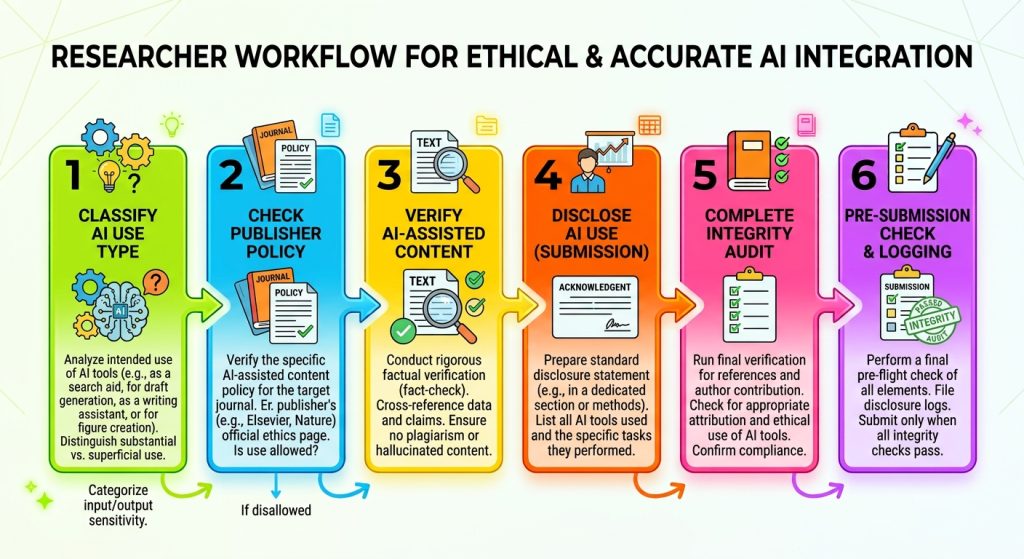
A Practical AI Compliance Workflow for Researchers
Use this workflow before submitting any AI-assisted manuscript:
AI used → classify the use → check journal policy → verify output → document use → disclose where required → audit references → review manuscript integrity → submit
Final Pre-Submission Checklist
Before submitting an AI-assisted research paper, confirm:
- I have read the target journal’s current AI policy.
- I know which AI activities are permitted.
- I have not treated a Turnitin AI percentage as a universal permission threshold.
- I understand that AI detection and similarity scores are separate metrics.
- I have investigated significant similarity matches.
- I have verified every AI-assisted factual claim.
- I have checked all AI-assisted references against authoritative sources.
- I have not used AI to fabricate data, citations, results, or conclusions.
- I have maintained human responsibility for scientific reasoning.
- I have not listed ChatGPT or another AI tool as an author.
- I have not uploaded confidential or sensitive manuscript material to an unsecured AI system.
- I have documented substantive AI use.
- I have included the required AI disclosure.
- My disclosure matches the journal’s requested format.
- All authors understand and approve the final manuscript.
- The final manuscript accurately represents the authors’ intellectual contribution.
Conclusion
So, how much AI is allowed in research papers in 2026?
There is no universal percentage.
The more useful standard is policy compliance, transparency, human accountability, and research integrity. A 5% Turnitin AI signal is not automatically acceptable, and a 25% signal is not automatically misconduct. Turnitin’s AI percentage is a detection signal, while the publisher’s policy determines what forms of AI assistance are permitted.
Major publishers and organizations including IEEE, Elsevier, Springer Nature, Nature Portfolio, and ICMJE are increasingly aligned around one principle: AI can assist researchers, but it cannot replace human scholarly judgment or accountability.
For researchers, the strongest strategy is therefore straightforward: use AI transparently, verify its output rigorously, protect confidential research, disclose substantive assistance, and retain complete responsibility for the scientific record.
Before submission, treat AI compliance as seriously as you treat reference formatting, reporting guidelines, plagiarism screening, and journal-specific manuscript requirements. A professionally edited manuscript should not merely produce a favorable detection score it should demonstrate clear authorship, sound evidence, accurate citations, and defensible scientific reasoning.
For expert support with manuscript language, structure, formatting, and publication readiness, explore ManuscriptLab’s professional editing and formatting services.