Submitting a manuscript to an academic journal is only the first step in the publication process. Before reviewers assess your methodology, results, or scientific contribution, an editor may conduct an initial screening and this is where many manuscripts fail.
A desk rejection, also called a rejection before peer review, occurs when a journal declines a manuscript without sending it to external peer reviewers. Editors may make this decision because the paper falls outside the journal’s scope, does not meet submission requirements, lacks sufficient novelty or priority, raises ethical concerns, or is not presented in a form suitable for further evaluation.
Desk rejection is not necessarily a judgment that the research is poor. A technically sound study can still be rejected if it targets the wrong journal, violates submission requirements, has serious presentation problems, or fails to communicate its contribution clearly.
The good news is that many desk rejection reasons are identifiable before submission.
This guide examines 10 common causes of manuscript rejection before peer review, explains why editors flag them, identifies the relevant publishing standards, and provides a practical workflow for reducing avoidable rejection risks.
💡 Need expert help with your paper?
Transform your manuscript with ManuscriptLab’s professional editing & formatting services!
What Is a Desk Rejection?
A desk rejection occurs when a journal editor rejects a manuscript during editorial screening rather than sending it through external peer review.
The initial screening process can assess several dimensions simultaneously:
- Scope and subject fit
- Scientific or scholarly contribution
- Novelty and significance
- Methodological appropriateness
- Reporting completeness
- Ethical compliance
- Manuscript presentation
- Formatting and submission requirements
- Language and readability
- Article type
- Authorship and disclosure information
- Potential plagiarism or duplicate publication
- Suitability for the journal’s readership
Editorial screening varies between journals. There is no universal checklist that determines whether a manuscript reaches peer review.
However, authors can substantially reduce preventable problems by treating submission as a compliance workflow, not simply as an upload task.
10 Key Reasons Manuscripts Are Rejected Before Peer Review
1. The Manuscript Is Outside the Journal’s Scope
One of the most fundamental research paper rejection causes is scope mismatch.
A manuscript can be methodologically rigorous and still be unsuitable for a particular journal.
Editors evaluate whether the research fits the journal’s:
- Subject area
- Aims and scope
- Article types
- Intended readership
- Geographic or clinical focus
- Methodological interests
- Thematic priorities
Why editors reject scope-mismatched papers
External peer review consumes editorial and reviewer resources. If an article clearly does not belong in the journal, sending it to reviewers may delay the process without benefiting the author or journal.
Industry-standard check
Read the journal’s Aims & Scope and examine recently published articles. Do not rely solely on the journal title.
Build a short comparison between your manuscript and at least 5–10 recent papers from the target journal.
Ask:
Does this journal regularly publish research asking questions similar to mine?
Common pitfall
Authors sometimes select journals based primarily on Impact Factor or prestige.
That reverses the submission workflow.
Start with scope and readership. Then evaluate journal metrics.
2. The Manuscript Does Not Demonstrate Sufficient Novelty
Another major reason for academic journal rejection is insufficient perceived novelty, significance, or priority.
Novelty does not necessarily mean that nobody has ever studied the subject.
A contribution may be novel because it:
- Introduces a new method.
- Provides a new dataset.
- Tests an established hypothesis in a new population.
- Resolves an unresolved contradiction.
- Provides stronger evidence for an existing finding.
- Advances theory.
- Offers a clinically relevant finding.
- Applies a validated method in a meaningful new context.
Why novelty matters at editorial screening
Editors need to determine whether the manuscript is potentially valuable to their readership.
If the introduction describes a broad topic but does not clearly identify the knowledge gap, the manuscript can appear incremental even when the underlying research is valuable.
Industry-standard metric
Use a gap-to-contribution statement.
Your introduction should allow an editor to identify:
What is known → What remains unknown → What this study does → Why the result matters.
Common pitfall
Do not confuse novelty with exaggerated claims.
Statements such as “This is the first study ever…” require comprehensive evidence.
A defensible contribution statement is stronger than an inflated novelty claim.
3. The Manuscript Violates Journal Submission Guidelines
Ignoring journal submission guidelines is one of the most avoidable causes of rejection.
Each journal can specify requirements for:
- Word count
- Abstract structure
- Keywords
- References
- Figures
- Tables
- File formats
- Supplementary information
- Author information
- Reporting checklists
- Ethical declarations
- Data availability
- Funding statements
- Conflict-of-interest disclosures
Some journals also specify formatting requirements such as line spacing, margins, figure dimensions, reference style, or manuscript organization.
Why this matters
Editorial screening is partly a compliance assessment.
If a journal requests a structured abstract with specific headings and the submitted manuscript provides an incompatible format, the editorial office may return or reject the submission.
Industry-standard metric
Create a journal compliance matrix before submission.
| Requirement | Journal specification | Manuscript status |
| Article type | Original Research | ✓ |
| Word count | Journal-specific | ✓ |
| Abstract | Structured | ✓ |
| Keywords | Journal-specific | ✓ |
| References | Required style | ✓ |
| Figures | Required format/resolution | ✓ |
| Reporting checklist | Study-specific | ✓ |
| Ethics statement | Required | ✓ |
| Data availability | Required | ✓ |
| Conflict of interest | Required | ✓ |
| Funding statement | Required | ✓ |
Common pitfall
Never assume that formatting for one journal automatically transfers to another.
Audit the manuscript against the target journal immediately before submission.
Also read: How to Benchmark Your Citation Rate Against Industry Competitors
4. Poor Manuscript Formatting Creates an Unnecessary Barrier
Poor manuscript formatting is rarely the most important scientific problem, but it can signal that the manuscript has not been prepared according to the journal’s requirements.
Formatting problems can include:
- Incorrect reference style
- Inconsistent headings
- Missing line numbering
- Incorrect figure placement
- Unclear tables
- Inconsistent abbreviations
- Missing page or section elements
- Incorrect file types
- Inconsistent fonts
- Improper supplementary files
Why formatting matters
Editorial staff need to process submissions efficiently. Consistent formatting makes the manuscript easier to navigate and reduces administrative friction.
Industry-standard specification
There is no universal academic font standard. If the journal does not specify typography, a conventional manuscript format such as 12-point readable serif text with double spacing may be acceptable during submission but the journal’s own instructions always take precedence.
Do not impose a generic “0.5-inch margin, Times New Roman, double-spaced” template when the target journal specifies something else.
Common pitfall
Authors sometimes spend hours redesigning the manuscript aesthetically while overlooking substantive requirements such as a missing ethics statement or reporting checklist.
Prioritize compliance over decoration.
5. The Cover Letter Is Weak, Generic, or Missing
A strong cover letter for journal submission helps an editor quickly understand why the manuscript belongs in the journal.
It should normally identify:
- Manuscript title
- Article type
- Core research question
- Principal contribution
- Journal fit
- Originality status
- Relevant ethical declarations
- Conflicts of interest
- Author approval where required
- Suggested information requested by the journal
Why the cover letter matters
The editor may review the cover letter alongside the title, abstract, manuscript, and submission metadata.
A generic letter that simply states “Please consider our manuscript for publication” misses an opportunity to establish relevance.
A practical structure
Use four short components:
1. Research problem: What question does the study address?
2. Principal finding: What did the research establish?
3. Contribution: What does the paper add to existing literature?
4. Journal fit: Why is this contribution relevant to the journal’s readership?
Common pitfall
Do not oversell.
Avoid claims such as “This groundbreaking study will revolutionize the field” unless such language is explicitly supported by evidence and appropriate to the journal.
Precision creates credibility.
6. Ethical or Publication-Integrity Problems Are Detected
Editors have responsibilities beyond evaluating scientific quality.
Potential concerns include:
- Plagiarism
- Duplicate publication
- Image manipulation
- Undisclosed conflicts of interest
- Questionable authorship
- Missing ethical approval
- Inadequate informed consent
- Unclear clinical trial registration
- Fabricated or manipulated data
- Inappropriate citation practices
Plagiarism in academic papers is particularly serious because it can involve presenting another person’s words, ideas, data, or work without appropriate attribution.
For biomedical submissions, authors should follow applicable ICMJE recommendations and the journal’s own research-ethics requirements.
ICMJE provides detailed guidance on authorship, conflicts of interest, research reporting, references, and manuscript preparation. (ICMJE Recommendations)
COPE also provides resources addressing publication ethics and editorial decision-making. (COPE)
Why this leads to desk rejection
Ethical deficiencies may prevent an editor from treating the manuscript as suitable for peer review.
For example, a clinical study may require evidence of ethics approval or appropriate registration information. The exact requirements depend on the study and journal.
Common pitfall
Do not add an ethics statement at the last minute.
Establish:
- Ethics approval
- Consent requirements
- Trial registration
- Data availability
- Funding
- Conflicts of interest
- Author contributions
before submission.
7. The Reporting Is Incomplete for the Study Design
A manuscript can contain good research but provide insufficient information for readers and reviewers to evaluate it.
Reporting standards exist to address this problem.
Depending on study design, relevant frameworks may include:
- CONSORT for randomized trials
- STROBE for observational studies
- PRISMA for systematic reviews and meta-analyses
- CARE for case reports
- STARD for diagnostic accuracy studies
- ARRIVE for animal research
The appropriate guideline depends on the research design.
Why incomplete reporting matters
Editors need confidence that the manuscript contains enough information for meaningful peer review.
For example, a clinical research manuscript may require information about participant selection, outcomes, interventions, statistical methods, and limitations.
Industry-standard metric
Use the appropriate reporting checklist as an audit instrument, not merely as a submission attachment.
The EQUATOR Network provides a searchable library of health-research reporting guidelines. (EQUATOR Network)
Common pitfall
Do not select a reporting guideline because its acronym appears frequently in your field.
Identify the study design first. Then select the applicable guideline.
8. The Abstract Does Not Clearly Communicate the Study
Editors often encounter a manuscript first through its:
- Title
- Abstract
- Keywords
- Cover letter
If these elements fail to communicate the research contribution, the manuscript can be difficult to evaluate quickly.
What a strong abstract should accomplish
The abstract should make the following information identifiable:
- Research problem
- Objective
- Methods
- Principal results
- Conclusion or implications
The exact structure depends on the journal.
Common problem
Authors sometimes write the abstract as a miniature introduction.
For example:
“Diabetes is a major global health problem. Many studies have investigated…”
This provides background but may fail to communicate what the current study actually found.
Better principle
Prioritize the study over the topic.
The abstract should tell the editor what you did, what you found, and why the finding matters.
Also read: Manuscript Editing Services strengthen clarity, consistency, academic language, and journal-readiness before submission.
9. Language and Academic Writing Problems Obscure the Research
Editors do not expect every manuscript to read like a literary work. They do expect scientific arguments to be comprehensible.
Problems that can interfere with editorial assessment include:
- Ambiguous terminology
- Excessive sentence length
- Inconsistent tense
- Unclear methodological descriptions
- Poor paragraph structure
- Undefined abbreviations
- Redundant discussion
- Unsupported claims
- Inconsistent terminology
Why language affects editorial screening
Scientific writing is a communication system.
If an editor cannot quickly determine the study objective, methods, contribution, and principal findings, the manuscript becomes harder to assess.
This is especially important for interdisciplinary research, where terminology may not be universally understood.
Industry-standard principle
Apply the one-paragraph-one-function approach:
- Introduction paragraphs establish the research problem.
- Methods paragraphs explain procedures.
- Results paragraphs report findings.
- Discussion paragraphs interpret findings.
Do not mix interpretation into the Results section unless the journal specifically permits it.
Common pitfall
Language editing should not alter scientific meaning.
A professional editor should improve expression while preserving:
- Statistical meaning
- Technical terminology
- Authorial claims
- Study limitations
- Numerical values
- References
10. The Manuscript Does Not Match the Journal’s Editorial Priorities
Scope and editorial priority are related but not identical.
A paper may fall technically within a journal’s subject area while still not being competitive for that journal’s current editorial program.
Editors may consider factors such as:
- Relevance to readership
- Novelty
- Scientific significance
- Methodological rigor
- Article type
- Current editorial priorities
- Balance of topics
- Space or publication constraints
- Whether similar work has recently appeared
Why this creates desk rejection
Journals receive more submissions than they can publish.
Consequently, editorial screening may involve a prioritization decision before peer review.
How to reduce the risk
Examine the journal’s recent literature.
Review approximately 10–20 recently published papers and categorize them by:
- Topic
- Study type
- Methodology
- Population
- Article type
- Research question
Then identify where your manuscript fits.
Common pitfall
Do not force your paper into a journal because its Impact Factor appears attractive.
A journal’s readership and editorial scope should be central to the selection process.
Desk Rejection: What Authors Can Control
Not every rejection is preventable.
You cannot control:
- The number of competing submissions.
- Editorial workload.
- Changes in journal priorities.
- Limited publication capacity.
- Whether an editor considers a particular finding sufficiently important.
- The subjective element of editorial judgment.
You can control your submission readiness.
| Risk area | Author action | Evidence to check |
| Scope mismatch | Compare aims and scope | Recent journal articles |
| Weak novelty | Define the knowledge gap | Introduction |
| Guideline noncompliance | Build a compliance matrix | Author instructions |
| Formatting | Apply journal-specific specifications | Submission checklist |
| Weak cover letter | Explain contribution and journal fit | Cover letter |
| Ethics concerns | Complete declarations | Ethics/funding/COI documents |
| Reporting gaps | Apply study-design checklist | CONSORT/STROBE/PRISMA etc. |
| Weak abstract | Present objective, methods, results | Abstract |
| Language problems | Conduct academic editing | Full manuscript |
| Editorial priority | Analyze recent publications | Journal archive |
This converts how to avoid desk rejection from a vague objective into an auditable workflow.
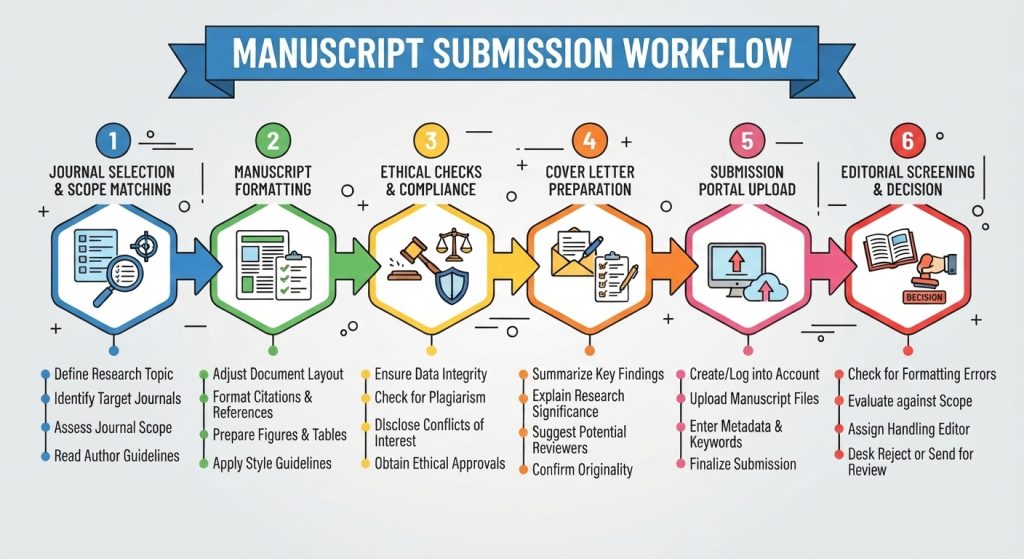
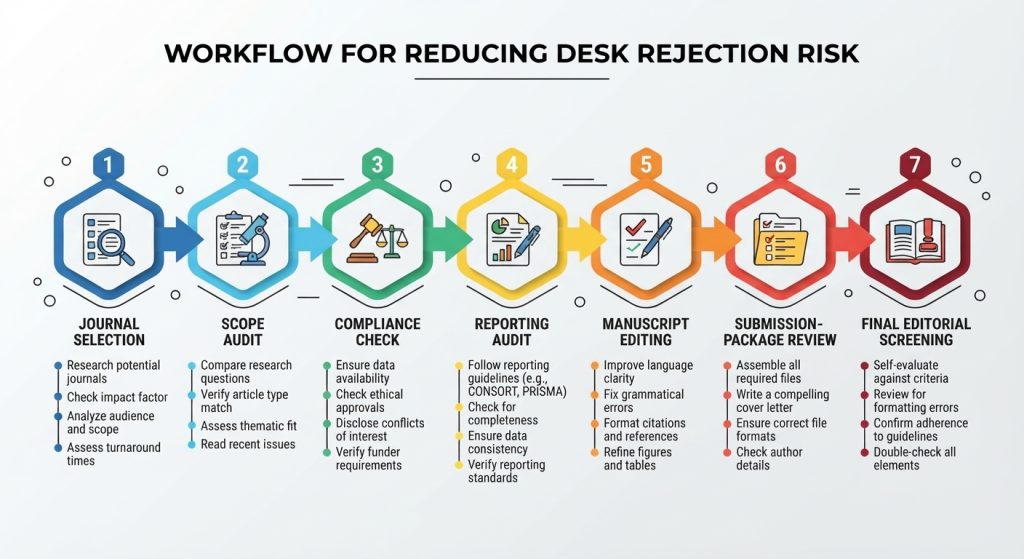
A 7-Step Workflow to Reduce Manuscript Rejection Risk
Step 1: Select the journal after defining the manuscript
Identify your research question, contribution, audience, and article type before selecting the target journal.
Step 2: Audit the journal’s scope
Read the aims and scope. Examine recent papers.
Step 3: Build a submission compliance matrix
Record every formatting, ethical, reporting, and administrative requirement.
Step 4: Audit scientific reporting
Apply the relevant reporting guideline and verify that all required methodological information is present.
Step 5: Edit the manuscript
Check scientific clarity, academic English, terminology, references, tables, figures, and internal consistency.
Step 6: Prepare the submission package
Check the manuscript, cover letter, supplementary files, declarations, reporting checklist, figures, graphical abstract, and other required documents.
Step 7: Conduct a final editorial simulation
Read the paper as an editor would.
Ask:
Is the study relevant to this journal, sufficiently clear, appropriately reported, ethically documented, and compliant with the submission requirements?
If the answer is uncertain, resolve the uncertainty before clicking Submit.
How ManuscriptLab Can Help Before Submission
Avoiding manuscript rejection requires more than correcting grammar.
A publication-ready manuscript needs alignment across several layers:
Scientific content → Reporting → Structure → Language → References → Formatting → Journal compliance → Submission documentation
A professional pre-submission review can identify inconsistencies that authors may overlook after months or years of working on the same manuscript.
Explore ManuscriptLab’s professional editing and formatting services to strengthen the manuscript before editorial screening.
For authors who need targeted support, ManuscriptLab’s manuscript editing services can be incorporated into the final pre-submission workflow rather than treated as a last-minute language check.
Pre-Submission Checklist: Reduce the Risk of Desk Rejection
Before submitting, verify the following:
Journal fit
- The manuscript matches the journal’s aims and scope.
- The article type is accepted.
- Recent publications demonstrate relevant subject coverage.
- The intended readership aligns with the study.
Scientific content
- The research question is clearly defined.
- The knowledge gap is explicit.
- The contribution is supported by evidence.
- Limitations are accurately reported.
- Conclusions do not exceed the data.
Reporting and ethics
- The appropriate reporting guideline has been applied.
- Ethics approval information is included where applicable.
- Consent requirements have been addressed.
- Trial registration is reported where applicable.
- Funding is disclosed.
- Conflicts of interest are disclosed.
- Author contributions meet journal requirements.
Formatting
- Word count complies with journal requirements.
- Abstract format is correct.
- Keywords meet journal requirements.
- Figures meet technical specifications.
- Tables are correctly formatted.
- References follow the required style.
- Supplementary files are correctly prepared.
Submission package
- Cover letter is customized.
- Manuscript title is consistent across files.
- Author information is correct.
- Affiliations are accurate.
- ORCID information is correct where required.
- All declarations are complete.
- Required checklists are uploaded.
Conclusion
A manuscript can be rejected before peer review for reasons that have little to do with whether the underlying research is valuable. Scope mismatch, inadequate novelty communication, submission-guideline violations, formatting problems, weak abstracts, incomplete reporting, ethical documentation gaps, language issues, and poor journal alignment can all create avoidable editorial barriers.
The solution is systematic preparation.
Audit the journal. Audit the manuscript. Audit the reporting. Audit the submission package.
Treat the manuscript submission workflow as an editorial compliance process rather than a final administrative step. By identifying preventable problems before submission, researchers can present their work more clearly and give editors the information needed to assess its suitability for peer review.
For a structured pre-submission assessment, explore ManuscriptLab’s professional manuscript editing and formatting services.