Researchers often encounter the terms Web of Science (WoS), Web of Science Core Collection, SCI, and SCIE when evaluating journals for publication. Because these terms are frequently used interchangeably, authors may assume that a journal described as “SCI indexed” is automatically equivalent to every journal in Web of Science.
That assumption is incomplete.
The Web of Science Core Collection is a curated collection of scholarly indexes, while Science Citation Index Expanded (SCIE) is one of the journal indexes within that collection. Clarivate identifies SCIE, Social Sciences Citation Index (SSCI), Arts & Humanities Citation Index (AHCI), and Emerging Sources Citation Index (ESCI) as journal indexes within the Web of Science Core Collection.
Understanding this hierarchy matters when you are choosing a journal, verifying an institution’s indexing requirements, interpreting citation metrics, or preparing a manuscript for an international publication.
This guide explains whether SCI and Web of Science are the same, how SCIE fits into Web of Science Core Collection, how Clarivate classifies journals, and how to verify a journal’s current indexing status before submission.
💡 Need expert help with your paper?
Transform your manuscript with ManuscriptLab’s professional editing & formatting services!
1. Web of Science vs SCI: What Is the Difference?
The simplest way to understand the relationship is to think of Web of Science as the broader platform/database environment and the Core Collection as one of its flagship curated databases.
Within the Core Collection are several journal indexes, including SCIE, SSCI, AHCI, and ESCI.
Is SCI and Web of Science the same?
No.
They are related, but they are not equivalent terms.
The terminology becomes particularly confusing because the Science Citation Index (SCI) has historical significance. Clarivate notes that the Web of Science began with the Science Citation Index, released in 1964. The current journal index used for scientific literature within the Core Collection is called the Science Citation Index Expanded (SCIE).
Therefore, when a university, researcher, or publisher says that a journal is “SCI indexed,” you should verify exactly what they mean.
Ask:
- Does the journal appear in SCIE?
- Is it listed in the Web of Science Core Collection?
- Is the claim based on a current Clarivate listing?
- Is the journal’s coverage active?
- Is the journal listed under the correct title and ISSN?
Do not rely solely on a journal’s website claiming “SCI indexed.”
2. What Is the Web of Science Core Collection?
The Web of Science Core Collection is Clarivate’s curated citation database for scholarly literature.
It covers journal, conference, and book content across numerous research areas and connects publications through cited-reference relationships. Clarivate currently describes the Core Collection as its flagship Web of Science database and reports more than 97 million records connected through more than 2.4 billion cited references.
The important point is that Core Collection is not one single journal index.
It contains different indexes serving different subject areas and editorial classifications.
Web of Science Core Collection hierarchy
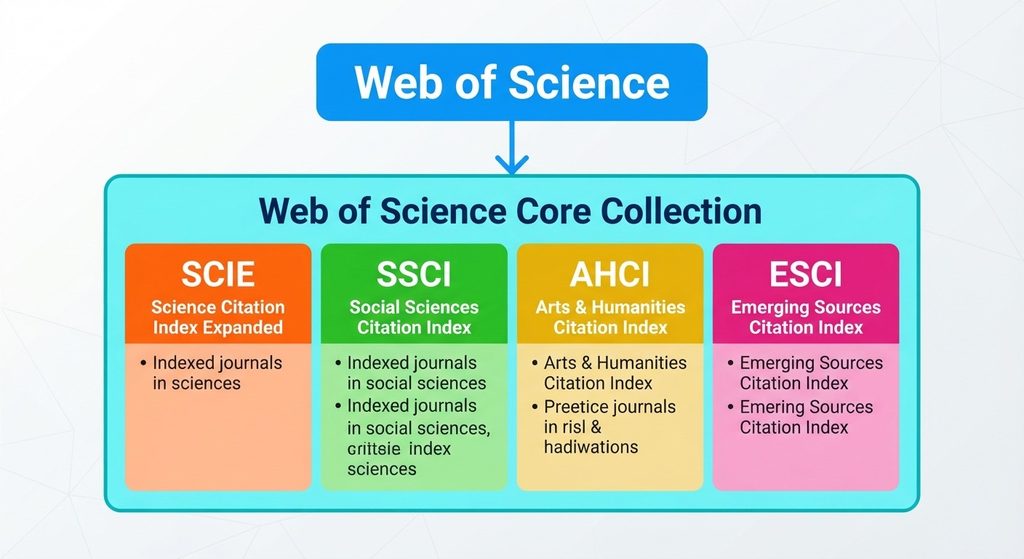
This hierarchy is critical because “indexed in Web of Science” does not, by itself, tell you which Core Collection index covers the journal.
3. What Is SCIE?
Science Citation Index Expanded (SCIE) is the Core Collection index most closely associated with the phrase “SCI indexed” in contemporary publishing discussions.
Clarivate describes SCIE as a multidisciplinary scientific citation index containing publication and citation data spanning more than 120 years. Its current coverage includes thousands of actively publishing journals across numerous subject categories.
SCIE is designed primarily around scientific and technical research.
Depending on discipline, researchers may encounter SCIE journals in areas such as:
- Medicine
- Clinical research
- Biology
- Chemistry
- Physics
- Engineering
- Environmental science
- Computer science
- Materials science
- Multidisciplinary sciences
However, SCIE is not synonymous with every Web of Science journal.
A social sciences journal, for example, may be covered by SSCI rather than SCIE. An arts and humanities journal may be covered by AHCI. A multidisciplinary emerging journal may be included in ESCI.
4. SCIE vs SCI: Why the Terminology Causes Confusion
One of the most important points for authors is the distinction between SCI and SCIE.
SCI
The original Science Citation Index was launched in 1964 and became a foundational citation index associated with the work of Eugene Garfield and the Institute for Scientific Information.
SCIE
Science Citation Index Expanded is the current expanded scientific index within the Web of Science Core Collection. Clarivate describes SCIE as one of the four journal indexes into which selected Core Collection journal content is indexed.
Consequently, contemporary authors should be precise when discussing indexing.
Instead of writing:
“This journal is in SCI.”
Use:
“This journal is currently indexed in SCIE within the Web of Science Core Collection.”
That wording identifies both the index and the database hierarchy.
Common pitfall
A journal may advertise itself as “SCI indexed” without providing a direct, current Clarivate record.
Audit the claim against the Master Journal List before submitting.
Also read: Is Web of Science Free? 7 Database Access Options and Free Alternatives in 2026
5. SCIE, SSCI, AHCI, and ESCI: What Is the Difference?
The four principal journal indexes within the Web of Science Core Collection serve different purposes.
| Index | Full Name | Primary Research Orientation | Position in Core Collection |
| SCIE | Science Citation Index Expanded | Sciences, technology, medicine, and related fields | Flagship index |
| SSCI | Social Sciences Citation Index | Social sciences | Flagship index |
| AHCI | Arts & Humanities Citation Index | Arts and humanities | Flagship index |
| ESCI | Emerging Sources Citation Index | Multidisciplinary and emerging research sources | Core Collection index |
Clarivate states that journals meeting its quality criteria enter ESCI, while journals that additionally meet its impact criteria can enter SCIE, SSCI, or AHCI depending on subject area.
Why this distinction matters
Suppose a university requires:
“Publication in a Web of Science Core Collection journal.”
A journal in SCIE, SSCI, AHCI, or ESCI may satisfy that wording because all four are Core Collection indexes.
But suppose the requirement specifically states:
“Publication in an SCIE-indexed journal.”
Now an ESCI journal does not meet the same stated criterion.
Always match the journal’s actual index to the precise wording of the institutional, funding, promotion, or doctoral requirement.
6. How Does Clarivate Classify Web of Science Journals?
Journal inclusion is based on an editorial evaluation process rather than a publisher simply paying for inclusion.
Clarivate currently states that journals are evaluated against 24 quality criteria, with additional impact criteria used for selection into SCIE, SSCI, or AHCI. Journals that satisfy the quality criteria can enter ESCI.
Quality criteria
Quality evaluation considers characteristics associated with responsible scholarly publishing and editorial rigor.
Examples include considerations around:
- Editorial content
- Peer-review process
- Editorial board information
- Author affiliations
- Publishing practices
- Ethical standards
- Journal information
- Regularity and timeliness
- Bibliographic information
Impact criteria
For journals already satisfying the quality threshold, Clarivate applies additional impact criteria when considering movement into SCIE, SSCI, or AHCI. Clarivate describes these as criteria related to citation activity and influence within the relevant research area.
This means Core Collection indexing is not a single static category.
Journal coverage can change.
7. Can a Journal Move Between ESCI and SCIE?
Yes.
Clarivate describes the Web of Science Core Collection as a dynamic collection subject to periodic re-evaluation. An ESCI journal that subsequently meets the relevant impact criteria can move into SCIE, SSCI, or AHCI. Conversely, journals in those flagship indexes can move to ESCI if they no longer meet the applicable impact criteria. A journal that fails the quality criteria can be removed from the Core Collection.
This has a major practical implication for researchers:
Do not verify indexing once and assume that the status will remain unchanged indefinitely.
Check the journal shortly before submission.
Common pitfall
Authors sometimes rely on:
- An old acceptance letter
- A journal’s outdated website
- A university spreadsheet
- A screenshot from several years ago
- A third-party indexing list
These sources may not reflect current coverage.
8. How Can I Verify if a Journal Is Indexed in Web of Science Core Collection?
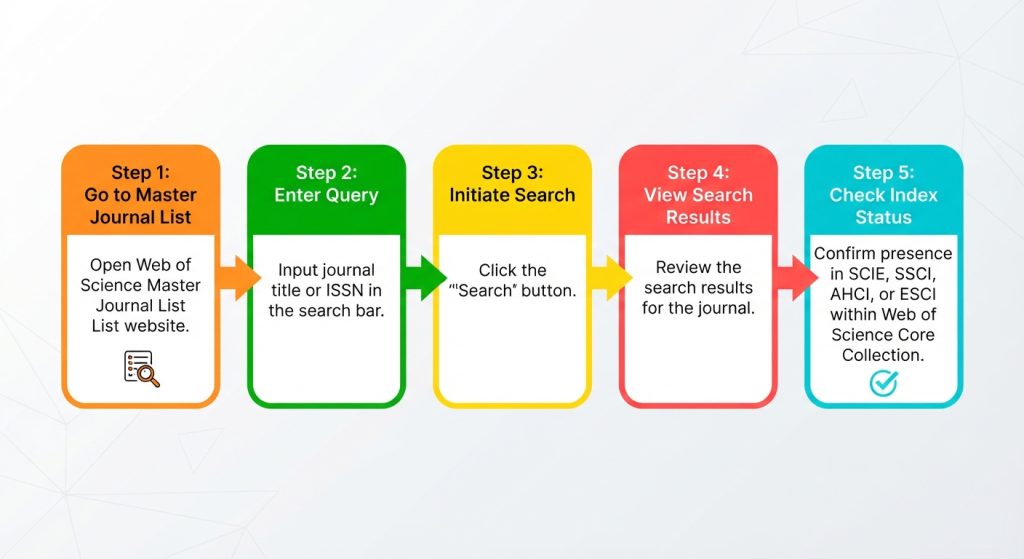
Use Clarivate’s Master Journal List (MJL).
Clarivate explicitly identifies the Master Journal List as the authoritative source for Web of Science journal coverage. It also provides information about coverage changes.
Verification workflow
Step 1: Obtain the exact journal title.
Do not rely solely on an abbreviation.
Step 2: Find the ISSN or eISSN.
The ISSN provides a more reliable identifier when journals have similar names.
Step 3: Search the Master Journal List.
Search using the journal title or ISSN.
Step 4: Check the index.
Determine whether the journal is listed under:
- SCIE
- SSCI
- AHCI
- ESCI
Step 5: Check coverage dates.
Do not assume that a current journal listing means every historical volume is covered.
Step 6: Check for status changes.
Clarivate provides information about changes in journal coverage, and its collection is subject to ongoing evaluation.
Also read: Scopus vs Web of Science: Which One Matters More for Researchers?
9. Is a Web of Science Journal Automatically an SCIE Journal?
No.
This is one of the most important distinctions in the entire database hierarchy.
The phrase “Web of Science indexed” is broader than “SCIE indexed.”
A journal can be included in the Web of Science Core Collection through ESCI, SSCI, AHCI, or SCIE, depending on its classification.
Consider these examples:
| Journal Status | Web of Science Core Collection? | SCIE? |
| SCIE journal | Yes | Yes |
| SSCI journal | Yes | No |
| AHCI journal | Yes | No |
| ESCI journal | Yes | No |
| Not listed in Core Collection | No | No |
This table illustrates why authors should never interpret “WoS indexed” as automatically meaning “SCIE indexed.”
10. Does Web of Science Indexing Mean a Journal Has an Impact Factor?
This question requires careful terminology.
Web of Science indexing and Journal Impact Factor are related but are not the same concept.
Journal Citation Reports (JCR) is a separate Clarivate product used to provide journal-level citation indicators. Clarivate explains that Web of Science is continuously updated, whereas JCR represents a defined dataset at a particular point in time.
Importantly, Clarivate expanded Journal Impact Factor coverage to all Web of Science Core Collection journals beginning with the 2023 JCR release, including journals in AHCI and ESCI.
Therefore, the older assumption that:
“Only SCIE and SSCI journals have a Journal Impact Factor”
is no longer an accurate description of the current JCR framework.
Common pitfall
Do not use phrases such as:
“Web of Science Impact Factor”
as though Web of Science itself were the metric.
Use the precise term:
Journal Impact Factor (JIF), as reported in Journal Citation Reports.
Also verify the relevant year’s JCR data rather than relying on a journal’s promotional statement.
11. Web of Science Core Collection vs SCI: Which One Should Researchers Look For?
The answer depends on what your institution, funder, employer, or doctoral program requires.
Do not select a journal merely because someone says it is “SCI” or “Web of Science.”
Instead, identify the exact requirement.
If your requirement says “Web of Science Core Collection”
Check whether the journal is currently covered by SCIE, SSCI, AHCI, or ESCI.
If your requirement says “SCIE”
Confirm that the journal is specifically listed under Science Citation Index Expanded.
If your requirement says “Web of Science with Impact Factor”
Verify the journal’s current JCR listing and JIF rather than assuming that Core Collection indexing alone answers the requirement.
If your requirement is discipline-specific
Match the journal to the relevant index and subject category.
This distinction can prevent a costly submission mistake particularly when publication is required for a PhD milestone, promotion, grant deliverable, or institutional research assessment.
12. How to Evaluate a Journal Beyond Its Index
Indexing is important, but it should not be the only criterion used to select a journal.
Audit the following before submission:
Scope and readership
Confirm that your research matches the journal’s aims and scope.
Peer-review model
Check whether the journal uses single-blind, double-blind, open, or another peer-review model.
Article type
Confirm that the journal accepts your manuscript category.
Publication fees
Check whether an Article Processing Charge (APC) applies, particularly for open-access publication.
Editorial and ethical standards
Review the journal’s policies on:
- Research ethics
- Conflicts of interest
- Data availability
- Corrections
- Retractions
- Authorship
- Peer review
- Plagiarism
Copyright and licensing
Determine whether authors retain copyright and which license applies to published articles.
Publication timelines
Look for information about submission-to-first-decision and production timelines, but treat stated averages as estimates rather than guarantees.
Indexing verification
Confirm current coverage through the official Clarivate source.
A journal that matches your research and publication requirements is more useful than one selected solely because an informal source labels it “high impact.
Also read: Why Was My Paper Desk Rejected? 10 Reasons and How to Fix Them
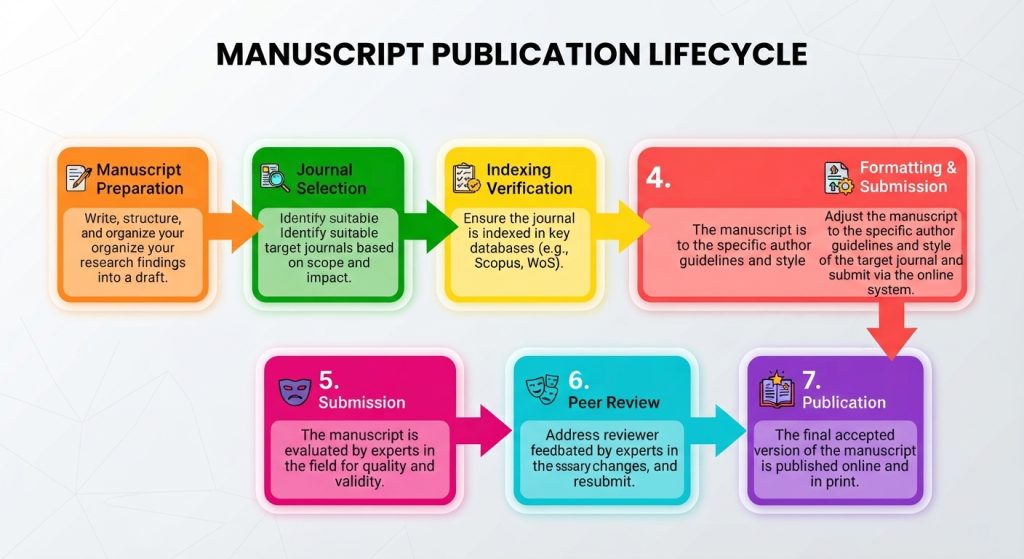
13. Why Indexing Verification Should Be Part of Manuscript Preparation
Journal selection should happen before final formatting not after your manuscript is finished.
Once you select a target journal, build its requirements into your manuscript submission workflow.
Audit:
- Article type
- Word count
- Abstract format
- Keywords
- Heading structure
- Reference style
- Figure specifications
- Table formatting
- Supplementary files
- Reporting guidelines
- Ethics statements
- Conflict-of-interest declarations
- Data availability
- Author contribution statements
- Copyright/licensing requirements
For clinical and biomedical research, also identify whether the study requires a reporting framework such as CONSORT, STROBE, PRISMA, or another applicable guideline.
Use ManuscriptLab Editing Services to perform a structured pre-submission review covering language, formatting, references, and journal-specific requirements.
14. Common Mistakes When Checking SCI and Web of Science Status
Mistake 1: Treating “SCI” as a generic synonym for Web of Science
Correction: Identify the precise index.
Mistake 2: Assuming every Core Collection journal is SCIE
Correction: Check whether the journal is in SCIE, SSCI, AHCI, or ESCI.
Mistake 3: Trusting the journal website alone
Correction: Verify coverage using Clarivate’s Master Journal List.
Mistake 4: Checking only the journal title
Correction: Verify the ISSN/eISSN where possible.
Mistake 5: Relying on an old indexing claim
Correction: Recheck coverage immediately before submission.
Mistake 6: Confusing JIF with Web of Science indexing
Correction: Check Journal Citation Reports separately.
Mistake 7: Assuming indexing guarantees acceptance
Correction: Indexing is a journal-level characteristic. It does not guarantee that an individual manuscript will pass editorial screening or peer review.
Frequently Asked Questions
Is SCI and Web of Science the same?
No. SCI and Web of Science are not the same. Web of Science is the broader research platform, while the Web of Science Core Collection is a curated database containing multiple citation indexes. The current scientific index within the Core Collection is Science Citation Index Expanded (SCIE). “SCI indexed” is often used informally, so researchers should verify the exact index in Clarivate’s Master Journal List.
Is Web of Science and SCI the same?
No. A journal can be indexed in the Web of Science Core Collection without being indexed in SCIE. For example, journals may be classified under SSCI, AHCI, or ESCI instead. Therefore, “Web of Science indexed” is a broader description than “SCIE indexed.”
What is the difference between Web of Science and SCI?
Web of Science is the broader citation research platform, whereas Science Citation Index (SCI) is a historical citation index. Today, researchers generally encounter Science Citation Index Expanded (SCIE) as the relevant scientific journal index within the Web of Science Core Collection. The distinction is important when an institution specifically requires SCIE rather than general Web of Science coverage.
Is the Science Citation Index part of the Web of Science Core Collection?
The original Science Citation Index is historically associated with the development of Web of Science. The current expanded scientific journal index is SCIE, which is part of the Web of Science Core Collection. Therefore, when verifying a contemporary journal’s scientific indexing status, researchers should look for its current SCIE listing rather than relying on the generic term “SCI.”
Is SCIE the same as Web of Science?
No. SCIE is one index within the Web of Science Core Collection, not the entire Web of Science database. Other Core Collection journal indexes include SSCI, AHCI, and ESCI. A journal being indexed in Web of Science does not automatically mean that it is indexed in SCIE.
How can I verify if a journal is indexed in the Web of Science Core Collection?
Use Clarivate’s Master Journal List and search for the journal using its exact title, ISSN, or eISSN. Check the journal’s current index classification such as SCIE, SSCI, AHCI, or ESCI and review the available coverage information. Do not rely solely on a journal’s website or third-party indexing lists.
What is the Web of Science Core Collection database hierarchy?
The simplified hierarchy is:
Web of Science → Web of Science Core Collection → SCIE / SSCI / AHCI / ESCI
The Core Collection therefore represents a broader group of curated indexes rather than a single journal index. The exact classification of a journal depends on Clarivate’s editorial evaluation and subject coverage.
What is the difference between SCIE, SSCI, AHCI, and ESCI?
These indexes cover different areas and classifications within the Core Collection:
- SCIE: Science Citation Index Expanded, primarily covering sciences, technology, medicine, and related fields.
- SSCI: Social Sciences Citation Index, covering social science disciplines.
- AHCI: Arts & Humanities Citation Index, covering arts and humanities research.
- ESCI: Emerging Sources Citation Index, covering journals that meet Clarivate’s quality criteria but are not necessarily classified in one of the flagship indexes.
The correct index depends on the journal’s subject area and Clarivate’s current classification.
Does Web of Science indexing mean that a journal has an Impact Factor?
Not necessarily in the way the phrase is often used. Web of Science indexing and the Journal Impact Factor (JIF) are separate concepts. JIF is a journal-level citation metric reported through Clarivate’s Journal Citation Reports (JCR). If an Impact Factor is important for your institutional or career requirement, verify the relevant JCR record and year separately.
Can a journal move from ESCI to SCIE?
Yes. Clarivate periodically evaluates journals and can change their Core Collection classification. A journal meeting the applicable additional impact criteria may move from ESCI into SCIE, SSCI, or AHCI depending on its subject area. Journal coverage can also change in the opposite direction or be discontinued.
How often should I check a journal’s Web of Science indexing status?
Check the journal shortly before submission, particularly when indexing is required for a PhD, promotion, funding, institutional assessment, or employment requirement. A journal’s indexing status should not be assumed to remain unchanged indefinitely because Clarivate periodically evaluates journal coverage.
Is an ESCI journal a Web of Science journal?
Yes. ESCI is one of the journal indexes within the Web of Science Core Collection. However, an ESCI journal is not automatically an SCIE journal. If your institution specifically requires SCIE, you should verify that the journal is currently classified under SCIE rather than ESCI.
Is every Web of Science Core Collection journal an SCIE journal?
No. The Web of Science Core Collection includes multiple journal indexes. A journal may be indexed in SCIE, SSCI, AHCI, or ESCI. Therefore, authors should identify the exact index rather than treating all Core Collection journals as SCIE journals.
Why should authors verify the ISSN when checking journal indexing?
Journal titles can be similar, abbreviated differently, or changed over time. The ISSN or eISSN provides a more precise way to identify the journal during an indexing check. Verifying the title together with the ISSN/eISSN can reduce the risk of checking the wrong publication.
What should I check besides Web of Science indexing before submitting?
Indexing should be only one part of journal selection. Also evaluate the journal’s aims and scope, article types, peer-review process, publication fees, editorial policies, research-ethics requirements, reporting guidelines, copyright and licensing terms, publication timelines, and manuscript formatting requirements.
A journal can be correctly indexed and still be unsuitable for your particular manuscript.
Pre-Submission Web of Science & SCI Checklist
Before submitting your manuscript, complete this audit:
- Identify the exact journal title.
- Record the journal’s ISSN/eISSN.
- Search the Clarivate Master Journal List.
- Confirm current Web of Science Core Collection coverage.
- Identify the exact index: SCIE, SSCI, AHCI, or ESCI.
- Check coverage dates.
- Review recent coverage changes where applicable.
- Verify whether the journal appears in the relevant JCR release.
- Check the current Journal Impact Factor if relevant to your requirement.
- Confirm the journal’s aims and scope.
- Confirm that your manuscript type is accepted.
- Review APC and open-access requirements.
- Audit the journal’s ethical and authorship policies.
- Apply the correct reporting guideline.
- Format references according to journal requirements.
- Check figures, tables, legends, and supplementary files.
- Proofread the complete manuscript.
- Prepare a journal-specific cover letter.
- Retain evidence of your indexing verification for institutional records.
Conclusion
Web of Science Core Collection and SCI are not the same thing. The Core Collection is a broader curated database containing multiple journal indexes, including SCIE, SSCI, AHCI, and ESCI. SCIE is the current scientific index that researchers commonly mean when they use the term “SCI indexed.”
The distinction matters because a journal’s exact index can affect whether it satisfies a university, funder, promotion, doctoral, or employer requirement.
Most importantly, verify rather than assume. Clarivate identifies its Master Journal List as the authoritative source for Web of Science coverage, and journal classifications can change following periodic evaluation.
Before submitting your next manuscript, confirm the journal’s current index, coverage status, JCR information where relevant, publication requirements, and editorial policies. Then align your manuscript with those requirements before entering the submission workflow.
For authors who want an additional quality-control layer, ManuscriptLab’s professional editing and formatting services can help audit manuscript language, structure, references, formatting, and journal-specific submission readiness.
Resources
- Clarivate Web of Science Core Collection: Web of Science Core Collection
- Clarivate Journal Evaluation Process: Journal evaluation process and selection criteria
- Clarivate Science Citation Index Expanded: Science Citation Index Expanded (SCIE)
- Clarivate Master Journal List guidance: Web of Science journal coverage and Master Journal List
- Clarivate Journal Citation Reports: Journal Citation Reports