Researchers often reach a frustrating point in literature searching: you find a promising paper in Web of Science, but the database asks you to sign in through an institution. This raises an important question: Is Web of Science free, or does accessing its full research database require a subscription?
The short answer is no, not in the conventional sense. Web of Science Core Collection is primarily an institutionally subscribed research database. Clarivate states that access to the Core Collection is available to institutions with a subscription, while a free Web of Science researcher profile can be created without institutional access. A profile, however, is not equivalent to full database access.
This distinction matters because researchers need to separate three things: access to the Web of Science platform, access to individual article full texts, and access to free scholarly discovery resources.
This guide explains Web of Science access options, why subscription pricing is difficult to standardize, how to find research papers for free legally, and which free academic databases can support literature reviews, systematic searches, citation discovery, and research planning in 2026.
💡 Need expert help with your paper?
Transform your manuscript with ManuscriptLab’s professional editing & formatting services!
Is Web of Science Free? The Short Answer
Web of Science Core Collection is not generally free for unrestricted individual use.
Clarivate describes Web of Science Core Collection as a subscription-access database. Institutions can license access for their researchers, while researchers without institutional access may encounter a sign-in or subscription barrier when attempting to use the full database.
However, several Web of Science-related resources are available without paying for a standard Core Collection subscription.
For example:
- A Web of Science researcher profile can be created for free.
- Some Web of Science-related services and limited tools may be available without full institutional access.
- Clarivate offers a free trial plan for its Web of Science Starter API, although this is a developer service with usage limitations rather than unrestricted Web of Science database access.
- Your university, hospital, research institute, or library may already provide institutional access.
Therefore, asking whether “Web of Science is free” requires specifying which Web of Science product and which type of access you mean.
1. What Does Web of Science Actually Provide?
Web of Science is more than a conventional search engine.
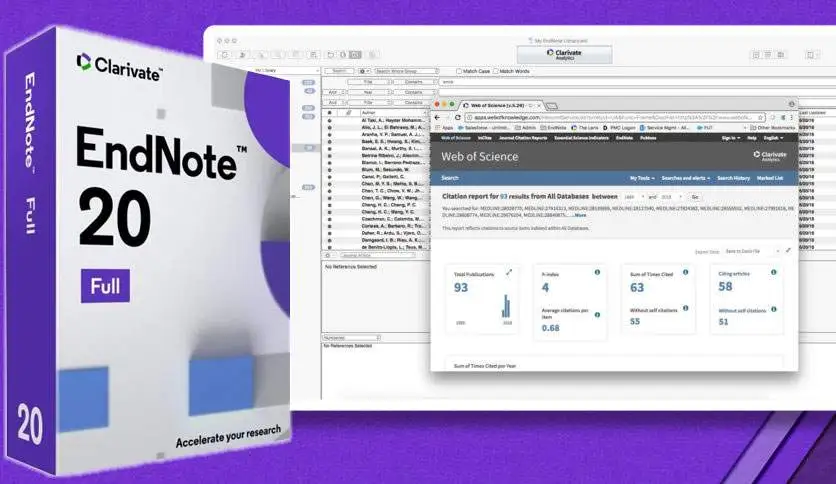
The Web of Science Core Collection is a curated multidisciplinary citation database. Clarivate says its editorial team evaluates journals, conference proceedings, and books against defined quality criteria before inclusion. The platform is designed for literature discovery, citation tracking, and research-impact analysis.
This distinction explains why researchers often use Web of Science for tasks such as:
- citation analysis;
- systematic literature searching;
- bibliometric studies;
- identifying highly cited research;
- tracing citation networks;
- journal and publication analysis;
- finding influential papers;
- monitoring research trends.
Clarivate currently reports that its Web of Science platform contains more than 34,000 journals, 288 million metadata records, and 3.4 billion citation links, with coverage extending back to 1864.
Why does that matter?
A free academic search engine may help you discover papers. A curated citation index can provide additional infrastructure for understanding how publications connect to one another.
For a systematic review, for example, citation tracking can help researchers move beyond keyword matching to identify:
- papers cited by a key study;
- later studies citing that study;
- related publications;
- influential research clusters;
- potentially important literature missed by a single keyword strategy.
Common pitfall
Do not assume that finding an article record in Web of Science means the full article is freely available.
Web of Science primarily functions as a discovery and citation-indexing platform. Full-text availability depends on the publisher, repository, institutional subscription, or open-access status of the individual article.
2. Why Does Web of Science Require a Subscription?
Maintaining a large curated citation database involves substantially more than hosting PDFs.
Clarivate describes Web of Science Core Collection as a publisher-independent citation database supported by editorial selection, continuous curation, standardized indexing, and enriched citation data.
Subscription access supports this infrastructure and the associated research functionality.
Unlike a conventional website that simply displays publicly available documents, a major citation database provides structured scholarly metadata and relationships between publications.
These can include:
- author information;
- institutional affiliations;
- publication metadata;
- citation relationships;
- journal indexing information;
- document types;
- research categories;
- cited-reference connections.
The value is therefore not limited to whether you can download a PDF.
Industry-standard distinction
Think of academic information resources in three layers:
Discovery → Verification → Full text
A search engine may help you discover a paper.
A citation database can help you verify its bibliographic and citation context.
A publisher or repository may provide the full text.
Do not confuse these functions when evaluating database access costs.
3. How Much Does Web of Science Cost?
One of the most common searches is “Web of Science subscription price” or “Web of Science database access cost.”
There is no single universal public price that applies to every researcher.
Web of Science access is generally sold through institutional arrangements, and the relevant cost can depend on factors such as:
- institution type;
- number of users;
- product package;
- geographic or contractual terms;
- subscription duration;
- additional Clarivate products;
- licensing arrangements.
Clarivate’s public product information directs organizations toward sales/contact channels rather than presenting a single universal individual subscription price for Core Collection.
What this means for researchers
Do not rely on outdated blog posts claiming that Web of Science costs a specific amount per year unless the figure comes from a current institutional agreement or official Clarivate quotation.
Instead:
- Check your university library.
- Search your institution’s electronic resources portal.
- Ask your librarian whether Web of Science Core Collection is licensed.
- Check whether your hospital or research institute provides access.
- Contact Clarivate if you represent an organization seeking a license.
Common pitfall
A researcher may conclude that Web of Science is inaccessible simply because their personal account does not provide database access.
That conclusion can be wrong.
Your institution may already pay for access, meaning you do not personally pay the subscription cost.
4. Web of Science Access Options in 2026
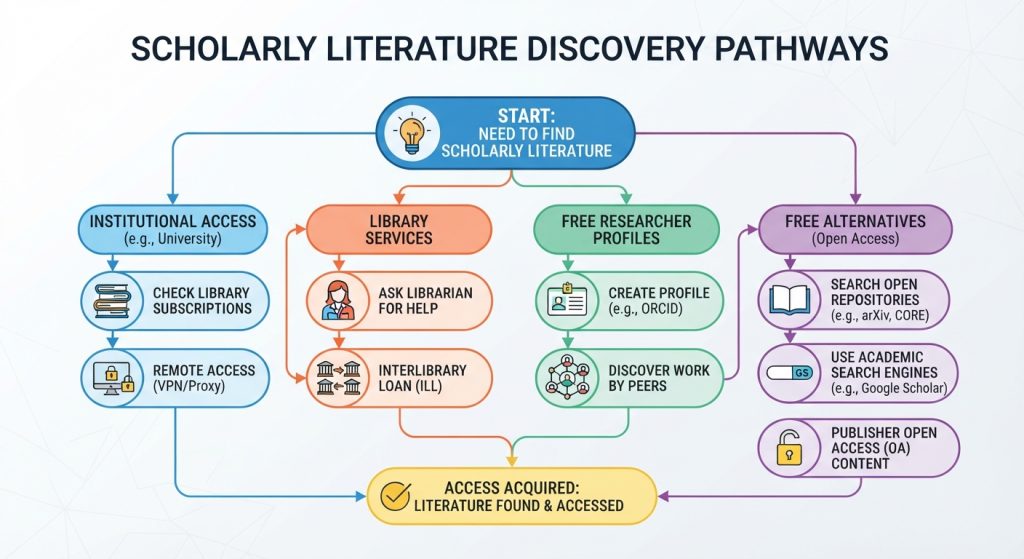
Researchers have several legitimate routes for accessing Web of Science or obtaining equivalent discovery functions.
| Access route | Cost to individual researcher | Full Web of Science access? | Best use |
| Institutional subscription | Usually covered by institution | Yes, depending on license | Comprehensive research |
| University library | Usually included in institutional services | Often yes | Literature reviews |
| Hospital/research institute | Depends on organization | Often licensed | Clinical and scientific research |
| Personal free profile | Free | No | Profile and personalization |
| Web of Science API free trial | Free within limits | No | Testing/API development |
| Google Scholar | Free | No | Broad scholarly discovery |
| PubMed | Free | No | Biomedical and life-science discovery |
| DOAJ | Free | No | Open-access journal discovery |
| OpenAlex | Free basic search/data access | No | Open scholarly metadata and analysis |
| CORE | Free | No | Open-access full-text discovery |
Clarivate confirms that researcher profiles can be created free of charge but that document searching and the full Web of Science experience require subscription access.
Also read: 10 Key Reasons Manuscripts Get Rejected Before Peer Review
5. The Best Free Alternatives to Web of Science
If you do not have institutional access, do not stop your literature search.
Several free academic research databases can provide valuable complementary coverage.
The important word is complementary.
No free tool should automatically be treated as a one-for-one replacement for Web of Science in every discipline or systematic-review workflow.
Google Scholar
Google Scholar provides broad scholarly discovery across articles, theses, books, abstracts, court opinions, repositories, universities, and publishers. It also supports citation exploration and related-work discovery.
Best for:
- broad literature discovery;
- finding obscure publications;
- locating theses and dissertations;
- citation chaining;
- finding accessible copies.
Limitation: Search results are broad and the platform is not equivalent to a curated subscription citation index.
PubMed
PubMed is particularly valuable for biomedical and life-science research.
PubMed itself is free to search. However, an individual article’s full text may still require payment unless it is available through PubMed Central, the publisher, a repository, or another legitimate access route. PubMed provides a Free full text filter to help researchers identify accessible material.
Best for:
- medicine;
- clinical research;
- biomedical sciences;
- health sciences;
- systematic evidence discovery.
OpenAlex
OpenAlex is a free and open catalog of the global research system. Its data connects scholarly works with authors, institutions, funders, journals, and citation relationships.
Its basic website search requires no account or charge and supports filtering and exporting.
Best for:
- bibliometric research;
- citation analysis;
- research mapping;
- open scholarly metadata;
- programmatic literature analysis.
OpenAlex also identifies open-access availability and links users toward freely accessible full-text versions when available.
DOAJ
The Directory of Open Access Journals (DOAJ) focuses on open-access scholarly journals.
It is particularly useful when the goal is not simply to discover a paper but to identify journals and articles that are openly accessible.
DOAJ’s metadata is also incorporated into other scholarly discovery systems, including OpenAlex, Google Scholar, and Web of Science.
Best for:
- open-access journal discovery;
- identifying OA publications;
- journal screening;
- locating freely accessible scholarly content.
CORE
CORE aggregates research from repositories and journals and describes itself as the world’s largest collection of open-access research papers. It currently reports hundreds of millions of searchable scholarly resources and a very large collection of free-to-read full texts.
Best for:
- finding repository copies;
- discovering open-access manuscripts;
- locating full-text research;
- repository-based literature searches.
CORE also offers a free discovery service designed to help users locate open-access versions of articles encountered behind paywalls.
6. Google Scholar vs Web of Science: Which Should Researchers Use?
The comparison between Google Scholar vs Web of Science should not be reduced to “free versus paid.”
The platforms serve different research needs.
| Criterion | Web of Science | Google Scholar |
| Basic access | Subscription-dependent | Free |
| Multidisciplinary discovery | Strong | Very broad |
| Citation tracking | Structured | Available |
| Editorial curation | Strong | Different indexing model |
| Bibliometric workflows | Strong | More limited |
| Institutional analytics | Strong | Limited |
| Full-text access | Depends on source/access rights | Often links to available copies |
| Systematic-review role | Useful database | Useful supplementary source |
| Cost | Institutional subscription commonly required | Free |
Google Scholar’s major advantage is breadth and accessibility. Web of Science’s major advantage is its structured, curated citation-index environment.
For serious evidence synthesis, use the database that matches the review protocol rather than choosing solely according to price.
Research evaluating academic search systems has found substantial differences in retrieval quality and cautions against treating Google Scholar as an automatic substitute for a systematic-search database.
Also read: Manuscript Editing and Formatting Services for Journal Submission
7. Can Free Databases Replace Web of Science for a Systematic Review?
This is where researchers need to be especially careful.
Searching for “best databases for systematic literature reviews” often produces lists of platforms without explaining why database selection matters.
A systematic review requires a reproducible search strategy.
Depending on the research question, you may need:
- multiple databases;
- controlled vocabulary;
- Boolean operators;
- database-specific syntax;
- documented search dates;
- inclusion/exclusion criteria;
- deduplication;
- citation chaining;
- supplementary searching;
- transparent reporting.
A single free search engine is rarely sufficient for every review.
For biomedical research, for example, PubMed may be essential. A multidisciplinary review might require additional databases. A bibliometric review may prioritize citation-index data.
Practical strategy
If you lack Web of Science access:
Step 1: Identify the databases required by your protocol.
Step 2: Use discipline-specific free resources such as PubMed where appropriate.
Step 3: Use Google Scholar for supplementary discovery and citation chasing.
Step 4: Search OpenAlex for additional scholarly metadata and citation connections.
Step 5: Use DOAJ and CORE to locate open-access literature.
Step 6: Record your exact search strings, dates, filters, and database names.
The objective is not to recreate Web of Science artificially. The objective is to construct a transparent, reproducible evidence-search workflow.
How to Find Research Papers for Free Legally
When you encounter a paywall, do not immediately assume the paper is unavailable.
Use a structured access workflow.
1. Check the publisher
Some articles are temporarily free, fully open access, or available under specific access conditions.
2. Search the title in Google Scholar
Google Scholar can identify copies hosted by universities, repositories, and other legitimate sources.
3. Check PubMed Central
For biomedical literature, PubMed’s Free full text filter and PubMed Central can identify freely available articles.
4. Search OpenAlex
OpenAlex records can identify whether a work has an open-access location and link to a free version where one is available.
5. Search CORE
CORE specializes in aggregating repository and open-access content.
6. Check institutional repositories
Authors may deposit accepted manuscripts or other permitted versions in university repositories.
Common pitfall
Do not equate free to read with free to reuse.
An article may be freely accessible while still being protected by copyright. Check the article’s license before reproducing figures, tables, substantial text, or other protected material.
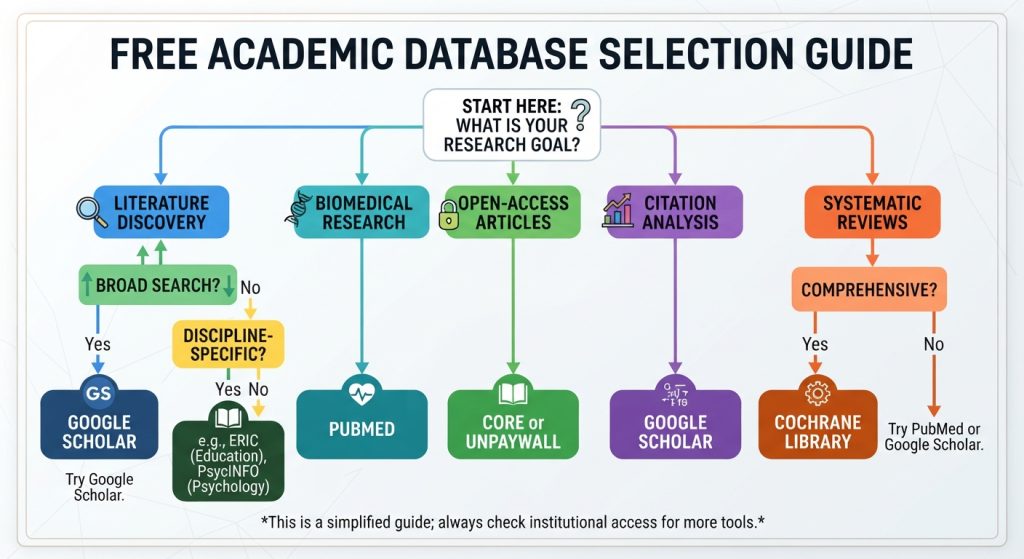
8. Which Database Should You Choose?
Use your research objective to determine the right resource.
For broad scholarly discovery
Use Google Scholar + OpenAlex.
This combination provides broad discovery and structured scholarly metadata without requiring a Web of Science subscription.
For biomedical research
Use PubMed + PubMed Central, supplemented by other databases required by your research question.
For open-access literature
Use DOAJ + CORE + OpenAlex.
For citation analysis
Web of Science remains valuable when institutional access is available. OpenAlex can provide a free/open alternative for many bibliometric workflows, but researchers should validate whether its coverage and metadata meet the requirements of their specific analysis.
For systematic reviews
Do not select databases based solely on whether they are free.
Start with the review question, population, intervention/exposure, comparator, outcomes, study design, and field. Then select databases that collectively provide appropriate coverage.
9. Web of Science vs Scopus vs Free Alternatives
Researchers frequently search for Scopus vs Web of Science free access, but neither should be treated simply as a free research-paper website.
Both Web of Science and Scopus are major scholarly indexing and citation-analysis platforms whose institutional access arrangements can differ by organization.
A better comparison is functional:
| Research need | Web of Science | Scopus | Free alternative |
| Citation analysis | Excellent | Excellent | OpenAlex |
| Broad discovery | Excellent | Excellent | Google Scholar |
| Biomedical searching | Strong | Strong | PubMed |
| Open-access discovery | Good | Good | DOAJ/CORE |
| Repository full text | Variable | Variable | CORE |
| Bibliometrics | Strong | Strong | OpenAlex |
| No-cost basic access | Generally no | Generally no | Several options |
| Institutional licensing | Yes | Yes | Not generally required |
The correct choice depends on your research design and required evidence coverage.
10. What Researchers Should Do If They Cannot Access Web of Science
Lack of subscription access does not prevent rigorous scholarship.
Build a layered literature-search strategy:
Layer 1 — Primary discovery
Use discipline-specific databases such as PubMed where relevant.
Layer 2 — Broad discovery
Use Google Scholar and OpenAlex.
Layer 3 — Open-access retrieval
Use DOAJ, CORE, institutional repositories, and legitimate publisher copies.
Layer 4 — Citation chaining
Follow references backward and citations forward.
Layer 5 — Verification
Confirm bibliographic details using authoritative publisher, journal, DOI, or database records.
Layer 6 — Documentation
Record your search strategy so another researcher could reproduce it.
This approach is considerably stronger than relying on one search engine.
For researchers preparing manuscripts, systematic documentation also helps ensure that claims, citations, and evidence can be audited before submission.
Academic Publishing Resource Guide: Access Is Only the First Step
Finding literature is only one component of publication preparation.
Once you have identified the evidence base, audit your manuscript for:
- citation accuracy;
- reference completeness;
- duplicate citations;
- DOI accuracy;
- citation-style compliance;
- tables and figures;
- reporting guidelines;
- language quality;
- journal formatting;
- ethical declarations;
- authorship information;
- supplementary files.
ManuscriptLab Editing Services can help researchers move from literature-search results to a polished, submission-ready manuscript through professional editing and formatting support.
For manuscripts targeting medical journals, also verify applicable reporting standards and journal-specific requirements before submission.
Pre-Submission Literature Search Checklist
Before finalizing your literature review or manuscript, confirm the following:
- I know whether my institution provides Web of Science access.
- I have distinguished database access from full-text article access.
- I have checked institutional library subscriptions.
- I have selected databases appropriate to my discipline.
- I have not relied on a single search engine for a systematic review.
- I have documented search terms and Boolean operators.
- I have recorded database names and search dates.
- I have used legitimate open-access sources to locate free papers.
- I have checked PubMed/PubMed Central where relevant.
- I have considered OpenAlex for open scholarly metadata and citation analysis.
- I have checked DOAJ for open-access journal literature.
- I have searched CORE for repository-based full texts.
- I have verified bibliographic information before citing sources.
- I have checked article licenses before reusing published content.
- I have deduplicated search results where required.
- I have retained a reproducible record of my search methodology.
- My manuscript’s citations and references have been professionally audited.
Conclusion: Is Web of Science Free?
So, is Web of Science free? The answer is not for unrestricted access to the Web of Science Core Collection. Full database access is generally tied to institutional subscriptions, while some related features such as researcher profiles are available free of charge.
The good news is that researchers without a subscription have substantial legitimate alternatives. Google Scholar provides broad scholarly discovery; PubMed supports biomedical searching; DOAJ focuses on open-access journals; OpenAlex provides an open scholarly catalog and citation data; and CORE specializes in open-access research discovery.
Do not judge a research database solely by whether it is free. Judge it by coverage, indexing quality, search functionality, citation data, reproducibility, and suitability for your research question.
If Web of Science access is unavailable, construct a layered search strategy rather than abandoning rigorous literature discovery. Then strengthen the next stage of your publication workflow with ManuscriptLab’s professional editing and formatting services to ensure that your research is clear, consistent, accurately referenced, and ready for journal submission.