Authorship disputes can derail an otherwise strong medical manuscript. A researcher may contribute funding, supervise a clinical team, collect data, perform statistical analysis, or edit several drafts and still not qualify as an author under the ICMJE authorship criteria.
The International Committee of Medical Journal Editors (ICMJE) provides a structured four-part test for determining who qualifies as an author of a biomedical or medical journal article. The standard is deliberately cumulative: meeting only one, two, or three criteria is not enough. A qualifying author must satisfy all four requirements and accept responsibility for the published work.
For researchers preparing manuscripts in 2026, the issue has become more important because authorship now intersects with contributorship statements, CRediT taxonomy, multicenter collaborations, local investigator recognition, and artificial intelligence (AI). The ICMJE updated its Recommendations in January 2026, adding expanded guidance on AI in publishing and authors’ access to data.
This guide explains the ICMJE 4 criteria for authorship, who qualifies as a co-author, when acknowledgment is more appropriate, how AI affects authorship decisions, and how to document contributions before manuscript submission.
💡 Need expert help with your paper?
Transform your manuscript with ManuscriptLab’s professional editing & formatting services.
What Are the ICMJE Authorship Criteria in 2026?
The ICMJE recommends that authorship be based on four cumulative criteria:
Substantial contribution to the conception or design of the work, or to the acquisition, analysis, or interpretation of data.
Drafting the work or reviewing it critically for important intellectual content.
Final approval of the version to be published.
Accountability for all aspects of the work, ensuring that questions related to its accuracy or integrity are appropriately investigated and resolved.
The critical point is the word “and.” These are not alternative pathways. A person who performed the statistical analysis but never participated in critical manuscript review, final approval, or accountability does not satisfy the complete ICMJE authorship test.
The ICMJE also states that the researchers conducting the work not the journal editor are responsible for determining who meets the authorship criteria. Ideally, authorship should be discussed when the project is planned and revisited as contributions evolve.
The Four-Criterion Test at a Glance
| ICMJE criterion | What it requires | Typical evidence | Common pitfall |
| 1. Substantial contribution | Intellectual or research contribution to conception/design, data acquisition, analysis, or interpretation | Protocol, dataset, statistical plan, research records | Treating routine data collection as automatically sufficient |
| 2. Intellectual manuscript contribution | Drafting or critical review for important intellectual content | Draft history, substantive comments, revisions | Assuming proofreading or language editing qualifies |
| 3. Final approval | Approval of the final version | Author confirmation/submission record | Adding a senior author who has not reviewed the final manuscript |
| 4. Accountability | Responsibility for the integrity and accuracy of the work | Contribution statement, documented oversight | Assuming responsibility belongs only to the corresponding author |
The criteria should be evaluated together, not scored independently. A contributor cannot compensate for failing criterion 2 by making an exceptionally large contribution under criterion 1.
Also read: 10 Key Reasons Manuscripts Get Rejected Before Peer Review
1. Criterion One: Make a Substantial Contribution to the Research
The first requirement concerns substantive intellectual or research involvement.
Under ICMJE, a qualifying contribution may involve:
- Conception or design of the work
- Acquisition of data
- Analysis of data
- Interpretation of data
This criterion recognizes that modern biomedical research is collaborative. A biostatistician may make a substantial analytical contribution without designing the clinical protocol. A clinical investigator may contribute patient data and interpretation without performing the statistical analysis.
What counts as “substantial”?
The ICMJE does not establish a numerical threshold such as a minimum number of hours, pages written, experiments performed, or percentage of data analyzed.
Instead, evaluate intellectual significance.
For example:
Likely authorship contribution:
A statistician develops the analytical approach, evaluates model assumptions, performs the primary analysis, interprets results, and participates in manuscript development.
Not automatically sufficient:
A technician performs routine laboratory procedures according to an established protocol without contributing to study conception, interpretation, or other qualifying intellectual work.
Similarly, simply providing funding or general administrative supervision does not satisfy the authorship requirements by itself.
Common pitfall: equating access to data with authorship
Being responsible for obtaining data does not automatically establish authorship. The contribution must be considered alongside the other three criteria.
The safest approach is to document what the person actually contributed, rather than relying on job titles, seniority, institutional position, or ownership of a dataset.
2. Criterion Two: Contribute to the Manuscript’s Intellectual Content
The second ICMJE requirement is often misunderstood.
The current wording is:
Drafting the work or reviewing it critically for important intellectual content.
This wording matters because ICMJE revised criterion 2 in 2023. The change from “revising” to “reviewing” was intended to prevent the mistaken assumption that an author must substantially rewrite an earlier draft to qualify. An author who critically reviews the manuscript and agrees with its content may still satisfy the requirement.
What is critical review?
Critical review is more than proofreading.
It can involve evaluating:
- The scientific interpretation
- Methodological reasoning
- Statistical conclusions
- Clinical implications
- Limitations
- Discussion of competing explanations
- The relationship between results and conclusions
- Important intellectual arguments in the manuscript
By contrast, grammar correction, formatting, proofreading, and routine language editing alone do not establish authorship under ICMJE.
This distinction is particularly important when professional editors or medical writers assist with a manuscript.
A professional editing service may improve readability, structure, terminology, grammar, and journal compliance without becoming an author. Authorship depends on substantive intellectual contribution and fulfillment of all four ICMJE criteria not simply on the amount of text edited.
For researchers seeking publication-ready support, ManuscriptLab’s academic editing services can help strengthen clarity and presentation while preserving the authors’ scientific responsibility.
3. Criterion Three: Approve the Final Version
Every author must approve the version that will be published.
This requirement creates an important distinction between contributing to a manuscript and being accountable for the submitted article.
Suppose six researchers contributed to a study. Four actively reviewed the manuscript, while two were added to the byline because they were senior investigators. If those two individuals never reviewed or approved the final manuscript, the authorship arrangement is inconsistent with the ICMJE framework.
Why final approval matters
Publication is not simply a record of who participated in a project. The byline identifies people who accept responsibility for the published scientific record.
Before submission, every author should therefore have access to the final manuscript and confirm:
- The manuscript accurately represents the research.
- Their contribution is correctly described.
- They approve the final text.
- They agree to the author list.
- They understand their responsibility for the work.
ICMJE notes that journals may require an authorship statement confirming that all authors have read and approved the manuscript and that authorship requirements have been met.
4. Criterion Four: Accept Accountability for the Work
The fourth criterion distinguishes modern authorship from a simple credit system.
An author must agree to be accountable for all aspects of the work and should ensure that questions concerning its accuracy or integrity are appropriately investigated and resolved.
This does not mean that every author must personally reproduce every experiment or independently verify every line of code.
It means authors must understand the work sufficiently to take responsibility for their contribution and cooperate when legitimate concerns arise.
Accountability in large research teams
Large multicenter studies create an obvious challenge. A clinician at one research site may have direct knowledge of patient recruitment but not the statistical pipeline. A statistician may understand the analysis but not the clinical workflow.
The solution is not to make every author an expert in every component. Instead, establish clear contribution and responsibility structures.
Document:
- Who designed the study
- Who collected or managed data
- Who performed statistical analyses
- Who interpreted findings
- Who drafted specific sections
- Who reviewed the complete manuscript
- Who is responsible for resolving questions about particular components
The corresponding author often coordinates these processes, but accountability is not transferred exclusively to the corresponding author. All authors remain responsible for meeting the authorship standard.
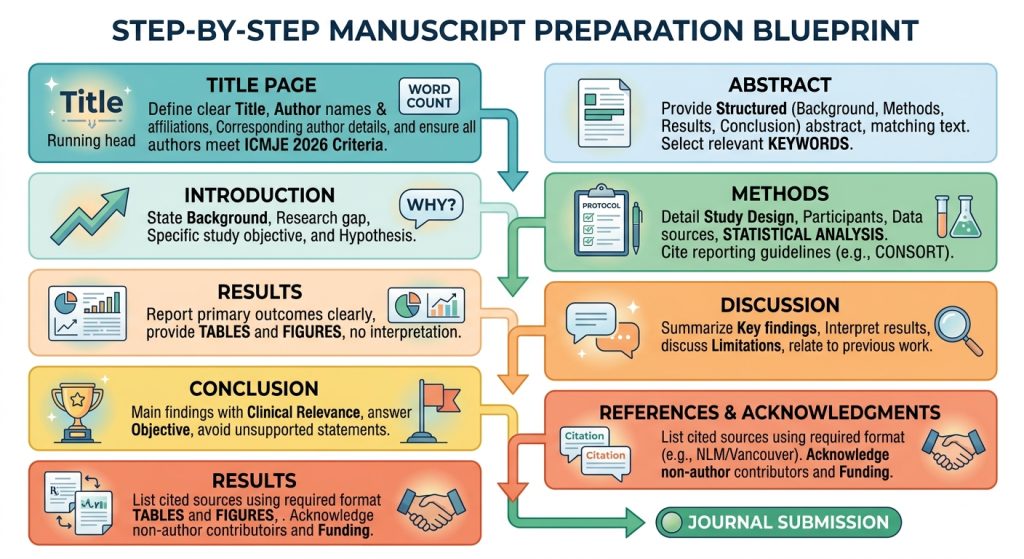
ICMJE Authorship vs. Acknowledgment: Where Is the Line?
One of the most common authorship problems is confusing valuable contribution with qualifying authorship.
ICMJE explicitly identifies several contributions that, when performed alone, do not justify authorship. These include:
- Acquisition of funding
- General supervision of a research group
- General administrative support
- Writing assistance
- Technical editing
- Language editing
- Proofreading
Contributors who meet fewer than all four ICMJE criteria should generally be acknowledged rather than listed as authors.
Authorship vs. acknowledgment in medical journals
| Contribution | Usually authorship by itself? | Appropriate treatment |
| Study conception/design | Potentially | Assess against all 4 criteria |
| Data acquisition | Potentially | Assess intellectual significance and remaining criteria |
| Statistical analysis | Potentially | Author if all 4 criteria are fulfilled |
| Interpretation of results | Potentially | Author if all 4 criteria are fulfilled |
| Manuscript drafting | Potentially | Author if all 4 criteria are fulfilled |
| Critical intellectual review | Potentially | Author if all 4 criteria are fulfilled |
| Funding acquisition alone | No | Acknowledgment/contribution statement |
| General supervision | No | Acknowledgment/contribution statement |
| Technical editing | No | Acknowledgment |
| Language editing | No | Acknowledgment |
| Proofreading | No | Acknowledgment |
| AI-assisted writing | No | Disclosure/acknowledgment as applicable |
The practical rule is straightforward:
Do not add someone because they are senior. Do not remove someone because they are junior. Assess contributions against the same criteria for everyone.
How CRediT Taxonomy Complements ICMJE Authorship
The CRediT taxonomy is increasingly useful for documenting research contributions, but it should not be confused with the ICMJE authorship test.
CRediT provides 14 contributor roles, including:
- Conceptualization
- Data curation
- Formal analysis
- Funding acquisition
- Investigation
- Methodology
- Project administration
- Resources
- Software
- Supervision
- Validation
- Visualization
- Writing original draft
- Writing review & editing
CRediT was approved as an ANSI/NISO standard in 2022 and is designed to make individual contributions more transparent.
A contributor may have a CRediT role without necessarily qualifying as an ICMJE author.
For example, Funding Acquisition can accurately describe a person’s contribution while not satisfying ICMJE authorship when it is their only qualifying role.
Use CRediT to answer:
What did each contributor do?
Use ICMJE to answer:
Does this person qualify as an author?
That distinction prevents a common mistake: treating a long contribution list as proof of authorship.
Also read: Manuscript Editing and Formatting Services for Journal Submission
AI Authorship Guidelines Under ICMJE in 2026
AI is one of the most important developments in the 2026 ICMJE guidance.
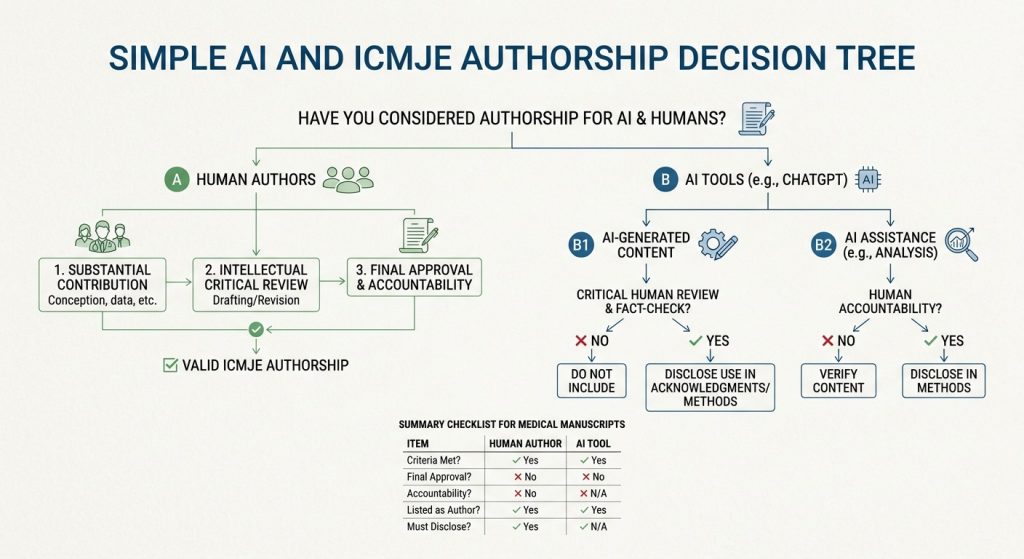
The current ICMJE Recommendations state that AI tools, including chatbots such as ChatGPT, should not be listed as authors or cited as authors. The fundamental reason is accountability: AI systems cannot assume responsibility for the accuracy, integrity, and originality of the published work.
What should authors do if they use AI?
Authors should disclose AI-assisted technology use at submission and describe how the technology was used. Depending on the use case, disclosure may belong in the acknowledgment, methods, cover letter, or another journal-specified section.
Examples include:
Language assistance:
AI was used to improve grammar or clarity. Human authors remain responsible for reviewing every change.
Content generation:
AI generated draft material. Authors must critically evaluate, verify, revise, and take responsibility for the resulting text.
Data analysis or figure generation:
The use should be described in the methods where appropriate.
The 2026 standard: human accountability remains non-negotiable
ICMJE emphasizes that AI-generated output can be incorrect, incomplete, biased, or falsely authoritative. Authors must therefore verify AI-assisted material, ensure appropriate attribution, and check for plagiarism.
Authors should also avoid treating AI-generated material as a primary source.
A useful operational rule is:
AI can assist the workflow; it cannot assume authorship responsibility.
Authorship Order Is a Separate Decision
Meeting ICMJE criteria determines who qualifies as an author. It does not determine the precise order in which authors should appear.
ICMJE states that author order should be determined collectively by the author group. Journals generally do not arbitrate disagreements about author order.
Therefore, establish author order early.
Discuss:
- First-author responsibilities
- Senior/last-author conventions
- Corresponding-author responsibilities
- Equal-contribution designations
- Group authorship
- Consortium or multicenter authorship
- Changes caused by evolving contributions
Do not wait until submission to negotiate authorship. Last-minute changes create unnecessary conflict and can trigger requests for documentation from the journal.
How to Prevent Authorship Disputes Before Submission
Authorship should be treated as a project-management issue, not merely an editorial formality.
At the beginning of the study, create an authorship matrix.
For each contributor, record:
| Contributor | Research contribution | Manuscript role | Final approval | Accountability |
| Researcher A | Study conception | Drafting | Yes | Yes |
| Researcher B | Statistical analysis | Critical review | Yes | Yes |
| Researcher C | Data acquisition | Critical review | Yes | Yes |
| Researcher D | Funding only | None | No | No |
Then update the matrix as the project evolves.
This approach is especially valuable for PhD projects, clinical collaborations, multicenter studies, and industry-academic research where responsibilities can change significantly between protocol development and publication.
The ICMJE recommends discussing authorship during project planning and modifying decisions as contributions develop.
What if authors disagree?
Do not expect the journal editor to resolve a substantive authorship dispute.
ICMJE states that authors collectively determine who qualifies for authorship. If agreement cannot be reached, the institution or institutions where the research was conducted should investigate rather than the journal editor acting as an arbitrator.
COPE similarly treats authorship disputes as an important publication-ethics issue and emphasizes the responsibilities associated with authorship, including accountability for the work.
For this reason, document decisions before submission rather than attempting to reconstruct contribution histories after a dispute occurs.
Do ICMJE Criteria Apply to Every Journal?
ICMJE Recommendations are primarily intended for authors submitting to ICMJE member journals, but many non-ICMJE journals voluntarily follow them. ICMJE explicitly advises authors to use its Recommendations together with the individual journal’s Instructions for Authors and relevant reporting guidelines.
Always check the target journal for additional requirements involving:
- Authorship declarations
- CRediT statements
- AI disclosure
- Corresponding-author responsibilities
- Group authorship
- Equal contributions
- Author forms
- Conflict-of-interest declarations
- Data availability
- Reporting guidelines
Journal policies should be transparent about authorship and contributorship; this is also part of broader publishing best-practice principles promoted by organizations including COPE and DOAJ.
For clinical manuscripts, also check whether your study requires a reporting framework such as CONSORT, STROBE, PRISMA, or another applicable guideline.
ICMJE Authorship Pre-Submission Checklist
Before submitting a medical manuscript in 2026, confirm:
- Every listed author satisfies all four ICMJE authorship criteria.
- Each author made a substantial contribution to the research.
- Each author drafted the manuscript or critically reviewed it for important intellectual content.
- Every author reviewed and approved the final version.
- Every author accepts accountability for the work.
- Contributors who do not meet all four criteria are not incorrectly listed as authors.
- Funding-only, supervision-only, editing-only, or proofreading-only contributions are handled appropriately.
- Author order has been discussed and agreed upon by the research team.
- CRediT roles are documented where required or useful.
- AI use has been disclosed according to ICMJE and the target journal’s policy.
- AI tools have not been listed as authors.
- AI-assisted content has been fact-checked and critically reviewed by human authors.
- AI-generated material has been checked for plagiarism and appropriate attribution.
- The corresponding author has the required author approvals and declarations.
- The target journal’s Instructions for Authors have been audited before submission.
Conclusion
The ICMJE Authorship Criteria (2026) are fundamentally about more than assigning credit. They establish a framework for credit, intellectual contribution, transparency, and accountability.
The four criteria must be satisfied together: make a substantial contribution, participate in drafting or critical intellectual review, approve the final version, and accept accountability for the work. Funding, supervision, technical editing, proofreading, or other isolated contributions do not automatically confer authorship.
The 2026 guidance adds another essential principle: AI cannot be an author. Human researchers remain responsible for the accuracy, originality, integrity, attribution, and disclosure of work produced with AI assistance.
Resolve authorship early, document contributions throughout the project, use CRediT where helpful, and audit the target journal’s policies before submission. A transparent authorship process protects collaborators and strengthens the integrity of the scientific record.
For researchers preparing a manuscript for a high-impact medical or biomedical journal, ManuscriptLab’s professional manuscript editing and formatting services can help refine scientific language, structure, formatting, and submission readiness while preserving the authors’ intellectual responsibility.