Publishing in the wrong journal can cost far more than an article processing charge (APC). A questionable publisher can undermine the visibility of your research, complicate institutional reporting, weaken your publication record, and make it difficult for readers to distinguish credible scholarship from unreliable content.
That concern naturally raises the question: Is F1000Research predatory?
The short answer is no not on the evidence available from its current publishing model and publicly documented practices. F1000Research operates as an open research publishing platform with rapid publication, transparent post-publication peer review, article-level versioning, and stated inclusion in major bibliographic databases for articles that meet its peer-review requirements.
However, legitimacy should never be determined by reputation alone. The more important skill is knowing how to verify a journal before submission.
This guide explains how to evaluate F1000Research and gives you a repeatable framework for checking Scopus indexing, DOAJ status, peer review, editorial policies, APCs, publisher identity, and other warning signs.
💡 Need expert help with your paper?
 Transform your manuscript with ManuscriptLab’s professional editing & formatting services!
Is F1000Research Predatory? Start With the Evidence
The term predatory journal generally refers to a publishing operation that misrepresents or fails to provide essential scholarly publishing services while prioritizing revenue from authors. Warning signs can include deceptive claims about peer review, misleading indexing claims, unclear fees, fabricated editorial boards, aggressive solicitation, and inadequate publication-ethics procedures.
Importantly, there is no single universal database that definitively labels every journal as predatory or legitimate. The International Committee of Medical Journal Editors (ICMJE) explicitly advises authors to evaluate a journal’s integrity, history, practices, and reputation. It also warns that predatory or pseudo-journals may falsely claim relationships with organizations such as ICMJE or COPE.
That makes a checklist-based approach more reliable than relying on a single “predatory journal checker.”
What does F1000Research actually do?
F1000Research describes itself as an open research publishing platform. Its model differs substantially from the conventional journal workflow:
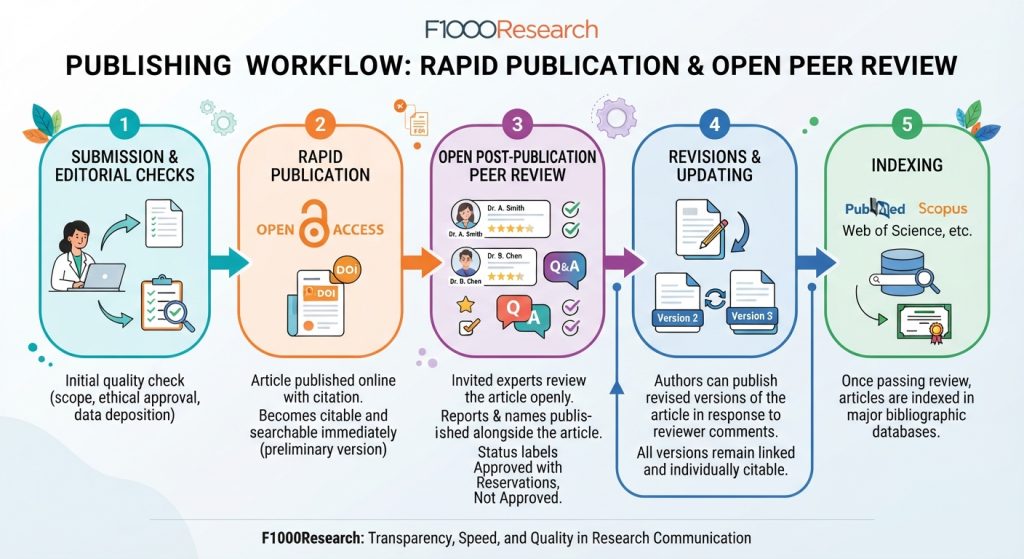
- Manuscripts undergo initial editorial checks.
- Eligible articles are rapidly published.
- Formal peer review occurs after publication.
- Peer reviewers are identified publicly.
- Peer-review reports are published alongside the article.
- Authors can respond and publish revised versions.
- Peer-review status determines whether an article progresses to specified bibliographic indexes.
This is not the same as conventional pre-publication, double-blind peer review. That distinction matters when determining whether the platform fits your university, funder, promotion criteria, or discipline.
F1000Research’s model is therefore better described as open, post-publication peer review rather than conventional anonymous peer review.
F1000Research Open Peer Review Model Explained
One of the biggest reasons researchers question F1000Research is its peer-review sequence.
In a conventional journal, the workflow usually looks like:
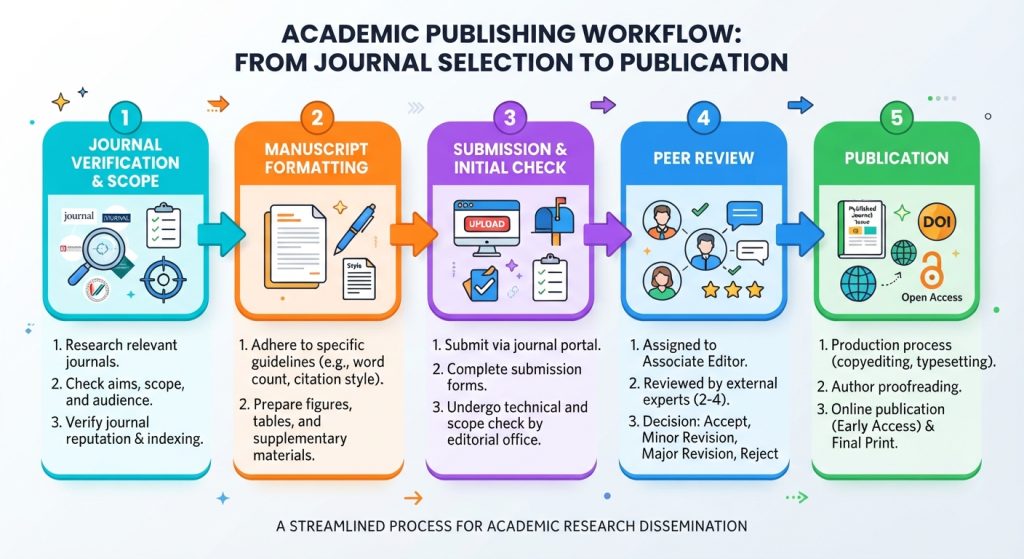
Submission → Editorial screening → Peer review → Revision → Acceptance → Publication
F1000Research reverses the central publication sequence:
Submission → Initial checks → Publication → Open peer review → Revision → Indexing when peer-review criteria are met
F1000Research states that its reviewers’ identities, affiliations, and review reports are made public. Review reports remain associated with the article, including when the article is indexed.
Why use post-publication peer review?
The model is designed around transparency and rapid dissemination.
Researchers can see:
- The original manuscript
- Reviewer identities
- Reviewer reports
- Approval status
- Author responses
- Subsequent article versions
That creates a visible scholarly record rather than keeping the peer-review process entirely behind the editorial curtain.
What is the industry-standard metric?
There is no universally accepted numerical score that determines whether post-publication peer review is “good” or “bad.”
Instead, evaluate:
- Reviewer identity transparency
- Reviewer expertise
- Review depth
- Number of independent reviews
- Editorial oversight
- Publication-ethics policies
- Version control
- Indexing status
- Institutional acceptance
F1000Research states that its articles generally receive two or three peer-review reports and that reviewer approval statuses contribute to determining whether an article has passed peer review.
Common pitfall
Do not assume:
“Published before peer review” = “not peer reviewed.”
The two concepts are different.
Instead, determine when peer review occurs, who conducts it, whether identities are disclosed, how reports are handled, and what happens when reviewers do not approve an article.
Also read: 10 Key Reasons Manuscripts Get Rejected Before Peer Review
F1000Research Indexing Status: Scopus, PubMed, and DOAJ
Indexing is one of the most frequently misunderstood aspects of journal verification.
A publisher may advertise “indexed in Scopus,” but you should never accept that statement without checking the indexing database itself.
F1000Research currently states that articles that pass its peer-review requirements are indexed in databases including PubMed, PubMed Central, MEDLINE, Europe PMC, Scopus, Crossref, DOAJ, and Embase. Articles appear in Google Scholar regardless of peer-review status.
The important qualification is article-level status.
You should not interpret this as:
Every article published on the platform automatically receives the same indexing treatment.
F1000Research explicitly links progression into several bibliographic databases to its peer-review approval requirements.
How to check if a journal is Scopus indexed
Do not rely solely on a journal website.
Elsevier states that authors can verify titles through the Scopus Sources information and Source Title List. The information is updated regularly, and the Scopus source records contain information such as title, ISSN, and publisher details.
Use this sequence:
1. Record the journal’s exact title.
2. Record its ISSN/eISSN.
3. Search the official Scopus Sources database.
4. Compare the publisher and ISSN.
5. Check active/discontinued status.
6. Review coverage information.
ISSN matching is particularly important because journals can have similar or deliberately confusing titles.
Scopus also maintains information on discontinued sources, and titles can be re-evaluated for concerns about publication practices.
How to verify PubMed indexing
For biomedical and clinical research, PubMed verification is equally important.
PubMed allows searches using:
- Full journal title
- Journal abbreviation
- ISSN
The NLM recommends searching using the journal title or abbreviation for comprehensive retrieval.
Do not confuse “an article appears in PubMed” with “the entire journal is currently indexed in MEDLINE.”
Those are different claims.
DOAJ Verification: What It Tells You
For open-access journals, the Directory of Open Access Journals (DOAJ) is an important verification point.
DOAJ evaluates journals against defined criteria covering areas such as:
- Editorial information
- Peer-review processes
- Publication ethics
- Journal management
- Archiving
- Copyright
- Licensing
- Transparency
- Editorial-board information
Its application criteria also consider the journal’s reputation, peer-review practices, website information, and management.
However, DOAJ inclusion should be treated as one verification signal not a universal quality guarantee.
A journal can be legitimate without being indexed in every database.
Likewise, a database listing does not eliminate the need to assess scope, peer review, editorial quality, and institutional suitability.
7 Checks to Verify Any Journal Before Submission
Use the following framework before uploading your manuscript.
1. Verify the Publisher’s Identity
Start with the organization behind the journal.
Look for:
- Legal or organizational identity
- Physical contact information
- Publisher history
- Institutional affiliations
- Editorial office details
- Consistent domain ownership
- Transparent contact channels
A legitimate publisher should make it reasonably easy to identify who is responsible for the journal.
Industry standard: publisher information should be consistent across the journal website, indexing databases, ISSN records, and published articles.
Common pitfall: trusting a professional-looking website.
A sophisticated website proves very little. Deceptive publishers can copy legitimate journal designs, logos, and terminology.
DOAJ’s transparency principles specifically warn against misleading journal websites and copied publisher designs.
2. Audit the Journal’s ISSN
An ISSN is an identifier not a quality certificate.
Check whether:
- The ISSN is valid.
- The print and electronic ISSNs are correctly distinguished.
- The ISSN matches the journal title.
- The publisher information is consistent.
- The same ISSN appears in indexing databases.
Why it matters: a fraudulent website can claim the ISSN of a legitimate journal or manipulate journal-title information.
Always compare identifiers independently rather than copying them from the publisher’s marketing material.
3. Verify Scopus, PubMed, Web of Science, or Other Claimed Indexes
Create an indexing verification matrix rather than accepting a list of logos.
| Claim | What to verify | Best evidence | Risk if unverified |
| Scopus indexed | Exact title + ISSN + coverage | Official Scopus Sources | High |
| PubMed indexed | Journal title/ISSN | PubMed/NLM | High for biomedical papers |
| MEDLINE indexed | NLM journal status | NLM Catalog | High |
| DOAJ listed | Exact journal record | DOAJ | Moderate |
| Web of Science indexed | Collection and title record | Clarivate | High |
| Google Scholar | Article discoverability | Google Scholar | Low |
| “Impact Factor” | Official JCR metric | Clarivate | Very high |
Industry-standard principle: verify the claim at the database level.
Never treat a logo on a journal homepage as sufficient evidence.
4. Examine the Peer-Review Process
Ask five questions:
- Is peer review clearly described?
- Is reviewer selection explained?
- Are reviewers independent?
- Are review reports retained or published?
- What happens if reviewers reject the manuscript?
A credible journal should explain its process in enough detail for authors to understand what scholarly evaluation actually means.
This is especially important for platforms using open peer review, post-publication review, or other nontraditional models.
For F1000Research, the answer is unusually transparent: reviewer identities and reports are published, and peer-review status is visible on the article.
5. Audit APCs Before Submission
Article Processing Charges are not inherently evidence of predatory publishing.
Legitimate open-access journals may charge APCs to fund:
- Editorial operations
- Peer-review administration
- Typesetting
- XML/metadata production
- Digital hosting
- Long-term preservation
- DOI registration
- Indexing infrastructure
- Post-publication services
The problem arises when fees are hidden, misleading, unexpectedly increased, or disconnected from meaningful publishing services.
Before submission, document:
APC amount → Currency → VAT/tax → Waiver eligibility → When payment is due → Refund policy → Additional charges
Do not submit first and investigate the fee later.
6. Check Editorial Board and Governance
Review several editorial-board members rather than simply checking whether names appear on a page.
Verify:
- Institutional affiliation
- Research field
- Current position
- Recent publications
- Whether the person acknowledges the role
- Whether the board’s expertise matches the journal scope
Warning sign: a long editorial board containing researchers who appear unrelated to the journal’s subject area.
A legitimate editorial board should have meaningful disciplinary relevance.
7. Check Publication Ethics and Transparency
A credible journal should clearly state its policies concerning:
- Conflicts of interest
- Authorship
- Research misconduct
- Corrections
- Retractions
- Complaints
- Appeals
- Data availability
- Human/animal ethics
- Copyright
- Licensing
- Duplicate publication
The Principles of Transparency and Best Practice in Scholarly Publishing, developed by COPE, DOAJ, OASPA, and WAME, provide a useful benchmark for evaluating these policies.
Warning Signs of Predatory Publishers
No single warning sign proves that a journal is predatory. Look for patterns.
High-risk indicators include:
- Guaranteed acceptance
- Extremely short peer-review promises
- Hidden APCs
- False indexing claims
- Fake or unverifiable impact metrics
- Editorial-board members who deny involvement
- Aggressive mass-email solicitation
- Poorly defined aims and scope
- Missing publication-ethics policies
- Fake addresses
- Journal names confusingly similar to established publications
- Poorly maintained websites
- Unclear copyright ownership
- No correction or retraction mechanism
- Pressure to submit immediately
ICMJE specifically warns that predatory or pseudo-journals may claim to conduct peer review when they do not, imitate established journal names, and make misleading claims about affiliations with scholarly organizations.
What is the common mistake?
The biggest mistake is treating one positive signal as proof of legitimacy.
For example:
“It is indexed in Scopus, therefore it is automatically a high-quality journal.”
That conclusion is too broad.
Indexing is important, but authors should still evaluate the journal’s current coverage, peer-review model, editorial practices, fees, scope, and institutional requirements.
Think. Check. Submit. Before You Upload
The Think. Check. Submit. initiative provides a practical journal-verification framework developed by organizations across scholarly publishing, including COPE and DOAJ. Its central principle is straightforward: investigate a journal, verify its claims, and submit only when you can answer most or all checklist questions confidently.
Use its framework alongside your own institutional requirements.
Think
Ask:
- Is this the right journal for my research?
- Does its scope match my manuscript?
- Who publishes it?
- Who reads it?
- Does its publishing model fit my field?
Check
Verify:
- ISSN
- Publisher
- Editorial board
- Peer-review model
- Indexing
- APC
- Copyright
- Licensing
- Ethics policies
- Archiving
Submit
Only proceed when:
- The journal is legitimate.
- Its scope fits your research.
- Its indexing meets your requirements.
- The publishing model is acceptable to your institution.
- You understand the APC.
- You understand the peer-review process.
- Your manuscript follows the journal’s author guidelines.
How to Avoid Desk Rejection Due to Publisher Mismatch
Journal verification is only half the submission decision.
You can select a legitimate journal and still receive a desk rejection because the manuscript does not fit.
Before submission, compare your paper against:
Scope
Does the journal publish your research area?
Article type
Does it accept:
- Original research?
- Systematic reviews?
- Case reports?
- Methods articles?
- Data notes?
- Protocols?
- Short communications?
Reporting requirements
Clinical researchers should check whether the journal expects relevant reporting frameworks such as CONSORT, STROBE, PRISMA, or other discipline-specific standards.
Formatting
Check:
- Word limit
- Abstract structure
- Keywords
- Reference style
- Figure specifications
- Table formatting
- Supplementary files
- Data availability statement
- Ethics declarations
Language and presentation
Even technically correct research can underperform if the manuscript contains unclear prose, inconsistent terminology, poor figure preparation, or reference-style errors.
This is where ManuscriptLab’s professional editing and formatting services can help authors prepare a submission-ready manuscript.
F1000Research vs Traditional Journals: What Should Authors Expect?
| Criterion | F1000Research model | Conventional peer-reviewed journal |
| Initial publication | Rapid publication after checks | Usually after editorial decision and peer review |
| Formal peer review | Post-publication | Usually pre-publication |
| Reviewer identity | Open | Often anonymous |
| Review reports | Public | Often confidential |
| Article versions | Explicit versioning | Varies by journal |
| Article status | Peer-review status displayed | Usually accepted/rejected |
| Open access | Core publishing model | Varies |
| APC | May apply depending on route/gateway | Varies |
| Indexing | Dependent on stated criteria for relevant databases | Depends on journal/index |
| Transparency | High by design | Varies considerably |
The critical lesson is not that one model is universally superior.
The question is:
Does the model satisfy your research field, institution, funder, promotion system, and career objectives?
For example, a university may distinguish between an article being “published,” “peer reviewed,” “indexed in Scopus,” and “indexed in a specific Web of Science collection.”
Do not assume these terms are interchangeable.
Are Post-Publication Peer Review Journals Accepted by Universities?
There is no universal yes-or-no answer.
Institutional policies vary by:
- Country
- University
- Faculty
- Promotion framework
- Funding agency
- Degree requirements
- Research assessment system
- Discipline
A PhD candidate should therefore check the specific doctoral handbook or institutional publication policy before selecting a nontraditional publishing venue.
For a clinical researcher, the relevant requirement might be MEDLINE or PubMed indexing.
For another researcher, the requirement might be Scopus, Web of Science, a particular quartile, or a university-approved journal list.
The correct verification question
Do not ask:
“Is F1000Research legitimate?”
Ask:
“Does this publishing venue meet the publication requirements that apply to my research and career objective?”
That is a much stronger decision framework.
Professional Journal Formatting and Manuscript Preparation Still Matter
Journal verification does not replace manuscript preparation.
Once you select the journal, align your manuscript with its current author guidelines.
Audit:
- Title-page requirements
- Abstract format
- Keywords
- Heading hierarchy
- Reference style
- Citation order
- Figure resolution
- Table formatting
- Supplementary material
- Data availability
- Ethics statements
- Conflict-of-interest declarations
- Funding statements
- Author contributions
Do not blindly apply generic formatting such as 12-point Times New Roman, double spacing, or 1-inch margins if the target journal specifies something else.
Journal requirements take precedence over generic manuscript conventions.
Before uploading, use ManuscriptLab’s manuscript editing and preparation support to identify inconsistencies that can create avoidable editorial problems.
A Practical Journal Verification Scorecard
For high-stakes submissions, create a simple audit before you submit.
| Verification category | Pass condition | Action if failed |
| Publisher identity | Clearly verifiable | Investigate further |
| ISSN | Matches official records | Do not submit yet |
| Scope | Strong manuscript fit | Consider alternatives |
| Peer review | Clearly documented | Investigate model |
| Editorial board | Verifiable experts | Investigate identities |
| APC | Transparent and affordable | Confirm before submission |
| Scopus | Verified independently | Do not trust website logo |
| PubMed/MEDLINE | Verified where relevant | Confirm exact status |
| DOAJ | Verified where relevant | Treat as supporting evidence |
| Ethics | Clear policies | Investigate further |
| Archiving | Long-term preservation stated | Assess risk |
| Copyright | Clearly explained | Review agreement |
| Institutional fit | Meets your requirements | Check policy before submission |
| Formatting | Fully compliant | Correct before upload |
A journal that passes this audit is not automatically “perfect.” The purpose is to replace assumptions with documented evidence.
How to Verify Any Journal Before Submission: The 10-Minute Workflow
When time is limited, use this sequence.
Minute 1–2: Identify the journal.
Record the exact title, publisher, ISSN/eISSN, and official website.
Minute 3: Verify indexing.
Check Scopus, PubMed, Web of Science, DOAJ, or other databases relevant to your discipline.
Minute 4: Examine peer review.
Determine whether review occurs before or after publication and whether reviewer identities are disclosed.
Minute 5: Check APCs.
Record the complete publication cost and waiver conditions.
Minute 6: Check the editorial board.
Verify several members independently.
Minute 7: Review ethics policies.
Look for corrections, retractions, misconduct, conflicts, complaints, and appeals.
Minute 8: Check copyright and licensing.
Confirm who retains copyright and what licence applies.
Minute 9: Compare institutional requirements.
Check your university, funder, department, or promotion framework.
Minute 10: Audit manuscript fit.
Confirm scope, article type, word limit, reporting requirements, references, figures, and submission files.
This workflow is faster and considerably safer than relying on a single predatory-journal blacklist.
Pre-Submission Journal Verification Checklist
Before submitting your research paper, confirm:
- I verified the exact journal title and ISSN.
- I independently verified the publisher.
- I checked the journal’s official indexing status.
- I verified Scopus status through the official Scopus source information where relevant.
- I checked PubMed/MEDLINE status for biomedical research where applicable.
- I checked DOAJ for open-access journals where relevant.
- I understand whether peer review is pre-publication or post-publication.
- I understand whether reviewer identities and reports are public.
- I checked the editorial board.
- I confirmed the complete APC and any additional charges.
- I reviewed copyright and licensing terms.
- I checked publication-ethics policies.
- I verified archiving and preservation arrangements.
- I checked my university/funder’s publication requirements.
- My manuscript matches the journal’s scope and article type.
- I followed the journal’s current author guidelines.
- My references, figures, tables, and supplementary files are submission-ready.
Conclusion: Is F1000Research Predatory?
Current evidence does not support classifying F1000Research as a predatory publisher. Its publishing model is unconventional, but unconventional does not mean illegitimate. F1000Research openly documents its post-publication peer-review process, reviewer transparency, article versioning, publication policies, and indexing pathway.
The more important lesson is broader: do not outsource journal verification to a single blacklist, indexing logo, impact metric, or online opinion.
Use multiple independent signals. Verify indexing at the database level. Examine peer-review practices. Audit APCs. Check editorial governance and publication ethics. Then compare the journal against your institution’s requirements and your manuscript’s scope.
For researchers trying to avoid deceptive publishers in academia, this evidence-based approach is far more defensible than relying on reputation alone.
Ready to submit? Make the final stage as rigorous as the research itself. Get professional manuscript editing and formatting support from ManuscriptLab before you upload your paper.