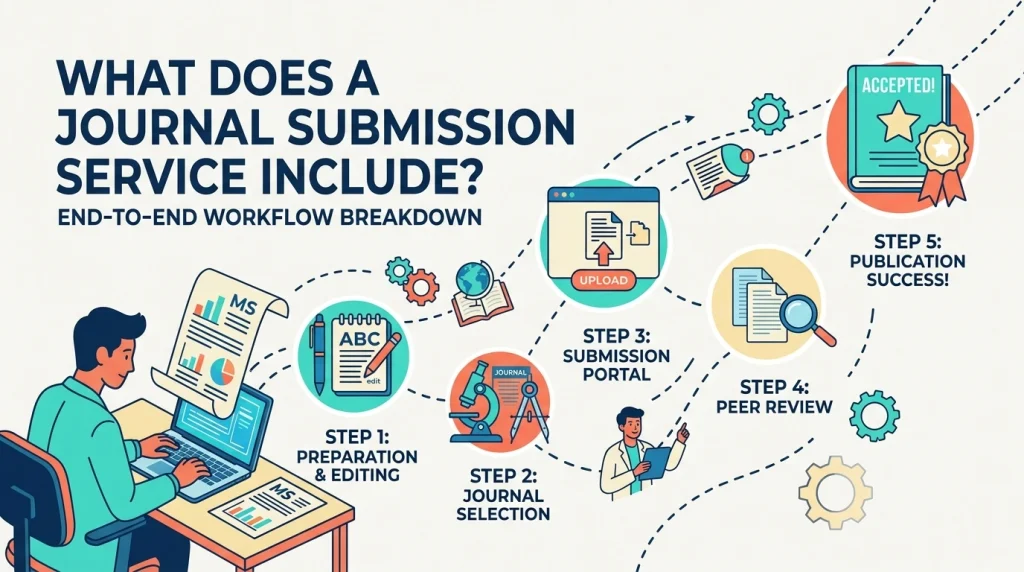
Submitting a research paper to an academic journal involves more than uploading a manuscript and clicking “Submit.” Authors must interpret journal-specific guidelines, prepare supporting documents, complete mandatory declarations, enter accurate metadata, and verify every submission file. Even a strong manuscript can encounter avoidable delays when administrative requirements are overlooked.
A journal submission service provides practical assistance with these tasks, helping researchers prepare and manage the administrative and technical stages of the manuscript submission workflow. Depending on the provider and service package, support may include target-journal guideline checks, cover letter preparation, reference formatting, submission portal navigation, author metadata entry, disclosure checks, and final quality control.
Understanding what a journal submission service includes helps researchers select appropriate support without surrendering control over their research or publication decisions.
This guide breaks down the end-to-end workflow, explains the responsibilities of submission specialists and authors, compares service options, and identifies the ethical safeguards that matter when choosing a provider in 2026.
💡 Need expert help with your paper?
Transform your manuscript with ManuscriptLab’s professional editing and formatting services!
1. Target Journal Selection and Guideline Assessment
The first stage is confirming that the manuscript is prepared for the intended journal. Some submission services provide journal selection support, while others begin after the author has selected a target publication.
What does this stage include?
A submission specialist may review the journal’s aims and scope, accepted article types, author instructions, formatting requirements, submission policies, and required supporting documents.
The assessment can cover:
- Whether the research topic fits the journal’s stated scope.
- Whether the manuscript follows the required article structure.
- Abstract length, keyword limits, and main-text word limits.
- Reference style and citation requirements.
- Figure, table, and supplementary file specifications.
- Reporting checklists required for particular study designs.
- Open-access options, article processing charges (APCs), and relevant copyright policies.
For clinical research, the journal may require reporting checklists such as CONSORT for randomized trials or STROBE for observational studies, depending on the study design and journal policy.
Why does it matter?
Journal requirements differ, even among publications within the same discipline. A manuscript formatted correctly for one journal may need substantial adjustments before submission to another.
A structured guideline assessment reduces preventable technical corrections and helps authors identify missing documents before entering the submission portal.
Industry-standard metric: There is no universal compliance score or fixed number of formatting requirements for every journal. The practical benchmark is documented compliance with the target journal’s current instructions for authors.
Common pitfall: Assuming that a journal submission service automatically includes journal selection, journal ranking analysis, or Impact Factor evaluation. Confirm these deliverables before purchasing the service. Authors should also independently verify the journal’s credibility, indexing claims, and publication policies.
For journal transparency and publishing standards, consult the Directory of Open Access Journals’ transparency and best-practice principles.
2. Manuscript Formatting and Technical File Preparation
Formatting is one of the most visible components of manuscript submission assistance. It focuses on presenting the manuscript in the structure and file formats requested by the target journal.
What does formatting support include?
Depending on the package, a specialist may check:
- Title page and author information.
- Abstract headings and keyword presentation.
- Main-text headings and section order.
- In-text citations and reference-list consistency.
- Table numbering, figure legends, and cross-references.
- Supplementary materials and appendices.
- Line numbering, page numbering, and manuscript layout.
- File names, file types, and upload requirements.
A journal might request a Word document with double spacing and continuous line numbering, while another may require a separate title page and a blinded main manuscript for double-blind peer review.
Image requirements also vary. A journal may specify a minimum resolution, accepted formats, or separate figure uploads. A resolution of 300 DPI is a common print-oriented reference point, but it is not a universal requirement for every figure or online submission.
Why does it matter?
Technical consistency allows editorial staff to process a submission efficiently and reduces the likelihood of administrative requests for corrected files.
Formatting also helps prevent errors such as missing figure references, inconsistent citation numbering, or author-identifying information appearing in a blinded manuscript.
Industry-standard metric: Measure compliance against the journal’s actual specifications rather than a generic template. Check every required file against the relevant file type, size, resolution, and naming rules.
Common pitfall: Confusing manuscript formatting with substantive scientific editing. Correcting headings, spacing, and references does not establish that the study design, statistical analysis, or scientific conclusions are valid.
For specialist support with academic editing and formatting, explore ManuscriptLab’s services.
3. Cover Letter Drafting and Supporting Documents
A cover letter introduces the manuscript to the editor and explains why the work may be appropriate for the journal. Submission services may draft a letter from information supplied by the authors, refine an existing draft, or check the letter against journal requirements.
What should a cover letter contain?
Depending on the journal and article type, it may include:
- The manuscript title and article category.
- A concise explanation of the study’s contribution.
- The manuscript’s relevance to the journal’s readership.
- A statement concerning originality and exclusive submission, where applicable.
- Confirmation of author approval, when required.
- Relevant conflict-of-interest or prior-publication disclosures.
- Information about related manuscripts or previous editorial decisions, where appropriate.
The International Committee of Medical Journal Editors (ICMJE) outlines information that may need to accompany a manuscript, including statements concerning overlapping publications, conflicts of interest, authorship, and other relevant matters.
Other documents may include a conflict-of-interest form, funding declaration, ethics approval documentation, informed consent statement, clinical trial registration details, permissions for reproduced material, and reporting checklists.
Not every manuscript requires every document. Requirements depend on the study, discipline, journal, and applicable policies.
Why does it matter?
A complete and accurate document package helps the editorial office determine whether the submission satisfies its administrative requirements.
Industry-standard metric: Use a document-by-document checklist based on the target journal’s instructions. Every mandatory item should be present, accurate, and approved by the responsible author.
Common pitfall: Allowing a service provider to invent novelty claims, make unsupported statements about originality, or confirm ethical approval without evidence. Authors must supply and verify the underlying facts.
Also read: 10 Key Reasons Manuscripts Get Rejected Before Peer Review
4. Author Declarations and Publication Ethics Checks
Ethical compliance is a critical part of manuscript submission assistance. A service provider can help identify missing declarations and organize the information required by the journal, but it cannot replace the authors’ responsibility for research integrity.
Which declarations may be required?
A submission workflow may include checks for:
- Ethics committee or institutional review board approval.
- Informed consent, where applicable.
- Funding sources and financial support.
- Conflicts of interest.
- Author contributions and authorship approval.
- Data availability statements.
- Clinical trial registration, where applicable.
- Permissions for copyrighted material.
- Related submissions, preprints, or overlapping publications.
- Research reporting and transparency requirements.
- AI-use disclosures, where required by the journal.
The ICMJE provides guidance on author responsibilities and conflicts of interest. Its recommendations also address the use and disclosure of AI-assisted technologies in scholarly publishing.
Why does it matter?
Missing or inconsistent declarations can delay editorial processing and raise questions about transparency. Accurate disclosures help editors evaluate the manuscript within the journal’s ethical and administrative framework.
Industry-standard metric: Verify every declaration against the journal’s current policy and the authors’ documented information. There is no universal declaration set applicable to all research fields.
Common pitfall: Treating an ethics checklist as proof of ethical compliance. A service provider can identify missing information, but authors and their institutions remain responsible for the accuracy of research-related declarations.
5. Submission Portal Setup and Navigation
Many journals use online manuscript management platforms, including Editorial Manager and ScholarOne Manuscripts. A journal submission service may help authors navigate these systems and prepare the required information for entry.
What tasks may be handled?
Depending on the provider’s procedures and authorization, assistance may include:
- Identifying the correct journal submission route.
- Organizing account registration information.
- Selecting the correct manuscript type.
- Completing required submission fields.
- Uploading the designated manuscript and supporting files.
- Assigning file designations, such as main document, title page, figure, or supplementary material.
- Checking the system-generated PDF or submission proof.
- Identifying validation errors before final submission.
A service provider should explain whether it offers guided support, prepares the submission for the author, or performs portal entry under an explicitly agreed authorization.
Why does it matter?
Online submission systems validate information in addition to receiving files. Inconsistent author names, missing mandatory fields, incorrectly designated files, or incomplete declarations may prevent a submission from progressing.
Industry-standard metric: The relevant completion benchmark is a correctly populated submission record that passes the portal’s required validation checks. Portal acceptance alone does not establish scientific quality or guarantee that an editor will send the manuscript for peer review.
Common pitfall: Assuming that every journal uses the same portal workflow. Field labels, file categories, author verification requirements, and final confirmation procedures vary by platform and journal.
Authors should retain control of their credentials and comply with the journal’s account-access policies. Never share passwords through unsecured channels or authorize a provider to make declarations on an author’s behalf without appropriate review and approval.
6. Metadata Entry: Abstracts, Keywords, Authors, and Affiliations
Metadata is the structured information associated with a manuscript in the journal’s submission system. It may later contribute to indexing, discovery, citation records, and publisher workflows.
Which metadata fields are commonly required?
- Full manuscript title and, if requested, a short title.
- Abstract and keywords.
- Names and institutional affiliations of all authors.
- Corresponding author’s contact information.
- Author order and contribution details, where requested.
- Funding information and grant identifiers.
- Disclosure statements.
- Suggested reviewers, when requested and permitted.
- Subject classifications or article categories.
A specialist can transfer approved information from the manuscript into the portal and compare both records for consistency.
Why does it matter?
Metadata errors can create inconsistencies between the published article, indexing databases, institutional records, and author profiles. Incorrect author order or affiliations may also require time-consuming corrections.
Industry-standard metric: Compare every portal field with the final, author-approved manuscript and supporting documents. Names, affiliations, abstract text, author order, and disclosures should match exactly where the journal requires identical records.
Common pitfall: Assuming that accurate metadata guarantees discoverability or a particular citation count. Indexing and citation outcomes depend on many factors beyond submission data quality.
Also read: How to Publish a Paper in Scopus Indexed Journals
7. Final Quality Control and Pre-Submission Verification
Before the final submission, a professional service may perform a structured check of the manuscript package and portal record.
What should the final audit cover?
A practical audit includes:
- Confirming that all required files are present.
- Checking that the correct manuscript version is being submitted.
- Verifying title, abstract, and author information.
- Confirming reference and figure consistency.
- Reviewing declarations and supplementary documents.
- Checking anonymization for double-blind review, where applicable.
- Confirming that the submission PDF renders correctly.
- Resolving portal validation warnings.
- Recording any outstanding issues for the corresponding author.
Why does it matter?
A final review catches discrepancies that may have been introduced when files were revised, converted, uploaded, or transferred into the submission system.
Industry-standard metric: Use a documented pass/fail checklist for all mandatory requirements. Any unresolved issue should be flagged clearly rather than silently treated as complete.
Common pitfall: Confusing a technical pre-submission audit with peer review. A submission specialist does not automatically validate the study’s methodology, independently reproduce statistical results, or establish that the paper meets a journal’s scientific threshold.
8. Submission Confirmation and Post-Submission Support
The workflow may continue after the author submits the manuscript. Some service packages include confirmation checks or limited administrative follow-up; others end when the submission package is ready.
What might post-submission support include?
- Checking whether the portal records the submission as received.
- Helping the author locate the manuscript ID.
- Confirming that the system-generated submission record is available.
- Explaining routine administrative status labels.
- Identifying requests from the editorial office.
- Helping organize documents requested for technical corrections.
- Providing guidance on preparing a resubmission package, if included in the agreement.
The service should distinguish between a manuscript being uploaded, a submission being formally completed, and a manuscript being accepted for editorial consideration. These are different stages.
Industry-standard metric: The relevant evidence is the journal’s submission confirmation or manuscript identification number, when issued. Review timelines vary by journal, discipline, editorial workload, and manuscript type.
Common pitfall: Treating submission confirmation as evidence of acceptance or promising a specific editorial decision date without a reliable basis. Reputable publishing support should describe its scope transparently and avoid guaranteeing acceptance.
Also read: ICMJE Guidelines 2026: How to Format a Medical Manuscript
9. What Does a Journal Submission Service Include? A Comparison Table
Service packages differ, so authors should compare specific deliverables rather than relying on the service name alone.
| Service component | Basic support | Comprehensive support | Key consideration |
| Journal guideline review | May be included | Usually a core task | Confirm whether journal selection is included |
| Manuscript formatting | Basic checks or formatting | Detailed technical compliance | Verify the target journal’s specifications |
| Cover letter | Author-prepared or template | Drafting or detailed review | Authors must approve factual claims |
| Declarations and forms | Checklist | Document coordination and completeness checks | Authors retain responsibility for accuracy |
| Portal assistance | Guidance | Guided or authorized entry | Confirm account-access procedures |
| Metadata entry | May be excluded | May include complete field entry | Verify author names and affiliations |
| Final quality control | Limited review | Structured file and portal audit | Request a defined checklist |
| Post-submission support | Often limited | May include administrative follow-up | Check duration and exclusions |
Note: This is a general comparison, not a claim about the exact packages offered by any individual provider. Request a written scope of work before purchasing a service.
10. Is Using a Journal Submission Service Permitted Under Publication Ethics?
Administrative submission assistance can be compatible with responsible scholarly publishing when it follows journal policies, protects confidential information, and preserves author accountability.
The distinction is between administrative support and misrepresentation of scholarly responsibility.
Appropriate assistance may include formatting references, checking required documents, organizing metadata, reviewing portal fields, and helping prepare a cover letter based on author-provided information.
Problems arise if a provider fabricates declarations, changes scientific claims without authorization, impersonates an author, conceals relevant conflicts, or promises acceptance in exchange for payment.
The ICMJE recommendations explain key responsibilities for authors and other participants in scholarly publishing. The DOAJ transparency principles also emphasize transparent editorial policies and responsible publishing practices.
Before engaging a provider, clarify:
- Who will have access to the manuscript and submission portal.
- How confidential research information will be protected.
- Whether authors must approve the final submission.
- Which tasks are included in the agreed fee.
- Whether any additional charges apply.
- How the provider handles conflicts, corrections, and journal requests.
- Whether the provider makes any claims about guaranteed acceptance.
A credible provider should be transparent about its role and avoid presenting administrative support as a substitute for editorial judgment or peer review.
11. How to Choose the Right Journal Submission Assistance
The most suitable service depends on your manuscript’s readiness, your familiarity with journal systems, and the complexity of the target journal’s requirements.
Step 1: Identify the actual bottleneck
If the manuscript is scientifically complete but the references, figures, and supporting documents need attention, formatting and technical checks may be sufficient.
If you are unfamiliar with the journal portal, guided submission assistance may be more appropriate.
If the manuscript still requires language editing or substantial structural revision, determine whether those services are available separately. Submission assistance should not be assumed to include comprehensive scientific or language editing.
Step 2: Request a clear deliverables list
Ask the provider to specify whether the service includes guideline assessment, formatting, cover letter preparation, declaration checks, metadata entry, portal assistance, final verification, and post-submission support.
Step 3: Check ethical and confidentiality safeguards
Confirm how documents are transferred, who can access them, how author approval is obtained, and whether the provider follows the journal’s submission policies.
Step 4: Compare price and scope
A lower price may reflect a narrower service rather than poor quality. Conversely, a more expensive package is not necessarily more comprehensive.
Compare the actual work, turnaround commitments, revision limits, exclusions, and communication process before deciding.
Step 5: Retain author oversight
The corresponding author should verify the completed submission and remain responsible for the accuracy of the information sent to the journal.
For additional support with preparing your manuscript, review ManuscriptLab’s professional services.
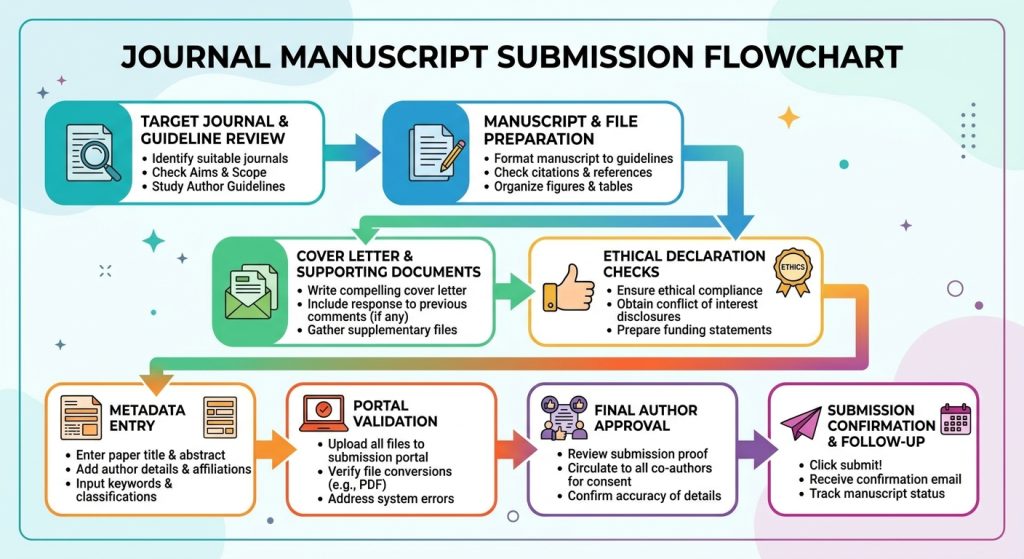
Visual Diagram Placeholder: End-to-End Journal Submission Workflow
12. Pre-Submission Checklist: What to Verify Before Clicking Submit
Use this checklist to confirm that the submission package is complete.
- Journal requirements: Confirm the target journal’s current author instructions and accepted article type.
- Manuscript files: Verify the correct main document, title page, figures, tables, and supplementary files.
- Formatting: Check word limits, references, headings, line numbering, and figure specifications.
- Cover letter: Confirm that the letter accurately describes the manuscript and its relevance.
- Author approval: Verify author order, affiliations, contributions, and required approvals.
- Ethics and disclosures: Confirm the accuracy of funding, conflict-of-interest, ethics, consent, and other applicable declarations.
- Reporting checklists: Include study-specific reporting documents when required.
- Metadata: Match the title, abstract, keywords, author details, and declarations to the approved manuscript.
- Portal validation: Resolve mandatory errors and review the generated submission PDF.
- Confidentiality and blinding: Remove identifying information where the journal requires anonymized review.
- Final approval: Ensure the corresponding author has reviewed and approved the complete submission.
- Confirmation: Retain the submission receipt, manuscript ID, and relevant correspondence.
Conclusion: Make the Journal Submission Process More Manageable
A journal submission service can help researchers navigate the administrative and technical work that accompanies academic publishing. Depending on the package, support may extend from journal guideline assessment and manuscript formatting to cover letter preparation, disclosure checks, metadata entry, portal navigation, and post-submission assistance.
The best service is not necessarily the one that promises the most. It is the one that clearly defines its deliverables, respects publication ethics, protects confidential information, and keeps authors involved in every important decision.
Prepare your manuscript carefully, verify the journal’s requirements, and maintain oversight of all declarations and submission records. When additional expertise would make the process easier, explore ManuscriptLab’s professional editing and formatting services to identify support suited to your publishing needs.