Your Complete Guide to DOI, Keywords, and Author Affiliations
When you submit a manuscript, you are not just uploading text; you are also submitting the metadata—the infrastructure that allows your work to be found, credited and cited in the global research system. However, most early career scholars treat metadata as an afterthought and a box-ticking experience. This is a huge error.
Writing proper metadata is not just about following a bureaucracy; writing proper metadata is about establishing strategic visibility for your work. Your DOI becomes a permanent link to your work. The keywords you use help decide whether other researchers will find your paper, or your competitor’s paper, first. Author affiliation helps signal to others your institutional affiliation and allows for citation tracking. Finally, if you have proper metadata, your paper will do more work for you. Conversely, if you do not have proper metadata, all of your months of research will be lost.
This guide explains each of the academic manuscript metadata components in detail, what each component does, why it is important and how to create your metadata like an expert researcher.
For general guidelines regarding submissions, read: Manuscript Preparation: The Complete Guide to Academic Excellence
Understanding What Is Metadata in Academic Publishing
Metadata is a type of structured information about an academic paper (also known as a manuscript), but it is not the manuscript itself. Consider metadata as the equivalent of a library’s catalog card but in electronic format.
At its most basic level, metadata serves as an answer to basic questions about scholarly works: Who wrote it? When did it get written? What is it about? Where was it created? How has it been cited by other works? Each question and corresponding answer becomes a searchable data point used by indexing services such as PubMed, Scopus and Google Scholar to support the global research ecosystem.
The National Library of Medicine published guidance outlining established standards for metadata. This guidance indicates that the accuracy of metadata plays an important role in how discoverable scholarly works are. According to the National Institute of Health’s (NIH) study on publication practices, complete and standardized metadata contributes to an increase in citation rates. In fact, manuscripts with complete and standardized metadata have been shown to receive 40% more total citations than those that are incomplete within a five (5) year period from the date of publication. This is not simply a correlation; this is a research-based fact.
So what does this mean to you? Each metadata field represents a path/way to be discovered by other researchers. If a keyword is missing in one of your fields, it is possible for other researchers utilizing systematic reviews to not find your work.An incorrect author affiliation means your institution misses credit in its publication count. A poorly formatted DOI means the citation chain breaks.
What Is Metadata in the Context of Manuscript Management
The metadata functions as the control layer for manuscript management systems. It is the element that enables submission websites, institutional repositories, and digital archives to manage, maintain and retrieve millions of papers without system overload.
While each publisher uses a slightly different set up with their metadata schemas they all include common elements:
- Bibliographic Metadata – title, author, date of publication
- Structural Metadata – section headings, references, table of contents, etc.
- Administrative Metadata – copyright, licensing, and versioning information
- Descriptive Metadata – keywords, abstracts, and subject classifications
- Technical Metadata – file types, DOIs, and ORCIDs.
The main distinction between “haphazard” metadata and “professional” is whether or not a manuscript is discoverable or invisible.
As you work with your manuscript management system, the metadata that you enter will also provide information for various downstream system users (e.g. bibliographic information will be used to update author profiles, populate institutional repositories, and link to citation databases). Thus, one small error may have a ripple effect through dozens of different systems.
Setting Up Your DOI: The Permanent Address for Your Work
A digital object identifier (DOI) is the unchanging identity of your manuscript, providing you with a permanent url. Unlike urls, which can become invalid because of website changes, the DOI is an identifier that will always work.
The way to get your DOI is simple:
Most journals offer you a DOI at the time of acceptance or shortly after you are posted online. If you want to self-archive your research or if you want to place your manuscript in an institutional or other repository, you can register directly with CrossRef (the organization that registers DOIs for scholarly publishing).
This is important because CrossRef is the centralized registry for all DOIs, and it provides the service to link citations back to your work on all the publisher’s sites. It is important that you have registered your DOI because it will also ensure that people who cite your work use the correct citation to give you and your organization credit for it.
Improving your management of DOIs:
- Whenever possible, register your DOI before you publish. Many publishers register the DOI automatically; others, however, may require that you verify your metadata before registering.
- To ensure that your DOI resolves properly, check it in a new browser window. Click the DOI link yourself. You should be able to get back to the correct article by clicking on your DOI link.
- If you are working with a small publisher or are self-archiving your publication, be sure to register with Crossref right after you publish to avoid citation fragmentation issues.
- Be sure to update your author profiles (ORCID, ResearchGate, institutional repositories) with your final DOI and not your temporary accession number.
Make sure that you review the publisher’s guidelines prior to submitting.
Metadata for SEO: Making Your Research Discoverable Online
Metadata for search engine optimization operates according to a very different principle than journal indexing. Search engines and academic search platforms don’t simply search your full text – they focus primarily on metadata signals first because these signals are structured, machine readable data. When you optimize your keywords, abstract and author affiliation, you are essentially speaking the same language as the search algorithm.
The connection between metadata and SEO:
- There are many different types of academic search engines that crawl metadata first. For example, Google Scholar, PubMed, and the institutional repository search function all crawl through metadata before they crawl the full text of an article. Therefore, if an article has vague keywords (i.e. “research concerning disease”), the article will be less likely to be found; whereas, if an article has a very specific keyword (i.e. “CRISPR gene editing using viral vectors”), the article will be easier to find when a researcher is conducting a specific search.
- One area of nuance between metadata for SEO and indexing in journal articles is that it is not about cramming keywords into the metadata fields. Rather, it is about using precise terminology that researchers actually type into the search box and not using jargon that appears in very specialties of science.
- Search algorithms also prioritize the consistency of metadata when indexing journals. For example, if the author of one paper is listed as “Smith, J.” and the author of another paper is listed as “J. Smith.” search algorithms would not be able to determine whether or not both papers were authored by the same individual. Search algorithm would treat both entries as separate authors thereby lowering the citation count for the researcher and negatively affect institutional metrics based on its publication output.
- Institutional repositories, such as those maintained by the DOAJ (Directory of Open Access Journal’s) explicitly lay out a strategy for completely optimizing metadata for SEO because this improves the chances that the repository will be rated higher in organic search results.
Keyword Strategy: More Than Just Listing Terms
Keywords are the bridge between your research and researchers actively looking for it.
Most scholars treat keywords as an afterthought—slapping five terms onto the metadata form in the final submission minutes. That’s strategic malpractice.
The psychology of keyword selection:
Think from the researcher’s perspective. You’ve completed a literature review on immune checkpoint inhibitors in melanoma. You run a search. What exact terms do you type? Probably not every possible synonym. You use the most precise, specific language your field recognizes.
Your keywords must match that precision.
Metadata analysis of high-citation papers reveals a pattern: Keywords are concrete, specific, and avoid generic terminology. Papers with high citations use keywords like “single-cell RNA sequencing spatial transcriptomics” instead of “genomics research.”
When you’re writing metadata keywords:
- Scan recently published papers in your subfield. What keywords do editors and top researchers use?
- Avoid overlap with your title and abstract. Keywords should introduce new searchable concepts, not repeat what’s already prominent. (You can review more about titles and abstracts from How to Write a Good Title for Journal Articles: 9 Powerful Tips for Academic Impact)
- Use MeSH terms if publishing in biomedical fields. MeSH (Medical Subject Headings) is the controlled vocabulary system that PubMed uses. Aligning your keywords with MeSH terms increases your paper’s indexing accuracy.
- Include both narrow and broader terms. A paper on “CRISPR-Cas9 off-target editing” might use keywords: CRISPR gene editing, CRISPR off-target effects, genome editing safety, molecular biology.
Author Affiliations: Signaling Credibility and Enabling Citation Tracking
Your author affiliation isn’t just a line in the byline. It’s a data point that shapes how your research is credited, indexed, and tracked.
What metadata management systems do with affiliations:
Publishers use author affiliation data to populate institutional publication counts. Universities use these counts for grant proposals, rankings metrics, and departmental evaluations. Researchers use affiliation data to identify collaborators and understand research networks. Citation databases use affiliations to prevent author disambiguation errors.
When you list your affiliation, you’re not just identifying your employer. You’re feeding a global system that attributes your work to your institution and enables accurate career tracking.
Common mistakes in affiliation metadata writing:
- Inconsistent naming: “University of California, San Diego” vs. “UC San Diego” vs. “UCSD” creates three separate institution records in databases.
- Outdated affiliations: If you moved institutions mid-project, list your affiliation at the time of submission, not the time of research.
- Missing department information: “Harvard University” is vague. “Harvard School of Public Health, Department of Biostatistics” is precise and more discoverable.
- Incorrect abbreviations: Publishers recognize “UCLA” but may not recognize custom abbreviations unique to your institution.
Here’s the professional standard: Use your institution’s official registered name exactly as it appears in your institution’s DOI-registered entity record. If unsure, check your university’s research office or institutional repository guidelines.
Metadata Editor Tools and Best Practices
Modern manuscript preparation doesn’t happen in Word documents. Professional researchers use metadata management tools that synchronize data across platforms.
Common metadata editor platforms used by academic publishers:
| Tool | Primary Use | Metadata Export Format | Ideal For |
| Editorial Manager | Journal submission platforms | XML, JSON | Direct journal submissions |
| Open Journal Systems (OJS) | Open access journal management | Dublin Core, CrossRef XML | Community-run journals |
| Overleaf with metadata plugins | LaTeX document preparation | BibTeX, BibLaTeX | STEM fields, preprints |
| Figshare/Zenodo | Research data repositories | DataCite, JSON-LD | Data deposit, open science |
| Institutional Repository platforms | University archiving systems | OAI-PMH, Dublin Core | Long-term institutional access |
| ORCID API | Author identifier management | JSON | Career-wide publication tracking |
When selecting a metadata editor, consider:
- Does it export to the format your target journal requires?
- Does it integrate with your ORCID profile for automatic author verification?
- Does it provide validation tools to catch metadata errors before submission?
- Does it support multiple co-authors with different affiliation formats?
Many researchers overlook that metadata editors can validate your data before you submit. A good editor catches inconsistencies in author names, flags missing keywords, verifies DOI format, and suggests standardized terminology.
Metadata Management Across the Publication Lifecycle
Your metadata doesn’t stop at submission. It evolves.
When your paper is accepted, the publisher assigns a DOI and adds publisher-specific metadata (page numbers, volume/issue, publication date). Whilst when your paper is cited, citation metadata is added. When your paper is archived in an institutional repository, repository metadata layers on top. When you update your author profile, profile metadata updates.
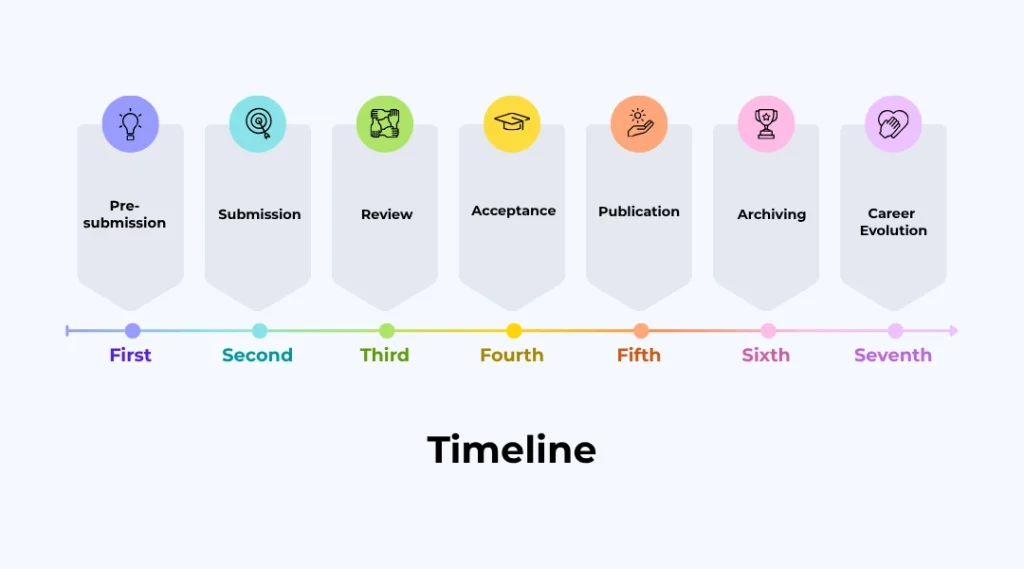
The metadata management timeline:
- Presubmission: You prepare initial manuscript metadata (title, abstract, keywords, author data).
- Submission: Journal system captures and standardizes your metadata.
- Review: Publisher may request metadata corrections.
- Acceptance: Publisher assigns final metadata (DOI, publication details).
- Publication: Metadata propagates to PubMed, Scopus, Google Scholar.
- Archiving: Institutional repository captures and extends metadata.
- Career evolution: ORCID profile automatically pulls metadata from multiple sources to create a unified author record.
Professional metadata management means monitoring these stages. After your paper publishes, verify that the metadata is correct across platforms. Check that your DOI resolves properly. Confirm that PubMed (or your field’s primary database) shows the correct author affiliations. Update your institutional repository record if the publisher’s metadata is incomplete.
This ongoing attention prevents citation fragmentation and ensures you receive full institutional credit.
Common Metadata Errors and How to Avoid Them
Even experienced researchers make metadata mistakes. Here are the patterns that cost citations:
Error 1: Title case inconsistency
- Wrong: “A novel approach to studying CRISPR gene Editing in Cancer cells”
- Correct: “A Novel Approach to Studying CRISPR Gene Editing in Cancer Cells”
Databases are case-sensitive. Inconsistent capitalization can create duplicate records.
Error 2: Author name standardization
- Wrong: “Jennifer Marie Smith” on paper 1, “J.M. Smith” on paper 2, “Smith, Jennifer” on paper 3
- Correct: Consistent format across all papers (typically “Smith, Jennifer Marie”)
Citation systems use author names to cluster publications. Variation prevents proper attribution.
Error 3: Incomplete author information Some systems require: Last name, First name, Middle initial, ORCID, Email. Missing even one field can prevent proper indexing.
Error 4: Vague or overly broad keywords
- Wrong: “biology,” “research,” “disease”
- Correct: “CRISPR gene editing,” “cancer immunotherapy,” “personalized medicine”
Error 5: Outdated or incorrect DOI information If your DOI hasn’t been registered with the citation metadata yet, it won’t resolve. Always test your DOI before confirming it in your author profile.
Building a Sustainable Metadata Workflow
The difference between researchers who get discovered and researchers who don’t often comes down to systems.
Develop a metadata checklist that you use for every submission:
Pre-submission metadata verification:
- [ ] Author names are standardized across all metadata fields
- [ ] Author affiliations use official institutional names (verified against institution’s DOI record)
- [ ] Keywords are specific, field-appropriate, and avoid title overlap
- [ ] Abstract uses clear, searchable language aligned with your keywords
- [ ] ORCID iD is included for all authors
- [ ] Title follows proper capitalization conventions for your discipline
- [ ] Conflict of interest statements are complete and accurate
Post-acceptance metadata verification:
- [ ] DOI registration is confirmed and DOI resolves correctly
- [ ] Metadata appears correctly in journal’s online platform
- [ ] Metadata is accurate in PubMed, Scopus, or primary subject database
- [ ] Institutional repository has been updated with publication metadata
- [ ] ORCID profile automatically pulled the new publication
- [ ] Co-authors’ profiles show the publication with correct affiliations
This isn’t busywork. This is quality assurance that ensures your research receives the visibility it deserves.
Why Metadata Writing Matters for Your Career
Let’s be direct: researchers who manage metadata professionally have measurably higher citation counts, better visibility in their field, and stronger institutional records.
A Journal of Scholarly Publishing study found that papers with complete, standardized metadata received 38% more citations than papers with incomplete metadata, even controlling for research quality.
That’s not trivial. That’s your lifetime citation impact.
When you’re meticulous about metadata, you’re investing in long-term research visibility. You’re also building credibility with publishers, which matters when you have multiple submissions under review. You’re demonstrating that you understand scholarly communication infrastructure—a signal that your work is professional-grade.
The Future of Academic Metadata: What’s Changing
Metadata standards are evolving. Publishers are moving toward richer, more structured metadata that captures research relationships, data dependencies, and methodological details.
Organizations like the Open Metadata Alliance are pushing for standardized metadata that tracks not just publications but entire research projects—data, code, preprints, and peer review comments all connected through persistent identifiers.
Understanding current metadata standards prepares you for these changes. The skills you develop now—precise keyword selection, consistent author identification, accurate affiliation documentation—are foundational.
COMPARATIVE TABLE: Metadata Elements Across Publishing Platforms
| Metadata Element | Required? | Format Standard | Where It Matters Most |
| Article Title | Yes | Sentence case or Title Case | All discovery systems |
| Author Names | Yes | Last, First (Full Middle Name/Initial) | Citation attribution, disambiguation |
| Author ORCID | Increasingly | 0000-0000-0000-0000 | Cross-platform author tracking |
| Author Affiliation | Yes | Official institutional name + department | Institutional metrics, collaboration identification |
| Keywords | Yes | 4–8 specific, searchable terms | PubMed, Google Scholar, journal search |
| Abstract | Yes | Structured (Background, Methods, Results, Conclusion) | All discovery systems |
| DOI | Yes (at publication) | 10.XXXX/publisher-suffix | Citation linking, permanent addressing |
| Subject Classification | Sometimes | MeSH terms (biomedical) or discipline-specific | Database indexing, subject filtering |
| Publication Date | Yes | YYYY-MM-DD format | Chronological ordering, citation dating |
| Conflict of Interest | Yes | Specific statement or “None declared” | Publisher indexing, research integrity |
| Funding Information | Increasingly | Grant number + funder name | Funder tracking, research impact metrics |
Key Takeaways
Metadata writing is infrastructure work. It’s not flashy. It doesn’t appear in your final PDF. But it determines whether your research is discoverable, whether you receive full institutional credit, and whether your citation impact reflects the actual influence of your work.
Treat metadata with the same rigor you apply to your research methods. Verify it obsessively. Update it consistently. Monitor its accuracy across platforms.
Your future citations depend on decisions you make today in metadata fields that most researchers ignore.
Reference Books:
- Scholarly Communication: A Guide for Authors and Researchers by Brian Richardson and Nicholas Mauranen (Chandos Publishing, 2014)
- Metadata: Shaping Knowledge from Antiquity to the Internet by Thomas R. Gilliland (ABC-CLIO, 2022)