Manuscript preparation serves as an integral part of academic publishing through which raw research transitions into an adequate document ready for publication. However, it is also the place most academic authors face challenges, whether they are preparing a manuscript for submission to a peer-reviewed journal, writing their thesis, or creating their first paper. There are many nuances to understanding manuscript preparation that distinguish professional academic authors from amateur academic authors.
This guide includes foundational elements of a manuscript, detailed instructions for the technical aspects of citing manuscripts-in-preparation, publication formatting of manuscript papers, and guidelines for delivering a finished manuscript that commands attention
For assistance, read these guides:
- How to Format a Medical Manuscript According to ICMJE Guidelines
- A Step-by-Step Guide to Formatting Your Manuscript for Nature and Lancet Guidelines (2026)
- Manuscript Formatting Checklist Before Journal Submission: 12 Essential Steps for Success
What Is a Manuscript? Understanding the Academic Document
A manuscript is the scholarly document that has been prepared for either publication/submission. However, unlike completed books or published articles, a manuscript is at that in-between place; it is written and polished, but it still will need to reach its final audience through official publishing channels.
The term includes any of the academic outputs from which a researcher will prepare a manuscript: such as academic papers, research articles, dissertations, theses, and book chapters. When academics talk about preparing an ‘MS’, they are talking about the entire lifecycle of that work’s creation and subsequent peer review or publication.
The distinction is important. The manuscript is not simply a written piece of text, but rather an argument that has been constructed in a specific way and supported with relevant evidence, and thus, formatted to meet required standards.
With the advent of digital technology, many modern-day manuscripts will exist in one or more digital forms (e.g. PDF, MS Word); and the traditional formatted forms of manuscript paper will also be common.
The first step in effectively preparing a manuscript is to determine what format your intended publication requires.
The Anatomy of a Professional Manuscript
Whether you are writing a research paper, thesis or any such document that has to be published, there are certain structural elements in the manuscript that serve a defined purpose. These components are not bureaucratic; they enable communication by making your research accessible and verifiable.
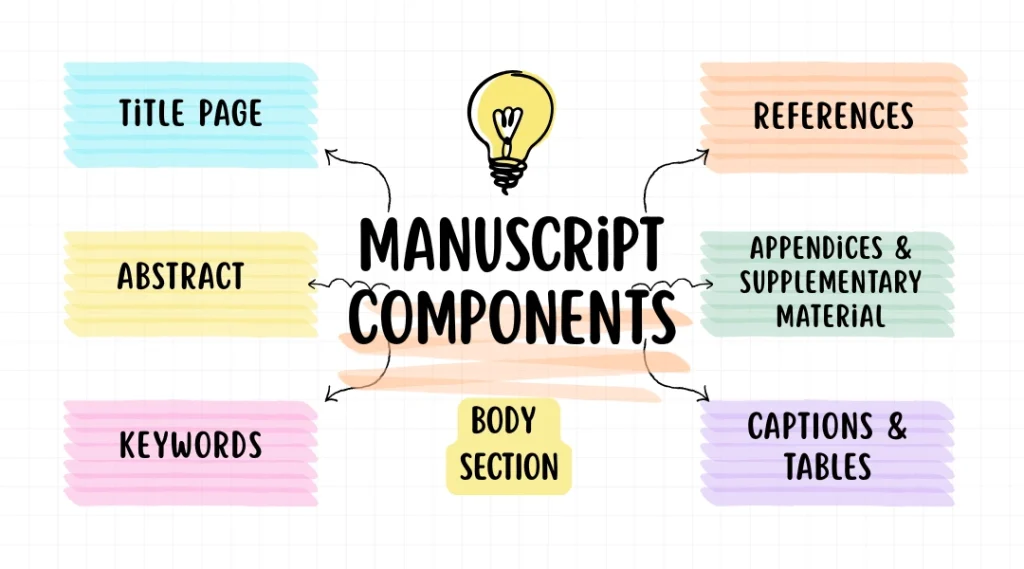
Some of the most essential components include:
1. Title Page: Contains the title of the manuscript, author information, institutional affiliations, and contact information.
2. Abstract: A brief summary, between 150 and 250 words, that provides a synopsis of the research question, methodology, results, and implications of the research.
3. Keywords: Provide 4 to 6 words that describe the primary concepts of the study.
4. Body Sections: Will typically consist of an introduction, literature review, methodology, results, discussion, and conclusion, etc.
5. References: Will contain a comprehensive list of any references used and must be in the proper format for each discipline.
6. Appendices and Supplementary Material: Will include supporting data/detailed methodology/raw datasets.
7. Captions and/or Tables: Will provide a visual representation along with a clear written explanation.
Each of the structural elements in your manuscript serve the reader/reviewer. The abstract may be the only section that most individuals ever read, while the methodology must have enough detail to allow for replication. References demonstrate scholarly rigor. If the structural elements are missing or poorly accomplished, then that would indicate a lack of care and are a warning sign for academic publishing.
Step-by-Step Manuscript Preparation Process
The correct way to prepare a manuscript is in sequential stages, and by rushing them can result in a lower quality proof as well as an increase in your chance to be rejected.
Stage 1: Research and Drafts
When initially writing the first draft, do not dwell on the perfection aspect of it as the main focus while writing will be to provide clarity of argument and provide ample evidence to support your argument. A major error that many scholars make is citing their sources when writing during the initial writing stage as this will only divert attention and slow down the speed of writing. Separate discovery & refinement phases.
Stage 2: Self Editing and Structural Editing.
When self-editing your manuscript, ask yourself if the arguments are presented in a logical order, if there is sufficient support for the claims made, and if each section relates to your thesis statement. This is where you will determine if the end product meets your original goal. In addition, cut out extraneous commentary or thoughts. Evaluate each and every argument and determine how to improve those deemed weak.
Stage 3: Citations and References.
There is no negotiating on this requirement. When making a claim/statement based off of the research done by others, you must provide a citation for said material. When reviewing how to cite a paper that will ultimately be prepared for publication (the manuscript) it will depend on what field you are writing for, (APA, MLA, Chicago, Harvard) as they all have guidelines for citations and references. Ensure to review the author guidelines of the journal you are submitting your manuscript to, when preparing your list (reference list). Failing to cite or not citing correctly is a sign of an unedited manuscript and reduces the credibility of the author.
Stage 4 – Technical formatting stage of manuscript
This can vary by discipline. For example, numerous journals require double spaces and/or margins, while other journals only require the proper font types and existing hierarchic styles for headings etc. There is a growing trend for consistent levels of headings with proper identification of figures and diagrams as well as table formatting when preparing a modern manuscript. If the journal you plan to publish in uses a third-party submission service (such as ScholarOne or Editorial Manager), you should research their respective technical requirements prior to submitting the completed manuscript.
Stage 5 – Proofread your final draft.
Small mistakes can have a major impact on the author’s reputation or credibility. Therefore, typos, incorrect or inconsistent terminology and/or format errors may reflect a lack of care. Read your manuscript out loud in order to identify any awkward wording or phrases. Additionally, ensure that all citations are complete and accurate (i.e., should match the number of figures prepared and referenced in each table).
Learn more with Proofreading vs Editing: 7 Powerful Differences Every Writer Should Know.
Manuscript Paper: The Physical and Digital Standards
The phrase “manuscript paper” carries historical weight. Traditionally, scholars submitted handwritten or typewritten work on physical pages. Today, manuscript paper pdf formats and digital submission have largely displaced paper-based approaches, yet physical presentation standards persist in digital form.
Understanding Manuscript Sheet Requirements
A manuscript sheet typically follows these specifications:
- 8.5 × 11 inches (or A4 international standard)
- 1-inch margins on all sides
- Double spacing for body text
- Single spacing acceptable for footnotes, block quotes, and references
- Left-aligned or justified text
- 12-point font in standard typefaces (Times New Roman, Calibri, Arial)
- Header with page numbers and running title
Many journals now distribute “blank manuscript paper” templates or accept submissions as Word documents. The principle remains constant: your manuscript should be legible, professionally formatted, and easy to navigate.
How to Get Completed Manuscript Look
To achieve a polished, completed manuscript aesthetic:
- Consistency is paramount: Use identical formatting throughout. Heading hierarchy must be visually distinct and logical (H1 > H2 > H3).
- White space matters: Don’t cram text. Generous margins and spacing between sections improve readability.
- Visual hierarchy: Use bold, italics, and indentation strategically. Overuse weakens impact.
- Table and figure integration: Ensure all visuals appear near their citations. Labels should be clear and descriptive.
- Professional appearance: Avoid decorative fonts, excessive colors, or unusual formatting. Academic manuscripts prioritize clarity over aesthetics.
Creating a Comprehensive Table for Manuscript Organization
Below is a practical reference table for manuscript preparation standards across major disciplines:
TABLE: Manuscript Preparation Standards by Discipline
| Element | STEM (APA) | Humanities (Chicago) | Social Sciences (MLA) | Engineering (IEEE) |
| Spacing | Double-spaced | Double-spaced | Double-spaced | Single or double (journal-dependent) |
| Font | 12pt Times New Roman | 12pt Times New Roman | 12pt standard | 10–12pt sans-serif |
| Margins | 1 inch all sides | 1 inch all sides | 1 inch all sides | 1 inch all sides |
| Title Page | Author, affiliation, note | Full title page | Centered, simple format | IEEE header format |
| Page Numbers | Header right | Center bottom | Right corner | As per journal style |
| Abstract | 150–250 words (required) | Optional; varies | Not standard | Brief summary |
| Keywords | 4–6 words (after abstract) | Not required | Not required | 4–8 terms |
| Section Headings | APA level hierarchy | Decimal/alphanumeric | Standard outline format | Numbered sections |
| References | APA format | Chicago Notes-Bibliography or Author-Date | MLA format | IEEE numbered |
| In-Text Citations | Author-date (Smith, 2023) | Superscript numbers or author-date | (Author Page) | [1] numbered brackets |
| Figure Placement | After text reference | As close as possible to text | After text reference | Embedded or appendix |
| Running Header | Short title (max 50 characters) | Author last name | Optional | Journal-dependent |
How to Cite a Manuscript in Preparation—The Complete Guide
Citing works that haven’t been formally published presents unique challenges. This is where many scholars falter. Academic integrity demands transparency about a manuscript’s status.
APA Format for Unpublished Manuscripts:
Smith, J. (2024). Title of the manuscript. Unpublished manuscript, Department of Psychology, University X.
Or, for manuscripts submitted for publication:
Smith, J. (2024). Title of the manuscript. Manuscript submitted for publication.
Chicago Manual of Style (Notes-Bibliography):
John Smith, “Title of the Manuscript” (unpublished manuscript, 2024), 45.
MLA Format:
Smith, John. “Title of Manuscript.” Unpublished manuscript, 2024.
IEEE Style:
[1] J. Smith, “Title of manuscript,” Unpublished, 2024.
For comparison, review this APA vs MLA vs Chicago: Which Citation Style to Use and When (2026 Guide)
Critical Points for Citing Manuscripts in Preparation:
- Always specify status: Readers must immediately recognize the manuscript’s publication status
- Include date: This contextualizes when the work was created
- Provide institutional information: Where was this research conducted?
- Add page numbers or location identifiers: If quoting, precision is essential
- Request permission: Before citing someone else’s unpublished work, obtain permission from the author
When your own manuscript is under review, indicate this clearly: “Author’s manuscript under peer review at [Journal Name].” This transparency strengthens rather than weakens your credibility.
Common Pitfalls in Manuscript Preparation
Understanding where others fail accelerates your success. These are the recurring mistakes that lengthen revision cycles and frustrate editors:
1. Inconsistent Citation Formatting
Authors often mix citation styles. One reference uses full punctuation; another omits it. Some entries include URLs; others don’t. Consistency signals professionalism.
2. Poor Figure and Table Quality
Low-resolution images, tables with inconsistent formatting, and unclear captions frustrate reviewers. Every visual should be publication-ready from your first submission.
3. Vague or Incomplete Keywords
Keywords serve indexing algorithms. Weak keywords reduce discoverability. Your keywords should represent your paper’s actual content and match terms that researchers in your field actually search.
4. Ignoring Journal-Specific Guidelines
Each journal publishes author guidelines for a reason. Following them isn’t busywork—it’s respect for the editor’s workflow and reviewers’ time. Failure to comply often leads to desk rejections before peer review.
5. Excessive Length or Unnecessary Content
Every word should serve your argument. Padded literature reviews, redundant methodology sections, and speculative discussions weaken impact. Conciseness demonstrates clarity of thinking.
6. Inadequate Proofreading
Typographical errors and grammatical mistakes accumulate and create the impression of carelessness. Professional manuscript preparation includes multiple proofreading passes.
Manuscript Preparation in the Digital Age
Manuscript preparation has been changed significantly by technology. Modern technology provides significant advantages over earlier generations; however, with these technologies comes added complexity.
Collaboration and Version Control:
Collaborative research is frequently done by greater than one author from multiple institutions. Overleaf, an online collaborative LaTeX editor, as well as Google Docs and manuscript management systems enable this; however, version control becomes an issue. Establish a consistent naming convention for files and keep a master copy in order to avoid confusion.
Reference Management Software:
Reference management systems such as Mendeley, Zotero, and EndNote can be integrated with MS Word and Google Docs. By using reference management systems, formatting citations can be done quickly and with fewer errors. Any manuscript that reviews a significant amount of literature must use one of these tools as part of its preparation.
Plagiarism Detection:
Many institutions advise that manuscripts should be checked for plagiarism before they are submitted by using a plagiarism detection tool (e.g., Turnitin or iThenticate). While this process does help detect intentional plagiarism, it also finds unintentional duplication or paraphrasing that is inadequate.
Visit the platform!
Accessibility Standards:
Increasingly, manuscripts are prepared with accessibility standards in mind. This includes providing alternate text (alt text) for images, ensuring adequate contrast ratios between color combinations, and using accessible fonts, thereby enhancing the likelihood of your manuscript reaching all audiences, including those who have visual or cognitive impairments.
Manuscript Preparation for Different Academic Contexts
Not all manuscripts follow identical standards. Context matters significantly.
Journal Article Manuscripts:
The most rigorous format. Follow every editorial guideline precisely. Length limits are firm, not suggestions.
Thesis and Dissertation Manuscripts:
Institutional guidelines often exceed journal standards. Your university likely provides specific formatting requirements. These documents are archived and must maintain standards for longevity.
Conference Proceeding Manuscripts:
Typically shorter than journal articles. Some conferences provide templates; use them exactly. Adherence to format requirements demonstrates professionalism and increases acceptance likelihood.
Book Manuscript Preparation:
Publishers provide detailed guidelines addressing chapter structure, front matter, back matter, and permissions. Book manuscripts demand comprehensive indexing and often require specialized formatting for print production.
The Psychology of Reader-Centered Manuscript Preparation
Here’s the hard truth: reviewers are exhausted. Your editor might be reviewing your manuscript at 10 PM after a full workday. Every element of professional manuscript preparation should reduce cognitive load.
- Clear structure: Help readers navigate your argument
- Explicit transitions: Don’t force readers to infer connections
- Highlighted key findings: Readers should never struggle to identify your core contributions
- Accessible language: Clarity trumps sophisticated vocabulary
- Professional presentation: Sloppiness suggests sloppy thinking
Psychology research on document design reveals that readers spend microseconds evaluating whether a document merits serious attention. Your manuscript has seconds to establish credibility through professional presentation.
Final Checklist for Manuscript Submission
Before hitting send:
- Read the author guidelines completely
- Verify all citations are accurate and complete
- Check that all figures and tables are referenced in text
- Ensure all headings follow consistent formatting
- Scan for grammatical errors and typos
- Verify pagination and running headers
- Confirm author information and affiliations are accurate
- Test all hyperlinks if submitting digital format
- Ensure any supplementary materials are properly labeled
- Read your manuscript aloud one final time
Conclusion
Manuscript preparation is not a bureaucratic obstacle—it’s the bridge between your research and its impact. The scholars whose work influences fields are rarely the smartest researchers; they’re the ones who communicate with clarity, rigor, and professionalism.
Whether you’re formatting blank manuscript paper, learning how to cite a manuscript in preparation, or fine-tuning a manuscript sheet for your thesis, remember that every decision reflects your scholarly identity. Invest in the process. The marginally extra effort distinguishes published research from forgotten drafts.
Your manuscript deserves professional preparation. And, your readers deserve clear communication. Your discipline deserves your best work.
For further details visit our official website:
REFERENCE BOOKS
- “The Chicago Manual of Style” (17th Edition) — University of Chicago Press. The gold standard for citation formats, academic writing conventions, and manuscript preparation across disciplines.
- “Publication Manual of the American Psychological Association” (7th Edition) — American Psychological Association. Essential for STEM and social science manuscript preparation, covering APA format standards comprehensively.