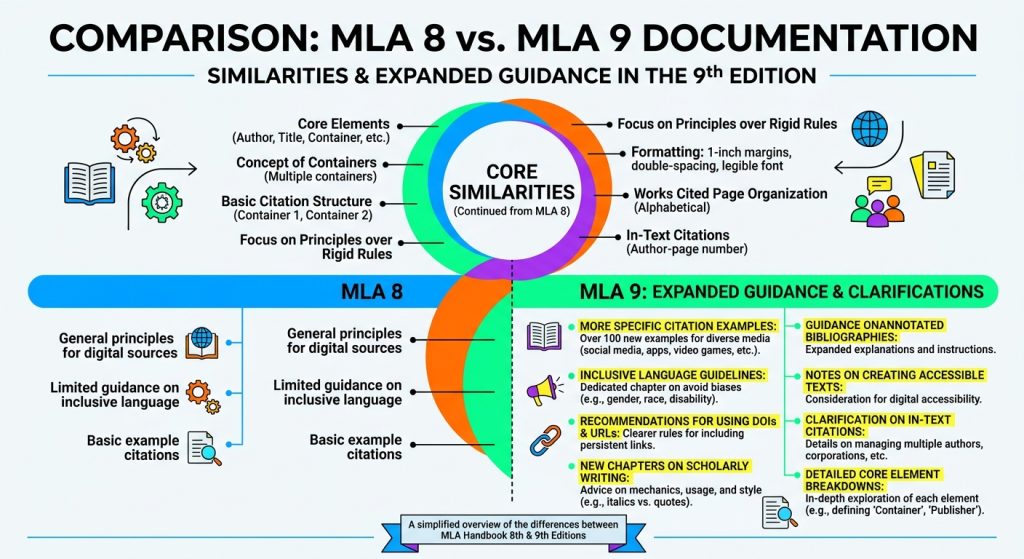
If you are still using an old MLA citation template, the problem may not be your research it may be your documentation system. The MLA 8 vs MLA 9 distinction matters because the ninth edition retains MLA’s core documentation framework but substantially expands its guidance on citations, paper formatting, inclusive language, plagiarism, notes, annotated bibliographies, and research writing.
This becomes especially important when citing graduate research. A master’s thesis or dissertation may exist as an unpublished institutional document, an online repository record, a ProQuest record, or a formally published work. Under MLA 9, you need to identify the relevant MLA Works Cited core elements, determine whether the work has a container such as a database or repository, and construct the entry accordingly.
The good news: MLA 9 did not replace the fundamental system introduced in MLA 8. Instead, it expanded and clarified it. The ninth edition was published in April 2021 and retains MLA’s core-elements approach while adding substantially more examples and guidance.
This guide explains the major MLA 8 to MLA 9 changes, how the editions compare, and exactly how to cite a master’s thesis or dissertation in MLA 9.
💡 Need expert help with your paper?
Transform your manuscript with ManuscriptLab’s professional editing & formatting services.
MLA 8 vs MLA 9: What Actually Changed?
The most important point is that MLA 9 is an expansion and refinement, not a complete overhaul.
MLA 8 introduced the modern template of core elements. Rather than assigning every source to a rigid publication-format category, writers identify information such as author, title, container, publisher, publication date, and location and assemble the entry based on the source being cited.
MLA 9 preserves that system.
What changed is the amount of guidance available for applying it. The ninth edition contains hundreds of additional examples, expanded explanations of citation practices, new paper-formatting guidance, inclusive-language recommendations, annotated-bibliography guidance, and new material on notes and plagiarism.
MLA 8 vs MLA 9 at a Glance
| Feature | MLA 8 | MLA 9 |
| Publication | 2016 | 2021 |
| Core-elements documentation | Yes | Yes; expanded guidance |
| Sample citations | 164 in the text | 333 in the text plus 200+ additional examples |
| Paper-formatting guidance | Limited | Expanded |
| Inclusive-language guidance | No dedicated chapter | New dedicated guidance |
| Annotated bibliographies | Limited | Expanded guidance |
| Notes | Existing guidance | New expanded chapter |
| Plagiarism guidance | Yes | Expanded |
| Quoting and paraphrasing | Yes | Expanded |
| In-text citations | Yes | New, clearer explanations |
| Research-paper formatting | Yes | New dedicated chapter and expanded guidance |
| Dissertation/thesis citation | Core-elements model | Same model with broader explanatory guidance |
The MLA Style Center confirms that the ninth edition retains the documentation system established in MLA 8 while adding extensive examples and guidance.
What Did Not Change?
Do not assume that moving from MLA 8 to MLA 9 means rebuilding every citation.
The central documentation logic remains intact:
Author → Title of source → Title of container → Other contributors → Version → Number → Publisher → Publication date → Location
Not every source contains every element. Your job is to identify the elements that apply and arrange them in MLA’s prescribed sequence.
This is particularly useful for dissertations because the same thesis may appear in several environments. The underlying work remains the same, but its container and location can change.
1. Understand the MLA 9 Core Elements Before Citing a Thesis
Before learning the specific dissertation format, understand the MLA 9 citation architecture.
The core elements are the building blocks used to construct a Works Cited entry. Common elements include:
- Author
- Title of source
- Title of container
- Other contributors
- Version
- Number
- Publisher
- Publication date
- Location
The MLA Style Center recommends evaluating the source first and then including the applicable elements in their prescribed order.
Why This Matters for Theses and Dissertations
A thesis can have several layers of information:
- Author
- Thesis or dissertation title
- University
- Degree designation
- Publication year
- Repository
- Database
- URL or DOI
The common mistake is to include everything indiscriminately.
MLA 9 instead asks you to determine what role each piece of information plays.
For example, if you access a dissertation through an institutional repository, the repository may function as a container. If you access it through a commercial database, the database can function as a second container.
This distinction produces a more accurate citation than simply copying metadata from a database record.
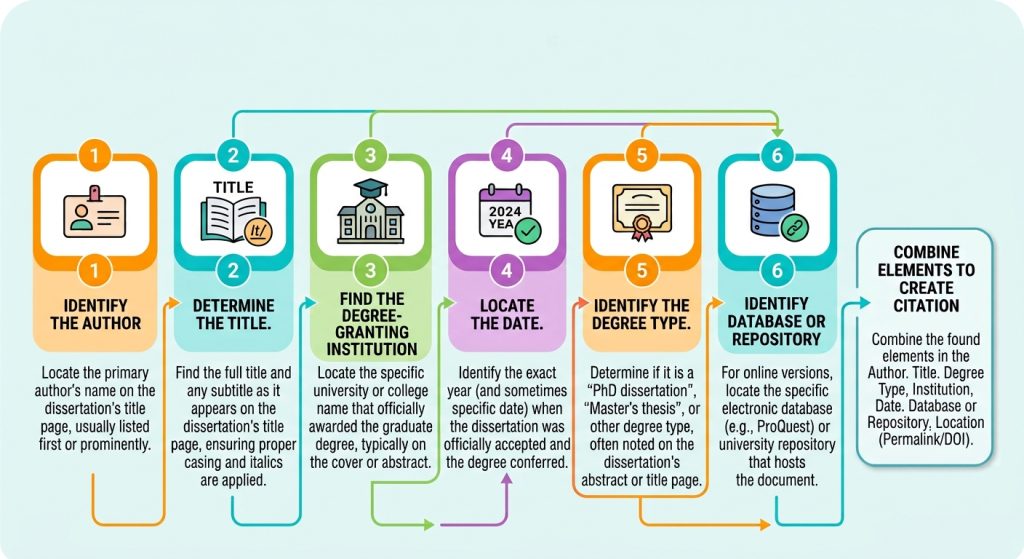
2. How to Cite a Master’s Thesis in MLA 9
A master’s thesis is generally cited using the same core-elements approach as a dissertation.
Start with the author’s name, followed by the title of the thesis. Then identify the date and, where appropriate, the institution and description of the work.
A basic structure is:
Author. Title of Thesis. Year. Institution, master’s thesis.
For example:
Rahman, Aisha. Digital Archives and Memory in Contemporary Fiction. 2024. University of Michigan, master’s thesis.
The exact wording of the degree description should reflect the source and your institution’s terminology. Do not invent a degree designation when the document itself provides different terminology.
Why the Degree Description Matters
Readers need to understand what kind of academic work they are consulting.
A master’s thesis is not necessarily equivalent to a doctoral dissertation, even if both are deposited in the same repository. Identifying the work accurately improves bibliographic precision and allows readers to evaluate the source in context.
Common Pitfall: Treating the University as the Publisher Automatically
Do not mechanically treat the university as a publisher.
The university may be the institution granting the degree, while a repository or database serves as the container through which you accessed the work. MLA’s core-elements system requires you to determine the function of each element rather than simply reproduce a database citation.
3. How to Cite a Dissertation in MLA 9
For a dissertation, begin with the author and title.
A simplified print or standalone format is:
Njus, Jesse. Performing the Passion: A Study on the Nature of Medieval Acting. 2010. Northwestern U, PhD dissertation.
The MLA Style Center explains that dissertations are treated as stand-alone works and that MLA does not distinguish between “published” and “unpublished” dissertations in the way older MLA guidance did.
This is one of the most important points when comparing older citation advice with current MLA practice.
Basic MLA 9 Dissertation Template
Use this conceptual template:
Author. Title of Dissertation. Year. Institution, PhD dissertation.
For a doctoral thesis using terminology from another national academic system, follow the terminology appearing on the work itself.
For example, the MLA Style Center notes that a doctoral research project in the United Kingdom may be called a “thesis” rather than a “dissertation.” Writers should examine the document and use the terminology it provides.
4. Citing a Dissertation from ProQuest or Another Database
Many researchers encounter dissertations through databases such as ProQuest.
In that situation, the database can function as a second container.
A useful model is:
Author. Title of Dissertation. Year. Institution, PhD dissertation. Database Name, URL.
For example:
Carter, Emily. Narrative Identity in Digital Communities. 2023. University of Chicago, PhD dissertation. ProQuest Dissertations & Theses Global, [database location].
The MLA Style Center provides a dissertation example in which ProQuest is included as the second container after the institution and degree description.
Why the Database Matters
A database is not merely a technical access point. It tells your reader where the version you consulted can be found.
This is particularly valuable when:
- the dissertation is difficult to locate through a general web search;
- multiple versions exist;
- the work has a stable database record;
- you need to distinguish the source from another document with the same title.
Common Pitfall: Adding a URL Without Considering the Container
Do not simply append every available URL to a citation.
First determine whether the URL identifies the actual work, a repository record, or a database record. The location element should help readers locate the source you actually consulted.
Also read: 10 Key Reasons Manuscripts Get Rejected Before Peer Review
5. Citing an Unpublished Thesis in MLA 9
The phrase “unpublished thesis” can create unnecessary confusion.
Older MLA advice often emphasized a distinction between published and unpublished dissertations. MLA’s current approach does not make that distinction in the same way. The eighth-edition guidance, which the MLA Style Center explicitly flags as superseded, already moved away from distinguishing published and unpublished dissertations.
Under MLA 9, focus instead on how and where you accessed the work.
If you consulted a thesis as a standalone institutional document, provide the relevant bibliographic information.
Example:
Ahmed, Sara. Language, Migration, and Cultural Memory. 2022. University of Toronto, master’s thesis.
If the thesis is available through an institutional repository, identify that repository as the appropriate container when applicable.
6. MLA In-Text Citation for a Thesis or Dissertation
The Works Cited entry and the in-text citation perform different functions.
Your Works Cited entry gives the reader enough information to identify and locate the source. The parenthetical citation connects your claim to that entry.
If the author’s surname is available and no page number is available, use the author’s name:
Digital archives can reshape how communities preserve collective memory (Ahmed).
If you identify the author in the sentence, the parenthetical citation may not need to repeat the name.
Ahmed argues that digital archives transform the relationship between memory and institutional authority.
What If the Dissertation Has Page Numbers?
If the source provides stable page numbers, include the relevant page number:
(Ahmed 47)
Do not automatically insert a page number simply because the database record contains a PDF. Confirm that the pagination corresponds to the document you actually consulted.
Common Pitfall: Creating an In-Text Citation That Does Not Match Works Cited
Your parenthetical reference must allow the reader to identify the correct Works Cited entry.
If your Works Cited entry begins:
Ahmed, Sara.
your parenthetical citation normally begins:
(Ahmed)
Maintain this connection consistently throughout the manuscript.
7. Works Cited Page Formatting Under MLA 9
Citation accuracy does not end with individual entries. Your entire Works Cited page formatting must follow MLA requirements.
For a conventional MLA research paper, pay attention to:
- double spacing;
- consistent font and readable type;
- 1-inch margins;
- a centered “Works Cited” heading;
- alphabetical ordering by the first element of each entry;
- hanging indentation;
- consistent punctuation and capitalization;
- accurate URLs or DOIs where required.
Your instructor, journal, department, or graduate school may impose additional formatting rules. Always prioritize specific submission instructions when they conflict with general style guidance.
Hanging Indent
Each Works Cited entry should use a hanging indent: the first line begins at the left margin, while subsequent lines are indented.
For example:
Ahmed, Sara. Language, Migration, and Cultural Memory. 2022.
University of Toronto, master’s thesis.
In a word processor, use paragraph formatting rather than manually inserting spaces.
Why Formatting Accuracy Matters
Formatting errors are easy to dismiss as cosmetic. In academic writing, they are evidence of documentation inconsistency.
A poorly formatted Works Cited page can make it difficult to:
- distinguish individual entries;
- locate a cited source;
- verify bibliographic information;
- assess whether sources have been cited consistently.
For thesis writers, citation consistency becomes especially important when hundreds of references accumulate across chapters.
8. MLA 8 to MLA 9 Changes You Should Actually Audit
If you are converting an existing paper from MLA 8 to MLA 9, do not blindly reformat every citation.
Instead, conduct a targeted audit.
Audit 1: In-Text Citations
MLA 9 provides expanded guidance on in-text citations and quotation practices. Review citations where the relationship between the prose and parenthetical reference is ambiguous.
Audit 2: Quotations and Paraphrases
Review quotations for punctuation, capitalization, integration, and attribution.
MLA 9 provides expanded guidance on differentiating your ideas from those of a source and on handling quotations and paraphrases.
Audit 3: Inclusive Language
MLA 9 introduced dedicated guidance on inclusive language, covering areas including race and ethnicity, religion, gender, sexual orientation, ability, age, and socioeconomic status.
This is not merely a formatting issue. It affects scholarly precision and responsible representation of research participants, historical groups, and communities.
Audit 4: Notes
MLA 9 includes new and expanded guidance on notes. If your manuscript uses footnotes or endnotes, review them rather than assuming your MLA 8 conventions remain optimal.
Audit 5: Annotated Bibliographies
If your assignment or research project includes an annotated bibliography, consult MLA 9’s expanded guidance rather than relying on an MLA 8 template.
Audit 6: Works Cited Entries
Do not replace a correct MLA 8 entry simply because it was created under MLA 8.
Instead, check whether the source has changed, whether your access route has changed, and whether MLA 9 provides additional guidance relevant to that source.
9. MLA 8 vs MLA 9: Common Mistakes to Avoid
Mistake 1: Assuming MLA 9 Completely Changed Citation Rules
It did not.
MLA 9 retains the core-elements system introduced in MLA 8. The major difference is expanded guidance and examples.
Mistake 2: Using APA Dissertation Formatting in an MLA Paper
APA and MLA handle references differently. Do not import an APA dissertation template into an MLA Works Cited page.
Mistake 3: Treating Every Thesis as a Book
A thesis is a distinct academic work. Identify its institutional and access context rather than forcing it into a generic book citation.
Mistake 4: Automatically Labeling Every Doctoral Work “Dissertation”
Terminology varies internationally. The MLA Style Center specifically notes that a doctoral project may be called a thesis in the United Kingdom. Check the document itself.
Mistake 5: Copying Database Metadata Without Verification
Database records can contain abbreviated institutional names, inconsistent capitalization, or incomplete information.
Verify the thesis title page and repository record whenever possible.
Mistake 6: Ignoring the Access Platform
If you accessed a dissertation through an online repository or database, determine whether that platform functions as a container and whether a location should be included.
Also read: Academic Editing and Manuscript Formatting Services
10. A Practical MLA 9 Thesis and Dissertation Citation Workflow
Use this workflow whenever you need to cite graduate research.
Step 1: Identify the Author
Record the author’s name exactly and invert it for the Works Cited entry:
Surname, First Name.
Step 2: Record the Complete Title
Copy the title from the thesis or dissertation itself.
Italicize the title because the thesis/dissertation is a stand-alone work.
Step 3: Identify the Date
Use the relevant publication or completion date associated with the source.
Step 4: Identify the Institution
Record the degree-granting institution where appropriate.
Step 5: Identify the Degree Description
Determine whether the work is described as a master’s thesis, PhD dissertation, DPhil thesis, or another academic designation.
Step 6: Identify the Container
If you accessed the work through an institutional repository or commercial database, determine whether that platform functions as a container.
Step 7: Verify the Location
Add the appropriate URL, DOI, or other location information when applicable.
Step 8: Build the In-Text Citation
Connect the parenthetical citation to the author element in the Works Cited entry.
Step 9: Audit the Works Cited Page
Check alphabetical order, hanging indents, spacing, punctuation, capitalization, and consistency.
Step 10: Cross-Check Every Citation
Every source cited in the manuscript should have a corresponding Works Cited entry, and every Works Cited entry should be cited in the text when required by your assignment or publication context.
MLA 9 Thesis Citation Cheat Sheet
| Source situation | Core approach | Example pattern |
| Standalone master’s thesis | Author + title + date + institution/degree | Author. Title. Year. University, master’s thesis. |
| Standalone dissertation | Author + title + date + institution/degree | Author. Title. Year. University, PhD dissertation. |
| Repository thesis | Add repository as applicable container | Author. Title. Year. University, degree. Repository, URL. |
| Database dissertation | Add database as container | Author. Title. Year. University, degree. Database, URL. |
| In-text citation with page | Author + page | (Ahmed 47) |
| In-text citation without page | Author | (Ahmed) |
Use the table as a drafting aid, not as a substitute for evaluating the source’s actual publication and access information. MLA’s core-elements system is intentionally flexible because sources differ.
11. When Should You Use MLA 9 Instead of MLA 8?
In 2026, if your institution, instructor, journal, or publisher specifies the MLA Handbook, 9th edition, use MLA 9.
The ninth edition is the current MLA Handbook edition and was published in 2021. The MLA Style Center continues to provide guidance based on the ninth edition.
If an instructor explicitly requires MLA 8, follow that requirement rather than unilaterally changing styles.
For manuscripts prepared for publication, follow the target journal or publisher’s author guidelines when they prescribe a particular version or house style.
The key is consistency. A manuscript that mixes MLA 8 conventions, MLA 9 recommendations, APA references, and database-generated citations becomes difficult to audit and harder for editors or reviewers to trust.
Pre-Submission MLA 9 Checklist
Before submitting your paper, thesis chapter, or manuscript, complete this audit:
- Confirm that your institution or publisher requires MLA 9.
- Verify every author’s name and source title.
- Apply MLA’s core-elements model rather than a generic citation template.
- Identify the correct container for online theses and dissertations.
- Distinguish repositories from commercial databases.
- Verify dissertation or thesis terminology from the source itself.
- Check publication/completion dates.
- Verify URLs and DOIs where applicable.
- Ensure every in-text citation corresponds to a Works Cited entry.
- Check that every required Works Cited entry is cited in the text.
- Apply hanging indents consistently.
- Alphabetize entries correctly.
- Check capitalization, italics, punctuation, and spacing.
- Review quotations and paraphrases against MLA 9 guidance.
- Audit inclusive-language choices where relevant.
- Review footnotes and endnotes if your manuscript uses them.
- Check the final document against your institution’s submission requirements.
Conclusion
The biggest misconception about MLA 8 vs MLA 9 is that the ninth edition replaced the eighth edition’s citation system. It did not. MLA 9 retains the core-elements framework introduced in MLA 8 while providing substantially more guidance, examples, and coverage for modern academic writing.
For master’s theses and dissertations, the most reliable strategy is to stop thinking in terms of a single rigid “thesis citation format.” Identify the source, determine its applicable core elements, establish whether a repository or database functions as a container, and then construct the Works Cited entry systematically.
When the citation is technically correct but the manuscript still contains inconsistent formatting, references, or documentation, a professional academic editing workflow can prevent avoidable submission problems.
For expert support with academic formatting, citation consistency, and manuscript preparation, explore ManuscriptLab’s academic editing and formatting services.