
A manuscript can present statistically significant findings, use sophisticated analytical techniques, and address an important scientific question yet still receive a desk rejection from a high-impact journal. The reason is often not poor writing alone. Editors must determine whether the research offers a sufficiently original contribution, whether its methodology supports its conclusions, and whether its findings matter to the journal’s readership.
Pre-submission peer review is an independent critical assessment of a manuscript before it enters a journal’s formal editorial workflow. It evaluates scientific novelty, research design, statistical validity, reporting transparency, and publication readiness. Unlike proofreading, it examines whether the study’s central claims are defensible and whether the manuscript makes a compelling case for publication.
For researchers targeting Q1 journals or publications with a high Impact Factor, this distinction matters. A polished manuscript cannot compensate for an inadequately justified research question, an underpowered study, inappropriate statistical methods, or conclusions that exceed the evidence.
This guide explains seven critical evaluation areas, practical assessment criteria, common methodological pitfalls, and a checklist for strengthening a manuscript before submission.
💡 Need expert help with your paper?
Transform your manuscript with ManuscriptLab’s professional editing and formatting services!
1. How Do High-Impact Journal Editors Distinguish True Novelty From Incremental Research?
Scientific novelty is not simply the absence of an identical previous publication. It is the extent to which a study advances existing knowledge through new evidence, methods, mechanisms, interpretations, or applications.
High-impact journals frequently prioritize manuscripts that address consequential questions or change how a field understands a problem. However, novelty is discipline-dependent. A replication study may be valuable when it tests a foundational result, addresses reproducibility concerns, or examines generalizability across populations.
What editors evaluate
The research gap: Does the introduction identify a specific unresolved question rather than merely state that few studies have examined a topic?
The incremental contribution: What does the study establish beyond the strongest existing evidence? Does it test an alternative mechanism, resolve conflicting findings, improve measurement, or validate an important result in a new context?
The significance of the advance: Could the findings influence subsequent experiments, clinical decisions, theoretical models, policy, or research priorities?
The evidence supporting originality: Does the literature review accurately represent relevant studies, including recent systematic reviews, contradictory findings, and closely related publications?
How to audit novelty before submission
Construct a literature comparison matrix covering approximately 10–20 of the most directly relevant studies, expanding the search when the field requires it. This is a practical starting point, not a universal editorial requirement.
| Comparison criterion | Questions to answer |
| Research question | What has already been established? |
| Population or dataset | Is the sample meaningfully different? |
| Methodology | Does the approach resolve a known limitation? |
| Main findings | Which results are genuinely new? |
| Scientific significance | Why should the field care about the difference? |
Use this matrix to write a concise contribution statement: Existing research establishes X, but Y remains unresolved. Our study addresses Y by using Z and provides evidence that advances understanding of W.
Avoid claiming that a study is the “first ever” unless a sufficiently comprehensive search supports that assertion. Likewise, do not equate a small numerical difference with a major scientific advance.
Industry standard: There is no universal novelty score or numerical threshold that determines acceptance at a high-impact journal. Editorial assessment depends on the journal’s scope, readership, competing submissions, and the importance of the advance.
2. How Does Pre-Submission Peer Review Help Prevent Editorial Desk Rejections?
Editorial desk rejection occurs when a journal declines a manuscript before sending it for external peer review. Editors may make this decision because the study falls outside the journal’s scope, lacks sufficient novelty or significance, contains major methodological weaknesses, or fails to meet submission requirements.
A pre-submission review can reduce avoidable risks, but it cannot guarantee that a manuscript will proceed to external review. Editors retain discretion over suitability, priority, and publication capacity.
Five common desk-rejection triggers
- Scope mismatch: The research question does not fit the journal’s aims or audience.
- Insufficient novelty: The manuscript does not explain how its findings advance the existing literature.
- Methodological weaknesses: The design cannot adequately address the stated research question.
- Unsupported conclusions: The discussion makes causal, clinical, or theoretical claims beyond the evidence.
- Incomplete submission materials: Required declarations, reporting checklists, figures, supplementary files, or ethics information are missing.
Conduct a journal-fit audit
Before submission, examine the journal’s aims and scope, article categories, recently published papers, methodological preferences, word limits, and submission checklist. Review several recent articles that resemble your manuscript in study design and scientific purpose.
Then ask whether your paper provides a contribution that the journal’s readers are likely to value. A study can be scientifically rigorous but unsuitable for a journal whose readership prioritizes different questions.
A professional pre-submission critique should separate fatal or potentially fatal scientific flaws from fixable presentation problems. A missing statistical justification may require substantive analysis; an unclear abstract may need only focused rewriting.
Also read: 10 Key Reasons Manuscripts Get Rejected Before Peer Review
3. How Do Reviewers Test Methodological Rigor?
Methodological rigor refers to the extent to which a study’s design, measurements, data collection, and analytical procedures reliably address its research question while minimizing bias.
Reviewers do not evaluate methodology solely by checking whether a sophisticated technique was used. They assess whether the selected design was appropriate, whether the methods were implemented consistently, and whether plausible alternative explanations were considered.
Evaluate the design against the research question
For clinical research, determine whether the design supports the intended inference. Randomized controlled trials can estimate intervention effects under appropriate conditions, while observational studies often identify associations that may remain vulnerable to confounding.
For laboratory research, examine controls, biological and technical replicates, randomization, blinding, measurement validity, and reproducibility. For qualitative research, assess sampling rationale, data collection, analytic transparency, reflexivity, and the adequacy of evidence supporting the interpretations.
Identify threats to validity
- Selection bias: Could participant recruitment, sample inclusion, or exclusions systematically distort the results?
- Measurement bias: Are the instruments validated, the outcomes clearly defined, and the measurements sufficiently reliable?
- Confounding: Could unmeasured or inadequately controlled variables explain the observed associations?
- Analytical flexibility: Were outcomes, exclusions, or statistical models selected after examining results in ways that increase the risk of misleading findings?
Check whether the sample size is justified, missing data are reported, exclusions are explained, and deviations from the original protocol are disclosed where relevant.
Use the correct reporting guideline
Reporting checklists improve transparency; they do not independently prove that a study is well designed. Select the guideline appropriate to the study and use it to identify missing methodological details. The EQUATOR Network provides a searchable library of reporting guidelines.
| Study type | Common reporting guideline | Core review priority |
| Randomized controlled trial | CONSORT | Randomization, allocation concealment, outcomes, participant flow |
| Observational study | STROBE | Participants, confounding, variable definitions, bias |
| Systematic review or meta-analysis | PRISMA | Search strategy, eligibility, study selection, synthesis |
| Diagnostic accuracy study | STARD | Reference standard, participant selection, diagnostic performance |
| Qualitative research | SRQR or COREQ, as appropriate | Sampling, analytic process, reflexivity, evidentiary support |
Common pitfall: Treating checklist completion as a substitute for methodological appraisal. A manuscript may report every required item and still contain a design flaw that prevents reliable interpretation.
4. How Do Reviewers Assess Statistical Rigor and Integrity?
Statistical review asks whether the analytical methods are appropriate, the assumptions are defensible, uncertainty is adequately quantified, and the conclusions follow from the results.
A low p-value does not establish that a finding is important, unbiased, reproducible, or clinically meaningful. Reviewers therefore evaluate the complete analytical argument rather than one headline statistic.
Four essential statistical checks
1. Sample size and power. Determine whether the planned sample size was justified by the primary outcome, expected effect, variability, significance level, and desired statistical power. A power calculation should use defensible assumptions. A conventional target such as 80% power is common in some study designs, but it is not a universal acceptance criterion. For exploratory work or analyses using existing datasets, explain the available sample and the implications for precision.
2. Model selection and assumptions. Check whether the statistical model matches the outcome type, study design, and data structure. Review independence assumptions, distributional requirements, model fit, clustering, repeated measurements, and potential overfitting. For regression analyses, consider collinearity and whether the number of candidate predictors is justified by the available information.
3. Effect sizes and uncertainty. Report effect estimates with appropriate confidence intervals, not p-values alone. Interpret the magnitude and precision of the estimated effect in relation to the scientific or clinical question.
4. Multiple comparisons and analytical transparency. Evaluate whether multiple hypothesis tests, subgroup analyses, interim analyses, or alternative models create an elevated risk of false-positive findings. Where appropriate, use a justified multiplicity adjustment and distinguish prespecified analyses from exploratory investigations.
Statistical significance versus practical significance
A large dataset can make a very small effect statistically significant. Conversely, an important effect may have a wide confidence interval when the study is small.
For example, a clinical intervention might produce a statistically significant improvement of two points on a scale ranging from 0 to 100. Whether that improvement matters depends on the instrument, context, uncertainty, and established threshold for clinical importance. The p-value alone cannot answer that question.
A pre-submission statistical audit should also verify that reported sample sizes match the tables, denominators are consistent, missing observations are handled transparently, and conclusions do not overstate the strength of the evidence.
Industry standard: There is no single statistical checklist applicable to every study. The required analyses depend on the design, outcome, estimand, assumptions, and journal expectations. For complex modeling, clinical trials, meta-analyses, or high-stakes clinical conclusions, an independent statistical reviewer may be warranted.
5. How Should Authors Evaluate the Strength of Their Conclusions?
Even when a study uses appropriate methods and produces credible results, reviewers may question whether the conclusions are proportionate to the evidence. This problem commonly arises when authors interpret associations as causal effects, generalize beyond the sampled population, or present exploratory findings as confirmed hypotheses.
Match every major claim to the evidence
Audit the abstract, results, discussion, and conclusion for consistency. Each major claim should be traceable to a reported analysis, an appropriate external source, or a clearly labeled interpretation.
- Causal claims: Confirm that the design and assumptions support causal inference. Statistical adjustment alone does not automatically eliminate confounding.
- Generalizability claims: Explain whether the sample, setting, and study conditions support application to other populations.
- Clinical claims: Distinguish statistical significance from clinical importance and avoid recommending practice changes unsupported by the evidence.
- Mechanistic claims: Separate directly measured biological mechanisms from plausible explanations that require further testing.
- Exploratory findings: Identify post hoc analyses and hypothesis-generating observations explicitly.
Assess limitations without undermining the study
A strong limitations section does not merely state that the sample was small or the study was conducted at one institution. It explains how each limitation could affect interpretation.
For example, a single-center observational study may provide valuable evidence about an association while leaving questions about causality and external validity unresolved. Explaining these constraints demonstrates analytical maturity rather than scientific weakness.
Common pitfall: Using a generic disclaimer such as “further research is needed” without explaining what remains uncertain, why the uncertainty matters, or which study design could resolve it.
During pre-submission peer review, ask an independent reviewer to identify the strongest alternative explanation for the main finding. If the manuscript does not adequately address that explanation, revise the analysis or narrow the claim.
Also read: Scopus vs Web of Science: Which One Matters More for Researchers?
6. What Should an Expert Manuscript Critique Include?
An effective expert manuscript critique should go beyond grammar correction and general comments. It should provide a prioritized assessment of scientific contribution, methodological defensibility, analytical integrity, reporting quality, and journal suitability.
The objective is to help authors distinguish between problems that threaten the validity of the research and those that primarily affect clarity or presentation.
Five components of a rigorous critique
Scientific novelty assessment: Evaluate whether the research gap is credible, the literature review is sufficiently current, and the contribution is differentiated from existing evidence.
Methodological appraisal: Examine the design, sampling, controls, outcome definitions, bias, reproducibility, and appropriateness of the methods.
Statistical assessment: Check analytical choices, model assumptions, effect estimates, uncertainty, multiplicity, missing data, and consistency between the results and conclusions.
Reporting and compliance review: Assess reporting-guideline alignment, ethics approval or exemption, informed consent where applicable, trial registration where required, funding statements, conflicts of interest, and author contributions.
Editorial readiness assessment: Review journal fit, abstract structure, title accuracy, figure legibility, reference accuracy, cover-letter positioning, and submission requirements.
For clinical manuscripts, the ICMJE Recommendations provide guidance on manuscript preparation, authorship, disclosures, and publication responsibilities. Requirements vary by journal, so authors must also consult the target journal’s current instructions.
How to prioritize review findings
| Priority | Example | Recommended action |
| Critical | Design cannot answer the primary research question | Reassess the study design or narrow the research claim |
| High | Major confounding or inappropriate statistical model | Consult a statistician and revise the analysis where possible |
| High | Novelty is unclear or overstated | Rebuild the literature comparison and contribution statement |
| Moderate | Important methods or results are inadequately reported | Add missing information and improve transparency |
| Routine | Inconsistent terminology, citations, or formatting | Complete technical and editorial corrections |
This hierarchy is a practical review framework, not an official classification used by all journals. A reviewer should explain the reasoning behind each concern and identify what evidence or revision would resolve it.
For additional support, explore ManuscriptLab’s professional editing services. Scientific critique and language editing address different needs; manuscripts with substantive design or statistical concerns may require a specialist in addition to an academic editor.
Also read: How to Write a Good Title for Journal Articles: 9 Powerful Tips for Academic Impact
7. Is Independent Pre-Submission Peer Review Permissible?
In general, authors may seek independent scientific feedback before submitting their work. External critique by a qualified colleague, subject-matter expert, methodologist, or professional review service is distinct from the journal’s formal peer-review process.
However, independent pre-submission review must not be confused with unauthorized access to confidential manuscripts already under review. Authors should protect unpublished data, patient information, intellectual property, and confidential collaborator materials. They should also follow institutional policies, data-use agreements, and applicable journal-specific requirements.
The Committee on Publication Ethics (COPE) outlines ethical expectations for formal peer reviewers, including confidentiality, impartiality, and disclosure of conflicts of interest. ICMJE likewise emphasizes the confidential nature of manuscripts submitted to journals.
Choose an appropriate independent reviewer
Look for demonstrated expertise in the relevant research area, familiarity with the study design, and the ability to identify substantive weaknesses rather than merely polish prose.
For a complex clinical trial, a useful review team might include a clinical subject-matter expert, a biostatistician, and an academic editor. A qualitative study may instead require expertise in qualitative methodology, the relevant discipline, and transparent reporting practices.
Before sharing a manuscript, establish the scope of the review, confidentiality arrangements, deliverables, and any conflict-of-interest considerations. If a reviewer has a relationship that could compromise impartiality, disclose it and consider another reviewer.
Can a pre-submission review prevent desk rejection?
It can help reduce avoidable risks by identifying scope mismatches, unclear novelty claims, reporting omissions, and major methodological concerns. It cannot predict every editorial decision or guarantee acceptance.
Use the feedback to improve the manuscript’s scientific defensibility, not to manufacture a more impressive narrative. Do not suppress unfavorable results, manipulate analyses to achieve significance, or overstate novelty to satisfy perceived editorial preferences.
Also read: ManuscriptLab professional editing and formatting services
The Pre-Submission Peer Review Workflow
Use a structured workflow to move from initial diagnosis to a submission-ready manuscript.
- Define the target journal: Check scope, readership, article type, and author instructions.
- Audit novelty and significance: Evaluate the literature gap, competing evidence, and original contribution.
- Review methods and statistics: Examine design validity, bias, assumptions, effect sizes, and uncertainty.
- Obtain independent expert critique: Seek prioritized scientific, analytical, and reporting feedback.
- Revise, verify, and submit: Resolve major issues, check compliance, and finalize submission files.
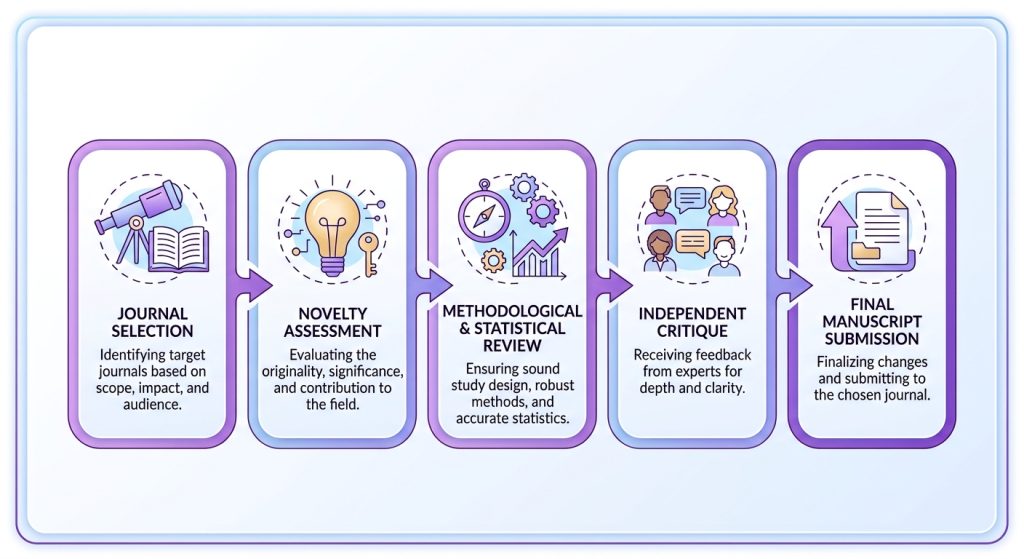
This workflow is iterative rather than strictly linear. If a reviewer identifies a fundamental limitation, authors may need to revisit the analysis, reconsider the claims, or select a more appropriate target journal before proceeding.
Pre-Submission Peer Review Checklist for Researchers
Before submitting to a Q1 or high-impact journal, verify that your manuscript is scientifically defensible, clearly positioned, and technically complete.
Novelty and journal fit
- The research gap is specific and supported by relevant literature.
- The manuscript clearly differentiates its contribution from prior studies.
- The target journal’s scope and readership match the research.
- The abstract and cover letter communicate the study’s significance without exaggeration.
Methods and statistical rigor
- The study design addresses the research question.
- Sample size, sampling strategy, controls, and exclusions are justified.
- Statistical models, assumptions, and missing-data procedures are appropriate.
- Effect sizes, confidence intervals, and relevant uncertainty measures are reported.
- Exploratory analyses and multiple comparisons are handled transparently.
Reporting and research integrity
- The relevant reporting guideline has been consulted.
- Ethics approval, consent, registration, and data statements are included where applicable.
- Funding, conflicts of interest, and author contributions are disclosed.
- References and supporting evidence have been verified.
- Conclusions remain proportionate to the evidence.
Submission readiness
- Figures, tables, and supplementary files are complete and legible.
- The manuscript follows the journal’s formatting and word-count requirements.
- A qualified independent reviewer has assessed substantive weaknesses.
- All critical review findings have been resolved or transparently addressed.
- The final submission files and declarations have been cross-checked.
Conclusion: Strengthen Your Manuscript Before the Editor Sees It
High-impact journal publication requires more than clear writing or statistically significant results. Editors and reviewers evaluate the originality of the research question, the importance of the contribution, the reliability of the methodology, the integrity of the statistical analysis, and the strength of the evidence supporting the conclusions.
A systematic pre-submission peer review helps researchers identify weaknesses early, improve scientific transparency, and align their manuscript with the expectations of the intended journal. By combining independent expert critique with appropriate reporting guidelines, careful statistical verification, and a final editorial audit, authors can make better-informed submission decisions and reduce avoidable rejection risks.
Prepare your manuscript for publication with ManuscriptLab. Whether you need an expert manuscript critique, academic editing, or formatting support, a structured review can help you identify the revisions that matter most.