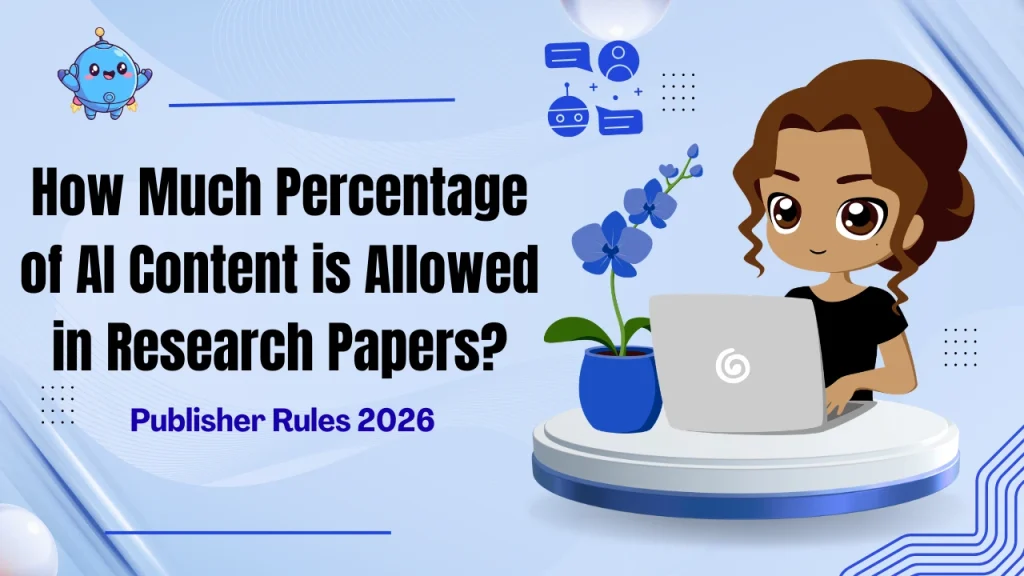
For researchers using ChatGPT, Claude, Gemini, or other generative AI tools, one question has become increasingly urgent: How much AI-generated content is actually allowed in a research paper?
The short answer is more nuanced than a percentage.
As of 2026, major academic publishers generally do not define a universal “10%,” “20%,” or “30%” allowable AI-content threshold for research papers. Instead, publishers increasingly evaluate how AI was used, whether its use was disclosed, whether the author retained intellectual responsibility, and whether the resulting content is accurate, original, and ethically produced.
This distinction matters because an AI detector score is not the same thing as a publisher’s AI-content limit. A manuscript that receives a high AI-detection score is not automatically equivalent to a manuscript containing a prohibited percentage of AI-generated text.
Publishers such as Elsevier, Springer Nature, Wiley, and organizations such as ICMJE and DOAJ increasingly emphasize transparency, human oversight, author accountability, and disclosure.
This guide explains the current publisher rules on generative AI in academic publishing, whether you can use ChatGPT to write a research paper, how AI detectors affect editorial screening, when disclosure is required, and how to use AI ethically without compromising your manuscript.
💡 Need expert help with your paper?
Transform your manuscript with ManuscriptLab’s professional editing & formatting services! Visit ManuscriptLab for expert support with academic editing, manuscript preparation, and journal formatting.
Is There an Allowable AI Content Percentage in Research Papers?
There is currently no universal AI-content percentage accepted across academic journal publishers.
This is the most important point for authors to understand.
A common misconception is that journals operate like plagiarism-screening systems, where a manuscript can contain a fixed percentage of AI-generated text before crossing a rejection threshold. In reality, publisher policies typically focus on the nature and purpose of AI use, not a single numerical percentage.
For example:
- Using AI to correct grammar may be treated differently from generating a literature review.
- Using AI to improve readability may be treated differently from asking it to write your Results section.
- Using AI to organize author-written material may be acceptable under some policies.
- Asking AI to generate scientific interpretations, research findings, or unsupported conclusions can be prohibited.
- Failing to disclose substantive AI assistance can create an editorial or research-integrity concern.
Springer Nature’s 2026 policy explicitly uses a risk-based framework. It distinguishes lower-risk uses such as language improvement from higher-risk uses such as generating scholarly content without appropriate human oversight.
Elsevier similarly permits responsible AI assistance while requiring authors to maintain human oversight and accountability.
Therefore, instead of asking:
“What percentage of my manuscript can be AI-generated?”
ask:
“What did AI do in my manuscript, and does my target journal permit, require disclosure of, or prohibit that use?”
That is the question most aligned with current publishing practice.
Why Publishers Do Not Use a Universal AI Percentage
A percentage-based threshold would be difficult to apply consistently.
Consider two manuscripts:
- Manuscript A contains 15% AI-assisted text used to improve grammar and sentence structure.
- Manuscript B contains 5% AI-generated text consisting of fabricated references and unsupported scientific claims.
A simple percentage would make Manuscript B appear safer because its AI percentage is lower. From a research-integrity perspective, however, the nature of the generated content matters far more than the numerical proportion.
Publisher policies therefore emphasize:
- Human intellectual contribution
- Accuracy and verification
- Transparency and disclosure
- Originality
- Research integrity
- Data and confidentiality protection
- Compliance with the target journal’s author instructions
This approach is also reflected in ICMJE guidance, which states that authors using AI-assisted technologies should disclose their use and remain responsible for the accuracy, integrity, and originality of submitted material.
What Percentage of AI Content Is Allowed by Academic Journal Publishers?
The practical answer is:
There is no single percentage that can be safely applied to every journal.
Instead, publishers classify AI use according to its function and risk.
| AI Use in Manuscript | Typical Risk | Disclosure Consideration | Author Responsibility |
| Spelling and basic grammar correction | Low | Often not required | Verify final text |
| Improving readability | Low–Moderate | Journal dependent | Review all changes |
| Translating author-written text | Moderate | Often required by publisher policy | Verify meaning and terminology |
| Creating an outline | Moderate | Journal dependent | Author develops final argument |
| Rewriting substantial sections | Moderate–High | Commonly requires disclosure | Verify accuracy and originality |
| Generating literature summaries | Moderate–High | Usually disclose if substantive | Verify every source |
| Generating scientific claims | High | Potentially problematic | Human verification essential |
| Generating Results or Discussion independently | High | May be prohibited | Maintain author-led analysis |
| Generating or fabricating research data | Extremely High | Not acceptable | Prohibited |
| Listing AI as an author | Not permitted | Not applicable | Human authors only |
These categories are not a universal publisher-wide classification. They are a practical framework derived from current publisher guidance and should always be checked against the individual journal’s instructions.
How Do Major Publishers Like Elsevier and Springer Regulate Generative AI?
Elsevier
Elsevier’s current journal policy allows authors to use generative AI and AI-assisted technologies responsibly during manuscript preparation.
Permitted applications can include activities such as organizing content, improving language and readability, summarizing complex literature, identifying research gaps, and generating ideas.
However, Elsevier requires human oversight. Authors must verify AI-generated information, check references, correct inaccuracies, and ensure that the manuscript represents their own analysis, interpretation, and contribution.
Elsevier also requires disclosure of substantive AI assistance. Basic spelling, grammar, and punctuation checks do not generally require disclosure, while substantive changes to sentence structure or organization should be disclosed.
If AI was used during the research process itself for example, in analysis or methodology—the use should be described appropriately in the Methods section.
Elsevier also states that AI tools should not be listed as authors.
Springer Nature
Springer Nature uses a risk-assessment approach.
Its current framework broadly separates AI-assisted manuscript preparation into low-risk, cautionary, and prohibited applications.
Low-risk applications include grammar and language editing, readability improvements, formatting, translation, and summarizing author-written material.
More extensive uses—such as generating outlines, drafting sections, or restructuring content—require greater care and transparent description.
Springer Nature identifies some applications as not permitted, including using AI to replace authorship, independently generate scientific claims or interpretations, or produce empirical data or figures without verifiable source material.
The publisher’s central principle is that AI may assist communication, but the argument, interpretation, conclusions, and scholarly responsibility must remain human-led.
Wiley
Wiley similarly emphasizes responsible use, disclosure, human oversight, and accountability.
Importantly, Wiley’s current guidance also recognizes the limitations of AI detectors. Its guidance states that generative-AI detection tools should not be used as a primary decision-making tool because they can produce false positives.
This distinction is critical for authors concerned about AI detector scores.
A detector may flag text as potentially AI-generated. That does not automatically establish that the text violates a journal’s policy.
Can You Use ChatGPT to Write Research Papers?
Yes but how you use ChatGPT matters more than whether you use it.
The question “Can you use ChatGPT to write research papers?” cannot be answered responsibly with a simple yes or no.
Using ChatGPT as a writing assistant can be compatible with publisher policies when the author retains intellectual control, verifies the output, protects confidential information, and follows the target journal’s disclosure requirements.
For example, ChatGPT may assist with:
- Improving sentence clarity
- Identifying grammatical errors
- Reorganizing author-written paragraphs
- Creating an initial outline
- Explaining difficult concepts
- Suggesting alternative wording
- Translating author-written text
- Generating questions for literature review planning
- Helping identify gaps that the researcher then independently investigates
The risk increases when ChatGPT becomes the source of the manuscript’s intellectual content.
Avoid asking an AI system to independently produce:
- Research findings
- Statistical interpretations
- Fabricated citations
- Unverified literature reviews
- Clinical recommendations
- Unsupported causal claims
- Experimental data
- Discussion conclusions that you have not independently developed
A useful principle is:
Use AI to support your research workflow, not to outsource your scholarly responsibility.
Also read: 10 Key Reasons Manuscripts Get Rejected Before Peer Review
Ethical Use of AI Tools in Scholarly Writing
Ethical AI use begins with maintaining a clear boundary between assistance and authorship.
A researcher should be able to explain what the AI tool did and what the researcher did afterward.
For every substantive AI-assisted passage, ask:
What did the AI contribute?
Document whether it:
- Generated new prose
- Reorganized existing prose
- Summarized literature
- Translated material
- Suggested arguments
- Generated code
- Analyzed information
- Created figures
- Altered an existing figure
What did the researcher verify?
Check:
- Scientific claims
- Numerical values
- Citations
- Statistical interpretations
- Terminology
- Methodological statements
- Clinical claims
- Quotations
- References
- Potential bias
Does the final manuscript represent the author’s intellectual contribution?
If the answer is unclear, the AI has probably been given too much responsibility.
Authors should also consider privacy and intellectual-property risks. Never assume that uploading unpublished research data, confidential manuscripts, patient information, proprietary datasets, or identifiable information to an AI platform is automatically safe.
Review the tool’s terms, institutional policies, and data-retention provisions before uploading research material.
How to Disclose Generative AI Assistance in a Research Paper
Disclosure requirements vary by publisher and journal, but a transparent statement generally identifies:
- The AI tool used
- The purpose of using it
- The part of the workflow it supported
- The extent of human review
- The author’s continuing responsibility
A practical disclosure statement might read:
“During the preparation of this manuscript, the authors used [AI TOOL] to assist with language refinement and organization. The authors reviewed and edited all AI-assisted content, independently verified factual claims and references, and take full responsibility for the final manuscript.”
Do not copy a disclosure statement blindly.
Check the journal’s instructions because publishers differ in where they want the declaration.
Elsevier, for example, provides a specific AI declaration format and asks authors to place the declaration near the end of the manuscript.
Wiley may require disclosure in the Methods, an appropriate disclosure section, or acknowledgements depending on the use.
ICMJE recommends disclosure both during submission and in the manuscript where appropriate.
Also read: AI Disclosure in Academic Writing: 2026 Guide to Compliant AI Use
What Do COPE Guidelines Say About AI in Manuscripts?
The Committee on Publication Ethics (COPE) has played an important role in shaping discussions about AI and authorship.
The central principle is that AI systems cannot assume the responsibilities of human authors.
An AI tool cannot independently take responsibility for:
- Accuracy
- Research integrity
- Originality
- Ethical compliance
- Final approval
- Responses to editorial questions
Consequently, AI systems should not be listed as authors.
The broader publishing-ethics principle is straightforward:
The human researchers remain accountable for the work, regardless of which tools assisted its production.
Authors should therefore retain records of substantial AI use where practical. Keep prompts, outputs, versions, and verification notes when they could help demonstrate how the manuscript was developed.
Can AI Detectors Result in Desk Rejections for Research Papers?
This is one of the most misunderstood issues in AI-assisted publishing.
An AI detector score should not be treated as a universal rejection threshold.
There is no industry-wide rule such as:
“AI score above 20% = automatic rejection.”
Publisher screening systems may nevertheless identify manuscripts that appear to contain potentially AI-generated text.
Wiley, for example, uses AI-related screening technology but explicitly warns that AI detectors can produce false positives and should not be used as the primary decision-making tool.
Springer Nature likewise warns that AI-detection tools cannot definitively establish whether AI use was safe or policy compliant.
This means authors should not attempt to “beat” an AI detector by mechanically rewriting sentences.
Instead:
- Follow the journal’s AI policy.
- Disclose substantive AI assistance.
- Independently verify claims and references.
- Ensure the research argument is genuinely yours.
- Remove hallucinated or unsupported content.
- Preserve evidence of your research process.
- Use professional editing to improve clarity without obscuring authorship.
The objective is research integrity, not achieving a particular detector percentage.
When Can AI Use Lead to Serious Editorial Problems?
AI use becomes particularly risky when it affects the reliability of the scholarly record.
Potentially serious problems include:
Fabricated references
Generative AI can produce plausible-looking but nonexistent citations. Every reference should be independently verified through authoritative databases, publisher platforms, or the original publication.
Incorrect scientific claims
AI-generated text can sound authoritative while being scientifically inaccurate or incomplete.
Fabricated data
Using AI to invent observations, participants, measurements, experimental results, or statistical outcomes is fundamentally different from using AI for language editing and is not an acceptable substitute for empirical research.
Undisclosed substantive AI use
If a journal requires disclosure and the author does not disclose relevant AI assistance, the issue can become a transparency or research-integrity concern.
Loss of intellectual contribution
If an AI system generates the central argument, interpretation, or conclusions with little meaningful author involvement, the manuscript may no longer satisfy the expectations of human scholarly authorship.
Confidentiality breaches
Uploading unpublished manuscripts, patient information, proprietary data, or confidential peer-review material into an inappropriate AI service can create privacy and intellectual-property problems.
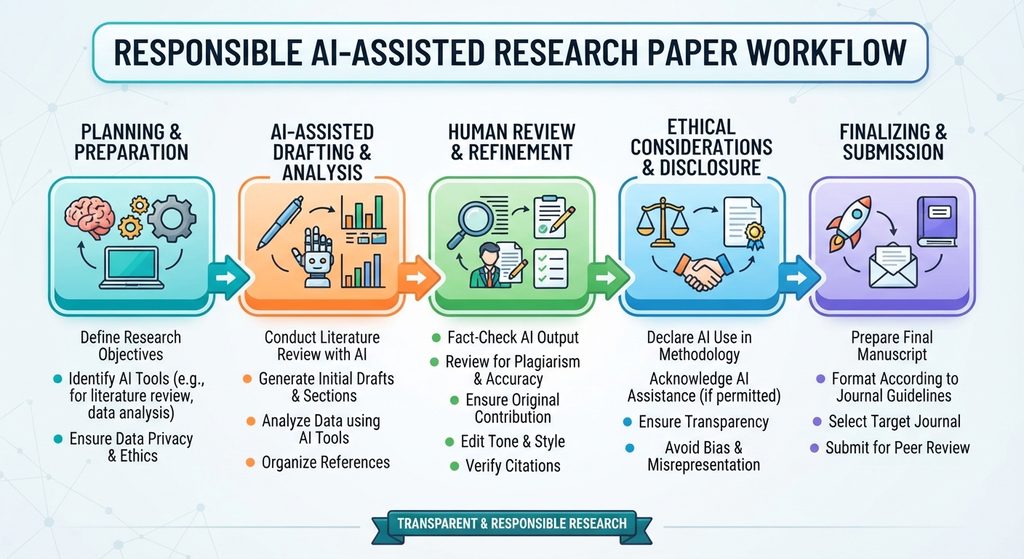
A Practical AI Compliance Workflow for Researchers
Use this workflow before submitting your manuscript.
Step 1: Identify every AI-assisted task
Create an AI-use log.
Record:
- Tool name
- Date
- Purpose
- Section affected
- Type of assistance
- Whether the output was substantially edited
- Verification performed
Step 2: Read the journal’s AI policy
Do not rely exclusively on the publisher’s general policy.
The journal may have additional instructions.
Check:
- Guide for Authors
- Editorial policies
- Submission checklist
- Instructions on AI disclosure
- Authorship requirements
- Data and confidentiality rules
Step 3: Separate language assistance from intellectual contribution
Mark AI use as either:
Language/presentation assistance
or
Substantive intellectual/content assistance
The second category usually requires substantially more scrutiny and disclosure.
Step 4: Verify every AI-derived claim
Do not assume that fluent text is accurate.
Check original sources and verify:
- DOI
- Author names
- Publication year
- Journal
- Volume and issue
- Page numbers
- Data
- Statistical values
- Scientific terminology
Step 5: Prepare the disclosure statement
Use the journal’s preferred wording and location.
Do not hide substantive AI assistance simply because an AI detector score is low.
Step 6: Conduct a final human-authorship audit
Before submission, ask:
- Can I defend every sentence?
- Can I explain every conclusion?
- Can I verify every citation?
- Did I personally interpret the findings?
- Did AI create any unsupported claims?
- Have I disclosed substantive AI use?
- Does my manuscript comply with the journal’s current policy?
If you cannot answer these questions confidently, the manuscript requires another review.
Also read: Professional Manuscript Editing and Formatting Services
Publisher Rules vs. AI Detector Scores: What Authors Should Actually Measure
Authors often focus on an AI percentage because it is easy to quantify.
But the more useful compliance metrics are qualitative.
| Metric | What It Tells You | Should It Determine Submission? |
| AI detector percentage | Estimated likelihood of AI-generated text | No, not by itself |
| Similarity percentage | Text overlap with indexed sources | Requires interpretation |
| Number of AI-assisted sections | Extent of AI involvement | Useful for disclosure |
| Number of verified references | Citation reliability | Yes |
| Disclosure completeness | Transparency | Yes |
| Human verification | Researcher oversight | Essential |
| Policy compliance | Whether journal rules are followed | Essential |
| Author contribution | Ownership of intellectual work | Essential |
The key lesson is that an AI detector score is a screening signal, not an ethical permission threshold.
How to Prepare an AI-Assisted Manuscript for Submission
A professional pre-submission review should go beyond grammar correction.
Audit the manuscript at four levels.
Level 1: Scientific accuracy
Check whether every claim is supported by appropriate evidence.
Level 2: Scholarly argument
Ensure that the introduction establishes a genuine research gap, the methodology addresses the research question, and the discussion interprets rather than merely repeats results.
Level 3: Publication compliance
Audit:
- Reference style
- Figure requirements
- Tables
- Word count
- Structured abstract
- Reporting guidelines
- Conflict-of-interest statements
- Funding disclosures
- AI declarations
- Data availability statements
For biomedical research, verify relevant reporting frameworks such as CONSORT, STROBE, PRISMA, or other discipline-specific standards where applicable.
Level 4: AI transparency
Document substantive AI use and verify that your disclosure matches what actually happened during manuscript preparation.
This final audit can prevent a common mistake: declaring only grammar correction when the tool actually generated substantial new content.
Also read: What is a Citation Booster? Ethical Ways to Scale Research Visibility in 2026
What Researchers Should Do in 2026
The publishing landscape is moving toward a use-based model rather than a percentage-based model.
That means authors should stop treating “0% AI” as the only safe target and stop assuming that “under 20% AI” is automatically acceptable.
Instead, adopt a documented, transparent workflow.
If AI only corrected punctuation, the journal may not require disclosure.
If AI substantially rewrote paragraphs, generated an outline, drafted content, translated sections, or influenced the structure of the manuscript, disclosure may be appropriate or required depending on the journal.
If AI generated scientific claims, interpretations, data, or conclusions without appropriate human oversight, the risk is substantially greater and the use may violate publisher policy.
The safest standard is therefore:
Human-led research + transparent AI use + independent verification + journal-specific compliance.
Pre-Submission AI Compliance Checklist
Before submitting your research paper, confirm:
- I checked the target journal’s current AI policy.
- I identified every substantive AI-assisted task.
- I did not list an AI tool as an author.
- I independently verified AI-generated references.
- I verified scientific claims and numerical information.
- I did not use AI to fabricate research data or results.
- I protected confidential and unpublished research information.
- I reviewed the AI tool’s applicable privacy and usage terms.
- I disclosed substantive AI assistance where required.
- My disclosure accurately describes how AI was used.
- My research argument and interpretation remain human-led.
- I did not treat an AI detector score as an acceptable-content threshold.
- The manuscript complies with the journal’s formatting and reporting requirements.
- Every author has reviewed and approved the final manuscript.
Conclusion
So, what percentage of AI content is allowed by academic journal publishers?
There is no universal percentage. In 2026, leading publishers increasingly focus on purpose, risk, disclosure, human oversight, accuracy, originality, and accountability rather than establishing one numerical AI-content limit.
Researchers can use AI tools responsibly for activities such as language refinement, organization, summarization, translation, and other appropriate forms of assistance. However, the author must remain responsible for the scientific reasoning, evidence, interpretation, references, and final manuscript.
Do not optimize your paper for an AI detector score. Optimize it for research integrity and journal compliance.
Before submission, read the specific journal’s AI policy, document substantive AI use, verify every AI-assisted claim, and ensure that the final manuscript genuinely represents your scholarly contribution.
For researchers who want an additional layer of quality control, ManuscriptLab can help with academic editing, manuscript formatting, language refinement, and publication preparation.