Researchers are under increasing pressure to demonstrate the reach and influence of their published work. Citation counts, h-index, field-weighted citation impact, and other scholarly metrics can affect how research is discovered, evaluated, and discussed. That pressure has also created a confusing market around the phrase “citation booster.”
So, what is a citation booster?
A citation booster is a strategy, service, or set of activities intended to increase the discoverability, accessibility, and legitimate scholarly use of a research publication, thereby creating more opportunities for relevant researchers to cite it. The ethical approach focuses on improving visibility and research communication—not manufacturing citations.
A legitimate citation strategy may include academic profile optimization, metadata improvement, repository deposits, researcher networking, publication discoverability, reference-quality audits, and targeted dissemination. It should never involve fabricated references, irrelevant self-citation, citation rings, purchased citations, or manipulating reviewers or editors.
This distinction matters. The International Committee of Medical Journal Editors (ICMJE) states that references should not be used by authors, editors, or peer reviewers to promote self-interest and that authors should cite directly pertinent original research whenever possible.
This guide explains what citation boosters actually do, which methods are ethical, which practices create publication-ethics risks, and how researchers can scale research visibility without compromising scholarly integrity.
💡 Need expert help with your paper?
Transform your manuscript with ManuscriptLab’s professional editing & formatting services!
What Is a Citation Booster?
The term citation booster does not describe a standardized academic metric, publishing protocol, or universally defined scholarly service. It is better understood as an umbrella term for activities designed to improve the conditions under which a paper can be found, read, understood, and legitimately cited.
The distinction is important:
Visibility creates opportunity; research quality creates citation value.
A paper cannot ethically be guaranteed a particular number of citations because citations depend on factors outside an author’s control, including field size, research novelty, publication timing, competing literature, methodological relevance, and whether subsequent researchers actually use the findings.
A citation booster should therefore be evaluated according to what it changes.
What an ethical citation booster can improve
An ethical strategy can help researchers:
- Make publications easier to discover.
- Improve article metadata and indexing readiness.
- Strengthen academic profiles.
- Increase awareness among relevant research communities.
- Make datasets, protocols, and supplementary materials easier to locate.
- Identify appropriate scholarly dissemination channels.
- Correct bibliographic inconsistencies.
- Improve the clarity of titles, abstracts, keywords, and summaries.
- Monitor citation and visibility metrics over time.
What it should not promise
Be cautious of services that promise:
- A fixed number of citations.
- Guaranteed Google Scholar or Scopus rankings.
- Guaranteed placement in a particular citation percentile.
- Paid citations from unrelated researchers.
- Reciprocal citation schemes.
- Artificially generated references.
- Guaranteed acceptance by a journal.
- Manipulation of peer reviewers or editorial decisions.
A professional citation strategy should improve discoverability, not fabricate scholarly demand.
How Does a Citation Booster Service Work?
A legitimate citation booster service typically operates across several stages of the research visibility lifecycle.
1. Audit the publication’s current visibility
Start with a baseline.
Review where the article is indexed, how its bibliographic metadata appears, whether the title and abstract accurately represent the research, whether author identifiers are correctly associated with the publication, and whether institutional or disciplinary repositories contain the appropriate version.
Useful indicators include:
- Current citation count
- Citation velocity
- Indexed databases
- Google Scholar visibility
- Scopus or Web of Science coverage, where applicable
- ORCID linkage
- Institutional repository availability
- DOI accuracy
- Author-name consistency
- Keyword discoverability
- Article-level engagement indicators where available
Do not confuse a baseline audit with a guarantee of future growth. Citation counts are dynamic and database-specific.
2. Optimize academic discoverability
Search systems rely heavily on structured bibliographic information.
Researchers should therefore audit:
- Article title
- Abstract
- Author names
- Affiliations
- Keywords
- Subject classifications
- DOI
- ORCID identifiers
- Funding information
- Dataset identifiers
- Repository metadata
ICMJE encourages authors to provide accurate author information and supports the use of ORCID identifiers.
A practical rule is simple: make it easy for another researcher to identify exactly what your study investigates and who conducted it.
Avoid keyword stuffing. Academic metadata should describe the research accurately rather than attempt to manipulate search algorithms.
3. Strengthen the article’s citation utility
Researchers cite papers because they are useful.
A paper may become more citable when its methodology, data, terminology, results, or theoretical contribution is clearly communicated.
Before publication, audit whether the manuscript clearly states:
- The research problem.
- The knowledge gap.
- The study objective.
- The methodology.
- The principal findings.
- The limitations.
- The practical or theoretical implications.
For clinical and biomedical research, align reporting with the appropriate reporting framework, such as CONSORT for randomized trials or STROBE for observational studies where applicable.
A polished manuscript is not merely easier to read. Clear reporting can make it easier for future researchers to determine whether the study is relevant to their own work.
Also read: How to Benchmark Your Citation Rate Against Industry Competitors compare citation performance against the appropriate field, publication year, and research population before interpreting whether your article is actually underperforming.
4. Build an Ethical Research-Visibility Distribution Strategy
Publishing the paper is only one part of the scholarly communication process.
After publication, researchers can disseminate legitimate research information through appropriate channels, subject to publisher and funder policies.
Potential channels include:
- Institutional repositories
- Disciplinary repositories
- ORCID
- Research group webpages
- University profiles
- Conference presentations
- Professional societies
- Academic seminars
- Research newsletters
- Author webpages
- Scholarly social networks where appropriate
- Press or institutional communications for genuinely newsworthy findings
The objective is not to repeatedly broadcast the same article indiscriminately.
Instead, identify the research communities most likely to benefit from the findings.
For example, a methodological paper on a statistical technique may be relevant to researchers who routinely use that technique. A clinical study may be more useful to clinicians, guideline developers, systematic reviewers, and researchers working on the same disease area.
Relevance is the foundation of ethical visibility.
5. Optimize Academic Profiles
Academic profile optimization is another legitimate component of citation growth.
Researchers should keep their professional identities consistent across major scholarly systems.
Audit:
- Full author name
- Name variants
- ORCID
- Institutional affiliation
- Research keywords
- Publication list
- DOI links
- Research interests
- Updated institutional profile
- Relevant researcher identifiers
Name ambiguity can make it harder for databases to correctly attribute publications.
Where possible, connect publications to a persistent researcher identifier such as ORCID. This does not create citations by itself, but it can improve the consistency of scholarly identity management.
Common pitfall: treating profiles as advertising pages
An academic profile should accurately document research.
Do not add unrelated keywords simply to attract searches. Do not claim expertise unsupported by your publication record. Do not manipulate publication dates, authorship, citation information, or research metrics.
Accuracy is more valuable than superficial profile volume.
6. Use Citation-Building Services Without Crossing Ethical Boundaries
Researchers searching for citation building services for researchers should ask what the provider actually does.
A legitimate service may conduct:
- Bibliographic audits
- Metadata optimization
- Repository strategy
- Academic profile cleanup
- Publication discoverability analysis
- Citation-gap analysis
- Research dissemination planning
- Reference-quality checks
- Scholarly communication support
- Citation-performance monitoring
These activities support legitimate discovery.
By contrast, services that sell citations or arrange irrelevant reciprocal citations introduce a fundamentally different risk profile.
Ethical versus manipulative citation practices
| Practice | Purpose | Ethical status | Primary concern |
| Metadata optimization | Improve discoverability | Generally appropriate | Must remain accurate |
| ORCID/profile optimization | Improve author identification | Appropriate | Avoid false information |
| Repository deposition | Increase legitimate access | Appropriate when permitted | Follow copyright/license rules |
| Relevant conference dissemination | Reach researchers | Appropriate | Content must accurately represent study |
| Citation audit | Identify legitimate opportunities | Appropriate | Do not manufacture references |
| Relevant self-citation | Connect current work with prior work | Context-dependent | Must be genuinely pertinent |
| Reciprocal citation agreements | Exchange citations | High risk | Can become citation manipulation |
| Citation rings | Coordinated citation increases | Inappropriate | Artificially inflates metrics |
| Purchased citations | Buy references to a paper | Inappropriate | Undermines metric integrity |
| Irrelevant self-citation | Add references primarily to increase counts | Inappropriate | Weakens scholarly relevance |
| Fabricated references | Create nonexistent citations | Serious misconduct risk | Falsifies the scholarly record |
ICMJE specifically advises that references should not be used to promote self-interest and that authors should provide direct references to original research whenever possible.
The Principles of Transparency and Best Practice in Scholarly Publishing, developed by COPE, DOAJ, OASPA, and WAME, also identify citation manipulation among the integrity issues publishers and editors should address.
Are Citation Boosters Ethical for Academic Publishing?
They can be, depending on what the service actually does.
The phrase itself does not establish whether a practice is ethical.
Consider the difference between:
“We will make your research easier for relevant scholars to discover.”
and:
“We will deliver 100 citations within three months.”
The first describes a visibility objective. The second attempts to sell an outcome that depends on independent scholarly behavior and may signal manipulative practices.
A practical ethical test
Before purchasing an ethical citation booster service, ask five questions:
- Where will the article be promoted or listed?
- Will every citation come from an independent scholarly source?
- Are citations required to be topically relevant?
- Does the service guarantee a specific citation number?
- Will the provider disclose exactly what activities it performs?
A transparent provider should be able to explain its workflow without relying on secret citation networks.
How Can Researchers Legally Increase Their Citation Count?
Researchers cannot legally or ethically force independent scholars to cite a paper. They can, however, improve the probability that relevant researchers will discover and use it.
1. Write precise titles
A title should communicate the central research contribution without unnecessary complexity.
Avoid vague titles that conceal the study’s subject.
2. Engineer a strong abstract
The abstract should communicate the problem, methods, results, and implications clearly.
For structured clinical research, follow the target journal’s abstract requirements rather than applying a generic template.
3. Use accurate keywords
Select terms researchers in your field actually use.
Include important concepts, population terms, methods, interventions, diseases, technologies, or theoretical constructs when appropriate.
4. Make supporting resources discoverable
Where ethically and legally possible, provide links to:
- Datasets
- Protocols
- Code
- Supplementary files
- Preregistrations
- Trial registrations
- Research materials
Persistent identifiers improve the traceability of scholarly resources.
5. Deposit permitted versions in repositories
Check the publisher’s copyright and licensing conditions before depositing a manuscript.
Do not upload a publisher’s final version when the publishing agreement does not permit it.
6. Present the research to relevant communities
A conference presentation, departmental seminar, specialist workshop, or research-network discussion can expose the work to researchers who genuinely work on the same problem.
The key is relevance, not volume.
7. Cite the literature accurately
Citation growth begins with citation integrity.
ICMJE recommends verifying references against bibliographic sources or original articles and checking for retracted publications.
A reference audit can therefore serve two purposes: improving the manuscript’s scholarly accuracy and ensuring that future researchers can correctly identify the sources on which your work builds.
Citation Growth Should Be Measured Against the Right Benchmark
A citation count has little meaning without context.
A 20-citation article published recently in a small research niche cannot automatically be compared with a 20-citation article published a decade ago in a high-volume discipline.
For meaningful scholar metrics and citation growth analysis, consider:
- Publication age
- Research field
- Document type
- Journal
- Database
- Geographic research community
- Citation window
- Research topic
- Open-access status
- Collaboration size
A useful citation strategy therefore starts with benchmarking rather than chasing an arbitrary number.
Metrics worth monitoring
| Metric | What it indicates | Important limitation |
| Total citations | Accumulated citation activity | Strongly affected by publication age |
| Citation velocity | Rate at which citations accumulate | Can fluctuate substantially |
| h-index | Combined productivity and citation threshold | Primarily useful at researcher level |
| Field-normalized impact | Citation performance relative to a field | Database methodology varies |
| Citation percentile | Relative position within a comparison group | Depends on the selected population |
| Views/downloads | Reader interest and access | Does not equal scholarly citation |
| Altmetric indicators | Online attention | Attention is not equivalent to research impact |
Do not optimize one metric in isolation.
A paper can receive substantial online attention without becoming heavily cited. Conversely, a specialized methodological paper may receive relatively little general attention but become highly influential within a narrow research community.
What Does a Citation Booster Service Do After Publication?
An effective post-publication strategy should operate as a cycle rather than a one-time campaign.
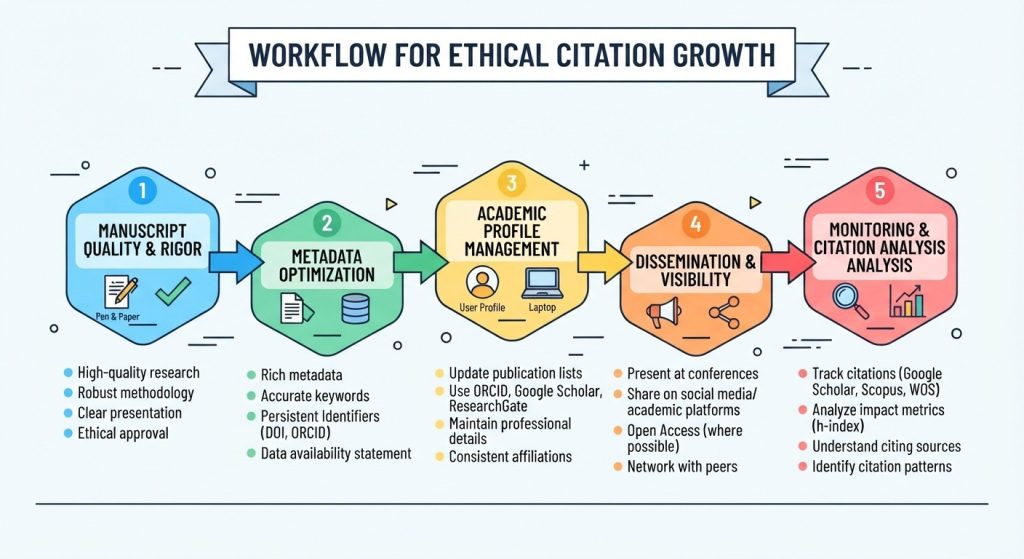
Audit → Optimize → Disseminate → Monitor → Refine
Audit: Establish the current citation and discoverability baseline.
Optimize: Correct metadata, author identity, keywords, abstracts, and publication profiles.
Disseminate: Share the work through relevant, legitimate scholarly channels.
Monitor: Track citations, indexing, profile accuracy, and other appropriate indicators.
Refine: Identify legitimate opportunities to improve discoverability based on evidence.
This process is more sustainable than attempting to create a sudden artificial increase in citations.
Researchers looking for how to scale research visibility should think in terms of infrastructure. Every publication should become easier to identify, retrieve, understand, and correctly cite.
Also read: 10 Key Reasons Manuscripts Get Rejected Before Peer Review strong research visibility starts with a manuscript that meets journal, reporting, formatting, and ethical requirements.
Red Flags When Choosing a Citation Booster Provider
Before engaging a provider, conduct due diligence.
Avoid guaranteed citation numbers
No ethical provider controls whether independent researchers will cite your work.
Avoid undisclosed citation networks
If a company refuses to explain where citations originate, treat that lack of transparency as a serious warning sign.
Avoid irrelevant placements
A citation from a paper unrelated to your research does not become legitimate simply because it increases a metric.
Avoid predatory journals
ICMJE advises authors to avoid citing articles in predatory or pseudo-journals.
A citation strategy that deliberately directs researchers toward questionable publications can damage rather than strengthen the scholarly record.
Demand methodological transparency
Ask for a written description of:
- Audit methodology
- Databases reviewed
- Profile optimization activities
- Repository strategy
- Dissemination channels
- Reporting frequency
- Data privacy practices
- Deliverables
- Limitations
A professional service should explain what it can influence and what it cannot control.
White-Hat Citation Strategies for Manuscripts
The safest approach is to treat citation growth as an extension of responsible scholarly communication.
A white-hat citation strategy emphasizes:
- Research quality.
- Accurate metadata.
- Strong abstracts.
- Appropriate keywords.
- Persistent identifiers.
- Legitimate repository use.
- Relevant academic dissemination.
- Accurate references.
- Researcher-profile consistency.
- Long-term monitoring.
This approach aligns visibility efforts with the underlying purpose of scholarly publishing: making reliable research available to the communities that can evaluate, reproduce, extend, or apply it.
For biomedical authors, the current ICMJE Recommendations emphasize accurate references, author accountability, research transparency, and responsible publishing practices. The ICMJE updated its recommendations in January 2026, including expanded guidance on AI in publishing and authors’ access to data.
Frequently Asked Questions About Citation Boosters
What is a citation booster?
A citation booster is a strategy or service designed to increase the legitimate discoverability and scholarly visibility of a research publication, creating more opportunities for relevant researchers to find and cite it. It should focus on metadata, academic profiles, dissemination, repository strategy, and research communication rather than artificial citation generation.
Are citation boosters ethical for academic publishing?
Citation-boosting activities can be ethical when they improve legitimate research discoverability. Purchasing citations, coordinating irrelevant reciprocal citations, fabricating references, or manipulating citation counts is fundamentally different from improving visibility.
How can researchers legally increase their citation count?
Researchers can improve citation opportunities by publishing high-quality work, using precise titles and abstracts, selecting accurate keywords, maintaining consistent academic profiles, using ORCID, depositing permitted versions in repositories, sharing research with relevant communities, and making supporting resources discoverable where appropriate.
What does a citation booster service do?
A professional service may audit citation performance, optimize academic profiles and metadata, identify discoverability gaps, develop legitimate dissemination strategies, and monitor citation-related metrics. It should not promise a predetermined number of citations.
Can anyone guarantee more citations?
No provider can ethically guarantee that independent researchers will cite a publication. Citation behavior depends on research relevance, field dynamics, publication age, discovery, methodological usefulness, and many other variables outside the author’s direct control.
Does improving visibility guarantee research impact?
No. Visibility is an enabling condition, not a substitute for research quality. A publication must provide information, methods, findings, data, or theoretical contributions that other researchers find useful.
Pre-Submission and Post-Publication Citation Visibility Checklist
Before publication:
- Write a precise, searchable title.
- Optimize the abstract for clarity and accuracy.
- Select discipline-appropriate keywords.
- Verify every reference.
- Remove irrelevant citations.
- Check for retracted references.
- Confirm author names and affiliations.
- Link authors to ORCID where appropriate.
- Follow the target journal’s reporting guidelines.
- Confirm DOI and bibliographic metadata.
After publication:
- Confirm the article is indexed correctly.
- Check author-profile attribution.
- Deposit a permitted version in an appropriate repository.
- Share the publication with relevant research communities.
- Present findings through appropriate academic channels.
- Monitor citation growth over an appropriate time window.
- Benchmark performance against a relevant field and publication cohort.
- Audit new citations for accuracy and relevance.
- Avoid citation exchanges, citation rings, and purchased citations.
- Reassess the visibility strategy using evidence rather than arbitrary citation targets.
Conclusion: Build Visibility, Not Artificial Citations
So, what is a citation booster? At its most useful, it is not a mechanism for manufacturing citations. It is a structured approach to making legitimate research easier to discover, access, understand, and use.
The strongest research impact and visibility strategies begin with the publication itself. Improve the manuscript, strengthen its metadata, establish a consistent researcher identity, distribute the work through relevant scholarly channels, and monitor citation performance against an appropriate benchmark.
Citation growth should be the consequence of research being found and used not the product of manipulating the scholarly record.
If your publication needs a structured audit of discoverability, academic profiles, citation opportunities, and research visibility, explore ManuscriptLab’s Citation Booster Services for professional support built around ethical scholarly communication.