Using artificial intelligence to improve a manuscript is no longer an unusual practice. Researchers use large language models (LLMs) and AI-assisted tools for language editing, translation, literature discovery, coding, data analysis, figure development, and even early-stage idea exploration.
The difficult question is no longer simply “Can you use AI to write research papers?” It is: What did the AI actually do, and does that use need to be disclosed?
In 2026, there is still no single disclosure format that applies to every journal. The International Committee of Medical Journal Editors (ICMJE), Springer Nature, Wiley, Elsevier, Taylor & Francis, and other publishers have developed overlapping but sometimes different requirements. Some distinguish routine spelling and grammar correction from generative AI; others request disclosure even for AI-assisted language editing.
For authors, the safest approach is therefore not to assume that all AI use is either permitted or prohibited. Instead, document the tool, identify its role, verify its output, and match your disclosure to the journal’s current author instructions.
This guide explains AI disclosure in academic writing, when disclosure is required, where to place it, how language editing differs from data analysis, and how to write a compliant AI disclosure statement for a journal submission.
💡 Need expert help with your paper?
Transform your manuscript with ManuscriptLab’s professional editing & formatting services!
What Is AI Disclosure in Academic Writing?
AI disclosure is a transparent statement explaining whether and how artificial intelligence or generative AI tools contributed to the preparation or research underlying a scholarly manuscript.
A useful disclosure identifies four elements:
- The AI tool or model used
- The specific task performed
- The stage of the research or writing process affected
- The author’s human review and responsibility
The level of detail should reflect the significance of the AI contribution.
For example, using an AI-enabled spelling checker to identify typographical errors is materially different from asking an LLM to generate a Discussion section, interpret statistical findings, construct a literature review, or produce a research figure.
The ICMJE’s current recommendations state that authors should disclose AI-assisted technologies used in submitted work and describe how they were used. They also make clear that AI systems cannot be authors because they cannot assume responsibility for accuracy, integrity, and originality.
Why disclosure matters
What: Disclosure creates a transparent record of AI involvement.
Why: Editors and readers need to understand how the manuscript was produced and where human judgment remained responsible.
Industry standard: A defensible disclosure should identify the tool and purpose rather than simply saying “AI was used.”
Common pitfall: Writing “AI was used to improve the manuscript” without explaining whether this meant grammar correction, rewriting, literature synthesis, coding, statistical interpretation, or content generation.
The distinction matters because these activities carry different implications for authorship, reproducibility, confidentiality, and research integrity.
Can You Use AI to Write Research Papers?
Yes, in some circumstances but “using AI to write” is too broad a category to determine compliance.
Publishers increasingly distinguish between AI that assists authors and AI that substitutes for substantive scholarly judgment.
For example, Taylor & Francis permits certain uses such as language refinement, translation, idea exploration, coding assistance, and selected research applications, while stating that generative AI should not replace core researcher and author responsibilities. Its current policy also requires authors to acknowledge generative AI use and identify the tool, version, purpose, and manner of use.
Elsevier similarly permits AI assistance under specified conditions but requires authors to retain responsibility for the manuscript. Its 2026 policy says basic spelling, grammar, and punctuation checks do not require disclosure, while generative AI used in manuscript preparation generally requires a declaration.
The practical distinction
Think of AI involvement as a spectrum:
| AI use | Typical scholarly role | Disclosure approach |
| Spell-checking | Corrects mechanical errors | May not require disclosure under some policies |
| Grammar correction | Improves language without changing scientific meaning | Journal-dependent |
| Translation | Converts an author’s existing work into another language | Often requires disclosure |
| Rephrasing/rewriting | Changes sentence construction and potentially emphasis | Usually disclose when generative AI is involved |
| Literature discovery | Identifies potentially relevant sources | Follow journal-specific methodology/disclosure rules |
| Literature synthesis | Interprets and combines scholarly information | Disclose; verify every source |
| Coding assistance | Generates or modifies code | Disclose where required and validate the code |
| Data analysis | Contributes to analytical workflow | Describe in Methods and disclose |
| Interpretation of results | Influences scientific reasoning | Substantive disclosure and rigorous human verification |
| AI-generated figures | Creates or substantially modifies visual content | Disclose in manuscript and/or figure caption as required |
| AI-generated manuscript sections | Produces substantive scholarly prose | Highly policy-sensitive; never submit without rigorous human review and required disclosure |
Common pitfall: Treating “AI-assisted” as synonymous with “grammar checker.” A modern LLM can perform substantially more than conventional proofreading, and the disclosure threshold may change accordingly.
1. Audit Your AI Use Before You Draft the Disclosure
Do not write the disclosure from memory immediately before submission. Reconstruct your AI workflow first.
What to audit
Record:
- Tool name
- Model or version, when available
- Date or period of use
- Prompts or workflow records, where relevant
- Manuscript sections affected
- Research tasks affected
- Whether confidential or unpublished material was uploaded
- Whether personal, clinical, or identifiable data were entered
- Whether AI-generated text was retained, substantially rewritten, or rejected
- Whether AI contributed to figures, code, analysis, interpretation, or conclusions
Why: Disclosure accuracy depends on knowing what the system actually contributed.
Practical standard: Maintain an AI-use log for any project involving substantive generative AI. For research-method applications, preserve prompts, outputs, model information, and validation records where feasible.
Common pitfall: Disclosing only the final visible use. If an LLM helped analyze data or identify literature but its output was later rewritten by the author, that underlying use does not disappear.
2. Separate Language Editing From Research and Data Analysis
One of the most important distinctions in current AI policy is where AI entered the scholarly workflow.
AI used for language editing
If an AI tool corrected grammar, improved readability, translated text, or suggested stylistic revisions, the contribution primarily concerns expression.
ICMJE notes that AI-assisted spelling and grammar correction is generally viewed as acceptable, while still emphasizing author responsibility and transparency.
However, do not assume that “grammar editing never needs disclosure.”
Publisher policies differ.
Elsevier states that basic spelling, grammar, and punctuation tools do not require disclosure under its current journal policy.
Springer Nature’s current manuscript-preparation guidance takes a broader transparency approach and says that even low-risk AI use for grammar, language editing, readability, and flow should be disclosed for editorial assessment.
Wiley likewise instructs authors to integrate AI disclosure according to the type of assistance, including placing writing-related AI use in the Acknowledgments for Wiley journals.
Standard: Always check the target journal rather than relying on a generic rule about grammar tools.
Common pitfall: Assuming that because one publisher exempts grammar checking, every journal does.
AI used for data analysis
Data analysis is substantially different.
If an AI system helped clean data, classify responses, identify patterns, recommend statistical procedures, generate code, or interpret analytical output, the use may become part of the research methodology.
That information belongs in the Methods section when relevant, not merely in a generic acknowledgment.
Taylor & Francis, for example, permits certain AI-assisted research methodologies but requires methodological detail, human oversight, appropriate reporting standards, and records of the methods and prompts used.
Standard: Make the analytical workflow reproducible. Identify the tool, version where applicable, task performed, relevant parameters or prompts, validation process, and human checks.
Common pitfall: Writing “ChatGPT assisted with data analysis” without explaining what analysis it performed or how the results were validated.
Also read: How Much AI Content is Allowed in Research Papers?
3. Follow the Target Publisher’s Disclosure Rules
There is no universal “AI disclosure paragraph” that guarantees compliance with every journal.
Use the publisher’s current policy as the controlling document.
Major publisher approaches in 2026
| Publisher/authority | General disclosure approach | Important distinction |
| ICMJE | Disclose AI-assisted technologies and explain how they were used | AI cannot be an author; human authors retain responsibility |
| Elsevier | Disclosure generally required for generative AI used in manuscript preparation | Basic spelling, grammar, punctuation checks are exempt under its current journal policy |
| Springer Nature | Uses a risk-based approach and emphasizes transparency | Even low-risk AI language assistance should be disclosed for editorial assessment |
| Wiley | Disclosure location depends on use | Acknowledgments for writing assistance; Methods for research use; figure captions for AI visuals |
| Taylor & Francis | Requires clear acknowledgment of generative AI use | Tool name/version, use, and reason should be stated |
| DOAJ guidance | Journals should have an AI policy | Generative AI use beyond straightforward language correction, editing, and formatting should be disclosed |
These policies demonstrate why authors should not copy a disclosure statement from another paper without checking the journal’s current Instructions for Authors.
Industry standard: Perform a policy audit immediately before submission.
Common pitfall: Following a publisher-level policy when the specific journal has additional restrictions.
4. Put the Disclosure in the Correct Location
The appropriate location depends on what AI did.
For writing assistance
Potential locations include:
- Acknowledgments
- Dedicated AI declaration
- End-of-manuscript declaration
- Submission system
- Cover letter
ICMJE recommends disclosure both at submission and in the manuscript’s appropriate section when AI-assisted technology has been used.
Elsevier’s current journal guidance asks authors to place a separate declaration immediately before the references.
Wiley uses a different structure, directing authors toward Acknowledgments for manuscript drafting, editing, translation, or formatting; Methods for research applications; and figure captions for AI-generated or AI-edited visual content.
For research methodology
Use the Methods section when AI is part of the research process.
Explain:
- Tool/model
- Version where available
- Function
- Inputs
- Relevant prompts or parameters
- Human oversight
- Validation
- Reproducibility safeguards
For figures
If AI generates or substantially modifies a figure, disclosure may need to appear in the figure caption or legend.
Springer Nature specifically requires transparent disclosure for AI-generated or AI-assisted visual content, while Taylor & Francis provides detailed caption-level requirements for permitted AI-assisted visuals.
Common pitfall: Hiding a substantive AI contribution in a generic acknowledgment when the journal expects methodological or figure-specific disclosure.
5. Write a Specific AI Disclosure Statement
A compliant statement should be factual, concise, and reproducible.
Example: language editing
During the preparation of this manuscript, the authors used [AI TOOL AND VERSION] to assist with grammar, spelling, and language editing. The authors reviewed and revised all AI-assisted output and take full responsibility for the final content, accuracy, and integrity of the manuscript.
Use this only if it accurately describes what occurred and if it satisfies the journal’s policy.
Also read: 10 Key Reasons Manuscripts Get Rejected Before Peer Review
Example: substantive writing assistance
During manuscript preparation, the authors used [AI TOOL AND VERSION] to assist with restructuring and language refinement of selected sections. All AI-assisted output was critically reviewed, fact-checked, revised, and approved by the authors. The authors remain fully responsible for the accuracy, originality, interpretation, and integrity of the submitted work.
Do not use this statement if the tool actually generated scientific arguments, interpretations, results, or conclusions that the authors did not independently develop and verify.
Example: research methodology
The authors used [AI TOOL AND VERSION] during the data-analysis workflow to assist with [specific task]. The analysis was independently reviewed and validated by the research team using [validation procedure]. The authors remain responsible for the analytical methodology, interpretation of results, and accuracy of the reported findings.
Example: no generative AI use
Some publishers explicitly ask authors to state when generative AI was not used.
A concise version is:
The authors report that generative AI was not used in the research or preparation of this manuscript.
Taylor & Francis currently provides similar wording for authors who did not use generative AI.
Common pitfall: Overstating human oversight. “The authors reviewed the output” is not enough if the authors did not independently verify references, calculations, data interpretations, and factual claims.
6. Do Not Treat AI as an Author
AI tools cannot be listed as authors.
The reason is not simply that AI is software. Authorship carries accountability: authors must be able to approve the final manuscript, respond to questions about accuracy and integrity, manage copyright responsibilities, and accept responsibility for the published work.
ICMJE explicitly excludes AI tools from authorship, and major publishers including Elsevier and Taylor & Francis maintain the same fundamental position.
Standard: Human researchers must retain authorship, accountability, and final editorial authority.
Common pitfall: Listing “ChatGPT,” “Claude,” “Gemini,” or another LLM in the author byline and attempting to compensate by adding an AI disclosure.
Disclosure does not convert a non-human tool into an author.
7. Verify Every AI-Generated Claim and Reference
AI-generated text can appear authoritative while containing incorrect claims, fabricated citations, incomplete references, or distorted interpretations.
The ICMJE specifically warns that AI output can be incorrect, incomplete, or biased and places responsibility for appropriate attribution and plagiarism checking on human authors.
Apply a three-stage verification audit
Stage 1: Source verification
Open every cited source. Confirm:
- Author names
- Article title
- Journal
- Year
- Volume and issue
- DOI
- Page numbers or article number
Stage 2: Claim verification
Check that the cited source actually supports the statement.
Stage 3: Interpretation verification
Determine whether the AI system exaggerated, generalized, or altered the original finding.
Industry standard: Every substantive citation should be traceable to the original or authoritative source.
Common pitfall: Assuming that a plausible-looking DOI or reference generated by an LLM is genuine.
DOAJ’s current guidance also states that generative AI should not be treated as a source to cite and that authors remain responsible for checking the validity of automated-tool outputs.
Also read: Why Was My Paper Desk Rejected? 10 Reasons and How to Fix Them
8. Protect Confidentiality, Copyright, and Research Data
AI disclosure is only one part of responsible AI use.
Before uploading manuscript material, ask:
- Does the tool retain submitted content?
- Can uploaded information be used for model training?
- Does the service provide appropriate privacy controls?
- Are you uploading unpublished results?
- Does the material contain patient or participant information?
- Do you have permission to upload copyrighted material?
This is particularly important for clinicians and researchers working with protected or identifiable information.
ICMJE warns that submitted manuscripts are privileged communications and should not be uploaded to AI systems where confidentiality cannot be assured without appropriate permission.
Elsevier similarly advises authors to consider privacy, confidentiality, intellectual property, and tool-specific terms before submitting unpublished or sensitive material to AI systems.
Standard: Use only tools and workflows compatible with your institutional, ethical, contractual, and journal requirements.
Common pitfall: Assuming that a paid or “private” AI account automatically provides sufficient confidentiality for unpublished research.
9. Preserve an AI Audit Trail for High-Stakes Research
For substantive AI use, maintain documentation just as you would for other methodological decisions.
A practical AI audit trail can include:
- Tool and model
- Version
- Date of access
- Purpose
- Relevant prompts
- Inputs
- Outputs
- Human modifications
- Validation procedure
- Final decision made by the researchers
This is particularly valuable for systematic reviews, bibliometric studies, qualitative coding, statistical workflows, software development, and AI-assisted data analysis.
Taylor & Francis currently advises authors using AI in research methodologies and literature reviews to retain records of methods and prompts and make them available to the journal upon request.
Common pitfall: Keeping only the final AI-generated paragraph. For methodological applications, the process may be as important as the output.
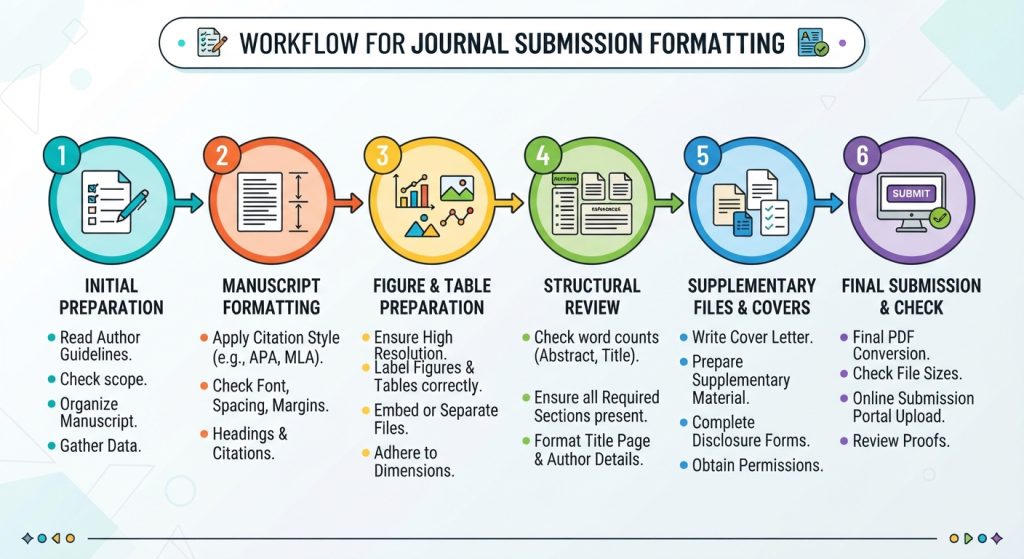
AI Disclosure Workflow for Journal Submission
Use this workflow before clicking Submit:
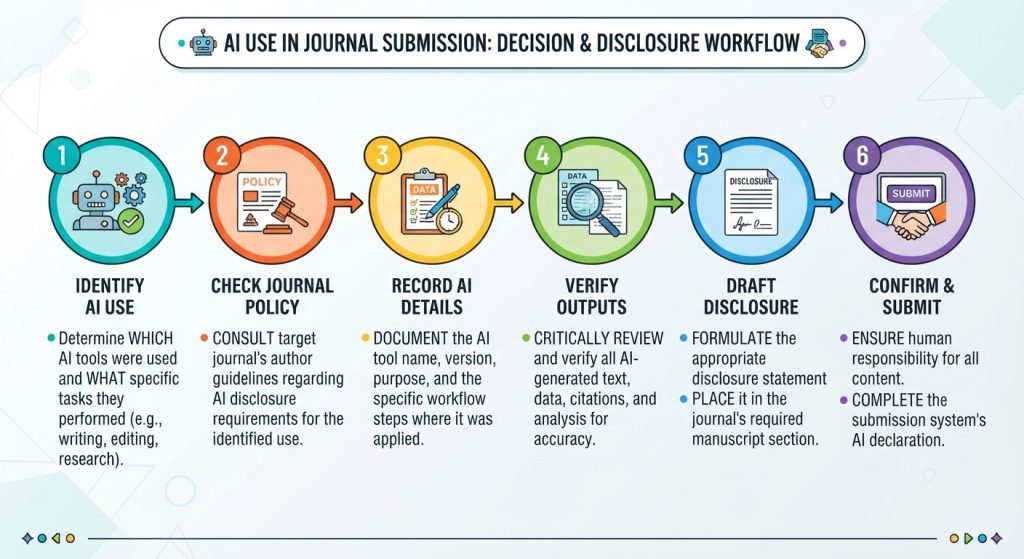
This workflow is more reliable than relying on a generic “AI was used responsibly” statement.
Where to Find Authoritative AI Publishing Guidance
Before submission, consult the current policies of the organizations relevant to your field:
- ICMJE: Use its recommendations when submitting to medical journals.
- DOAJ: Review its guidance on AI policies and transparency for open-access journals.
- COPE: Check current publication-ethics guidance concerning authorship, transparency, and responsible scholarly publishing.
- Target publisher: Always prioritize the journal’s current Instructions for Authors and AI policy over general advice.
Policies continue to evolve. ICMJE expanded its AI guidance in its January 2026 recommendations, while major publishers also updated their policies during 2026.
Also read: How to Prepare Tables and Figures to Meet High-Impact Journal Standards in 2026
Pre-Submission AI Disclosure Checklist
Before submitting your manuscript, confirm:
- I checked the journal’s current AI policy.
- I identified every AI tool used in the research and writing workflow.
- I recorded the model/version where available.
- I documented the specific purpose of each AI tool.
- I distinguished language editing from substantive content generation.
- I disclosed AI-assisted research or data analysis in the appropriate methodological location.
- I disclosed AI-generated or AI-modified visual content as required.
- I verified every AI-assisted citation against the original source.
- I independently checked factual claims and interpretations.
- I did not list an AI system as an author.
- I did not upload confidential, identifiable, or restricted material without appropriate safeguards.
- I checked copyright and licensing implications before using AI-generated material.
- I retained relevant prompts and workflow records for substantive AI use.
- I completed any AI disclosure questions in the submission system.
- My disclosure accurately reflects the actual AI contribution.
- Human authors retain full responsibility for the manuscript.
Conclusion
AI disclosure in academic writing is fundamentally a transparency and accountability practice not a declaration that automatically makes a manuscript acceptable or unacceptable.
The decisive questions are what the AI did, how substantially it influenced the work, whether the use was permitted, and whether the human authors can fully defend the resulting scholarship.
In 2026, publisher policies increasingly converge on human accountability, but they do not use identical disclosure thresholds or manuscript locations. Grammar and spelling assistance may be exempt at one publisher and subject to disclosure at another. Research-method applications generally require substantially more methodological detail than routine language editing.
Before submission, audit your AI workflow, verify every output, protect confidential research material, check the target journal’s current policy, and write a disclosure statement that accurately describes the tool’s contribution.
Transparent AI use is easier to defend than undisclosed AI use. Treat disclosure as part of your manuscript submission workflow not as an administrative formality added at the last minute.
Need help preparing your manuscript for journal submission? Explore ManuscriptLab’s professional editing and formatting services for expert support with language, formatting, references, and publication readiness.