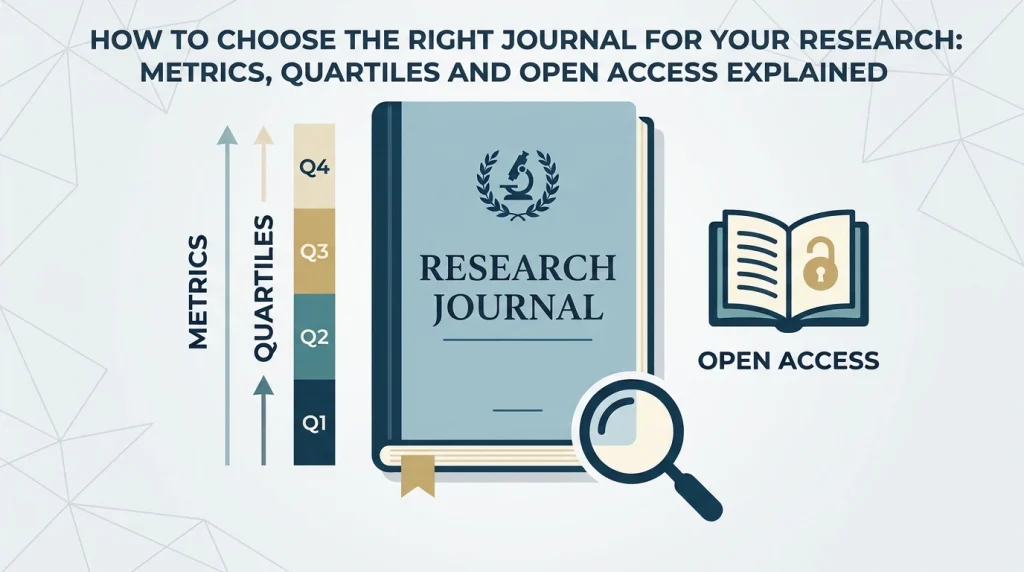
Choosing a journal is one of the most consequential decisions in the research publication process. A manuscript may present rigorous methods, statistically robust findings, and a meaningful contribution to its field, yet still receive a desk rejection because its subject does not align with the journal’s aims, scope, or readership. Selecting a journal based solely on its Impact Factor or Q1 ranking can create similar problems.
Choosing the right journal for your research requires a structured assessment of editorial fit, indexing status, citation metrics, quartile rankings, publication models, article processing charges (APCs), and research integrity standards. These factors determine whether your manuscript reaches the appropriate audience, satisfies institutional and funder requirements, and offers a realistic publication pathway.
This guide explains how to evaluate academic journals in 2026, compare Scopus and Web of Science rankings, distinguish open access models, assess publication costs, and identify warning signs associated with predatory publishers.
💡 Need expert help with your paper?
Transform your manuscript with ManuscriptLab’s professional editing and formatting services!
1. Evaluate Journal Aims, Scope, and Manuscript Fit
Before comparing journal rankings, determine whether the journal is an appropriate home for your research. Scope alignment is one of the most important factors in avoiding editorial rejection.
How do you know if a journal’s scope matches your manuscript?
Start with the journal’s official aims and scope statement. Examine its subject areas, preferred article types, methodological expectations, target readership, and stated editorial priorities.
Next, review five to ten recently published articles that resemble your manuscript. Compare their research questions, study designs, analytical methods, and contribution to the field. If your paper addresses a specialized clinical population, for example, a broad medical journal may be less suitable than a journal focused on that clinical specialty.
Assess the following criteria:
- Subject alignment: Does the journal regularly publish research in your specific discipline or subdiscipline?
- Article type: Does it accept original research, systematic reviews, case reports, brief communications, or methodological papers of your type?
- Methodological expectations: Does the journal publish studies using comparable experimental designs, statistical approaches, or qualitative methods?
- Audience relevance: Are the journal’s readers likely to use, cite, or apply your findings?
- Editorial priorities: Does your manuscript address the research questions and themes emphasized by the journal?
Why scope alignment matters
Editors frequently perform an initial screening before external peer review. A manuscript can be scientifically sound but unsuitable for the journal’s readership, article categories, or editorial priorities.
Review submission requirements before shortlisting a journal. For biomedical research, check whether the journal expects applicable reporting guidelines such as CONSORT for randomized trials, STROBE for observational studies, or PRISMA for systematic reviews.
The ICMJE Recommendations provide authoritative guidance on biomedical manuscript preparation, research reporting, authorship, and publication ethics.
Common pitfall: Choosing a journal because it publishes prestigious research without checking whether it publishes your specific research design or topic. Prioritize editorial fit before prestige.
2. Understand Journal Metrics: Impact Factor, CiteScore, and More
Journal metrics help researchers compare citation performance, but each metric measures something different. No single number provides a complete assessment of journal quality.
Journal Impact Factor (JIF)
The Journal Impact Factor is published in Clarivate’s Journal Citation Reports (JCR). It measures citations in a particular year to eligible scholarly items published in the journal during the preceding two-year period, using the JIF methodology.
For example, a journal’s 2025 JIF, released in 2026, reflects citations during 2025 to eligible content published in 2023 and 2024, divided by the corresponding eligible publication count.
A higher JIF may indicate stronger citation visibility within a journal’s field. However, citation patterns differ considerably across disciplines. A high-energy physics journal and a specialist humanities journal cannot be compared fairly using the same expectations.
Check the metric’s year and source through Clarivate’s Journal Citation Reports.
CiteScore
CiteScore is Elsevier’s journal-level citation metric based on Scopus data. Its methodology uses a four-year citation window and includes specified document types, including articles, reviews, conference papers, book chapters, and data papers.
CiteScore is not interchangeable with JIF. The two metrics use different databases, time windows, and calculation rules. A journal may therefore have a strong CiteScore but a comparatively modest JIF, or vice versa.
Consult the Scopus metrics overview and the CiteScore methodology before interpreting a reported value.
Other useful indicators
Consider additional measures when they are relevant to your field:
- CiteScore percentile: Shows a journal’s relative position within a Scopus subject category.
- Five-year JIF: Provides a longer citation window that may better reflect slower-moving research areas.
- Article-level citation counts: Help assess the influence of individual publications, although citation counts are sensitive to article age and topic.
- Field-Weighted Citation Impact (FWCI): Compares citation performance against a field-, year-, and document-type-adjusted benchmark where the metric is available.
Journal metric comparison table
| Metric | Primary source | What it measures | Key limitation |
| Journal Impact Factor | Clarivate JCR | Citation performance over a two-year publication window | Sensitive to field-specific citation patterns |
| Five-year JIF | Clarivate JCR | Citation performance over a longer window | Still a journal-level average |
| CiteScore | Scopus | Citations across a four-year window | Uses a different methodology from JIF |
| CiteScore percentile | Scopus | Relative position within a subject category | Depends on the selected category |
| FWCI | Scopus | Field-normalized citation impact | Does not independently establish research quality |
| Article citation count | Bibliographic databases | Citations received by an individual paper | Varies with publication age and topic |
Industry standard: Always record the metric name, database, reporting year, and subject category when comparing journals. Verify values using the official database rather than relying on publisher advertisements or outdated ranking lists.
Common pitfall: Treating the Impact Factor as a direct measure of an individual manuscript’s quality. Journal-level citation averages cannot predict the scientific merit or future citation performance of a particular article.
3. Understand Q1, Q2, Q3, and Q4 Journal Rankings
Quartiles divide journals into four relative ranking groups within a defined subject category. Researchers commonly use these rankings when selecting journals for publication, preparing grant applications, and documenting academic performance.
- Q1: The top 25% of journals in the relevant ranking category.
- Q2: The next 25%, approximately the 25th–50th percentile.
- Q3: The next 25%, approximately the 50th–75th percentile.
- Q4: The bottom 25% of journals in the relevant ranking category.
These are relative positions, not universal quality grades. A reputable Q2 journal may be more appropriate for a manuscript than a Q1 journal that rarely publishes its subject area.
How are journal quartiles calculated?
Quartiles are assigned using a journal’s position within a particular subject category and ranking system. The precise assignment can depend on the database, year, category, and ranking methodology.
A journal indexed in multiple subject categories may have different quartiles across those categories. Always identify which category and year support the ranking you intend to report.
Can a journal be Q1 in Scopus but Q2 in Web of Science?
Yes. A journal can be Q1 in Scopus-based rankings and Q2 in Web of Science-based rankings.
Scopus and Web of Science are separate citation databases. Their journal coverage, subject categories, citation data, and ranking methodologies differ. Scopus-based quartiles may be reported through CiteScore-related rankings or SCImago Journal Rank (SJR), while Web of Science quartiles may refer to Journal Citation Reports rankings.
These systems should not be treated as interchangeable. In particular, a journal’s SJR quartile is not automatically equivalent to its CiteScore quartile or JCR quartile.
To verify a journal’s standing:
- Search the journal by its exact title or ISSN in the relevant official database.
- Confirm that the journal is currently covered by that database.
- Identify the specific metric or ranking system being used.
- Check the reporting year and subject category.
- Record the quartile shown for that category and year.
- Repeat the process in the second database if you need to compare rankings.
Common pitfall: Assuming that a journal’s Q1 designation applies across every database and subject category. When an institution requires Q1 publication, confirm which database, metric, year, and category its policy recognizes.
Also read: Scopus vs Web of Science: Which One Matters More for Researchers?
4. Choose Between Traditional, Gold, Green, and Diamond Open Access
Open access (OA) publishing makes scholarly work available online without requiring readers to pay subscription fees to access the published content. However, the term covers several publishing models, each with different cost, licensing, and copyright implications.
Gold Open Access
Gold OA makes the published article openly available on the journal’s website. Many gold OA journals charge an APC, although fees are not universal.
Before submission, check the article’s licensing terms, APC amount, waiver policy, and whether the journal deposits the published version in an appropriate repository.
Green Open Access
Green OA involves depositing an eligible version of the manuscript in an institutional or subject repository. Depending on the publisher’s policy, this may be the accepted author manuscript rather than the final formatted version.
Embargo periods, permitted versions, and licensing conditions vary. Confirm the policy before sharing or depositing the paper.
Hybrid Open Access
Hybrid journals operate primarily through subscriptions but allow authors to make individual articles open access, usually by paying an APC.
This option can be useful when a journal is a strong subject fit and a funder requires immediate open access. However, verify whether the journal’s hybrid option satisfies the exact funding mandate.
Diamond Open Access
Diamond OA journals make articles freely available to readers and generally charge authors no APC. They are often supported by universities, scholarly societies, consortia, or public funding.
Diamond OA can be attractive for researchers with limited publication budgets, but the journal should still be assessed for editorial quality, indexing, peer-review transparency, and long-term sustainability.
Open access models compared
| Publishing model | Reader access | Typical author cost | Key consideration |
| Subscription | Usually restricted to subscribers or purchasing institutions | Often no mandatory OA APC | Check institutional access and self-archiving rights |
| Gold OA | Immediate open access to the published article | APC may apply | Verify license, fees, and waivers |
| Green OA | Access through an eligible repository copy | Often no repository fee | Check version restrictions and embargoes |
| Hybrid OA | Open access for selected articles in a subscription journal | APC commonly applies to OA articles | Confirm funder compliance and total costs |
| Diamond OA | Immediate open access | Generally no APC | Evaluate editorial governance and sustainability |
Common pitfall: Assuming that every open access journal is free for authors or that every subscription journal prohibits repository sharing. Check the specific journal and publisher policies.
5. Calculate APC Costs and Check Funder Mandates
An article processing charge is a fee that some publishers charge to cover publication-related costs for open access articles. APCs vary by journal, publisher, discipline, country, and article type. Some journals offer waivers or discounts, while others publish without charging authors.
Before selecting a journal, calculate the full publication cost rather than comparing APCs alone.
Include:
- The mandatory APC, if applicable.
- Taxes or additional administrative charges.
- Optional services that are genuinely necessary.
- Currency conversion and institutional payment requirements.
- Available institutional agreements, discounts, and waiver eligibility.
How do funder mandates affect journal choice?
Research funders and institutions may specify when and where funded work must be made openly available. Requirements can concern the timing of access, permitted licenses, repository deposits, or the use of approved publishing arrangements.
For example, a funder may require immediate open access under a particular license. A journal’s standard Green OA policy may not satisfy that requirement if it imposes an incompatible embargo or restricts the required version.
Before submission, confirm the mandate with your grant agreement, institutional research office, or funder’s official policy.
Industry standard: Do not assume that a journal’s general open access statement guarantees compliance with your particular grant. Verify the specific license, access date, repository requirements, and eligible payment route.
Common pitfall: Submitting to a journal before confirming that the APC is affordable or that its licensing policy meets funding requirements. These issues can create avoidable delays after acceptance.
Also read: 10 Key Reasons Manuscripts Get Rejected Before Peer Review
6. Verify Indexing and Avoid Predatory Journals
A journal’s claims about indexing, peer review, and editorial prestige should always be independently verified. Predatory or deceptive publishers may imitate established journals, advertise misleading metrics, or promise unrealistically rapid acceptance.
How to verify journal indexing
Check the journal’s exact title and ISSN in the database it claims to belong to. For example, use the official Scopus source records or the Web of Science Master Journal List rather than relying on a logo displayed on the journal website.
For open access journals, the Directory of Open Access Journals (DOAJ) can help identify journals that meet its inclusion criteria. DOAJ inclusion is useful evidence, but it does not replace a full evaluation of the journal’s suitability.
Warning signs to investigate
- Guaranteed acceptance or implausibly short peer-review timelines.
- Unclear editorial board membership or unverifiable editor credentials.
- Vague or undisclosed peer-review procedures.
- False claims of indexing or fabricated Impact Factors.
- Hidden APCs or unexpected charges after acceptance.
- A journal scope spanning unrelated disciplines without a credible editorial rationale.
- Website details, publisher identities, or contact information that cannot be independently verified.
No single warning sign proves misconduct. Assess the evidence collectively and contact the publisher or editorial office if details are unclear.
Review the ICMJE guidance on publication ethics and the Committee on Publication Ethics (COPE) resources for additional guidance.
Common pitfall: Equating a high metric or polished website with legitimacy. Verify indexing, editorial practices, publisher identity, and fee transparency independently.
7. Assess Acceptance Prospects, Review Times, and Publication Requirements
A journal’s acceptance rate and review timeline can inform submission planning, but these figures require careful interpretation.
Acceptance rates are not standardized across publishers. Some journals do not disclose them, and reported rates may refer to different periods or article categories. Similarly, a journal’s stated review time may represent the median time to first decision rather than the time to final acceptance or publication.
Check the journal’s official author information for:
- Article types and word limits.
- Required reporting checklists and supplementary files.
- Peer-review model, including whether double-blind review is available.
- Typical time to first decision, if reported.
- Publication frequency and online-first practices.
- Data availability, ethics approval, and disclosure requirements.
- Copyright, licensing, and author self-archiving policies.
Do not select a journal simply because it promises a fast decision. A credible peer-review process should provide appropriate editorial and scientific scrutiny.
If you need professional support with language, structure, or submission preparation, explore ManuscriptLab’s editing services. Thorough manuscript preparation can help authors address clarity and formatting issues before editorial assessment, although no editing service can guarantee acceptance.
Also read: Is Harvard Referencing the Same as MLA? Comparison and Formatting Rules 2026
8. Build a Journal Shortlist Using a Structured Decision Framework
Once you understand scope, metrics, quartiles, and publishing models, compare a manageable shortlist of approximately three to five journals.
Use a weighted scoring framework to make the decision transparent. The following weights are an illustrative starting point, not an industry-wide standard. Adjust them to your discipline and institutional requirements.
| Selection criterion | Suggested weight |
| Scope and readership fit | 30% |
| Indexing and publication integrity | 20% |
| Journal metrics and relevant quartile | 15% |
| Open access and funder compliance | 15% |
| APC affordability | 10% |
| Review timeline and publication workflow | 10% |
| Total | 100% |
Score each journal from 1 to 5 for each criterion. Multiply the score by the criterion’s weight and sum the results to obtain a comparative score.
For example, a journal that receives 5/5 for scope fit contributes 30 points under the suggested weighting. A journal scoring 3/5 for APC affordability contributes 6 points.
Treat indexing, ethical legitimacy, and funder compliance as mandatory eligibility checks, not merely low-scoring criteria that a journal can compensate for with a high Impact Factor.
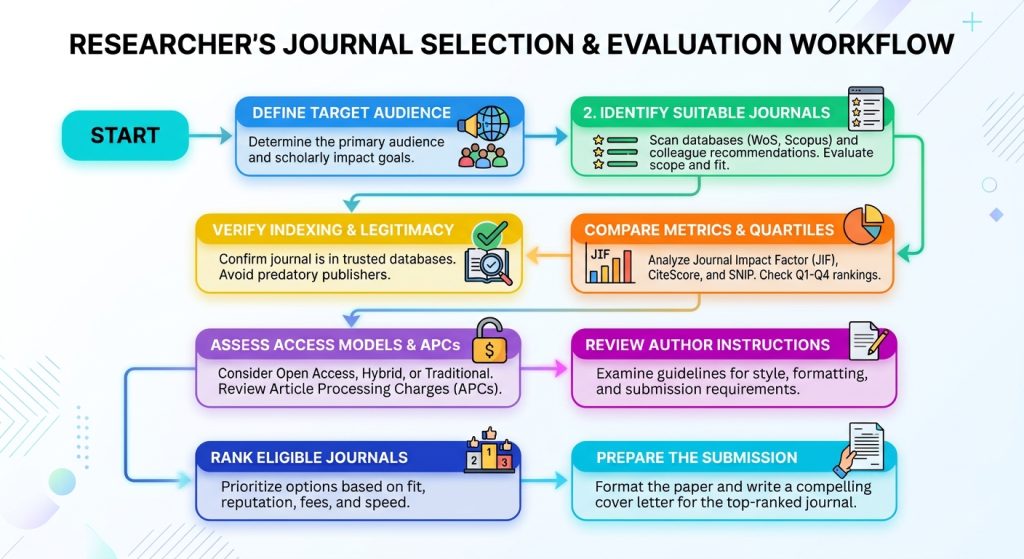
Visual: Journal selection workflow
Common pitfall: Choosing a journal based on a single composite score. A strong overall score cannot compensate for a journal that fails a mandatory funder requirement or has unverifiable publication practices.
9. Academic Journal Selection Checklist for Researchers
Before committing to a submission, complete the following checklist.
Scope and editorial fit
- The journal publishes research in my subject area.
- Recent articles demonstrate a relevant readership and research focus.
- My article type and study design are eligible.
- The manuscript meets the journal’s length and formatting requirements.
Metrics and quartiles
- I verified the journal’s metrics in the official database.
- I recorded the metric name, reporting year, and subject category.
- I confirmed the required Q1–Q4 ranking system, if applicable.
- I did not treat a journal-level metric as a direct measure of article quality.
Access, fees, and compliance
- I understand the journal’s subscription, Gold OA, Green OA, hybrid, or Diamond OA model.
- I confirmed the APC, taxes, and waiver options.
- The publishing license and repository policy meet funder requirements.
- Copyright and self-archiving conditions are acceptable.
Integrity and submission readiness
- Indexing and publisher identity have been independently verified.
- Editorial board and peer-review policies are transparent.
- I reviewed ethics, data availability, and disclosure requirements.
- The manuscript follows the applicable reporting guideline.
- My coauthors approve the target journal and submission plan.
Conclusion: Choose the Journal That Best Serves Your Research
The right journal is not necessarily the one with the highest Impact Factor or the most prestigious quartile. It is the journal that aligns with your manuscript’s scope, reaches the right readership, meets your institution’s and funder’s requirements, maintains credible editorial standards, and offers a feasible publication model.
Compare metrics carefully, verify Q1-Q4 rankings in the correct database, calculate APC costs, and confirm open access requirements before submitting. A systematic selection process reduces avoidable desk rejections and helps your findings reach the researchers, clinicians, and practitioners who can benefit from them.
Prepare your manuscript for its next publication milestone. Explore ManuscriptLab’s professional editing and formatting services to improve clarity, consistency, and submission readiness before sending your research to your chosen journal.