Publishing research in an academic journal is no longer just about securing acceptance. Researchers must also consider how their work will reach readers, whether it will remain accessible without subscription barriers, and how publication costs align with institutional and funder requirements.
Choosing the wrong Open Access (OA) publishing model can create unnecessary Article Processing Charges (APCs), delay public access to research, or lead to non-compliance with funding mandates. With Gold, Green, Diamond, and Hybrid Open Access options available, identifying the most appropriate route requires a clear understanding of their financial, licensing, and distribution requirements.
Open Access publishing refers to making scholarly research freely available online without subscription or paywall restrictions. However, different OA models determine who pays for publication, which manuscript versions become publicly available, when readers can access them, and what reuse rights apply.
This guide compares Gold, Green, and Diamond Open Access publishing models in 2026. It also explains Hybrid Open Access, APC structures, repository self-archiving, embargo periods, Plan S requirements, and practical considerations to help researchers select the most suitable publishing route.
💡 Need expert help with your paper?
Transform your manuscript with ManuscriptLab’s professional editing and formatting services!
1. Understanding the Three Main Open Access Publishing Models
Before selecting a journal, understand how each Open Access model works. Although all three aim to improve research accessibility, their funding structures and publication workflows differ considerably.
What Is Gold Open Access?
Gold Open Access makes the final published version of an academic article immediately available to everyone on the journal’s website.
Under this model, the publisher provides unrestricted access to the Version of Record (VoR), generally under a Creative Commons licence. Authors typically pay an Article Processing Charge (APC), although institutions, research funders, or other sponsors may cover the expense.
How it works:
- Submit your manuscript to a fully Open Access journal.
- Complete peer review and address editorial revisions.
- Receive an acceptance decision.
- Arrange APC payment if applicable.
- The publisher publishes the final article with immediate public access.
Industry considerations:
- Access: Immediate upon publication.
- Publication fees: APCs may apply.
- Licensing: Commonly Creative Commons, including CC BY.
- Copyright: Authors may retain copyright, depending on the agreement.
- Reuse: Determined by the selected licence.
Gold OA is particularly useful when researchers need immediate dissemination, broad readership, and compliance with funder requirements.
However, APCs can create financial barriers, particularly for independent researchers, early-career academics, and authors from institutions with limited publishing budgets.
What Is Green Open Access?
Green Open Access allows researchers to publish through a traditional subscription-based journal while making an eligible manuscript version freely available through an institutional or subject repository.
This approach is also known as self-archiving.
Instead of paying an APC for immediate Gold OA, authors deposit an approved version of their manuscript in a repository, subject to the publisher’s sharing policy and any applicable embargo.
How it works:
- Submit your manuscript to a subscription-based journal.
- Complete the journal’s peer-review process.
- Receive acceptance and identify the version permitted for sharing.
- Deposit the eligible manuscript in an institutional or subject repository.
- Make the manuscript publicly accessible according to the publisher’s embargo and licensing conditions.
Common repository options include:
- University institutional repositories.
- Subject-specific repositories.
- PubMed Central, where applicable.
- Other recognized scholarly repositories.
Green OA is particularly attractive to researchers who want to improve accessibility without paying an additional Gold OA APC.
However, the main limitation is that publishers may impose embargo periods of 6, 12, or 24 months, depending on the journal, discipline, and policy.
Always check the publisher’s current self-archiving policy before depositing your manuscript.
What Is Diamond (Platinum) Open Access?
Diamond Open Access, sometimes called Platinum Open Access, provides free access to scholarly publications without charging authors or readers.
Unlike conventional Gold OA, Diamond journals generally operate through alternative funding arrangements, such as:
- University or institutional support.
- Academic societies.
- Research grants.
- Government funding.
- Nonprofit publishing organizations.
- Collaborative scholarly publishing initiatives.
Authors can publish without APCs, while readers can access articles without subscription payments.
Key characteristics:
- No mandatory APCs.
- No reader subscription charges.
- Immediate public access.
- Open licensing, depending on journal policy.
- Academic editorial oversight and peer review.
Diamond OA is particularly beneficial for researchers with limited publication funding.
However, remember that free publication does not automatically indicate journal quality. Evaluate the editorial board, peer-review procedures, indexing status, publication history, and transparency of the journal’s operations.
Also read: How to Write a Discussion Section for a Research Paper
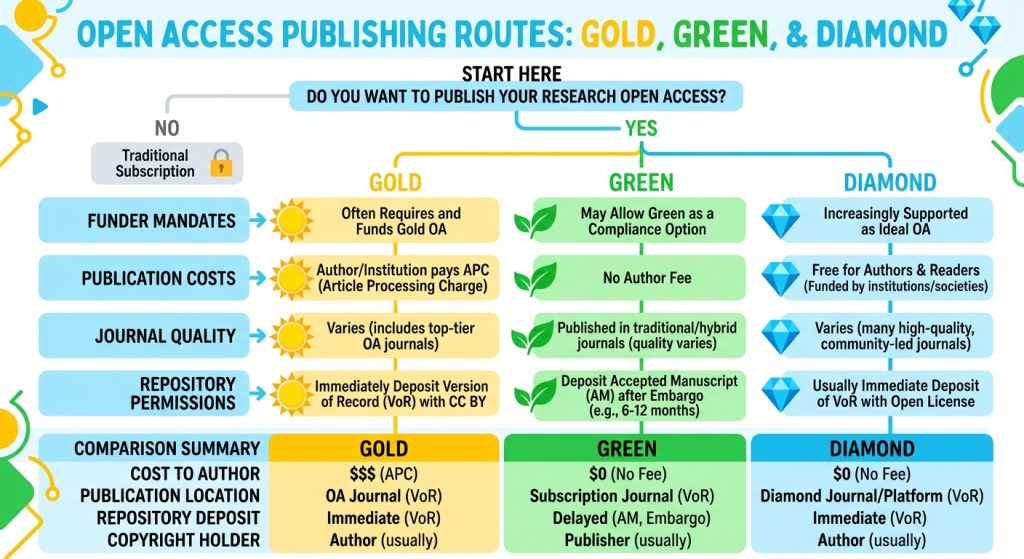
2. Gold vs Green vs Diamond Open Access: Key Differences
Understanding the differences between these publishing models makes it easier to assess their financial and academic implications.
| Comparison criteria | Gold OA | Green OA | Diamond OA |
| Reader access | Free immediately | Free according to deposit policy | Free immediately |
| Author APC | Usually applicable, but waivers may exist | Generally no additional OA APC | No APC |
| Publication platform | Publisher’s journal website | Repository alongside journal publication | Diamond OA journal |
| Embargo period | Generally none | May apply | Generally none |
| Peer review | Journal-dependent | Provided by publishing journal | Provided by journal |
| Copyright | Depends on agreement | Depends on publication and deposit terms | Depends on journal policy |
| Licensing | Often Creative Commons | Depends on deposited version and policy | Often Creative Commons |
| Funding | APCs, institutions, or grants | Traditional publishing model | Institutions, societies, grants, or nonprofit support |
| Main advantage | Immediate publisher-hosted access | Access without an OA publishing fee | Free access and publication |
Important distinction: Gold and Diamond describe fully Open Access publishing arrangements, whereas Green describes a repository-based route. Green OA can therefore operate alongside conventional subscription publishing.
3. What Are Article Processing Charges (APCs) in Gold Open Access?
Article Processing Charges are publication fees that publishers may charge to make accepted research articles openly accessible.
These charges are commonly associated with Gold Open Access publishing.
Why Do Publishers Charge APCs?
Publishing academic research involves several operational activities:
- Editorial management.
- Peer-review administration.
- Copyediting and proofreading.
- Typesetting and production.
- Digital hosting and content preservation.
- Metadata management and indexing support.
APCs help publishers recover these operational costs.
However, an APC does not purchase acceptance. Editorial decisions should remain independent of an author’s ability to pay.
How Much Do APCs Cost?
There is no universal APC rate. Charges vary according to publisher, journal, discipline, article type, and publishing arrangement.
| Publishing category | Typical APC consideration |
| Society journals | May offer subsidized or discounted rates |
| Commercial OA journals | Fees vary considerably |
| High-profile multidisciplinary journals | May charge comparatively high APCs |
| University-supported journals | May operate with institutional funding |
| Diamond OA journals | No APC |
Avoid relying on a single average APC when preparing your publication budget. Check the journal’s official fee schedule before submission.
How to Manage APC Costs
Consider these strategies:
- Check institutional agreements: Your university may have a Read and Publish or transformative agreement covering some or all APC costs.
- Review funder provisions: Research grants may include eligible publication expenses.
- Request an APC waiver: Some publishers provide full or partial waivers based on eligibility criteria.
- Consider Diamond OA: Choose a reputable no-APC journal when it suits your research.
- Evaluate Green OA: Repository self-archiving may provide a cost-effective alternative.
Do not select a journal solely because it advertises low APCs. Evaluate its peer-review standards, editorial credibility, indexing, and disciplinary relevance.
4. Green Open Access: Accepted Manuscripts, Repositories, and Embargo Periods
Green OA requires careful attention to manuscript versions and publisher permissions.
Depositing the wrong version or releasing a manuscript before an embargo expires can create copyright and licensing complications.
Which Manuscript Version Can You Upload?
Researchers generally encounter three manuscript versions during the publication process.
1. Preprint (Submitted Manuscript)
This is the manuscript version before formal peer review.
It contains the author’s original research submission but does not incorporate revisions resulting from peer-review feedback.
2. Author Accepted Manuscript (AAM)
The Author Accepted Manuscript is the version that has completed peer review and incorporates the revisions required by the journal.
It has been accepted for publication but has not necessarily undergone the publisher’s copyediting, typesetting, or final production.
This is commonly the version permitted for Green OA self-archiving.
3. Version of Record (VoR)
The Version of Record is the final, formally published article.
It includes the publisher’s production work, final formatting, and any formal corrections incorporated into the published version.
Publishers may restrict repository distribution of the VoR unless specific permissions or licensing arrangements apply.
Practical recommendation: Check the journal’s author rights policy before uploading any manuscript version. Never assume that acceptance automatically grants permission to distribute the publisher-formatted PDF.
What Are Green OA Embargo Periods?
An embargo period is the period during which an accepted manuscript cannot be made publicly accessible through a repository.
For example, a journal may permit an author to deposit an accepted manuscript immediately but restrict public access for 12 months after publication.
During this period, the repository may hold the manuscript as a closed deposit while displaying permitted metadata.
Embargo requirements vary by publisher and journal. Some publishers allow immediate repository access, while others impose restrictions of 6, 12, or 24 months.
For example, Cambridge University Press describes Green OA policies that can include immediate sharing under certain conditions, alongside more restrictive journal-specific policies. IOP Publishing has also documented 12-month embargo arrangements for certain subscription articles.
Always verify the policy applicable to your specific journal rather than relying on general publisher guidance.
Also read: Impact Factor vs CiteScore vs SJR: Which Journal Metric Should You Trust in 2026?
5. Hybrid Open Access: How Is It Different from Gold OA?
Hybrid Open Access is a publishing arrangement in which a subscription-based journal allows individual authors to make selected articles openly accessible by paying an APC.
The journal continues to operate through subscriptions, but authors can choose an Open Access option for their individual articles.
Gold vs Hybrid Open Access
The main difference concerns the journal’s overall publishing model.
- Gold OA: The journal publishes its content through a fully Open Access model.
- Hybrid OA: The journal combines subscription-based content with individually funded Open Access articles.
Both models can provide immediate access to an individual article, but their funding arrangements differ.
Understanding Double Dipping
One important criticism of Hybrid OA is the potential for double dipping.
Double dipping occurs when publishers receive APC revenue for making individual articles openly accessible while continuing to collect subscription revenue from libraries for access to the journal’s remaining content.
This concern becomes particularly relevant when subscription prices are not adjusted to reflect the additional revenue received through APCs.
However, double dipping should not be assumed in every hybrid arrangement. Some publishers operate offsetting mechanisms or transformative agreements intended to address overlapping payments.
Before selecting Hybrid OA, investigate:
- Whether your institution has an agreement with the publisher.
- Whether the APC is covered by institutional funding.
- Whether the publisher provides transparent pricing.
- Whether the agreement includes subscription offsets.
- Whether the journal satisfies your funder’s Open Access requirements.
Hybrid publishing may be appropriate when a specific subscription journal is important to your research field and offers a compliant OA arrangement.
6. Plan S, Horizon Europe, and CC BY Licensing Requirements
Funding mandates increasingly influence how researchers publish and distribute their work.
If your research receives external funding, do not select a journal before reviewing the relevant Open Access policy.
Understanding Plan S
Plan S is an initiative developed by cOAlition S, a group of research funders committed to accelerating immediate Open Access to scholarly publications.
Its principles require funded research articles to be made openly accessible immediately upon publication, without an embargo, under an appropriate open licence.
The default licensing approach is Creative Commons Attribution (CC BY), although specific exceptions may be permitted by participating funders.
Researchers can generally pursue compliance through eligible fully Open Access journals or platforms, or through repository deposit using the Rights Retention Strategy. Hybrid publishing is subject to specific conditions, including qualifying transformative arrangements.
What Is the Rights Retention Strategy?
The Rights Retention Strategy helps researchers retain sufficient rights to make their Author Accepted Manuscripts openly accessible without an embargo.
It is particularly relevant when an author wants to publish in a subscription-based journal while meeting a funder’s immediate-access requirements.
However, authors must review their funder’s implementation rules and the publisher’s licence-to-publish terms before submission.
Do not assume that every subscription journal automatically permits immediate Green OA under a funder mandate.
What About Horizon Europe?
Horizon Europe requires beneficiaries to provide immediate Open Access to peer-reviewed scientific publications resulting from funded projects, in accordance with the applicable grant agreement and programme requirements.
Researchers should review the specific requirements for:
- Repository deposition.
- Publication timing.
- Open licensing.
- Copyright retention.
- Eligible publication costs.
- Research output reporting.
The applicable grant agreement and current European Commission guidance should take priority over generic publishing advice.
Understanding Creative Commons Licences
Creative Commons licences define how readers can reuse published research.
| Licence | What it permits |
| CC BY | Sharing and adaptation, including commercial reuse, with attribution |
| CC BY-SA | Sharing and adaptation with attribution and the same licensing terms |
| CC BY-NC | Noncommercial reuse with attribution |
| CC BY-ND | Redistribution with attribution, without distributing adaptations |
For many funder mandates, CC BY is the preferred or required licence.
Always verify whether your funder permits alternative licences, particularly when considering CC BY-NC or CC BY-ND.
Also read: How to Find the Impact Factor of a Journal in 202
7. How to Choose the Right Open Access Route: A Practical Decision Framework
There is no universally superior Open Access model. The right choice depends on your funding arrangements, publication budget, preferred journal, manuscript rights, and dissemination objectives.
Use the following framework to make an informed decision.
Step 1: Identify Your Funding Requirements
Start by reviewing your grant agreement, institutional policy, and funder requirements.
Determine whether your funder requires:
- Immediate Open Access.
- A specific Creative Commons licence.
- Repository deposition.
- Publication in an eligible Open Access journal.
- Compliance with Plan S or other funder-specific requirements.
For Plan S-funded research, consult the official cOAlition S documentation and relevant Journal Checker resources.
Step 2: Establish Your Publication Budget
Calculate the total publication cost before submission.
Include:
- APCs.
- Taxes, where applicable.
- Optional publication services.
- Institutional publishing agreements.
- Potential waiver eligibility.
If your budget is limited, investigate Diamond OA journals and Green OA options.
Step 3: Evaluate Journal Quality and Credibility
An Open Access label does not guarantee academic credibility.
Evaluate each journal’s:
- Scope and disciplinary relevance.
- Editorial board qualifications.
- Peer-review procedures.
- Publication ethics.
- Indexing and discoverability.
- Copyright and licensing policies.
- Publication charges.
Use the Directory of Open Access Journals (DOAJ) to identify and evaluate eligible Open Access journals.
DOAJ requires listed journals to provide immediate free access, clearly disclose their policies, and operate a quality-control system. Its inclusion criteria also address editorial transparency and peer review.
However, DOAJ inclusion does not establish that a journal is indexed in every major bibliographic database. Verify Scopus, Web of Science, PubMed, or other relevant indexing independently.
Step 4: Check Repository Permissions
If you are considering Green OA, identify the permitted manuscript version and any embargo restrictions.
Check:
- Whether the preprint can be deposited.
- Whether the AAM can be deposited.
- Whether the VoR can be shared.
- Whether public access is immediate or delayed.
- Which licence applies.
- Which repositories are permitted.
Document these conditions before signing the publication agreement.
Step 5: Compare Dissemination Benefits
Consider the intended audience for your research.
Gold OA offers publisher-hosted immediate access. Green OA provides a repository-based access route. Diamond OA removes author-side APC barriers while maintaining free public access.
Choose the model that supports your research objectives without compromising funder compliance or publication quality.
Frequently Asked Questions About Open Access Publishing
1. What is the main difference between Gold and Hybrid Open Access?
Gold Open Access generally refers to publishing in a fully Open Access journal, where all articles are freely accessible.
Hybrid Open Access allows individual articles to become openly accessible within an otherwise subscription-based journal.
Both may require APCs, but their journal-wide funding structures differ.
2. Which manuscript version can I upload to a repository for Green Open Access?
The Author Accepted Manuscript is commonly eligible for Green OA self-archiving.
However, some publishers also permit preprints or the final Version of Record. The permitted version depends on the journal’s copyright agreement, repository policy, and any applicable embargo.
Always verify the publisher’s official self-archiving policy.
3. Are Diamond Open Access journals peer-reviewed and indexed in major databases?
Yes. Diamond OA journals can conduct rigorous peer review and achieve indexing in databases such as Scopus, Web of Science, and subject-specific indexes.
However, neither peer review nor indexing is automatically guaranteed by the Diamond model.
Evaluate the journal’s editorial standards and verify its indexing directly through the relevant database.
4. How do I verify whether my funder requires immediate Open Access under Plan S?
Review your grant agreement and your funder’s current Open Access policy.
If your funder participates in cOAlition S, consult the official Plan S principles, implementation guidance, and Rights Retention Strategy.
You should also check whether your preferred journal and proposed publication route satisfy the funder’s licensing and repository requirements.
5. Is Diamond Open Access better than Gold Open Access?
Neither model is universally better.
Diamond OA removes APC costs for authors, making it attractive to researchers with limited funding. Gold OA may offer a wider choice of established publishing platforms and publisher-hosted dissemination options.
The best choice depends on journal quality, disciplinary relevance, funder compliance, and publication objectives.
6. Can Green Open Access help me comply with funder mandates?
Yes, in many cases.
Some funders accept repository deposition of the Author Accepted Manuscript or Version of Record, provided the article is available immediately and under the required licence.
However, an embargo-based Green OA arrangement may not satisfy a mandate requiring immediate access. Review the specific policy before selecting your journal.
Pre-Submission Checklist: Choosing Your Open Access Publishing Route
Before submitting your manuscript, complete the following checks:
- Identify all applicable institutional and funder Open Access requirements.
- Confirm whether immediate public access is mandatory.
- Determine whether a CC BY licence is required.
- Compare Gold, Green, and Diamond OA publishing options.
- Calculate potential APCs and check institutional funding agreements.
- Investigate eligible APC waivers and discounts.
- Verify the journal’s peer-review and editorial policies.
- Check DOAJ inclusion and independently verify relevant indexing.
- Review publisher copyright and self-archiving policies.
- Identify the manuscript version permitted for repository deposition.
- Confirm any Green OA embargo periods.
- Review the licence-to-publish agreement before signing.
- Retain documentation of funder compliance and publication permissions.
Conclusion
Gold, Green, and Diamond Open Access offer different ways to make scholarly research available beyond traditional subscription barriers. Gold OA provides immediate publisher-hosted access, Green OA enables repository-based self-archiving, and Diamond OA removes both author publication charges and reader access fees.
Hybrid OA offers another option, particularly for researchers targeting established subscription journals, but its APC and subscription funding arrangements deserve careful evaluation.
Ultimately, selecting an Open Access route requires more than comparing publication fees. Assess journal credibility, licensing requirements, repository permissions, funder mandates, and long-term research accessibility before making your decision.
Make your research publication-ready with ManuscriptLab. Whether you are preparing a journal submission, refining your academic language, or checking manuscript formatting and consistency, professional editorial support can help strengthen your submission.
Explore ManuscriptLab’s professional editing and formatting services and take the next step towards publishing your research with confidence.