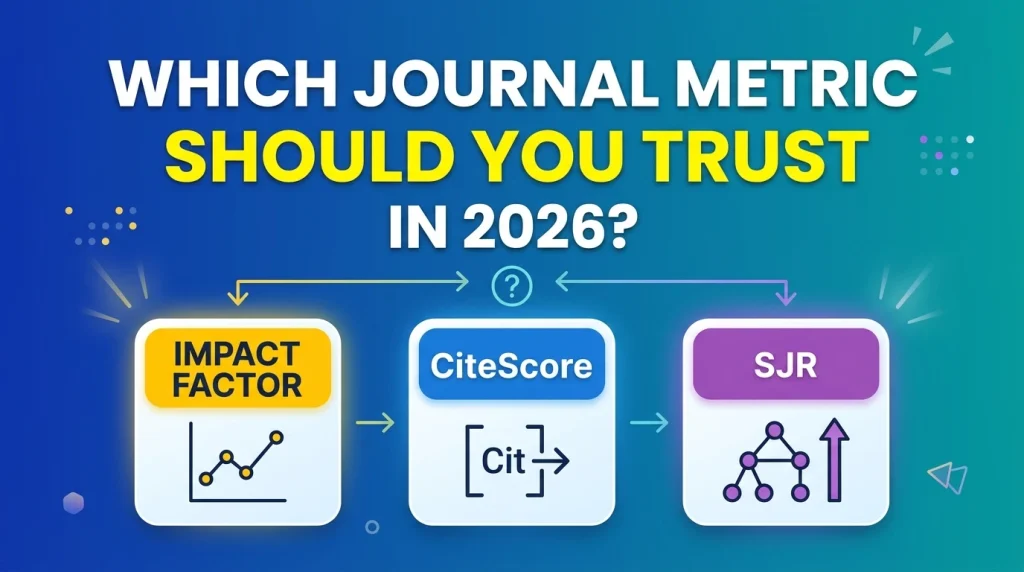
Choosing the right academic journal is one of the most consequential decisions in the research publication process. Yet researchers frequently encounter conflicting journal rankings: one journal has a high Impact Factor, another reports a substantially higher CiteScore, and a third holds a prestigious Q1 position in SCImago Journal Rank (SJR).
Which metric actually indicates journal quality?
The answer is not as straightforward as comparing numbers. Journal Impact Factor (JIF), CiteScore, and SCImago Journal Rank (SJR) measure citation performance using different databases, calculation periods, document classifications, and weighting systems. Consequently, their scores are not interchangeable, and a journal with a higher value under one metric is not necessarily more influential under another.
Understanding journal impact factor vs CiteScore vs SJR in 2026 is essential for PhD candidates, researchers, clinicians, and academic authors who want to publish in reputable journals, maximize research visibility, and avoid misleading journal rankings.
This guide examines the calculation methodologies, citation windows, document-type asymmetries, ranking systems, and practical limitations of all three metrics. It also explains how to evaluate Q1 and Q2 journals across Web of Science and Scopus before submitting your manuscript.
💡 Need expert help with your paper?
Transform your manuscript with ManuscriptLab’s professional editing and formatting services!
1. Understanding the Three Major Journal Metrics
Before comparing the numbers, understand what each metric measures and which indexing infrastructure supports it.
Journal Impact Factor (JIF)
The Journal Impact Factor is a journal-level citation indicator published by Clarivate through its Journal Citation Reports (JCR). It measures citations received during a particular year to scholarly content published in the journal during the preceding two years, relative to the number of qualifying articles and reviews published in that period.
JIF is calculated using data from the Web of Science Core Collection. It is particularly prominent in biomedical sciences, clinical research, life sciences, and established academic publishing environments.
However, JIF does not directly measure the quality of an individual article, the methodological rigor of a study, or the scientific contribution of an author.
CiteScore
CiteScore is Elsevier’s journal-level citation indicator based on the Scopus database.
Unlike the traditional two-year Impact Factor calculation, CiteScore uses a four-year publication and citation window. It includes five document categories: articles, reviews, conference papers, book chapters, and data papers.
Its broader document coverage provides a more inclusive representation of the scholarly output indexed in Scopus.
SCImago Journal Rank (SJR)
SCImago Journal Rank evaluates journal influence by considering not only the number of citations received but also the prestige of the journals providing those citations.
Its methodology is inspired by Google’s PageRank algorithm. Citations from highly influential journals can contribute more to a journal’s SJR than citations from less influential sources.
This distinction makes SJR a prestige-weighted indicator rather than a simple citation average.
Also Read: How to Write an Effective Discussion Section That Actually Engages Readers
2. Impact Factor vs CiteScore vs SJR: Key Differences in 2026
The following comparison summarizes the structural differences researchers should consider when selecting a journal.
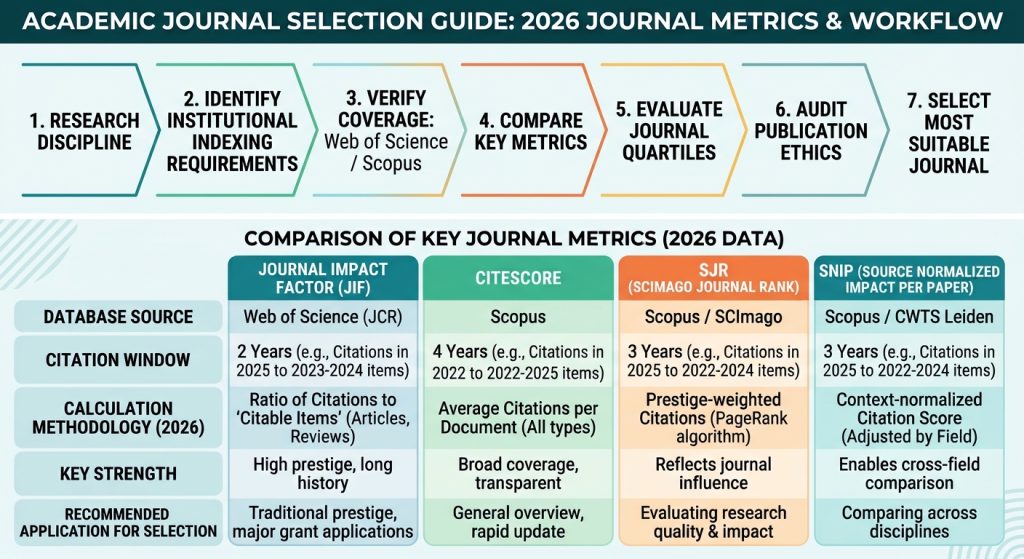
| Evaluation criterion | Journal Impact Factor | CiteScore | SJR |
| Publishing organization | Clarivate | Elsevier | SCImago |
| Primary database | Web of Science | Scopus | Scopus |
| Citation window | 2 years | 4 years | 3 years |
| Calculation approach | Citation average | Citation average | Prestige-weighted citations |
| Document coverage | Numerator and denominator differ | Five matched document types | Citation-network methodology |
| Citation weighting | Unweighted | Unweighted | Prestige-weighted |
| Subject comparison | JCR subject categories | Scopus subject categories | Scopus subject categories |
| Main advantage | Established recognition | Broader document coverage | Citation prestige |
| Main limitation | Document-type asymmetry | Database and coverage dependence | Algorithmic complexity |
Important: These indicators describe different aspects of journal performance. A JIF of 5, CiteScore of 8, and SJR of 2.0 cannot be interpreted as three measurements on the same numerical scale.
In 2026, researchers should also distinguish the calendar year of their evaluation from the data year underlying a published metric. For example, the 2026 JCR release reports the relevant completed citation year rather than representing citations accumulated throughout 2026.
3. How Is Journal Impact Factor Calculated?
Understanding the journal impact factor calculation is essential because its methodology creates some important differences from CiteScore.
The Journal Impact Factor formula
JIF = Citations in year Y to content from Y-1 and Y-2 ÷ Articles and reviews published in Y-1 and Y-2
For example, the 2026 Journal Citation Reports release uses 2025 citation activity and publications from 2023 and 2024.
Consider this hypothetical journal:
- Citations received in 2025 to its 2023–2024 content: 1,200
- Articles and reviews published during 2023–2024: 200
- Calculated Impact Factor: 6.0
Therefore, the journal has a 2026 JIF of 6.0.
The document-type asymmetry problem
One of the most important structural limitations of JIF is the difference between its numerator and denominator.
The numerator can include citations to different types of journal content, whereas the denominator counts qualifying citable items, principally articles and reviews.
For example, citations to certain editorials, letters, and other non-citable material can contribute to the numerator without those materials necessarily increasing the denominator.
This is known as document-type asymmetry.
Why does this matter?
A journal that publishes substantial editorial content may receive additional citations without a corresponding increase in its denominator. Consequently, its calculated Impact Factor can be influenced by editorial publishing practices and document classification.
Industry standard consideration: Clarivate identifies Articles and Reviews as citable items for the standard JIF calculation. Researchers should consult the relevant JCR documentation rather than assume that every published document contributes equally.
Common pitfall: Never interpret a high Impact Factor as proof that every article published in the journal receives a similar number of citations. Citation distributions are highly skewed, and a relatively small number of frequently cited articles can substantially influence a journal’s average.
Also Read: How to Choose the Right Journal for Your Research in 2026
4. How Is CiteScore Calculated? Understanding Its Four-Year Window
CiteScore addresses some limitations associated with the traditional Impact Factor methodology through a longer citation window and more consistent document classification.
The CiteScore formula
CiteScore = Citations received over four years ÷ Documents published over the same four years
The 2024 CiteScore, for example, uses citations received during 2021–2024 to documents published during 2021–2024.
The calculation includes five document types:
- Articles
- Reviews
- Conference papers
- Book chapters
- Data papers
Both the numerator and denominator use these same five categories.
Why is CiteScore generally higher than Journal Impact Factor?
Researchers frequently ask why CiteScore values are generally higher than Journal Impact Factors for the same journal.
There are several methodological explanations.
First, CiteScore uses a four-year window. A longer window allows more time for articles to accumulate citations, particularly in disciplines where research influence develops gradually.
Second, CiteScore includes additional document types. Conference papers, book chapters, and data papers contribute to its calculation. These publications can generate substantial citation activity in disciplines such as engineering, computer science, and interdisciplinary research.
Third, its document-type counting is symmetrical. The same five document categories are included in both the numerator and denominator, reducing the specific classification asymmetry associated with JIF.
However, a higher CiteScore is not guaranteed. Database coverage, publication patterns, citation distributions, and document composition can produce different outcomes.
What is the industry standard?
Scopus calculates annual CiteScore metrics and also provides CiteScore Tracker information that reflects developing citation performance.
Do not confuse a current Tracker value with the finalized annual CiteScore. When comparing journals, use finalized values from the same metric year.
Common pitfall: Comparing a journal’s current CiteScore Tracker against another journal’s finalized CiteScore produces an inconsistent comparison.
5. What Makes SJR Different? Understanding the Prestige-Weighted Algorithm
The main structural advantage of SJR over Impact Factor and CiteScore is its consideration of the prestige of the citing journal.
Traditional citation averages generally treat citations equally. SJR does not.
How the SJR algorithm works
SJR uses a citation-network approach inspired by Google’s PageRank algorithm.
Imagine two journals receiving 100 citations each:
- Journal A receives citations predominantly from highly influential journals.
- Journal B receives citations predominantly from less influential sources.
Although both journals have identical raw citation counts, their SJR values may differ because the sources of their citations have different prestige.
The algorithm distributes prestige through the citation network using an iterative calculation.
It considers factors such as:
- The prestige of citing journals.
- The distribution of citations across the network.
- The number of references made by citing sources.
- The journal’s position within the scholarly citation network.
SJR uses a three-year publication window for its standard citation indicator.
Why is prestige weighting important?
Citation quantity alone does not necessarily reflect scholarly influence.
A citation from a highly influential research journal may indicate a different level of network influence than a citation from a relatively low-impact source.
SJR attempts to account for this distinction.
This makes it particularly useful when researchers want to investigate the influence and reputation of journals within a scholarly citation network.
Common SJR mistakes
Mistake 1: Treating SJR as a direct citation average.
SJR is not simply the total number of citations divided by the number of published articles.
Mistake 2: Assuming prestige guarantees research quality.
A journal’s position within a citation network does not establish the methodological quality, reproducibility, or clinical significance of every article it publishes.
Mistake 3: Comparing SJR values without checking subject categories.
Journal ranking and quartile placement depend on the classification system and subject category being considered.
Also Read: How to Write the Methods Section for Clinical Papers Using CONSORT Checklists
6. SNIP: The Additional Metric Researchers Should Not Ignore
Although the main comparison involves JIF, CiteScore, and SJR, another useful indicator is Source Normalized Impact per Paper (SNIP).
Developed by the Centre for Science and Technology Studies (CWTS) at Leiden University, SNIP evaluates citation impact while accounting for differences in citation practices between research disciplines.
How SNIP works
Different disciplines have different citation patterns.
For example:
- Biomedical research frequently contains extensive reference lists.
- Mathematics publications may have substantially fewer references.
- Social sciences often have longer publication and citation cycles.
Comparing raw citation averages across these disciplines can produce misleading conclusions.
SNIP addresses this problem by adjusting citation impact according to the citation potential of the subject field.
Its underlying approach considers the characteristics of the publications citing a journal rather than relying exclusively on fixed subject-category comparisons.
Illustrative interpretation:
- SNIP = 1.0: approximately the overall normalized reference level.
- SNIP above 1.0: citation impact above the relevant normalized reference level.
- SNIP below 1.0: citation impact below that reference level.
SNIP is particularly useful for interdisciplinary research and cross-disciplinary journal comparisons.
Common pitfall: SNIP is not a substitute for checking the journal’s indexing status, editorial standards, or suitability for your research topic..
7. Web of Science vs Scopus: Why Journal Rankings Differ
Researchers frequently encounter different journal rankings when checking Web of Science and Scopus.
This does not automatically mean that one database is incorrect.
The two platforms have different indexing policies, journal coverage, classification systems, and citation-recording processes.
| Comparison factor | Web of Science | Scopus |
| Main journal metric | JIF | CiteScore |
| Journal ranking source | Journal Citation Reports | CiteScore and related indicators |
| Citation coverage | Web of Science Core Collection | Scopus database |
| Quartile classification | JCR subject categories | Scopus subject categories |
| Additional metrics | JIF, 5-year JIF | CiteScore, SJR, SNIP |
| Coverage differences | Its own indexed journal collection | Its own indexed journal collection |
Understanding Q1, Q2, Q3, and Q4 rankings
Quartiles divide journals into four ranking groups within a particular subject category.
- Q1: Top 25% of journals.
- Q2: 25%-50%.
- Q3: 50%-75%.
- Q4: Bottom 25%.
For example, a journal ranked in Q1 for Public Health may hold a Q2 position in another subject category.
A journal can also have different quartiles in JCR and SCImago because the underlying databases, classifications, and ranking indicators differ.
How should researchers evaluate Q1 and Q2 journals?
Do not assume that Q1 status is universal.
Check:
- The exact database providing the ranking.
- The journal’s subject category.
- The metric year.
- The journal’s percentile or ranking position.
- Whether the journal remains actively indexed.
Important: A Q1 journal in SJR is not automatically a Q1 journal in JCR. Always identify the ranking system when reporting quartile status.
8. How to Avoid Metric Manipulation in Academic Publishing
Journal metrics are useful evaluation tools, but they can be distorted through inappropriate citation practices.
Researchers should understand the difference between legitimate scholarly citation and deliberate citation manipulation.
Common forms of citation manipulation
1. Excessive journal self-citation
A journal may encourage authors to cite previously published papers from the same journal without a genuine scholarly justification.
2. Citation stacking
Multiple journals or editorial groups may coordinate citation practices to artificially increase their respective citation indicators.
3. Coercive citation requests
A reviewer or editor may request unnecessary citations to their own publications or a particular journal as a condition of acceptance.
4. Strategic editorial publishing
Excessive publication of highly cited reviews, editorials, or other content can influence certain journal-level citation indicators.
How can researchers identify suspicious metric patterns?
Look beyond the headline number.
- Investigate unusually high journal self-citation rates.
- Examine whether citations are relevant to the research topic.
- Compare recent metric growth with publication volume.
- Review editorial policies and peer-review transparency.
- Check whether the journal has been subject to indexing or editorial integrity concerns.
The Committee on Publication Ethics (COPE) provides guidance on identifying citation manipulation.
Also review the Directory of Open Access Journals (DOAJ) when evaluating eligible open-access journals.
Industry standard: Responsible publishing requires legitimate citation practices, transparent editorial policies, and compliance with established publication ethics standards.
Do not artificially add references to improve your paper’s perceived citation potential. Cite sources because they contribute to the scientific argument.
Also Read: How to Write a Strong Abstract for a Research Paper
9. Which Journal Metric Should You Prioritize When Choosing Where to Submit?
The most appropriate metric depends on your research discipline, publication objectives, institutional requirements, and target audience.
There is no universally superior metric.
Use the following decision framework.
| Research objective | Metric to prioritize | Reason |
| Institutional JCR requirements | JIF | Recognized Web of Science indicator |
| Broad Scopus citation coverage | CiteScore | Four-year window and broader document coverage |
| Journal citation prestige | SJR | Weights citations according to source prestige |
| Cross-disciplinary comparison | SNIP | Adjusts for differences in citation practices |
| Overall journal evaluation | Multiple indicators | Reduces dependence on one metric |
Scenario 1: Biomedical and clinical researchers
For clinical researchers, JIF may be particularly important when institutional policies specifically require a JCR-indexed journal.
However, clinical relevance, reporting quality, and readership should also influence journal selection.
Ensure that your manuscript follows the appropriate reporting framework, such as CONSORT for randomized trials or STROBE for observational studies.
Scenario 2: Engineering and computer science researchers
CiteScore can be especially informative when conference papers are an important part of the scholarly communication landscape.
SJR can provide additional information about the prestige of the journals citing your work.
Scenario 3: Interdisciplinary researchers
SNIP is particularly valuable when comparing journals from disciplines with substantially different citation practices.
Combine it with CiteScore and SJR rather than relying on a single ranking.
Scenario 4: Researchers targeting prestigious journals
Consider SJR alongside JIF and CiteScore to understand whether a journal’s citation influence comes from a broad citation base or highly influential citing sources.
Nevertheless, journal reputation, editorial selectivity, peer-review standards, and topical relevance remain essential.
10. A Practical Six-Step Journal Selection Strategy for 2026
Use this workflow before submitting your manuscript.
Step 1: Identify your target research audience.
Determine whether your paper primarily addresses clinicians, experimental researchers, engineers, social scientists, or interdisciplinary readers.
Step 2: Verify indexing status.
Check the journal directly in the relevant official database. Do not rely exclusively on screenshots, promotional banners, or third-party claims.
Step 3: Compare metrics from equivalent reporting years.
Record JIF, CiteScore, SJR, and SNIP where available. Avoid comparing a finalized annual value with an evolving tracker.
Step 4: Evaluate subject-category quartiles.
Confirm whether the journal is Q1 or Q2 in the database and category relevant to your institutional requirements.
Step 5: Investigate editorial quality.
Review the editorial board, peer-review process, publication ethics, retraction policies, APC transparency, and author copyright policies.
Step 6: Assess manuscript compatibility.
Check the journal’s aims and scope, article types, word limits, reference requirements, open-access options, and acceptance policies.
A technically strong paper submitted to an unsuitable journal can still face rejection.
For additional support, explore ManuscriptLab’s academic editing services and professional manuscript preparation support.
11. Visual Guide: Choosing the Right Journal Metric
12. Frequently Asked Questions (FAQs)
Why are CiteScore values generally higher than Journal Impact Factors for the same journal?
CiteScore often produces higher values because it uses a four-year citation window and includes five document types in both its numerator and denominator. JIF uses a two-year window and has a different document-type counting structure. However, CiteScore is not always higher.
What is the main structural advantage of SJR over Impact Factor and CiteScore?
SJR incorporates the prestige of citing journals into its calculation. Consequently, citations from influential journals can contribute more than citations from less influential sources. This provides a perspective on citation influence that simple citation averages cannot offer.
How does document-type asymmetry affect Journal Impact Factor calculations?
JIF’s numerator can include citations to different types of journal content, while its denominator counts qualifying citable items, principally articles and reviews. Citations to certain non-citable content can therefore increase the numerator without increasing the denominator proportionally.
Which journal metric should I prioritize when choosing where to submit my manuscript?
Prioritize the metric required by your institution or funding organization. If no specific metric is required, evaluate JIF, CiteScore, and SJR together. Consider SNIP for cross-disciplinary comparisons, and give substantial weight to journal scope, editorial quality, indexing status, and audience relevance.
Is Q1 in Scopus the same as Q1 in Web of Science?
No. Scopus-based and Web of Science-based quartiles use different databases, subject classifications, and ranking methodologies. A journal can be Q1 in SCImago but Q2 or unranked in a corresponding JCR category.
Is a journal with a high Impact Factor necessarily reputable?
No. A high Impact Factor indicates citation performance, not guaranteed editorial integrity or research quality. Investigate peer-review transparency, editorial credentials, publication ethics, and indexing status independently.
13. Pre-Submission Journal Evaluation Checklist
Before submitting your manuscript, complete the following checks:
- Confirm the journal’s official indexing status in Web of Science or Scopus.
- Verify the latest finalized JIF and CiteScore.
- Check the journal’s SJR and SNIP values where available.
- Confirm Q1/Q2 classification in the correct database and subject category.
- Compare metrics using equivalent reporting years.
- Investigate journal self-citation and suspicious citation practices.
- Review the editorial board and peer-review process.
- Verify APCs and other publication charges.
- Check copyright retention and open-access licensing options.
- Confirm manuscript scope, formatting, and reporting requirements.
- Prepare references, tables, figures, and supplementary files.
- Ensure your manuscript is professionally edited before submission.
Conclusion: Trust the Methodology, Not Just the Metric
The debate surrounding impact factor vs CiteScore vs SCImago Journal Rank is not about identifying one universally superior indicator. Each metric offers a different perspective on journal performance.
JIF provides an established citation indicator through Web of Science. CiteScore offers broader document coverage and a four-year calculation window through Scopus. SJR evaluates citation prestige through a weighted citation network, while SNIP helps account for differences in disciplinary citation practices.
The most reliable journal selection strategy combines multiple metrics with editorial credibility, indexing verification, research relevance, and publication ethics.
Choose journals that genuinely serve your research objectives rather than pursuing the highest available number. A well-matched publication venue can improve your research visibility, support meaningful scholarly engagement, and strengthen the long-term contribution of your work.
Ready to prepare your manuscript for publication? Visit ManuscriptLab for professional academic editing, manuscript formatting, and publication preparation support.