Academic researchers face a difficult writing challenge: presenting important findings with confidence without making claims that extend beyond their evidence. A manuscript that sounds excessively cautious may struggle to communicate its contribution, while one that makes absolute or exaggerated statements can attract criticism from peer reviewers.
The solution lies in understanding hedging language in academic writing. Hedging is the strategic use of linguistic expressions to qualify claims, communicate degrees of certainty, and distinguish established evidence from plausible interpretations. Rather than weakening an argument, appropriate hedging demonstrates scientific precision, critical thinking, and awareness of research limitations.
This distinction matters across disciplines. In medical research, overclaiming can lead to misleading clinical interpretations. In STEM publications, it can obscure uncertainty in experimental results. In social sciences, it can create unjustified generalizations about populations or behaviors.
This guide explains seven practical strategies for using hedging effectively, identifies common academic hedging words and examples, compares hedging with boosting, and shows how to calibrate claims for stronger manuscript submissions in 2026.
💡 Need expert help with your paper?
Transform your manuscript with ManuscriptLab’s professional editing and formatting services. Improve clarity, academic tone, and publication readiness with expert support.
1. Understand What Hedging Language Means in Academic Writing
Hedging refers to linguistic strategies that reduce the categorical force of a statement without removing its underlying meaning. It allows researchers to communicate how strongly their evidence supports a particular proposition.
For example:
- Overclaim: The treatment eliminates cardiovascular disease.
- Appropriately hedged: The treatment may reduce the risk of cardiovascular disease in selected patient populations.
The second statement is more scientifically responsible because it acknowledges that the effect may depend on patient characteristics, study design, and other influencing variables.
What is epistemic modality in scientific writing?
Epistemic modality describes how writers communicate their assessment of the certainty, probability, or possibility of a statement.
In research manuscripts, it is expressed through modal verbs, probability adverbs, evaluative adjectives, and reporting verbs.
Consider these examples:
- The results demonstrate an association.
- The results suggest an association.
- The results may indicate an association.
Each sentence communicates a different level of authorial commitment. The appropriate choice depends on the research design, statistical evidence, reproducibility, and supporting literature.
Hedging is therefore not simply a stylistic preference. It is an important part of scientific argumentation. Research on academic discourse, including Ken Hyland’s work on scientific research articles, identifies hedging as a mechanism for expressing caution and negotiating the acceptance of scholarly claims.
2. Understand the Difference Between Hedging and Boosting
Hedging and boosting represent two complementary strategies for positioning academic arguments.
Hedging qualifies a statement to acknowledge uncertainty or limitations. Boosting strengthens a statement to communicate a high degree of confidence or commitment.
Neither strategy is inherently superior. Researchers should select the appropriate expression according to the strength of the available evidence.
Hedging vs. boosting in research writing
| Feature | Hedging | Boosting |
| Primary purpose | Qualify claims | Strengthen claims |
| Certainty | Limited or conditional | High or emphatic |
| Common expressions | May, might, appears | Clearly, demonstrates, confirms |
| Research function | Acknowledge uncertainty | Emphasize robust findings |
| Typical application | Interpretations and limitations | Well-supported results |
| Main risk | Excessive uncertainty | Overstatement |
Examples of hedging and boosting
Hedging:
The findings suggest that sleep quality may influence cognitive performance.
Boosting:
The findings clearly demonstrate a substantial improvement in cognitive performance.
The second sentence requires considerably stronger evidence. If the study establishes only an association, the word “demonstrate” may overstate what the research can establish.
When should researchers use each strategy?
Use hedging when:
- The sample size is relatively small.
- Findings are preliminary or exploratory.
- The research identifies associations rather than causation.
- Statistical estimates involve considerable uncertainty.
- Results differ from previous studies.
- Mechanisms remain hypothetical.
Use boosting when:
- Results are directly supported by robust analyses.
- The evidence is consistent and reproducible.
- The statement describes an established methodological fact.
- Multiple independent studies support the conclusion.
The essential principle: Match linguistic certainty to evidential certainty. Do not use strong language merely to make a manuscript sound more authoritative.
3. Build an Effective Academic Hedging Vocabulary
Researchers can improve manuscript precision by developing a functional vocabulary of hedging expressions. However, selecting words randomly from a list is not sufficient. Each expression communicates a slightly different degree or type of uncertainty.
Academic hedging words list and examples
| Category | Common expressions | Example |
| Modal verbs | May, might, could, would | The intervention may improve recovery. |
| Reporting verbs | Suggest, indicate, appear, imply | The findings suggest a possible association. |
| Probability adverbs | Possibly, probably, potentially, presumably | The mechanism potentially explains the observed effect. |
| Evaluative adjectives | Possible, likely, probable, apparent | A possible explanation involves inflammation. |
| Hedging nouns | Possibility, tendency, likelihood, assumption | There is a possibility of selection bias. |
| Qualifying phrases | To some extent, in certain cases, generally | This pattern may apply in certain populations. |
A. Modal auxiliaries
Modal verbs are among the most recognizable hedging devices.
- May: Indicates possibility.
- Might: Often communicates a more tentative possibility.
- Could: Suggests a potential explanation or outcome.
- Would: Can express conditional relationships or hypothetical implications.
Example:
Instead of writing, “The intervention improves treatment outcomes,” write, “The intervention may improve treatment outcomes in patients with similar clinical characteristics.”
B. Epistemic reporting verbs
Reporting verbs help researchers distinguish between direct evidence and interpretation.
Examples include:
- Suggest
- Indicate
- Appear
- Seem
- Imply
- Propose
- Estimate
For instance, “The results indicate a relationship between exposure and disease progression” is more appropriately qualified than “The results prove that exposure causes disease progression.”
Remember that “indicate” does not automatically make a claim accurate. The underlying research design must still support the interpretation.
C. Probability adverbs
Probability adverbs communicate the researcher’s assessment of uncertainty.
Examples include:
- Possibly
- Probably
- Potentially
- Apparently
- Presumably
- Relatively
Use these expressions carefully. Avoid combining several uncertainty markers in one sentence.
For example:
Weak: The findings might possibly suggest that the intervention could potentially improve outcomes.
Improved: The findings suggest that the intervention may improve outcomes.
The revised sentence communicates uncertainty without becoming unnecessarily complicated.
4. Calibrate Claims According to Research Evidence
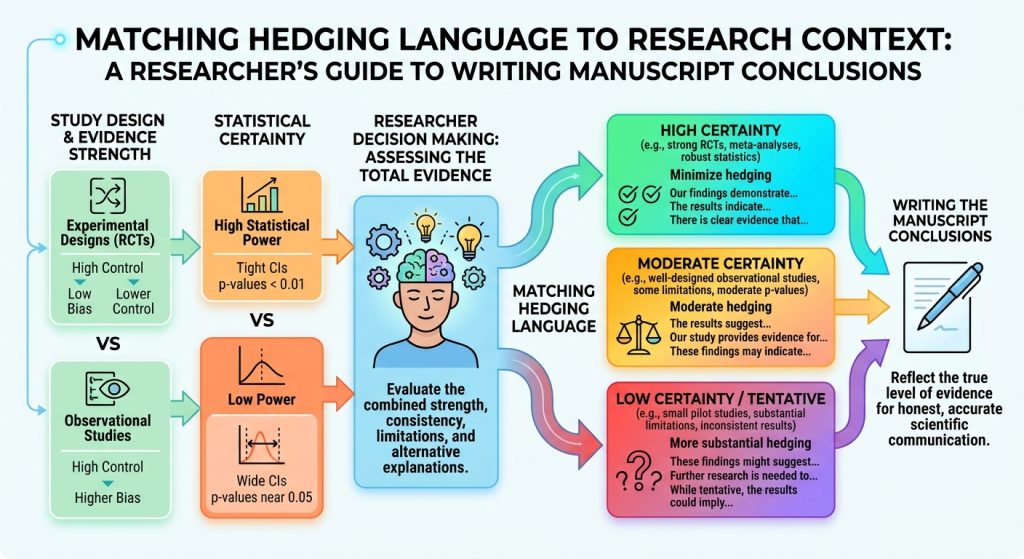
One of the most important applications of hedging is ensuring that research claims remain proportional to the evidence.
A manuscript may contain statistically significant findings but still lack sufficient evidence to establish causality, generalizability, or clinical importance.
Researchers should distinguish among statistical significance, effect size, confidence intervals, study design, and external validity.
Match claim strength to study design
| Research evidence | Appropriate language | Avoid |
| Cross-sectional study | Is associated with | Causes |
| Observational cohort | Was associated with an increased risk | Proves causation |
| Small exploratory study | May suggest | Establishes conclusively |
| Randomized controlled trial | Reduced the measured outcome | Eliminates the condition |
| Systematic review | The evidence indicates | Universally proves |
| In-vitro experiment | Demonstrates an effect under experimental conditions | Confirms clinical effectiveness |
These are general writing recommendations, not rigid rules. A randomized controlled trial can support causal inference within its design and assumptions, but it does not automatically establish universal effectiveness.
Consider statistical uncertainty
Suppose a clinical study reports an estimated treatment effect with a 95% confidence interval that includes the null value.
A statement such as:
“The treatment significantly reduces mortality.”
would be inappropriate if the reported analysis does not support statistical significance.
A more defensible alternative might be:
“The findings suggest a potential reduction in mortality, although the confidence interval indicates considerable uncertainty.”
Likewise, statistical significance alone does not establish clinical importance. Researchers should report effect sizes, uncertainty intervals, and relevant absolute numbers where appropriate.
Avoid overgeneralization in research conclusions
Overgeneralization occurs when researchers extend findings beyond the population, setting, variables, or conditions actually examined.
For example:
Overgeneralized: The intervention improves learning outcomes among all university students.
More precise: The intervention was associated with improved learning outcomes among undergraduate students enrolled in the participating institutions.
The second statement identifies the population and context to which the evidence directly applies.
5. Use Hedging Effectively in the Discussion and Conclusion Sections
The Discussion section is particularly vulnerable to overclaiming because researchers must interpret their findings, explain possible mechanisms, and describe their wider implications.
The challenge is to remain analytical without presenting speculation as established knowledge.
Softening strong statements in the manuscript Discussion section
Consider the following examples.
Example 1: Interpreting an observed relationship
Overstated: Our findings establish that physical inactivity causes depression.
Improved: Our findings suggest an association between physical inactivity and depressive symptoms.
Why it works: Unless the study design supports causal inference, the revised statement avoids assigning causality to an observed relationship.
Example 2: Explaining a biological mechanism
Overstated: Inflammation explains the observed treatment response.
Improved: Inflammation may contribute to the observed treatment response.
Why it works: The revised statement identifies a plausible mechanism without implying that it has been conclusively established.
Example 3: Discussing broader implications
Overstated: These results will transform clinical practice worldwide.
Improved: These findings may have implications for clinical practice, although further validation in diverse patient populations is required.
Why it works: The revised version recognizes the potential importance of the research while acknowledging the need for additional evidence.
A practical approach to revising the Discussion
Follow these four principles:
- Separate findings from interpretations. Report what the data demonstrate before discussing what the results might mean.
- Identify alternative explanations. Consider confounding variables, measurement limitations, and competing mechanisms.
- Acknowledge methodological constraints. Explain how sample characteristics, study design, and analytical choices affect interpretation.
- Qualify future implications. Present recommendations as potential applications when further research is necessary.
The International Committee of Medical Journal Editors (ICMJE) recommends linking conclusions to study objectives while avoiding unqualified statements and conclusions unsupported by the data.
This is particularly important in clinical research, where exaggerated conclusions can influence subsequent investigations and clinical decision-making.
Also read: 10 Key Reasons Manuscripts Get Rejected Before Peer Review
6. Recognize and Correct Over-Hedging
Although excessive certainty creates problems, excessive hedging can also undermine academic writing.
Over-hedging occurs when researchers qualify statements so frequently that their findings become unclear, unnecessarily tentative, or difficult to interpret.
For example:
Over-hedged: The findings might perhaps possibly indicate that the intervention could have some potential influence on patient outcomes.
Improved: The findings suggest that the intervention may influence patient outcomes.
The revised version preserves appropriate uncertainty while eliminating redundant expressions.
How do you know if your Discussion section is over-hedged?
Look for these warning signs:
- Multiple uncertainty markers appear in one sentence.
- Established scientific facts are presented as possibilities.
- Strong statistical findings are described using unnecessarily tentative language.
- Every sentence begins with “may,” “might,” or “could.”
- The research contribution becomes difficult to identify.
- The conclusion does not clearly communicate the main findings.
A practical editing test
Review each hedged statement and ask:
- Is the uncertainty scientifically justified?
- Does the hedge communicate a specific limitation?
- Would removing the hedge make the statement misleading?
- Does the sentence still communicate the research contribution?
If a hedge does not improve scientific accuracy or clarify the degree of certainty, consider removing it.
Remember: Confidence does not require absolute certainty. It requires clear, defensible communication of what the evidence establishes.
Also read: Paraphrasing vs Summarizing vs Quoting: 2026 Guide to Using Sources Without Plagiarizing
7. Apply Discipline-Specific Hedging Strategies
Hedging requirements differ across academic disciplines because research methods, evidence standards, and accepted forms of inference vary.
STEM and engineering manuscripts
Scientific precision is especially important when discussing experimental results, computational models, and theoretical explanations.
Common expressions include:
- The model appears to predict…
- The findings suggest a potential relationship…
- This mechanism may explain…
- The observed variation could be attributed to…
Avoid presenting simulation results as direct experimental confirmation or treating a single experimental outcome as universally reproducible.
Medical and clinical manuscripts
Medical authors must distinguish statistical findings from clinical recommendations.
Useful expressions include:
- May be associated with improved outcomes.
- Could represent a potential therapeutic approach.
- The findings warrant further clinical investigation.
- The results should be interpreted cautiously.
Use established reporting guidelines, including CONSORT for randomized trials and STROBE for observational studies. Hedging cannot replace transparent reporting of study design, limitations, and statistical results.
Social sciences and humanities
Interpretive research frequently involves context-dependent findings.
Appropriate expressions include:
- The evidence appears to support…
- This interpretation may reflect…
- The findings could be understood in relation to…
- The observed pattern suggests…
Avoid assuming that findings from one geographical, cultural, or institutional context apply universally.
A visual framework for scientific claim calibration
8. Follow a Practical Claim-Calibration Workflow Before Submission
Before submitting a manuscript, conduct a dedicated review of the language used to describe your results and conclusions.
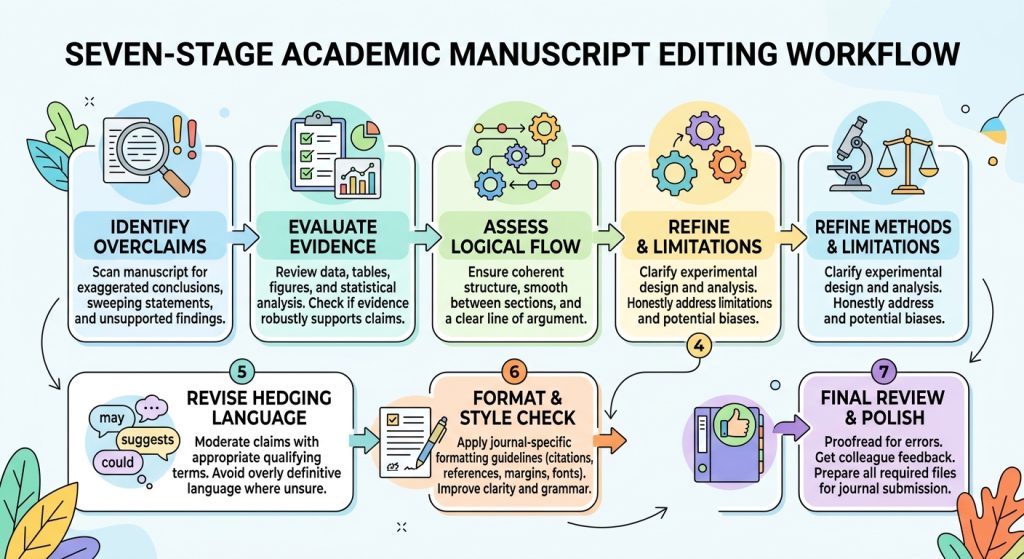
Use the following workflow:
Step 1: Identify high-impact claims.
Highlight statements containing words such as proves, establishes, confirms, eliminates, always, never, and guarantees.
Step 2: Trace every claim to its evidence.
Check the corresponding table, figure, statistical analysis, or cited publication. Confirm that the statement reflects the actual findings.
Step 3: Assess the level of certainty.
Consider sample size, study design, confidence intervals, potential bias, reproducibility, and external validity.
Step 4: Revise unsupported certainty.
Replace categorical language with an appropriately qualified expression when the evidence does not support a definitive conclusion.
Step 5: Remove redundant hedging.
Eliminate repeated uncertainty markers and unnecessary qualifiers.
Step 6: Check consistency across sections.
Ensure that the Abstract, Results, Discussion, and Conclusion communicate compatible levels of certainty.
Step 7: Conduct a final editorial review.
Check terminology, sentence clarity, reporting accuracy, and discipline-specific journal requirements.
Also read: Professional Academic Editing and Manuscript Preparation Services
9. Frequently Asked Questions About Hedging Language in Academic Writing
What is the main difference between hedging and boosting in academic writing?
Hedging qualifies claims to communicate uncertainty, possibility, or limitations. Boosting strengthens claims to express greater certainty and authorial commitment. Both are useful when they accurately reflect the available evidence.
Does using hedging language make my research sound weak or unconvincing?
No. Appropriate hedging demonstrates scientific precision and critical judgment. It helps researchers distinguish established findings from interpretations and hypotheses. However, excessive hedging can make an otherwise strong argument sound unnecessarily uncertain.
What are the most common hedging words used in STEM and medical manuscripts?
Common examples include may, might, could, suggest, indicate, appear, potentially, possibly, likely, and probable. Researchers should select expressions according to the strength of the experimental or clinical evidence.
How do I know if I have over-hedged my manuscript’s Discussion section?
Look for repeated uncertainty markers, unnecessarily tentative descriptions of established findings, and sentences that obscure the main research contribution. Retain only the qualifiers that communicate meaningful scientific uncertainty.
Can hedging improve my chances of peer review acceptance?
Appropriate hedging can improve the accuracy, credibility, and defensibility of manuscript claims. It does not guarantee acceptance, but it helps authors address a common source of reviewer criticism: conclusions that extend beyond the supporting evidence.
Should I use hedging in the Abstract and Conclusion?
Yes, when the evidence requires qualification. The Abstract and Conclusion should communicate the principal findings accurately without overstating their significance, generalizability, or implications.
Pre-Submission Checklist: Is Your Hedging Language Appropriate?
Before submitting your research paper, verify the following:
- Every major claim is supported by the reported evidence.
- Causal language is appropriate for the study design.
- Statistical significance is distinguished from clinical or practical significance.
- Modal verbs and probability expressions are used accurately.
- The Discussion acknowledges relevant methodological limitations.
- Speculative explanations are distinguished from established findings.
- Generalizations remain within the scope of the study population.
- Strong findings are not weakened by unnecessary hedging.
- Repeated qualifiers and redundant expressions have been removed.
- The Abstract and Conclusion reflect the same evidential certainty as the Results section.
- Reporting guidelines and journal-specific requirements have been followed.
- The final manuscript has undergone an academic language and consistency review.
Conclusion: Communicate Scientific Confidence Through Precision
Effective hedging is not about making research sound uncertain. It is about communicating exactly what the evidence supports, acknowledging what remains unresolved, and presenting interpretations without exaggeration.
By understanding the difference between hedging and boosting, developing an appropriate academic vocabulary, calibrating claims to research evidence, and reviewing the Discussion and Conclusion carefully, researchers can produce manuscripts that are both confident and scientifically responsible.
A credible research paper does not need exaggerated statements to demonstrate its contribution. It needs precise arguments, transparent limitations, and conclusions that withstand critical evaluation.
Make every research claim count. Let ManuscriptLab help you refine your academic language, strengthen your manuscript, and prepare your research for publication. Explore ManuscriptLab’s professional editing and manuscript preparation services and take the next step toward a publication-ready paper.