Academic writing depends on existing research. Whether you are preparing a journal article, developing a PhD dissertation, writing a systematic review, or publishing a clinical study, you must engage with previously published literature. However, using another researcher’s work introduces an important responsibility: representing their ideas accurately while maintaining your own academic voice.
Many researchers struggle to distinguish between paraphrasing, summarizing, and quoting. These three source-integration techniques serve different purposes, and using them incorrectly can lead to patchwriting, inadequate attribution, or plagiarism. Simply changing a few words in a published sentence does not make the content original. Similarly, citing a source does not excuse reproducing another author’s exact wording without quotation marks.
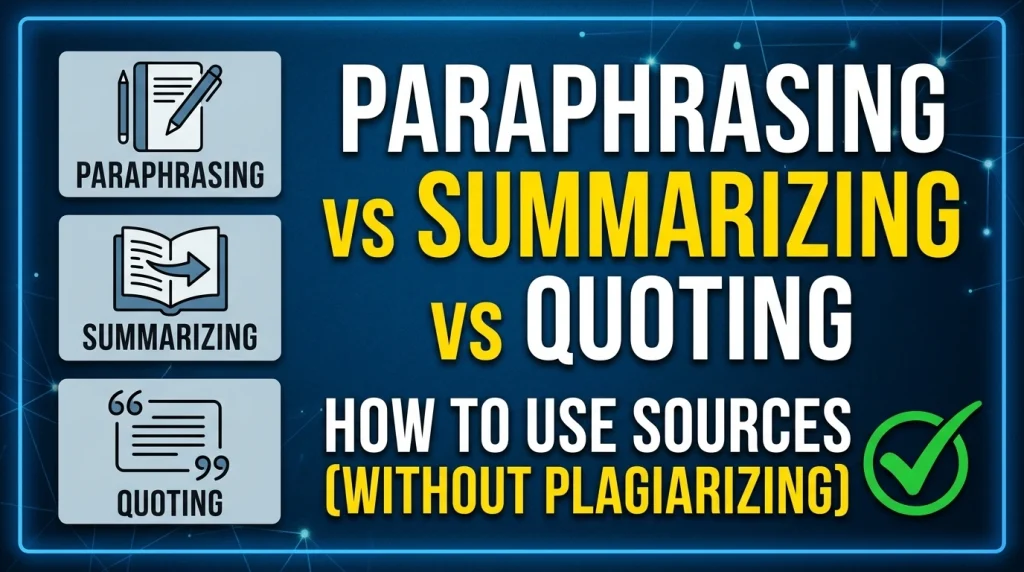
Understanding paraphrasing vs summarizing vs quoting is essential for producing academically sound, publication-ready manuscripts. Each technique allows you to incorporate external evidence while maintaining scholarly integrity, supporting your arguments, and demonstrating critical engagement with existing literature.
This guide explains the differences between these three techniques, demonstrates how to apply them in academic and scientific writing, and provides practical strategies for avoiding inadvertent plagiarism.
💡 Need expert help with your paper?Transform your manuscript with ManuscriptLab’s professional editing and formatting services!
1. Paraphrasing vs Summarizing vs Quoting: Understanding the Key Differences
Paraphrasing, summarizing, and quoting are three fundamental methods of incorporating external information into academic writing. Although all three require appropriate attribution, they differ in how closely the resulting text follows the original source.
The primary distinction involves the amount of information retained, the degree of textual transformation, and the importance of the original author’s exact wording.
What Is Paraphrasing?
Paraphrasing involves expressing another author’s specific idea or passage using your own vocabulary, sentence structure, and phrasing while preserving its original meaning.
Unlike direct quotation, paraphrasing does not reproduce the source’s exact language. Instead, it demonstrates that you understand the underlying concept and can communicate it independently.
For example:
- Original: Regular physical activity improves cardiovascular health by reducing blood pressure and enhancing vascular function.
- Paraphrased: Engaging in consistent exercise supports cardiovascular health through improvements in blood pressure regulation and vascular performance.
The paraphrased sentence communicates the same scientific concept but uses a different sentence structure and vocabulary.
Why researchers use it: Paraphrasing allows researchers to integrate specific findings, theoretical explanations, and methodological information without filling their manuscripts with lengthy quotations.
Industry standard: A successful paraphrase must preserve the original meaning, accurately represent the evidence, and include an appropriate in-text citation. Page numbers may also be required or recommended depending on the citation style and journal instructions.
Common pitfall: Replacing individual words with synonyms while retaining the original sentence structure constitutes patchwriting rather than effective paraphrasing.
What Is Summarizing?
Summarizing involves condensing a larger passage, research paper, chapter, or body of literature into a shorter explanation of its most important points.
A summary removes secondary details and focuses on the central arguments, findings, or conclusions.
For example:
- Original research finding: A clinical study investigates the relationship between regular exercise, blood pressure regulation, vascular function, and cardiovascular outcomes across several participant groups.
- Summary: The study reports an association between regular physical activity and improved cardiovascular health.
The summary communicates the broader finding without reproducing every methodological detail or supporting observation.
Why researchers use it: Summarizing is particularly valuable in literature reviews, research introductions, discussion sections, and systematic reviews. It helps authors establish the research context without overwhelming readers with unnecessary information.
Industry standard: A summary should accurately represent the source’s principal findings, acknowledge important limitations, and include an appropriate citation. Its length depends on the complexity of the source and the purpose of the discussion.
Common pitfall: Oversimplifying research findings can distort scientific meaning. For example, describing an observational association as proof of causation misrepresents the original evidence.
What Is Quoting?
Quoting means reproducing another author’s exact words without changing their wording. Direct quotations must be clearly distinguished from your own writing using quotation marks or the appropriate block-quotation format.
For example:
- Original: “Physical activity is associated with improved cardiovascular health.”
- Direct quotation: The authors concluded that “physical activity is associated with improved cardiovascular health” (Author, Year, p. XX).
The quotation preserves the original wording and explicitly identifies it as another author’s work.
Why researchers use it: Direct quotations are appropriate when the exact language is important to the analysis, such as when discussing a formal definition, historical statement, theoretical proposition, or policy recommendation.
Industry standard: Follow the relevant citation style and journal requirements. APA generally requires a locator for direct quotations, while Vancouver-style references commonly identify the source through numbered citations, with additional location information where appropriate.
Common pitfall: Including a source citation without quotation marks does not make copied wording acceptable. Exact language must be identified as a quotation and attributed appropriately.
2. Comparison Table: Paraphrasing vs Summarizing vs Quoting
The following table highlights the practical differences between these three source-integration techniques.
| Evaluation criterion | Paraphrasing | Summarizing | Quoting |
| Primary purpose | Restate a specific idea | Condense broader information | Preserve exact wording |
| Word choice | Your own words | Your own words | Original author’s words |
| Sentence structure | Reconstructed | Newly developed | Identical to source |
| Length | Similar or variable | Substantially shorter | Exact wording reproduced |
| Quotation marks | Not normally required | Not normally required | Required for short quotations |
| Citation required | Yes | Yes | Yes |
| Best application | Explaining specific findings | Literature reviews | Important definitions or statements |
| Main risk | Patchwriting | Misrepresentation | Unmarked copied text |
Important distinction: All three methods require attribution when you use another author’s ideas or information. Changing the wording does not eliminate the obligation to cite the original source.
3. How to Paraphrase Technical Text Without Changing Scientific Meaning
Technical paraphrasing requires more than vocabulary replacement. Researchers must preserve scientific accuracy while restructuring the original explanation.
This is particularly important in medical, pharmaceutical, engineering, and life sciences manuscripts, where changing a single technical term can alter the interpretation of a finding.
Follow these steps to produce accurate paraphrases.
Step 1: Understand the Complete Original Passage
Read the entire passage before attempting to rewrite it. Identify its central claim, supporting evidence, technical terminology, and any qualifications.
For example, distinguish between:
- A statistically significant association.
- A demonstrated causal relationship.
- A preliminary experimental observation.
- A clinically meaningful treatment effect.
These expressions are not interchangeable.
Step 2: Identify the Essential Scientific Information
Extract the information that must remain unchanged.
Depending on the research context, this may include:
- Numerical findings and percentages.
- Statistical significance and confidence intervals.
- Study population characteristics.
- Experimental conditions.
- Methodological limitations.
- Technical definitions.
For example, if the original study reports a 15% reduction in a measured outcome, do not describe it as a 20% improvement simply to create different wording.
Step 3: Rewrite Without Looking at the Original
Close the source document and explain the concept in your own words.
Change the sentence structure rather than simply replacing individual terms. Reorganize the explanation where appropriate, while retaining the original logical relationship between variables and findings.
Step 4: Compare Both Versions
Reopen the original passage and evaluate your paraphrase for accuracy.
Check whether the rewritten version:
- Preserves the original meaning.
- Maintains all essential technical details.
- Avoids unsupported interpretations.
- Uses independently constructed sentence structures.
- Clearly identifies borrowed ideas through citation.
Step 5: Add the Appropriate Citation
Include an in-text citation immediately after the paraphrased material or at the appropriate point in the paragraph.
Common pitfall: Over-paraphrasing technical terminology can reduce accuracy. Established scientific terms, gene names, chemical compounds, diagnostic classifications, and standardized methodological expressions do not need artificial synonyms.
4. What Is Patchwriting and Why Is It Considered Plagiarism?
Patchwriting occurs when a writer reproduces substantial elements of an original passage while making superficial changes to its vocabulary, phrasing, or sentence structure.
It often happens when researchers understand the general subject but struggle to explain complex information independently.
Consider this example:
Original sentence:
“Chronic inflammation contributes to the development and progression of several metabolic disorders.”
Patchwritten version:
“Long-term inflammation plays a role in the development and advancement of various metabolic diseases.”
Although several words have changed, the sentence closely follows the original structure and expression.
Why is this problematic?
Patchwriting does not demonstrate sufficient independence in writing. Even when a citation is provided, closely reproducing another author’s language without identifying the borrowed wording can create plagiarism concerns.
The solution is to understand the underlying concept before reconstructing the explanation.
Improved paraphrase:
“Persistent inflammatory activity is implicated in the pathophysiological mechanisms underlying multiple metabolic conditions (Author, Year).”
This version changes the sentence construction while retaining the central scientific concept. The citation acknowledges the original research.
However, if the original wording is particularly important, quote it directly rather than attempting to disguise it through superficial revisions.
Practical Strategies to Avoid Patchwriting
- Read the complete source rather than rewriting sentence by sentence.
- Take conceptual notes instead of copying original passages.
- Separate direct quotations from paraphrased notes.
- Avoid relying excessively on synonym-replacement tools.
- Compare your final draft with the source material.
- Cite borrowed concepts even when the wording is entirely original.
Also read: 10 Key Reasons Manuscripts Get Rejected Before Peer Review
5. When Should Researchers Use Direct Quotes in Scientific and Medical Manuscripts?
Direct quotations are relatively uncommon in many STEM and medical research articles. These disciplines generally prioritize concise reporting, objective interpretation, and evidence-based synthesis.
Paraphrasing and summarizing are usually more appropriate when discussing experimental results, clinical outcomes, statistical findings, and established scientific concepts.
However, direct quotations remain useful in specific circumstances.
Appropriate Situations for Direct Quotations
1. Reporting Formal Definitions
When a recognized organization establishes a specific definition, reproducing the exact wording may be necessary if the language itself is important to your discussion.
2. Discussing Policy or Regulatory Statements
Official recommendations, clinical guidelines, and regulatory statements may require precise wording to avoid changing their intended interpretation.
3. Analyzing Theoretical Arguments
In humanities, social sciences, and qualitative research, the original wording may be essential to interpreting an author’s argument.
4. Presenting Participant Statements
Qualitative studies frequently use verbatim interview excerpts to demonstrate participant experiences and support thematic analysis. Researchers must follow ethical approval, confidentiality, consent, and reporting requirements.
When Direct Quotations Should Be Avoided
Avoid quoting routine methodological descriptions, standard background information, and findings that can be accurately paraphrased.
Excessive quotation can make a manuscript appear dependent on existing literature rather than demonstrating the author’s own analysis.
There is no universal percentage of direct quotations that is acceptable across all journals. Follow the target journal’s author instructions and the conventions of your discipline.
Also read: Is It Worth Paying for Professional Academic Editing? An Honest Look at Cost, Value, and Common Myths
6. Proper In-Text Citation Methods: APA, MLA, and Vancouver
Correct attribution is essential regardless of whether you paraphrase, summarize, or quote.
Citation styles differ in their formatting conventions, but they share the same fundamental purpose: identifying the original source so readers can locate and verify the information.
| Citation style | In-text citation format | Common application |
| APA 7th edition | (Smith, 2024) | Psychology, education, social sciences |
| MLA 9th edition | (Smith 45) | Literature and humanities |
| Vancouver | (1) or superscript ¹ | Medicine and biomedical sciences |
APA Citation
APA uses an author-date citation system.
For example:
“Previous research has demonstrated a relationship between sleep quality and cognitive performance (Smith, 2024).”
For direct quotations, include a page number when available:
“Sleep quality influences cognitive performance” (Smith, 2024, p. 45).
MLA Citation
MLA generally uses the author’s surname and page number.
Example:
Improved sleep quality may support cognitive performance (Smith 45).
Vancouver Citation
Vancouver uses numbered references that correspond to the reference list.
Example:
Improved sleep quality may support cognitive performance (1).
The reference list provides the complete bibliographic information.
Important: Always follow the target journal’s instructions. Medical journals frequently specify Vancouver-style referencing, but individual publications may modify citation placement, punctuation, and reference formatting.
For further guidance, consult the International Committee of Medical Journal Editors (ICMJE).
7. How to Use Sources Without Plagiarizing: Academic Attribution and Source Integration
Effective academic writing involves more than incorporating citations. Researchers must establish clear relationships between external evidence and their own arguments.
Use the following source-integration techniques to strengthen your manuscript.
Introduce Sources With Appropriate Attribution
Identify the researchers or organizations responsible for the evidence.
Useful academic expressions include:
- According to Smith et al. (2024)…
- Previous research has demonstrated…
- The findings reported by Johnson and colleagues suggest…
- A recent systematic review identified…
- In contrast, another investigation reported…
These expressions establish the relationship between the evidence and the source.
Synthesize Multiple Sources
Avoid presenting one study after another without evaluating their relationships.
Instead, compare findings, identify methodological differences, and explain areas of agreement or disagreement.
For example:
“Several investigations have reported associations between physical activity and improved metabolic health (Smith, 2022; Johnson, 2023; Lee, 2024). However, differences in participant characteristics and study design may explain variations in the reported effect sizes.”
This approach demonstrates critical thinking rather than simply reproducing published information.
Distinguish Evidence From Interpretation
Clearly separate what the original researchers reported from your own interpretation.
Use cautious expressions such as “may indicate,” “is associated with,” or “suggests” when the evidence does not establish causation.
This distinction is particularly important when preparing discussion sections and interpreting clinical research.
Maintain a Traceable Reference Record
Record complete bibliographic information during literature searches.
Include author names, publication year, article title, journal, volume, issue, page range, DOI, and relevant page numbers where available.
Reference management software can help organize sources and reduce citation inconsistencies.
Also read: How to Write a Literature Review: Structure, Synthesis Matrix, and 7 Common Mistakes to Avoid in 2026
8. Can Turnitin Detect Paraphrasing and What Is an Acceptable Similarity Score?
Similarity-checking software, including Turnitin, can identify textual matches between submitted manuscripts and content available in its comparison databases.
However, a similarity score is not a direct measurement of plagiarism.
A manuscript may contain legitimate matching text because of:
- Standard scientific terminology.
- Properly attributed quotations.
- Common methodological descriptions.
- Bibliographic references.
- Previously published material that is appropriately disclosed.
Conversely, a low similarity score does not guarantee that a manuscript is free from plagiarism. Unattributed paraphrasing and the misappropriation of research ideas may not produce substantial textual matches.
What Similarity Score Should Researchers Target?
There is no universally accepted similarity percentage for all academic institutions and journals.
| Similarity range | General interpretation | Recommended action |
| 0-5% | Limited textual overlap | Review matching passages |
| 6-15% | Moderate textual overlap | Examine individual matches |
| 16-25% | More substantial overlap | Investigate sources and repeated wording |
| Above 25% | High textual overlap | Conduct a detailed similarity audit |
Important: These ranges are illustrative review categories, not official Turnitin thresholds or universal journal acceptance criteria. Actual requirements vary between institutions, journals, disciplines, and manuscript types.
Review the similarity report at the passage level. Identify unattributed text, excessive quotations, duplicated material, and legitimate technical overlap before making revisions.
9. Common Mistakes When Paraphrasing, Summarizing, and Quoting
Even experienced researchers can make source-integration mistakes, particularly when preparing lengthy manuscripts under submission deadlines.
Avoid these common problems:
Mistake 1: Assuming Citation Alone Prevents Plagiarism
A citation identifies the source but does not indicate that copied wording is a direct quotation. Use quotation marks or the required block format for exact language.
Mistake 2: Changing Only a Few Words
Superficial synonym replacement does not produce an independent paraphrase. Reconstruct the explanation using your own understanding.
Mistake 3: Removing Important Scientific Qualifications
Do not remove limitations, confidence intervals, or uncertainty statements when summarizing findings.
Mistake 4: Overusing Direct Quotations
Excessive quotation can interrupt the manuscript’s argument and reduce the visibility of your own scholarly contribution.
Mistake 5: Citing Secondary Sources as Primary Evidence
Whenever possible, consult the original research rather than relying exclusively on another author’s summary of it. If you cannot access the original, follow the appropriate secondary-citation rules.
Mistake 6: Treating AI-Generated Rewriting as Automatic Plagiarism Prevention
AI-assisted paraphrasing tools cannot guarantee originality, factual accuracy, or appropriate attribution. Researchers remain responsible for verifying the scientific content, checking source references, and following journal disclosure policies.
The ICMJE Recommendations provide guidance on authorship, publication ethics, and the responsible use of AI-assisted technologies in scholarly publishing.
10. A Practical Blueprint for Ethical Source Integration
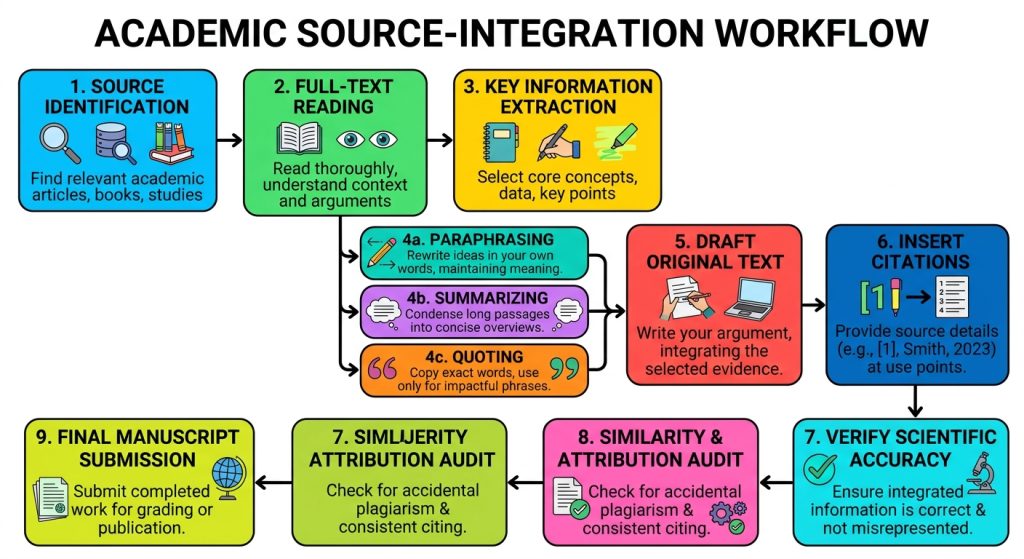
Use this workflow throughout the writing process rather than waiting until the manuscript is complete. Early source tracking makes citation verification and reference management significantly easier.
Also read: Professional Manuscript Editing and Formatting Services
11. Pre-Submission Checklist: Are You Using Sources Correctly?
Before submitting your research manuscript, complete the following checks:
- Every borrowed idea, finding, and argument has an appropriate citation.
- Direct quotations are clearly identified using the required formatting.
- Paraphrased passages use independently constructed sentence structures.
- Summaries preserve the original research’s principal findings.
- Scientific terminology, numerical values, and statistical results remain accurate.
- No passages rely on superficial synonym replacement or patchwriting.
- Primary research sources have been consulted wherever possible.
- In-text citations correspond to the reference list.
- All references follow the target journal’s required citation style.
- Similarity reports have been reviewed at the passage level.
- Previously published material has been appropriately attributed and disclosed.
- AI-assisted writing, where applicable, complies with journal policies.
Conclusion: Build Academic Credibility Through Ethical Source Integration
Understanding paraphrasing vs summarizing vs quoting is fundamental to responsible academic writing. Although all three techniques allow researchers to incorporate existing knowledge, each serves a distinct purpose.
Paraphrasing communicates specific ideas using independently constructed language. Summarizing condenses broader information into its essential findings. Quoting preserves exact wording when the original expression is important.
Regardless of the technique, accurate attribution remains essential. Researchers must preserve scientific meaning, avoid patchwriting, distinguish their interpretations from published evidence, and follow the target journal’s citation requirements.
A strong research manuscript does not simply reproduce existing knowledge. It evaluates, synthesizes, and builds upon it.
Need help preparing a scientifically accurate, plagiarism-conscious, and publication-ready manuscript? Explore ManuscriptLab’s professional editing and formatting services and strengthen your manuscript before submission.