Academic proofreading is a specialized service, but setting the right price can be challenging. Charge too little, and you risk undervaluing your expertise, spending unpaid hours on complex manuscripts, and limiting your earning potential. Charge too much without clearly communicating your value, and prospective clients may choose a competitor.
So, how much should I charge for proofreading academic papers, dissertations, and scientific manuscripts? The answer depends on your editing scope, subject expertise, word count, turnaround time, and pricing model.
Academic proofreading focuses on correcting grammar, spelling, punctuation, typographical errors, and consistency while preserving the author’s intended meaning. It differs from substantive editing, which may involve restructuring arguments, improving clarity, and addressing broader issues in academic writing. This distinction directly affects what you should charge.
In this guide, we explain academic proofreading rates per word, per page, and per hour; compare freelance and agency pricing models; calculate realistic project fees; and show you how to price dissertations, STEM manuscripts, and medical research papers sustainably.
💡 Need expert help with your paper?
Transform your manuscript with ManuscriptLab’s professional editing and formatting services!
1. How Much Should I Charge for Academic Proofreading?
There is no universal rate for academic proofreading. A suitable fee reflects the work required to deliver a polished manuscript, not simply the number of words submitted.
For freelancers serving international academic clients, the following ranges can serve as illustrative starting estimates in USD, not official industry averages or verified current EFA quotations.
| Pricing model | Illustrative rate | Best suited for |
| Per word | 0.015–0.04 | Standard academic proofreading |
| Per page | 4–10 | Manuscripts with a clearly defined page format |
| Per hour | 25–60 | Variable-scope or specialized assignments |
| Per project | 150–1,200+ | Dissertations, theses, and longer manuscripts |
| Rush surcharge | 20%–50% above the base fee | Short-deadline projects |
These estimates are intended for initial pricing calculations. Actual market rates vary by country, client segment, language proficiency, subject complexity, service scope, and editor experience. Advanced scientific editing and agency packages may cost substantially more.
What determines your proofreading rate?
Evaluate five factors before quoting a fee:
- Editing scope: A final language check requires less intervention than extensive academic copyediting.
- Manuscript condition: A carefully revised paper generally takes less time than a manuscript with pervasive grammatical problems.
- Subject complexity: Specialized terminology, equations, clinical terminology, and technical abbreviations can increase the time needed.
- Deadline: A 24-hour turnaround may require schedule disruption or additional resources.
- Deliverables: Tracked changes, a style sheet, reference checks, formatting, and a second review can justify a higher fee.
The most important principle is to price the actual work involved. A 5,000-word manuscript with persistent language errors may require more effort than a well-prepared 10,000-word paper.
2. Understand EFA Academic Proofreading Rate Benchmarks
The Editorial Freelancers Association (EFA) publishes rate information intended to help freelance editorial professionals understand the market. Its rate charts are useful reference points, but they should not be treated as mandatory prices or guarantees of what clients will pay.
Visit the Editorial Freelancers Association to review its published rate information and identify the categories most relevant to your services.
How should you use EFA rates?
First, match the service category. Proofreading, copyediting, developmental editing, and academic editing are not interchangeable. Compare your proposed fee with the category that most closely reflects your deliverables.
Second, check the unit of measurement. Some editorial rate references use hourly rates, while others use per-word or per-page equivalents. Convert them into a common unit before drawing conclusions.
Third, consider your market positioning. A new freelancer working with general academic manuscripts may price differently from an experienced medical editor serving researchers preparing submissions to international journals.
Finally, calculate your effective hourly earnings. A seemingly competitive per-word rate may become unprofitable if the manuscript requires extensive intervention.
For example, charging $0.025 per word for a 6,000-word paper generates $150 in revenue. If the work takes five hours, your gross hourly revenue is $30. If it takes eight hours, that figure falls to $18.75 before expenses and taxes.
Use external rate benchmarks to inform your decisions, then validate your pricing against actual project time, client demand, and business costs.
Also read: How to Cite a Master’s Thesis and PhD Dissertation in MLA 9 Style
3. Choose the Right Academic Proofreading Pricing Model
Your pricing model influences profitability, client expectations, and administrative workload. Choose a model that fits the predictability of your assignments.
A. Per-word pricing
Per-word pricing is often straightforward for academic manuscripts because clients can estimate the total cost before commissioning the work.
Illustrative formula:
Project fee = Word count × Rate per word
Suppose your standard proofreading rate is $0.025 per word.
- 3,000 words: $75
- 5,000 words: $125
- 10,000 words: $250
- 20,000 words: $500
- 30,000 words: $750
This model works well when the manuscript’s condition and the scope of work are reasonably predictable.
Common pitfall: Applying the same rate to every manuscript. A highly technical clinical paper may require considerably more concentration than a general humanities essay. Establish complexity tiers or quote a premium rate for specialized work.
B. Per-page pricing
Per-page pricing can work for clients who think in terms of manuscript pages rather than total word count. However, a page is not a standardized unit unless you define it.
A manuscript formatted in 12-point Times New Roman, double-spaced, with 1-inch margins may contain approximately 250–300 words per page. Tables, figures, equations, and reference lists can substantially alter that estimate.
If you charge $6 per standardized page, a 40-page manuscript costs $240.
Specify whether a page means a standardized word-equivalent page or an actual formatted page. Also clarify whether references, appendices, tables, figure captions, and supplementary materials are included.
Common pitfall: Quoting a fee based on the document’s current page count without checking its formatting. A change in font, spacing, or margin settings can distort the actual workload.
C. Hourly pricing
Hourly pricing is useful when the scope is uncertain, the manuscript requires diagnostic assessment, or the client requests work beyond proofreading.
Use this formula:
Hourly rate = Target gross project revenue ÷ Estimated working hours
If you want to earn $40 per hour and expect a manuscript to take six hours, your base quote should be $240.
Include time for document review, editing, quality assurance, client communication, and file preparation. Otherwise, your actual earnings will be lower than your target.
Hourly billing can be less attractive to clients who need a fixed budget. Provide a realistic estimate or a not-to-exceed amount when possible, and obtain approval before exceeding the agreed scope.
D. Fixed-project pricing
Fixed-project pricing is particularly useful for dissertations, theses, grant applications, and complete journal submissions.
Before quoting, review a representative sample of the document. Estimate the total word count, assess language quality, identify technical sections, and confirm the required deadline.
A fixed fee gives clients budget certainty while allowing experienced editors to benefit from efficient workflows. However, the agreement must specify the scope, revision policy, and treatment of additional material.
Best practice: Quote a fixed fee only after assessing the manuscript. For unfamiliar projects, state that the quote is conditional on the document matching the sample reviewed.
E. Tiered service pricing
A tiered model allows you to distinguish proofreading from more comprehensive editing.
| Service tier | Typical scope | Pricing approach |
| Standard proofreading | Grammar, spelling, punctuation, consistency | Base rate |
| Academic copyediting | Language, clarity, terminology, style consistency | Higher rate |
| Technical or scientific editing | Specialized language and discipline-specific conventions | Premium rate |
| Editing plus formatting | Language work and journal-specific presentation | Combined project fee |
| Rush service | Agreed scope completed on an accelerated schedule | Base fee plus surcharge |
Do not describe substantive rewriting, reference verification, or journal formatting as proofreading unless those services are explicitly included. Transparent service definitions prevent disputes and protect the credibility of your business.
Also read: Why ChatGPT Can’t Pass Peer Review (And Why You Still Need a Human Editor)
4. How to Calculate Per-Word Versus Hourly Rates
The most reliable pricing method compares the fee you quote with the time you actually spend completing the work.
Consider a 7,500-word academic manuscript.
Per-word quote: At $0.03 per word, the fee is $225.
Now compare the effective hourly revenue:
| Total working time | Effective gross hourly revenue |
| 3 hours | $75.00 |
| 4.5 hours | $50.00 |
| 6 hours | $37.50 |
| 7.5 hours | $30.00 |
| 9 hours | $25.00 |
The quoted project fee remains $225, but the profitability changes substantially as the workload increases.
Calculate your minimum sustainable rate
Start with your desired annual income, operating expenses, and realistic billable hours.
For example, assume you want $60,000 in annual pre-tax business income and expect $12,000 in annual operating expenses. If you can bill 1,200 hours per year, your minimum hourly revenue target is:
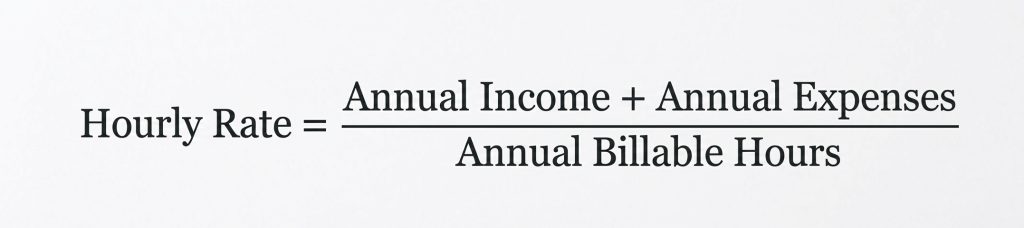
This calculation excludes income taxes and any additional allowance you may need for unpaid leave, retirement contributions, or business reserves. Adjust the target accordingly.
Next, estimate how many hours a manuscript will take. If a 6,000-word paper requires five hours of work, a $60 hourly revenue target implies a $300 project fee, equivalent to $0.05 per word.
That may be higher than the illustrative standard-proofreading range. If so, you can improve profitability by refining your workflow, targeting clients who value your expertise, narrowing your service scope, or specializing in higher-value work.
Do not reduce your rate automatically simply because a competitor charges less. First determine whether the competitor offers the same service to the same client segment.
Also read: 10 Key Reasons Manuscripts Get Rejected Before Peer Review
5. What Should You Charge for a 30,000-Word Academic Dissertation?
Dissertations require careful planning because they contain multiple chapters, references, tables, figures, appendices, and discipline-specific terminology. Their length also increases the risk of inconsistent spelling, abbreviations, formatting, and terminology.
Consider a 30,000-word dissertation with a quoted rate of $0.025 per word.
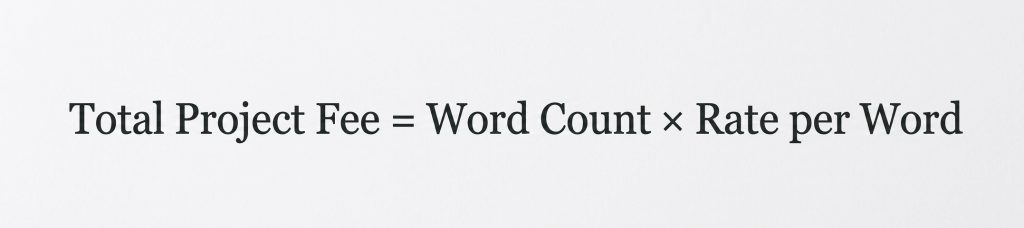
At this rate, the project fee is $750 before any approved add-ons or rush charges.
| Per-word rate | Fee for 30,000 words |
| $0.015 | $450 |
| $0.020 | $600 |
| $0.025 | $750 |
| $0.030 | $900 |
| $0.040 | $1,200 |
These figures are calculation examples, not a verified average price for dissertation proofreading.
What should your dissertation quote include?
Before accepting the project, clarify:
- Whether the abstract, references, appendices, tables, and captions are included.
- Whether the editor will use tracked changes in Microsoft Word.
- Whether university formatting guidelines must be followed.
- Whether citation formatting or reference verification is included.
- Whether the client expects a second pass after implementing revisions.
- Whether the dissertation must meet a specific submission deadline.
A dissertation that needs only a final language check should not be priced identically to one requiring extensive copyediting. Request a representative sample from each major section, particularly if language quality varies across chapters.
Practical recommendation: For long dissertations, offer a paid sample edit or an initial assessment. Use the results to estimate the workload, confirm the scope, and establish a realistic delivery schedule.
6. Should You Charge More for STEM, Medical, and Scientific Manuscripts?
Yes, when the manuscript’s complexity, required expertise, or quality-control burden justifies a premium.
Scientific proofreading often requires familiarity with technical terminology, abbreviations, units of measurement, statistical notation, figure labels, and discipline-specific style conventions. Medical manuscripts may also contain clinical terminology, drug names, diagnostic classifications, and reporting requirements.
However, a premium should reflect the actual service and qualifications involved—not simply the fact that a paper belongs to a scientific discipline.
Factors that justify higher rates
Specialist knowledge: Editors with relevant scientific or clinical expertise may be better equipped to recognize inconsistent terminology and obvious language-related ambiguities.
Technical formatting: Equations, tables, Greek symbols, superscripts, subscripts, and figure captions can require additional checking.
Journal requirements: Some assignments involve adherence to a journal’s author instructions, reference style, or reporting checklist.
Quality assurance: Highly technical manuscripts may require additional consistency checks and more careful handling of tracked changes.
Use a complexity premium only when you can explain what it covers. For example, you might apply a 15%–30% planning premium to a manuscript that demonstrably requires more time than a standard paper. This is an illustrative pricing strategy, not an established industry-wide surcharge.
Do not silently alter scientific meaning or independently change research results. Flag ambiguous statements for author clarification, preserve the author’s intended meaning, and distinguish language editing from scientific validation.
For clinical studies, consult the EQUATOR Network for reporting guidelines such as CONSORT for randomized trials and STROBE for observational studies. These guidelines support reporting completeness; checking compliance is a separate service unless explicitly included in your contract.
Also read: ManuscriptLab Editing Services
7. How Much Should You Charge for Rush Academic Proofreading?
Short deadlines can increase workload, reduce scheduling flexibility, and require you to postpone other assignments. Your rush fee should compensate for those constraints.
An illustrative rush-pricing structure is:
| Turnaround | Possible pricing approach |
| Standard schedule | Base fee |
| Moderately accelerated | 10%–20% surcharge |
| High-priority turnaround | 20%–35% surcharge |
| Same-day or overnight | 35%–50% or a separately quoted premium |
These percentages are suggested business policies, not standardized market rates. A rush assignment should be accepted only if you can complete it without compromising quality.
Before confirming a deadline, consider the manuscript’s word count, condition, technical complexity, time-zone differences, and whether a second quality-assurance pass is feasible.
State the delivery date and time zone in writing. Define whether the deadline covers the edited file only or also includes a final quality check and any agreed follow-up.
Common pitfall: Accepting an unrealistic deadline because the surcharge appears attractive. A missed deadline can damage client relationships and create more costs than the rush fee compensates for.
8. Why Do Academic Editing Agencies Charge More Than Freelancers?
Academic editing agencies may charge more than individual freelancers because the service can include several layers of coordination, quality assurance, and customer support. However, the price difference varies by provider and service level.
| Factor | Independent freelancer | Editing agency |
| Project coordination | Usually handled by the editor | May involve a coordinator or account manager |
| Editor selection | Based on one editor’s expertise | May offer discipline-based matching |
| Quality assurance | Depends on the freelancer’s workflow | May include an additional review |
| Turnaround capacity | Limited by individual availability | May have a larger editor network |
| Pricing flexibility | Direct negotiation may be possible | Packages and minimum fees may apply |
| Accountability | Direct relationship with the editor | May include centralized support and service policies |
These are typical operating models, not guarantees. Some freelancers provide excellent multi-stage quality assurance, while some agencies outsource most editing without an additional review.
How should freelancers compete with agencies?
Avoid competing on price alone. Instead, communicate your qualifications, subject expertise, editorial process, turnaround reliability, confidentiality practices, and clearly defined deliverables.
Offer a transparent scope of work. Explain what is included, what requires an additional fee, and what the author remains responsible for verifying.
For agencies, pricing must account for more than editor compensation. Project management, recruitment, quality assurance, customer support, payment processing, and business development all contribute to operating costs.
A higher agency price is defensible when it reflects measurable service benefits. Clients should be able to understand what those benefits are.
9. Build a Sustainable Freelance Academic Editing Pricing Strategy
A pricing strategy should support both client acquisition and long-term business viability.
Step 1: Define your specialization
Identify the manuscript types you can edit confidently. Examples include doctoral dissertations, biomedical research, engineering papers, social science manuscripts, and humanities research.
Specialization helps you estimate project duration more accurately and communicate your value to the right clients.
Step 2: Set a minimum project fee
Small assignments still require communication, document setup, payment administration, and quality checks. A minimum fee prevents short documents from consuming disproportionate amounts of unpaid time.
For example, you could establish a $50 minimum project fee as an internal starting policy. Adjust it to your market, operating costs, and typical workload.
Step 3: Establish clear service boundaries
Specify whether the fee includes proofreading, copyediting, formatting, reference checks, or journal-specific compliance checks.
Do not promise acceptance by a journal, a higher Impact Factor, or a specific citation outcome. Editing can improve presentation and readability, but editorial decisions depend on the manuscript’s scientific contribution, methods, relevance, and peer review.
Step 4: Track effective hourly revenue
Record the quoted fee, word count, estimated hours, actual hours, revision time, and any additional work for every project.
After completing 10–20 comparable assignments, review the results. Identify which manuscript types consistently take longer than expected and revise your pricing or scope.
Step 5: Review rates periodically
Review your pricing at least annually and whenever your expertise, demand, or operating costs change materially. Use reliable market references, client feedback, and your own project data.
Do not treat one published rate chart as a complete representation of the global academic editing market.
10. Pre-Quote Checklist for Academic Proofreaders
Before sending a quote, verify the following:
- Confirm the total word count and document format.
- Review a representative sample of the manuscript.
- Distinguish proofreading from copyediting and substantive editing.
- Identify technical terminology, equations, tables, and figures.
- Confirm the required reference style and journal guidelines.
- Define whether references, appendices, and supplementary files are included.
- Estimate editing, quality-assurance, and administrative time.
- Calculate your minimum sustainable project fee.
- Add a clearly stated rush surcharge if applicable.
- Specify deliverables, tracked changes, and revision limits.
- Confirm the delivery date and time zone.
- Document the fee, scope, confidentiality arrangements, and payment terms.
Conclusion: Price Your Academic Proofreading Services with Confidence
The right academic proofreading rate balances the manuscript’s complexity, your expertise, the client’s expectations, and the time required to deliver consistent results. Per-word pricing works well for predictable assignments, hourly pricing helps manage uncertain scopes, and fixed-project quotes offer budget clarity for dissertations and journal submissions.
Use EFA benchmarks as a reference rather than a rigid rule. Calculate your effective hourly revenue, establish clear service boundaries, and charge appropriately for specialist knowledge and accelerated deadlines.
Most importantly, communicate your value through a transparent editorial process and realistic deliverables. Sustainable pricing helps you build a professional academic editing business while giving researchers the language support they need to present their work clearly.
Need professional support with your academic manuscript? Explore ManuscriptLab’s editing and formatting services to help prepare your paper for submission.