Citing a master’s thesis or PhD dissertation correctly can be surprisingly difficult. The source may be unpublished, stored in a university repository, available through ProQuest, or hosted on another academic database. Each situation raises practical questions: How do you cite a master’s thesis in MLA? Do you italicize the title? Should you include the university? What changes when the dissertation comes from a database?
MLA 9 addresses these questions through its core-element approach to documentation. Rather than memorizing an entirely separate citation system for every source type, you identify the relevant elements author, title, publication information, date, container, and location and arrange them according to MLA’s template.
For a thesis or dissertation, the essential information usually includes the author, italicized title, year, institutional or degree information when relevant, and the repository or database when the work was accessed there. MLA does not require writers to create one citation style for “published” dissertations and another for “unpublished” dissertations.
This guide explains how to cite a master’s thesis in MLA 9, how to cite a PhD dissertation in MLA, how to handle unpublished works and database records, how to format in-text citations, and how to avoid the most common Works Cited errors.
💡 Need expert help with your paper?
Transform your manuscript with ManuscriptLab’s professional editing & formatting services!
1. Understand the MLA 9 Thesis and Dissertation Citation Structure
MLA 9 uses a flexible template of core elements rather than a rigid source-by-source formula. For theses and dissertations, this means you should first identify what information is actually available for the work you consulted.
A practical base structure is:
Author. Title of Thesis or Dissertation. Year. Institution, Degree or document description. Database or Repository, URL.
Not every element will apply in every case.
For example:
Bishop, Karen Lynn. Documenting Institutional Identity: Strategic Writing in the IUPUI Comprehensive Campaign. 2002. Purdue University, PhD dissertation.
If the dissertation was accessed through a database, the database can function as a second container:
Mitchell, Mark. The Impact of Product Quality Reducing Events on the Value of Brand-Name Capital: Evidence from Airline Crashes and the 1982 Tylenol Poisonings. 1987. PhD dissertation. ProQuest Dissertations and Theses.
The important principle is do not add information simply because a citation template appears to require it. MLA 9 is designed to accommodate sources for which certain elements are unavailable.
Why this matters
Academic citation is not merely a formatting exercise. A complete citation allows readers to identify the exact scholarly work you used and, where possible, locate it themselves.
A missing author, incorrect title, omitted database, or incorrectly constructed URL can make an otherwise legitimate source difficult to verify.
Industry-standard metric: the nine core elements
MLA 9 organizes documentation around nine core elements:
- Author
- Title of source
- Title of container
- Other contributors
- Version
- Number
- Publisher
- Publication date
- Location
The MLA Style Center describes these elements as the basis for constructing Works Cited entries across different source types.
2. How to Cite a Master’s Thesis in MLA 9
When you need to cite a master’s thesis, begin with the author’s name.
The general pattern is:
Lastname, Firstname. Title of Thesis. Year. Institution, Master’s thesis.
For example:
Carter, Emily. Digital Literacy Practices among Graduate Students. 2022. University of Michigan, master’s thesis.
The title is italicized because a thesis or dissertation is treated as a standalone work.
Do you italicize the title of a thesis or dissertation in an MLA Works Cited entry?
Yes.
The title of a master’s thesis or doctoral dissertation should be italicized in the Works Cited entry.
Correct:
Ahmed, Sara. Language, Identity, and Academic Writing. 2023. University of Chicago, master’s thesis.
Incorrect:
Ahmed, Sara. “Language, Identity, and Academic Writing.” 2023.
Quotation marks are generally associated with shorter works, whereas a thesis or dissertation is a standalone work.
This distinction is one of the most common formatting errors when writers cite graduate research.
Master’s thesis vs. master’s dissertation
Terminology varies internationally. A graduate research project may be called a master’s thesis, master’s dissertation, or another institutional term.
Do not automatically change the terminology appearing on the source. When the type of work needs to be identified, use an accurate description based on the document and institutional context.
For example:
Williams, Jordan. Migration Narratives in Contemporary Fiction. 2021. University of Leeds, master’s dissertation.
The exact terminology can therefore depend on how the institution identifies the work.
3. How to Cite a PhD Dissertation in MLA 9
The basic process for citing a PhD dissertation is similar.
A useful structure is:
Lastname, Firstname. Title of Dissertation. Year. Institution, PhD dissertation.
Example:
Rodriguez, Maria. Ecological Memory and Environmental Narratives in Contemporary Literature. 2024. Stanford University, PhD dissertation.
The title remains italicized.
The degree-granting institution and description of the work help readers understand what kind of academic document they are consulting.
Should you write “PhD dissertation” or “doctoral dissertation”?
Use a clear description that accurately identifies the work. “PhD dissertation” is common when the degree is a PhD.
However, terminology varies by country and institution. In some academic systems, a doctoral research project may officially be called a thesis rather than a dissertation.
When in doubt, examine the title page or institutional repository record. MLA guidance has specifically addressed international differences in terminology.
Also read: APA vs MLA vs Chicago: Which Citation Style to Use and When
4. How to Cite an Unpublished Master’s Thesis in MLA 9
One of the most persistent misconceptions is that MLA requires a completely different citation format for unpublished theses.
MLA’s current approach does not require a separate “unpublished” citation system comparable to older conventions.
Instead, construct the entry using the information relevant to the work.
For example:
Patel, Neha. Representation of Memory in Postcolonial Fiction. 2021. University of Toronto, master’s thesis.
If the work is available through a university repository, identify that repository as the relevant container and provide the location when appropriate.
For example:
Patel, Neha. Representation of Memory in Postcolonial Fiction. 2021. University of Toronto, master’s thesis. TSpace, tspace.library.utoronto.ca/….
Common pitfall: adding “Unpublished”
Writers sometimes produce entries such as:
Patel, Neha. Representation of Memory in Postcolonial Fiction. Unpublished master’s thesis, University of Toronto, 2021.
That format reflects older or other citation conventions and should not be inserted automatically into an MLA 9 entry.
The better approach is to determine how the thesis was actually accessed and document the relevant elements.
Also read: MLA 8 vs MLA 9: Key Differences & How to Cite a Master’s Thesis or Dissertation in 2026
5. How to Cite a PhD Dissertation Retrieved from a Database
Database access introduces another important element: the container.
Suppose you accessed a dissertation through ProQuest Dissertations & Theses Global. Your citation can identify the dissertation first and then the database as the second container.
A practical structure is:
Author. Title. Year. Institution, PhD dissertation. Database Name, URL.
Example:
Johnson, Daniel. Artificial Intelligence and the Transformation of Academic Research. 2020. Columbia University, PhD dissertation. ProQuest Dissertations & Theses Global.
If a stable URL or other appropriate location is available, include it according to the information provided by the database.
Why the database matters
The database tells the reader where you accessed the version of the dissertation.
This is particularly useful when the dissertation itself does not have a conventional publisher. A scholarly database can function as a container for the work.
Do not confuse the database with the author or publisher. They represent different roles in the citation.
Database vs. search engine
A search engine that merely helped you discover a dissertation is generally not equivalent to a database that contains the dissertation as a source.
For example, finding a dissertation through Google does not mean Google should automatically appear in the citation.
Instead, identify the actual repository, database, or website hosting the work.
6. Thesis Citation Formats at a Glance
Use the following comparison when determining which information belongs in your MLA 9 entry.
| Source situation | Basic MLA 9 structure | Key consideration |
| Master’s thesis, institution copy | Author. Title. Year. Institution, master’s thesis. | Identify the work and institution |
| PhD dissertation, institution copy | Author. Title. Year. Institution, PhD dissertation. | Identify doctoral status |
| Thesis in university repository | Author. Title. Year. Institution, thesis. Repository, URL. | Repository may function as container |
| Dissertation in academic database | Author. Title. Year. Institution, dissertation. Database, URL. | Database can be a second container |
| International doctoral thesis | Author. Title. Year. Institution, degree description. Repository, URL. | Follow terminology used by the institution |
| Work with incomplete metadata | Author. Title. Available elements. | Do not invent missing publication data |
The central rule is consistency: document the information that identifies the work and the version or container you actually consulted.
7. How to Format the Works Cited Entry
Getting the individual citation right is only part of MLA compliance. The entire Works Cited page must follow MLA formatting requirements.
Use a separate Works Cited page
Start the Works Cited list on a new page.
Center the heading:
Works Cited
Do not italicize, bold, or place quotation marks around the heading.
Double-space the entries
MLA requires double spacing throughout the Works Cited list.
Do not insert additional blank lines between individual citations.
Use a 0.5-inch hanging indent
The first line of each citation should begin at the left margin. Subsequent lines should be indented by 0.5 inches.
Example:
Johnson, Daniel. Artificial Intelligence and the Transformation of Academic
Research. 2020. Columbia University, PhD dissertation. ProQuest.
In a word processor, use the paragraph settings to apply a hanging indent rather than manually inserting spaces.
Alphabetize entries
Alphabetize Works Cited entries according to the first element, normally the author’s surname.
If you cite several theses and dissertations, do not create a separate “Theses” subsection unless your instructor, department, or publication guidelines specifically require one.
Maintain consistent typography
A conventional MLA research paper commonly uses a readable 12-point font, although MLA does not mandate one universal font choice in the way some institutional style sheets do. Follow your university, journal, or instructor’s specific requirements where they supplement MLA.
Also read: Professional Academic Editing and Manuscript Formatting Services
8. How to Cite a Thesis or Dissertation in MLA In-Text
The Works Cited entry identifies the complete source. Your in-text citation connects the claim in your paper to that entry.
For a source with a known author, MLA generally uses the author’s surname.
Example:
Graduate researchers frequently use institutional repositories to disseminate completed research (Patel).
If you mention the author’s name in the sentence, the parenthetical citation may not need to repeat it:
Patel argues that institutional repositories can increase the accessibility of graduate research.
The exact in-text format depends on what information you provide in the prose and whether a page number or other locator is available.
Do not force a page number
Electronic dissertations may use PDF page numbers, printed page numbers, or other navigation systems. Use an appropriate locator when MLA recommends or permits one and when the source provides a reliable locator.
Do not invent page numbers simply to make the citation look complete.
Match the Works Cited entry
The identifying element in the parenthetical citation should correspond clearly to the beginning of the relevant Works Cited entry.
This is essential when citing multiple works by the same author or works without conventional pagination.
Also read: 10 Key Reasons Manuscripts Get Rejected Before Peer Review
9. How the MLA 9 Core-Element Model Prevents Citation Errors
The core-element model is particularly useful for theses and dissertations because repositories vary considerably in how they display metadata.
One repository might provide:
- Author
- Full thesis title
- Degree
- University
- Year
- Repository
- Persistent URL
Another might provide:
- Author
- Title
- Year
- Department
- DOI
Instead of forcing both records into an identical checklist, MLA 9 allows you to evaluate which elements apply.
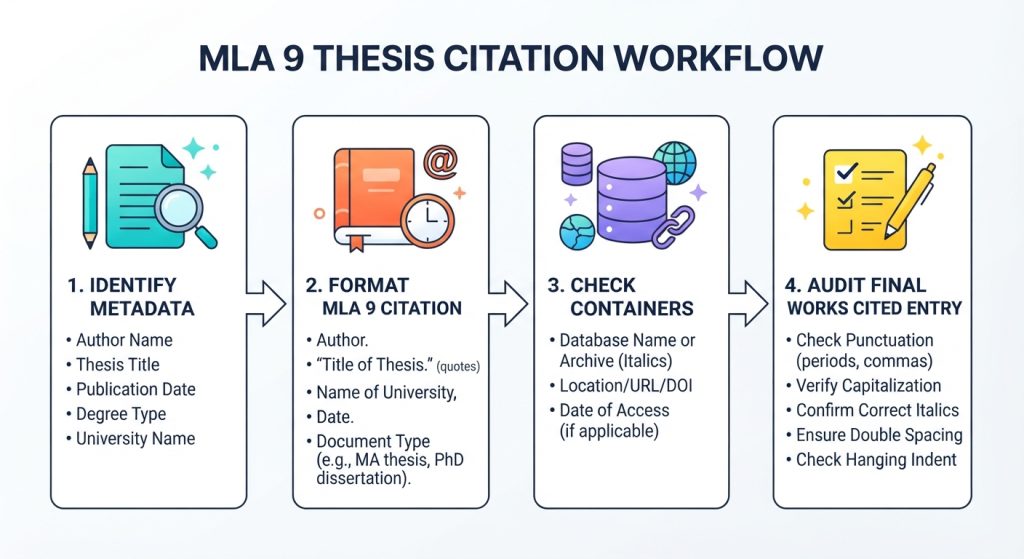
Step 1: Identify the author
Record the author’s name exactly enough to create the correct MLA name format.
For a standard individual author:
Lastname, Firstname.
Step 2: Record the complete title
Use the title shown on the thesis or dissertation record.
Italicize the title because the work is a standalone document.
Step 3: Find the publication or completion year
Use the appropriate date associated with the work.
Do not substitute the date you downloaded the PDF for the date associated with the thesis itself.
Step 4: Identify the institution and document type
Record the degree-granting institution and a concise description such as “master’s thesis” or “PhD dissertation” when applicable.
Step 5: Identify the container
If the dissertation or thesis is housed in a university repository or database, determine whether that platform should be documented as a container.
Step 6: Add the location
For online material, this may be a URL or another appropriate persistent location.
Prefer a stable institutional repository or persistent identifier when one is available.
10. Common MLA 9 Thesis Citation Mistakes
Mistake 1: Putting the thesis title in quotation marks
Because a thesis is a standalone work, its title is italicized.
Correct:
Language, Identity, and Academic Writing.
Incorrect:
“Language, Identity, and Academic Writing.”
Mistake 2: Using APA formatting in an MLA paper
APA and MLA organize thesis and dissertation information differently.
Do not copy a citation generated for APA and assume it is MLA-compatible.
Mistake 3: Treating every online location as a database
A university repository, ProQuest, an institutional archive, and a general website may play different roles.
Identify what actually contains the work.
Mistake 4: Adding information that does not exist
Never fabricate a publication date, publisher, page range, DOI, or document type.
MLA’s flexible framework is designed to accommodate incomplete source information.
Mistake 5: Forgetting the second container
If the thesis is accessed through a database or repository that should be identified as a container, omitting it can make the citation less useful for retrieval.
Mistake 6: Formatting the citation correctly but the Works Cited page incorrectly
A technically correct citation can still appear unprofessional if the page uses single spacing, lacks hanging indents, or contains inconsistent alphabetization.
Audit the entire Works Cited page, not just individual entries.
11. Use Citation Management Tools But Audit the Output
Reference managers can save considerable time when working with dozens or hundreds of sources. However, automated citation generation should be treated as a starting point rather than an authority.
Repository metadata can be incomplete or inconsistent. A citation generator may:
- Capitalize titles incorrectly
- Misidentify a thesis as a book
- Treat a repository as a publisher
- Omit the document type
- Duplicate database information
- Insert APA-style fields into an MLA citation
For high-stakes academic writing, verify the generated entry against the source record and current MLA guidance.
The MLA Style Center provides official guidance and resources for MLA documentation, while Purdue OWL offers a practical MLA 9 formatting reference.
12. Final MLA 9 Thesis and Dissertation Checklist
Before submitting your manuscript, thesis, article, or research paper, run this audit:
- Confirm the author’s name and spelling.
- Copy the complete thesis or dissertation title.
- Italicize the title of the standalone work.
- Confirm the year associated with the work.
- Identify the degree-granting institution where relevant.
- Identify the work as a master’s thesis, PhD dissertation, or appropriate institutional equivalent.
- Determine whether a repository or database should be included.
- Add a stable URL or other appropriate location when applicable.
- Check whether the source is available in a second container.
- Ensure the in-text citation corresponds to the Works Cited entry.
- Alphabetize the Works Cited list correctly.
- Double-space the Works Cited page.
- Apply a 0.5-inch hanging indent.
- Remove unnecessary blank lines between entries.
- Do not invent missing metadata.
- Verify automatically generated citations against MLA 9 guidance.
- Check your institution or journal’s author guidelines for additional requirements.
Conclusion
Learning how to cite a master’s thesis in MLA 9 becomes much easier when you stop treating thesis citations as an isolated formula. Start with the MLA core elements, identify the thesis or dissertation as a standalone work, italicize its title, document the relevant institution and degree information, and then determine whether a repository or database functions as a container.
The same principles apply when citing a PhD dissertation, an unpublished graduate thesis, or a dissertation retrieved from an academic database. The goal is not to force every source into an identical citation pattern. The goal is to provide enough accurate information for readers to identify and locate the work you used.
Before submission, audit both the individual citation and the complete Works Cited page. Consistent MLA formatting strengthens the credibility, traceability, and professionalism of your research.
For authors who need a deeper editorial review, ManuscriptLab can help with academic editing, manuscript formatting, and publication preparation.