Researchers increasingly use automated software before submitting a manuscript to a journal. AI detectors, similarity checkers, reference verification systems, grammar tools, and automated formatting platforms can identify problems that might otherwise trigger editorial queries or slow the submission process.
But what happens when the tool you are researching does not appear to offer the service you expect?
That is the key issue behind the question: Is Koalaty Research legit as a pre-submission manuscript checking tool?
As of 2026, the publicly identifiable Koalaty Research website does not present itself as an academic manuscript-checking platform. Its website describes the business as a supplier of research compounds and laboratory materials, and its product pages concern research-use compounds rather than manuscript screening, plagiarism detection, AI detection, citation checking, or journal formatting.
That distinction matters. A legitimate research supplier is not automatically a legitimate academic editing or manuscript-screening service and a website with “Research” in its name should not be assumed to provide scholarly publishing tools.
This guide examines what researchers should verify before uploading a paper to any online checking service, how automated manuscript checks actually work, what they cannot guarantee, and how to build a reliable pre-submission assessment for scientific manuscripts.
💡 Need expert help with your paper?
Transform your manuscript with ManuscriptLab’s professional editing & formatting services!
Is Koalaty Research a manuscript checking tool?
The first step in evaluating any academic software is to verify what the company actually offers.
The current Koalaty Research website describes its business as providing research compounds and states that its products are intended for research use only. Its visible product catalog includes laboratory compounds and associated certificates of analysis.
This is fundamentally different from a manuscript health check tool for journals.
A genuine academic pre-submission platform would normally describe capabilities such as:
- Similarity or plagiarism screening
- AI-assisted writing detection, where offered
- Grammar and spelling correction
- Reference and citation verification
- Journal formatting checks
- Reporting-guideline checks
- Figure and table compliance
- Manuscript completeness checks
- Journal-specific submission requirements
- Data, ethics, authorship, or disclosure checks
No evidence located in the current public Koalaty Research website indicates that it provides this type of manuscript-screening workflow.
Therefore, researchers should not treat Koalaty Research as an academic manuscript checking service based solely on its name.
This is not the same as concluding that the business itself is fraudulent. It means that its publicly presented business category does not match the manuscript-checking services described in the search terms surrounding this topic.
That distinction is essential for responsible publishing content.
What should a legitimate pre-submission checking tool actually do?
A pre-submission manuscript checking tool should reduce preventable technical and editorial problems before the manuscript reaches a journal’s editorial office.
It should complement not replace human review.
The best way to assess such software is to divide the manuscript audit into separate quality-control layers.
1. Similarity and plagiarism screening
A similarity checker compares manuscript text against indexed or licensed sources and identifies overlapping passages.
However, similarity is not synonymous with plagiarism.
A legitimate scholarly article may contain unavoidable overlap in:
- Standard methodological terminology
- Technical definitions
- Names of established instruments
- Statistical terminology
- Regulatory language
- Properly quoted material
- Reference information
The important metric is therefore not simply a single percentage.
Researchers should examine where the matches occur, how long the matched passages are, whether they are properly cited, and whether the overlap represents inappropriate duplication.
A similarity score of 10% does not automatically mean a paper is acceptable, while a higher score does not automatically establish misconduct.
Use the report diagnostically.
2. AI detection
AI detectors attempt to estimate whether text was generated or substantially assisted by artificial intelligence.
This area requires particular caution.
An AI detector should never be treated as definitive proof of authorship or misconduct. False positives and false negatives can occur, particularly with highly formulaic academic prose, multilingual writing, heavily edited text, and technical language.
Journal policy also matters more than an application’s generic AI score.
For example, current ICMJE recommendations state that authors using AI-assisted technologies should disclose their use when required and remain responsible for the accuracy, integrity, and originality of submitted material. ICMJE also emphasizes that authors must ensure AI-assisted material does not introduce plagiarism or inappropriate attribution.
Consequently, when researchers ask where to check a research paper for plagiarism and AI before submission, the correct answer is not simply “run it through an AI detector.”
Instead:
- Check the target journal’s AI policy.
- Review the manuscript’s provenance.
- Verify all citations and quotations.
- Examine any AI-assisted passages critically.
- Run similarity screening where appropriate.
- Disclose AI use when the journal requires it.
Can automated software accurately detect formatting and citation errors?
Only partially.
Automated software is effective at identifying structured, machine-readable problems. It is much less reliable at judging whether a manuscript is scientifically appropriate.
For example, software may detect:
- Missing references
- Incorrect citation formatting
- Inconsistent numbering
- Duplicate references
- Incorrect heading structures
- Missing figure citations
- Inconsistent abbreviations
- Certain metadata omissions
But it cannot reliably determine whether:
- The research question is sufficiently novel
- The statistical model is scientifically appropriate
- A conclusion is supported by the data
- A reporting decision introduces bias
- A citation genuinely supports the claim being made
- The manuscript makes a meaningful contribution to the field
This is why automated software should be considered a quality-control layer, not an automated peer reviewer.
ICMJE guidance reinforces this principle. Manuscripts need sufficient methodological detail for readers to understand and assess how the research was conducted, while statistical methods should be described in enough detail to permit informed evaluation.
What software can check vs. what humans must check
| Manuscript element | Automated checking | Human review |
| Spelling and grammar | High | Essential |
| Citation formatting | High | Essential |
| Duplicate references | High | Essential |
| Basic similarity | High | Essential |
| AI-text signals | Limited | Essential |
| Journal formatting | Moderate–High | Essential |
| Reporting guideline compliance | Moderate | Essential |
| Statistical validity | Low | Essential |
| Scientific novelty | Very low | Essential |
| Argument quality | Limited | Essential |
| Ethical interpretation | Very low | Essential |
| Data integrity | Very low | Essential |
The strongest workflow combines both columns.
Also read: 10 Key Reasons Manuscripts Get Rejected Before Peer Review
How do publisher-integrated screening tools differ from general grammar checkers?
This distinction is frequently overlooked.
A general grammar checker primarily evaluates language.
A publisher-integrated screening system operates closer to the manuscript submission workflow.
The difference can be substantial.
General grammar and spelling tools
These typically focus on:
- Grammar
- Spelling
- Punctuation
- Sentence construction
- Readability
- Word choice
They may improve linguistic quality but generally do not know the specific requirements of your target journal.
Academic compliance systems
A more specialized academic paper editing and compliance software platform may evaluate:
- Reference formatting
- Manuscript structure
- Journal-specific requirements
- Figures and tables
- Required sections
- Reporting checklists
- Metadata
- Author information
- Supplementary files
Publisher-integrated systems
Publisher or editorial-office screening may operate even closer to the journal’s actual workflow.
These systems can be connected to editorial processes involving:
- Similarity screening
- Manuscript completeness
- Ethical declarations
- Duplicate submissions
- Author metadata
- Reporting requirements
- Image screening
- Submission-system validation
That makes publisher-integrated screening more relevant to editorial compliance than a general grammar checker.
However, it does not mean every publisher’s automated check is comprehensive. Authors must still follow the journal’s Instructions for Authors.
Also read: How to Check if a Journal Is Predatory
What features should I look for in an academic pre-submission checking tool?
Before uploading a manuscript, audit the tool itself.
1. Transparent data handling
Ask:
- Is the manuscript stored?
- For how long?
- Is it deleted automatically?
- Is uploaded text used to train AI models?
- Is it shared with third-party providers?
- Can you request deletion?
- Does the company explain its data-processing practices?
These questions are particularly important for unpublished manuscripts containing proprietary methods, patentable findings, confidential datasets, or commercially sensitive information.
A platform that cannot clearly explain what happens to your manuscript deserves additional scrutiny.
2. Clear similarity methodology
Do not rely on marketing language such as “the world’s most accurate plagiarism detector.”
Look for information about:
- Search corpus
- Database coverage
- Indexing
- Match thresholds
- Exclusions
- Citation handling
- Reporting methodology
The report should allow the author to inspect individual matches rather than simply displaying one percentage.
3. Reference verification
A good reference verification software for scholarly writing should help identify inconsistencies between in-text citations and the reference list.
Check whether it can detect:
- Missing references
- Uncited references
- Duplicate references
- Incomplete metadata
- DOI inconsistencies
- Author-name inconsistencies
- Year discrepancies
But verify important references manually.
A software system can determine that a DOI exists. It cannot always determine whether the cited paper actually supports the sentence for which it is cited.
4. Journal-specific formatting
A strong automated journal formatting and compliance checker should allow researchers to select a target journal or style.
Look for checks involving:
- Word count
- Abstract format
- Heading hierarchy
- Reference style
- Figure requirements
- Table formatting
- Supplementary files
- Cover letter requirements
- Required declarations
ICMJE notes that authors should follow individual journal requirements in addition to general recommendations.
5. Privacy and intellectual-property controls
The question “Are online manuscript checking tools safe to use without risking intellectual property theft?” cannot be answered with a universal yes or no.
Security depends on the specific service.
Before uploading an unpublished manuscript, review:
Data ownership → retention → training use → third-party processing → deletion → security → jurisdiction.
If these policies are unclear, do not upload the complete manuscript until the risks have been assessed.
A practical manuscript readiness workflow
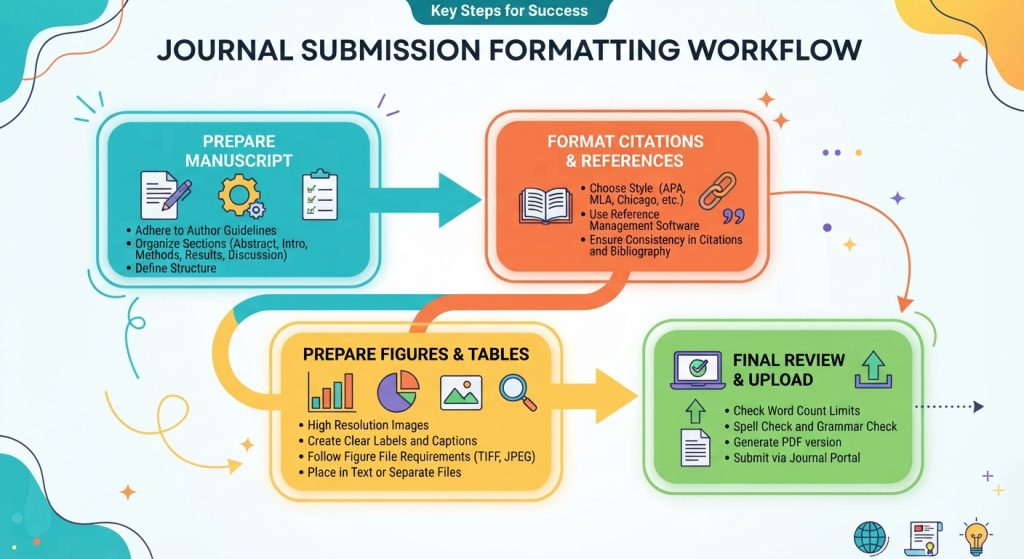
A reliable research paper readiness checker should form only one part of a larger workflow.
Step 1: Validate journal fit
Confirm that the journal’s scope matches the manuscript.
Check:
- Aims and scope
- Article type
- Word limit
- Study-design requirements
- Reporting guidelines
- Reference style
- Open-access model
- APC
- Submission requirements
Step 2: Check reporting guidelines
Match the study design to the appropriate reporting framework.
Examples include:
- CONSORT for randomized trials
- STROBE for observational studies
- PRISMA for systematic reviews
- STARD for diagnostic-accuracy research
ICMJE explicitly directs authors toward reporting guidelines appropriate to different study designs.
Step 3: Audit references
Run a reference audit before the final language edit.
Check every citation for:
- Accuracy
- Relevance
- Completeness
- DOI
- Author names
- Publication year
- Journal title
- Citation placement
Do not inflate the bibliography simply to increase the apparent scholarly weight of the paper.
Step 4: Run similarity screening
Review the report manually.
Investigate substantial matches and determine whether they represent:
- Legitimate terminology
- Proper quotation
- Correctly cited background information
- Methods language
- Duplicate publication
- Inappropriate copying
Step 5: Review AI use
If AI tools were used, document their role according to the journal’s policy.
Do not assume that passing an AI detector means the manuscript satisfies the journal’s AI requirements.
ICMJE’s current guidance places responsibility for AI-assisted content firmly on human authors.
Step 6: Perform a formatting audit
Check:
- Font
- Line spacing
- Margins
- Heading hierarchy
- Tables
- Figures
- Captions
- References
- Supplementary files
- Page or word limits
Do not blindly apply a universal format such as 12-point Times New Roman and 1-inch margins. Journal requirements vary, and the target journal’s Instructions for Authors take precedence.
Step 7: Complete the submission package
A final pre-submission assessment for scientific manuscripts should include more than the manuscript itself.
Depending on the journal, verify:
- Cover letter
- Title page
- Main manuscript
- Figures
- Tables
- Supplementary information
- Conflict-of-interest declaration
- Funding statement
- Ethics statement
- Author contributions
- Data availability statement
- AI-use disclosure
- Reporting checklist
ICMJE notes that submission materials may include disclosures, authorship information, permissions, and study-specific reporting checklists.
Also read: How to Avoid AI Detection in Academic Writing (Ethically)
Is Koalaty Research legit for checking a research paper?
Based on the publicly available information reviewed for this article, Koalaty Research should not be treated as a manuscript-checking platform.
The current website presents Koalaty Research as a research-compound supplier, with product pages and certificates of analysis rather than academic manuscript-screening services.
That leads to an important editorial conclusion:
The issue is not simply whether Koalaty Research is “legit.” The more important question is whether you are evaluating the correct company and service.
Researchers searching for an AI detector and similarity checker for research papers, academic grammar software, or a manuscript readiness platform should verify the exact domain, product description, privacy policy, technical documentation, and intended use before uploading any manuscript.
If a website does not clearly identify manuscript checking as its service, do not assume that its name or branding implies academic publishing functionality.
How to evaluate a manuscript checking platform before uploading your paper
Use this five-part due-diligence test.
Identity
Confirm:
- Exact company name
- Official domain
- Business purpose
- Contact information
- Product documentation
Capability
Verify that the service explicitly supports the checks you require.
Evidence
Look for:
- Technical documentation
- Transparent methodology
- Independent evaluations
- Clear limitations
- Reproducible reports
Privacy
Review:
- Data retention
- Manuscript storage
- AI training provisions
- Third-party processing
- Deletion mechanisms
- Terms of service
Publishing compatibility
Confirm whether the tool aligns with:
- Your target journal
- Its reporting guidelines
- Its AI policy
- Its reference requirements
- Its submission system
Transparency is an established principle in scholarly publishing. DOAJ, COPE, OASPA, and WAME have jointly emphasized transparency around publishing practices, policies, fees, editorial processes, and website information.
Also read: Manuscript Editing and Formatting Services
What automated tools cannot tell you
A manuscript can pass every automated check and still be rejected.
Automated tools cannot reliably determine whether your:
- Research question is novel
- Hypothesis is logically justified
- Methods are reproducible
- Statistical analysis is appropriate
- Conclusions match the results
- Discussion overstates the findings
- Literature review is sufficiently comprehensive
- Journal is the right venue
- Scientific contribution is substantial
These are editorial and scholarly judgments.
A manuscript readiness workflow should therefore progress from machine-checkable errors to expert-level scientific review.
Think of automated software as the equivalent of a technical inspection before submission—not the equivalent of peer review.
Pre-Submission Checklist
Before clicking Submit, complete this final audit:
- Confirm the journal’s scope and article type.
- Read the current Instructions for Authors.
- Verify word, figure, table, and reference limits.
- Apply the required reference style.
- Check all in-text citations against the reference list.
- Verify DOI and bibliographic metadata where applicable.
- Run a similarity check and manually review matches.
- Review AI-assisted content according to journal policy.
- Confirm required AI disclosure.
- Complete the appropriate reporting guideline checklist.
- Check ethics approval and informed-consent statements where applicable.
- Verify funding and conflict-of-interest declarations.
- Check author contributions and affiliations.
- Review figure resolution and file formats.
- Confirm table numbering and in-text citations.
- Remove tracked changes and comments.
- Check supplementary files.
- Prepare the cover letter.
- Verify manuscript privacy before uploading it to any third-party tool.
- Conduct a final human editorial review.
Final Verdict
So, is Koalaty Research legit?
If the question concerns Koalaty Research as a manuscript pre-submission checking tool, the available evidence does not establish that it is such a service. The identifiable website currently describes a research-compound business rather than an academic manuscript screening platform.
For researchers, the larger lesson is more useful: never evaluate an academic tool from its name alone. Verify its actual function, technical methodology, privacy terms, manuscript-retention policy, and compatibility with your target journal.
The safest publishing workflow combines automated checks with human expertise. Use software to identify mechanical problems, similarity, formatting inconsistencies, and selected compliance issues. Then use expert editorial review to evaluate clarity, structure, argumentation, reporting quality, references, and journal readiness.
For medical and biomedical authors, the current ICMJE Recommendations remain an important baseline, while journal-specific instructions should always take precedence.
A manuscript that is technically clean is easier to submit. A manuscript that is technically compliant, scientifically coherent, ethically transparent, and strategically aligned with the target journal is much better positioned for editorial consideration.
Ready to move beyond automated checks? Explore ManuscriptLab’s professional editing and formatting services for a deeper manuscript-readiness review before submission.