Submitting a manuscript to the wrong journal can cost far more than an article processing charge (APC). A questionable publisher may expose your research to inadequate peer review, misleading indexing claims, opaque fees, poor archiving, copyright complications, or a publication record that carries little academic value.
The challenge is that predatory journals do not always look obviously fraudulent. Some use professional websites, impressive-sounding editorial boards, fabricated metrics, familiar database names, or journal titles that resemble established publications. The International Committee of Medical Journal Editors (ICMJE) warns that so-called predatory or pseudo-journals may misrepresent peer review, fees, affiliations, and even their relationship with established organizations.
So, how can you check if a journal is predatory before submission?
The most reliable approach is not to depend on a single blacklist or warning sign. Instead, audit the journal’s identity, editorial process, indexing, fees, policies, metrics, ownership, and publication history using authoritative sources.
This guide explains 10 major red flags, shows how to verify a journal’s claims, and provides a practical pre-submission checklist you can use in 2026.
💡 Need expert help with your paper?
Transform your manuscript with ManuscriptLab’s professional editing & formatting services!
What Is a Predatory Journal?
A predatory journal is a publication that presents itself as a legitimate scholarly journal but fails to maintain essential standards of editorial independence, peer review, publication ethics, transparency, or scholarly publishing practice.
The term should be used carefully. There is no single universally accepted test or official global list that can definitively label every questionable journal as predatory. ICMJE specifically notes that there is no validated mechanism that reliably identifies all fake, predatory, or pseudo-journals. Researchers should therefore evaluate the journal’s actual practices rather than relying on one database, website, or blacklist.
A legitimate open-access journal, for example, may charge an APC. That does not make it predatory. Similarly, a new journal may not yet have an Impact Factor or Scopus coverage. The critical question is whether the publisher is transparent and follows credible scholarly publishing practices.
The principles developed by organizations including COPE, DOAJ, OASPA, and WAME emphasize transparency around journal identity, website practices, peer review, ownership, editorial governance, fees, copyright, licensing, and publication ethics.
Also read: How to Get an AI Detection Report from Turnitin Before Submitting in 2026
10 Red Flags of a Predatory Academic Journal
1. The Journal Promises Guaranteed or Extremely Fast Acceptance
One of the strongest warning signs is a journal that effectively eliminates editorial uncertainty.
Statements such as:
- “Guaranteed publication”
- “Acceptance within 48 hours”
- “Publish in 3 days”
- “100% acceptance”
- “No rejection”
- “Peer review completed in 24 hours”
should trigger immediate scrutiny.
What to check
Look for a clearly described peer-review workflow. A credible journal should explain:
- Whether peer review is single-blind, double-blind, or open
- Whether reviewers are external or independent
- Who selects reviewers
- How conflicts of interest are managed
- What happens when reviewers disagree
- Whether manuscripts can be rejected after review
Think. Check. Submit. specifically advises researchers to be cautious of journals that guarantee acceptance or promise unrealistically short peer-review periods.
Why it matters
A legitimate peer-review process requires time for editorial screening, reviewer selection, manuscript evaluation, author revisions, and editorial decisions. A short review period is not automatically fraudulent, but guaranteed acceptance combined with minimal evidence of genuine review is a serious warning sign.
Industry benchmark: There is no universal legitimate “maximum” or “minimum” review time. Evaluate the process, not a particular number of days.
Common pitfall: Assuming that rapid publication automatically means poor quality. Some reputable journals offer accelerated review for urgent or high-priority research. The red flag is the absence of credible editorial scrutiny, not speed alone.
2. The Editorial Board Is Missing, Fake, or Difficult to Verify
A credible journal should identify its editor-in-chief, editorial board members, institutional affiliations, and relevant roles.
Predatory publishers may:
- List researchers without permission
- Use outdated affiliations
- Include famous academics who have no relationship with the journal
- Provide no institutional information
- List an editorial board with little subject expertise
- Use generic email addresses without institutional context
How to verify the board
Search several editorial board members independently. Check their university profiles, ORCID records, institutional pages, and publication histories.
Do not assume that a prominent name appearing on a journal website has endorsed the journal.
Why it matters
Editorial governance is central to scholarly quality control. Editors are responsible for evaluating manuscripts, selecting appropriate reviewers, managing conflicts of interest, and maintaining publication ethics.
Industry standard: A credible journal should provide sufficient information for authors and readers to understand who is responsible for editorial decisions.
Common pitfall: Checking only the editor-in-chief. Examine several board members, especially those in your research specialty.
3. The Journal Claims Indexing That You Cannot Independently Verify
False indexing claims are among the most dangerous tactics because researchers often equate “indexed” with “credible.”
A journal might display logos or statements claiming inclusion in:
- Scopus
- Web of Science
- PubMed
- DOAJ
- MEDLINE
- Google Scholar
- Other subject-specific databases
But a logo on a journal website is not proof of current indexing.
How can I verify if a journal is indexed in legitimate databases like Scopus or Web of Science?
Search the journal using its exact title and ISSN in the database’s official source.
For Scopus, Elsevier provides the Source Title list and explains that the Source profile and title information are updated regularly.
For Web of Science, use Clarivate’s official Master Journal List, which allows researchers to search journals and examine their Web of Science coverage.
Do not rely on:
- Screenshots
- Publisher-created “indexing certificates”
- Third-party indexing lists
- A journal’s own database logos
- Search-engine snippets
Common pitfall: Confusing “indexed in Google Scholar” with inclusion in a selective citation database. Google Scholar has a fundamentally different coverage model and should not be treated as equivalent to Scopus or Web of Science.
4. The Journal Uses Fake Impact Factors or Misleading Metrics
Another major red flag is a long list of impressive-sounding metrics from obscure organizations.
You may encounter claims such as:
- “Global Impact Factor”
- “Universal Impact Factor”
- “Cosmos Impact Factor”
- “International Impact Factor”
- “Advanced Impact Factor”
- “Global Citation Index”
The existence of a number does not make it a recognized journal metric.
Fake impact factors and misleading metrics: what should you check?
First determine who produces the metric and whether it is an established, independently recognized measurement.
For example, researchers should distinguish the Journal Impact Factor, associated with Clarivate’s Journal Citation Reports, from unrelated metrics that merely contain the phrase “impact factor.”
Likewise, CiteScore is an Elsevier metric associated with Scopus. A journal claiming an extraordinary “impact factor” should therefore be investigated at the source rather than accepted at face value.
Why it matters
Metrics can influence promotion, grant applications, institutional evaluation, and academic reputation. Misleading metrics can create a false impression of journal prestige.
Industry standard: Verify the metric through its official provider.
Common pitfall: Treating a metric’s numerical size as evidence of quality. A large number is meaningless if the metric itself lacks recognized methodology.
Also read: 10 Key Reasons Manuscripts Get Rejected Before Peer Review
5. The Journal’s Scope Is Excessively Broad or Scientifically Incoherent
A legitimate journal should have a defined aims and scope.
Be cautious when one journal claims to publish everything from:
clinical medicine and molecular biology to artificial intelligence, civil engineering, economics, literature, agriculture, and astrophysics
without a coherent multidisciplinary rationale.
Broad scope alone does not prove misconduct. Some legitimate multidisciplinary journals intentionally cover large research areas.
The warning sign is scope without editorial logic.
What to examine
Compare:
- The journal’s stated aims and scope
- Its editorial board expertise
- Recently published articles
- Its author guidelines
- The subject areas claimed in indexing databases
If these five elements do not align, investigate further.
Common pitfall: Rejecting every multidisciplinary journal as predatory. The issue is inconsistency, not breadth.
6. The Journal Website Is Misleading, Poorly Maintained, or Designed to Mimic Another Journal
A journal website is part of its scholarly infrastructure.
Look for:
- Misspellings and grammatical errors throughout
- Broken navigation
- Missing publisher information
- Unclear contact details
- No physical address
- Copied text from established journals
- Fake logos
- Misleading claims about affiliations
- HTTPS/security problems
- Journal names that closely resemble established publications
The transparency principles for scholarly publishing state that journal names should be unique and should not mislead readers or authors about the journal’s origin, scope, or affiliations. They also call for properly maintained websites that do not mislead users.
Why journal-name similarity is dangerous
A questionable journal may select a title resembling a respected publication to exploit author familiarity.
Check the ISSN, not just the journal name.
A legitimate journal’s ISSN can be cross-checked using recognized ISSN resources and database records.
Common pitfall: Assuming that a familiar-looking website indicates a legitimate publisher. Visual professionalism is not evidence of editorial integrity.
Also read: AI Disclosure in Academic Writing
7. APCs and Other Publication Fees Are Hidden or Disclosed Only After Acceptance
Article Processing Charges are common in legitimate open-access publishing.
The red flag is financial opacity.
Before submission, you should be able to determine:
- Whether an APC applies
- The exact amount or calculation method
- When the fee becomes payable
- Whether taxes are additional
- Whether waivers or discounts are available
- Whether submission itself is free
- Whether other charges apply
- What happens if the manuscript is rejected
Think. Check. Submit. recommends checking whether journal fees are clearly disclosed before submission.
Are all open-access journals considered predatory?
No.
Open access is a publishing model, not a quality classification.
A reputable open-access journal may use an APC to fund:
- Editorial administration
- Peer-review infrastructure
- Production and typesetting
- XML/HTML conversion
- DOI registration
- Digital preservation
- Hosting and platform maintenance
- Archiving and discovery services
The relevant question is not:
“Does this journal charge an APC?”
It is:
“Is the journal transparent about its fees and does it provide credible scholarly publishing services in return?”
8. The Journal Has Weak or Missing Publication Ethics Policies
A credible journal should provide clear policies concerning publication ethics and editorial misconduct.
Depending on discipline, look for policies covering:
- Plagiarism
- Duplicate publication
- Retractions
- Corrections
- Conflicts of interest
- Authorship
- Data availability
- Research misconduct
- Human and animal research ethics
- Clinical trial registration
- Peer-review confidentiality
- Appeals and complaints
For biomedical journals, the ICMJE Recommendations are an important reference point. The current recommendations were updated in January 2026 and include guidance concerning scientific misconduct, AI, data access, clinical trial registration, and other publication practices.
What should you verify?
If a journal claims adherence to ICMJE or COPE standards, verify the claim independently.
Importantly, ICMJE changed its approach to listing journals that claimed to follow its recommendations in 2025, citing concerns about verification and predatory publishing. Therefore, an ICMJE logo or claim on a journal website should never be treated as certification.
Common pitfall: Assuming that a policy page automatically means the journal follows the policy. Compare the stated policy with the journal’s actual practices.
9. The Publisher Pressures You Through Aggressive Email Invitations
Predatory publishers frequently use mass email campaigns to solicit manuscripts.
Common messages include:
- “Dear Esteemed Researcher”
- “We read your prestigious paper”
- “Submit your manuscript within 48 hours”
- “Join our editorial board immediately”
- “We urgently need papers for our next issue”
- “Guaranteed publication”
- “Special discount if you submit today”
A legitimate journal can certainly send calls for papers or special-issue announcements. The warning sign is generic, persistent solicitation combined with exaggerated praise and unrealistic promises.
How to evaluate an invitation
Do not submit directly from the email.
Instead:
- Open the journal’s official website independently.
- Confirm the journal title and ISSN.
- Examine its editorial board.
- Verify its indexing claims.
- Read recent articles.
- Check APCs and publication policies.
- Compare the journal against Think. Check. Submit. criteria.
Industry standard: Treat unsolicited invitations as lead-generation messages, not evidence of journal quality.
10. The Journal’s Published Articles and Publication Record Do Not Withstand Scrutiny
The strongest test is often the content itself.
Read three to five recent articles before submitting.
Evaluate:
- Scientific quality
- Reference quality
- Article structure
- Statistical reporting
- Figure and table quality
- Language editing
- Retraction/correction history
- Editorial consistency
- Relevance to the stated scope
- Publication frequency
A journal that publishes large volumes of poorly reviewed, unrelated, or scientifically weak material deserves additional scrutiny.
For clinical research, check whether articles appropriately report study design and relevant standards such as CONSORT or STROBE where applicable.
Why this test is powerful
A journal can manufacture a sophisticated website. It is much harder to consistently manufacture a credible scholarly record.
Common pitfall: Looking only at article titles. Open several full papers and examine methods, references, peer-review information where available, and publication ethics statements.
How to Check if a Journal Is Predatory: A 15-Minute Verification Workflow
Use the following workflow before submitting any manuscript.
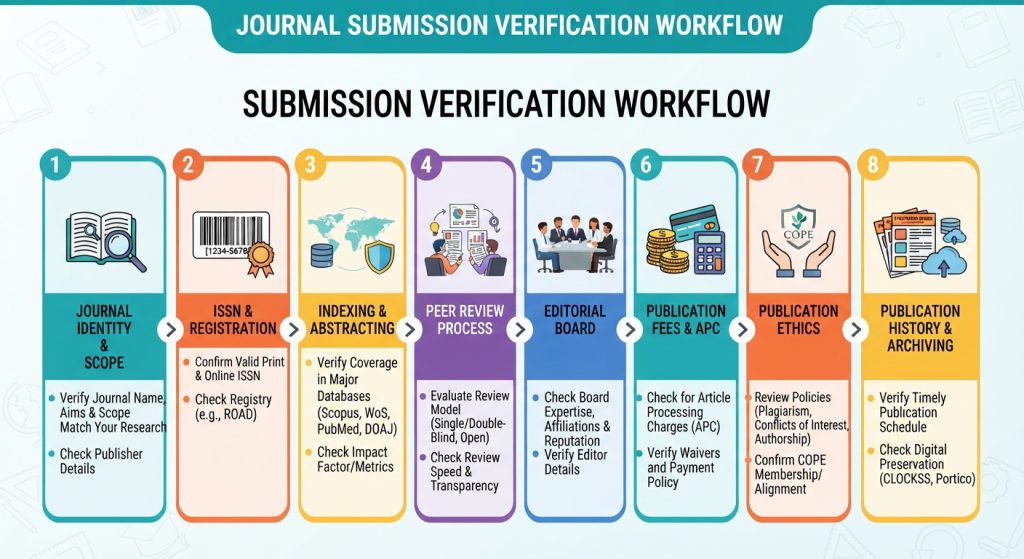
Step 1: Confirm the journal’s identity
Record:
- Exact journal title
- ISSN/eISSN
- Publisher
- Journal website
- Country or location of publisher
- Editor-in-chief
If the title is confusingly similar to another publication, investigate immediately.
Step 2: Verify indexing independently
Search the exact ISSN in:
- Scopus Sources
- Web of Science Master Journal List
- DOAJ, where applicable
- Relevant subject databases
Never treat the journal website’s indexing logos as sufficient evidence.
Step 3: Audit the peer-review process
Ask:
Who reviews manuscripts, and how?
Look for a documented process rather than vague statements such as “rigorous international peer review.”
Step 4: Verify the editorial board
Randomly select three to five board members.
Check whether their affiliations and involvement are genuine.
Step 5: Audit fees
Record every possible cost before submission.
Do not submit until you understand the financial model.
Step 6: Audit metrics
Identify the provider behind every claimed metric.
If you cannot determine who calculates the metric or how it is calculated, do not use it as evidence of journal prestige.
Step 7: Review recent articles
Read several papers from the latest issues.
Step 8: Check ethics and preservation
Look for:
- Retraction policy
- Corrections policy
- Plagiarism policy
- Copyright/licensing information
- Digital preservation
- DOI information
- Data policies
Step 9: Use a structured checklist
Think. Check. Submit. provides a dedicated journal checklist covering journal identity, publisher contact information, peer review, indexing, archiving, persistent identifiers, fees, and recognized publishing initiatives.
Step 10: Ask an experienced researcher or librarian
When uncertainty remains, obtain a second opinion.
A senior researcher, academic librarian, research office, or publishing specialist may identify problems that are difficult to recognize from a website alone.
Predatory vs. Legitimate Open-Access Publishing: What Should You Look For?
| Criterion | Credible Journal | Potential Predatory Warning |
| Open access | Clearly explained OA model | Used as a marketing claim without transparency |
| APC | Clearly disclosed before submission | Hidden until acceptance |
| Peer review | Process and reviewer model explained | Guaranteed or implausibly rapid acceptance |
| Editorial board | Verifiable researchers with affiliations | Missing, unverifiable, or falsely listed |
| Indexing | Independently verifiable | Logos or claims cannot be confirmed |
| Metrics | Recognized provider and methodology | Obscure or fabricated “impact factors” |
| ISSN | Verifiable and consistent | Missing, incorrect, or inconsistent |
| Ethics | Detailed policies | Generic or missing policies |
| Publisher | Identifiable and contactable | Anonymous or difficult to locate |
| Articles | Consistent scholarly quality | Poor, unrelated, or suspiciously rapid output |
| Archiving | Clear preservation strategy | No information on long-term access |
| Journal scope | Coherent with editorial expertise | Extremely broad and inconsistent |
Important: One warning sign does not automatically prove that a journal is predatory. Assess the pattern of behavior and transparency.
Also read: ManuscriptLab Editing Services for Publication-Ready Research
What About DOAJ, Scopus, and Web of Science?
No single database should replace journal-level due diligence, but authoritative indexes can provide valuable evidence.
Directory of Open Access Journals (DOAJ)
For open-access journals, DOAJ is an important discovery and verification resource. Its transparency principles address journal identity, websites, peer review, ownership, editorial governance, fees, copyright, licensing, and publication ethics.
A journal’s absence from DOAJ does not automatically mean it is predatory. Not every legitimate journal is open access, and not every legitimate OA journal necessarily meets or seeks DOAJ inclusion.
Scopus
Use the official Scopus Sources information rather than a publisher’s claim.
Elsevier states that researchers can check titles through the Scopus Source Title list, including publisher and ISSN information. The Source profile and title information are updated regularly.
Check the:
- Exact journal title
- ISSN/eISSN
- Publisher
- Active/discontinued status
- Source details
Web of Science
Clarivate’s Master Journal List is the appropriate starting point for checking Web of Science coverage. It allows researchers to search journals and examine their coverage across Web of Science indexes.
Do not confuse:
- Web of Science Core Collection
- ESCI
- SCIE
- SSCI
- AHCI
They represent different coverage categories. Always determine which index covers the journal rather than simply accepting “Web of Science indexed” as a complete description.
Why Blacklists Alone Are Not Enough
Researchers frequently search for a “list of predatory publishers vs legitimate open access” resources. Such lists can be useful as warning signals, but they should not be the final decision-making mechanism.
Journal status can change. Publishers can launch new titles, discontinue titles, change ownership, lose indexing, or alter editorial practices.
A better approach is to create an evidence file for your target journal.
Record:
| Evidence | Verification |
| ISSN | Official ISSN/database record |
| Scopus status | Official Scopus source information |
| Web of Science status | Clarivate Master Journal List |
| OA status | Journal + DOAJ where applicable |
| APC | Journal fee page |
| Editorial board | Institutional/ORCID verification |
| Peer review | Journal policy |
| Ethics | Journal policy |
| Archiving | Publisher/preservation information |
| Recent papers | Direct journal inspection |
This creates an auditable record of why you selected the journal.
A Simple Risk-Scoring Framework
For internal screening, you can assign:
- 0 points: No concern; independently verified
- 1 point: Minor concern requiring additional verification
- 2 points: Significant concern
- 3 points: Serious warning sign
Evaluate:
- Peer review
- Editorial board
- Indexing
- Metrics
- Fees
- Publisher identity
- Ethics policies
- Website
- Publication record
- Solicitation behavior
Interpret the result cautiously
0–5: Low apparent risk; proceed with normal due diligence.
6–12: Moderate risk; investigate individual concerns before submission.
13+: High-risk profile; seek expert review and strongly consider an alternative journal.
This is a screening framework, not an official industry classification. Do not describe a journal as predatory solely because it exceeds an arbitrary numerical threshold. ICMJE emphasizes that there is no validated universal mechanism for identifying every predatory journal.
How to Verify Journal Credibility Before Submission
Before uploading your manuscript, ask five final questions:
1. Can I independently verify the journal?
You should be able to confirm its title, ISSN, publisher, editorial leadership, and publication history.
2. Can I understand how peer review works?
The process should be documented clearly enough for authors to understand what happens after submission.
3. Can I calculate the complete publication cost?
There should be no financial surprises after acceptance.
4. Can I verify its major claims?
Indexing, metrics, memberships, affiliations, and editorial-board information should be independently checkable.
5. Would my institution recognize this publication venue?
Check your university, funder, promotion framework, doctoral program, or research office requirements. A journal can be legitimate but still be a poor strategic fit for your career or funding requirements.
Pre-Submission Predatory Journal Checklist
Before submitting your manuscript, confirm:
- The journal’s exact title and ISSN are verified.
- The publisher’s identity and contact information are clear.
- The journal has a coherent aims-and-scope statement.
- The editor-in-chief is identifiable and verifiable.
- Editorial board members can be independently confirmed.
- Peer-review procedures are clearly described.
- The journal does not guarantee acceptance.
- Review timelines are plausible and transparently explained.
- APCs and additional charges are disclosed before submission.
- Claimed Scopus indexing has been checked through official Scopus sources.
- Claimed Web of Science coverage has been checked through Clarivate’s Master Journal List.
- DOAJ inclusion has been verified where relevant.
- Claimed Impact Factor or other metrics have been independently verified.
- Publication ethics policies are available.
- Copyright and licensing terms are clear.
- Retraction and correction policies are available.
- Digital preservation/archiving information is available.
- Recent articles demonstrate credible scholarly quality.
- The journal’s scope matches your research.
- You have reviewed the journal using the Think. Check. Submit. checklist.
For researchers who need a standardized external framework, Think. Check. Submit. journal checklist is a practical starting point. Its current checklist asks researchers to assess journal identity, publisher contact information, peer review, indexing and archiving, fees, and recognized publishing initiatives.
Final Takeaway
Knowing how to check if a journal is predatory requires more than spotting a suspicious website or searching for a blacklist. The most reliable strategy is evidence-based verification.
Check the ISSN, editorial board, peer-review process, indexing, metrics, APCs, publication ethics, publisher identity, archiving, and recent articles. Verify important claims through the organization that actually controls the relevant database or standard.
Most importantly, do not equate open access with predatory publishing. Legitimate OA journals can charge APCs and can provide rigorous peer review, transparent governance, recognized indexing, and durable access to scholarly content.
Your publication venue becomes part of your research record. Before submitting, invest 15–30 minutes in journal due diligence. That small investment can protect your manuscript, research reputation, funding record, and future citation potential.
If you want an additional layer of quality control, ManuscriptLab’s professional editing and formatting services can help you prepare a submission that meets the target journal’s technical and editorial requirements before you enter the manuscript submission workflow.