Researchers often encounter a frustrating question when preparing a manuscript: Is Web of Science free to access? The answer is not a simple yes or no. Web of Science is a subscription-based research platform, but several related Clarivate resources including the Master Journal List are freely accessible.
This distinction matters when you need to verify whether a journal is indexed, identify suitable journals for submission, check citation information, or conduct a comprehensive literature search. Confusing the free Master Journal List with the full Web of Science database can lead to incorrect assumptions about journal indexing, citation coverage, and publication credentials.
In this guide, we explain what you can access for free, what requires a subscription, how to use the Clarivate Master Journal List to check journal indexing, and which free academic databases can supplement or replace Web of Science for specific research tasks.
💡 Need expert help with your paper?
Transform your manuscript with ManuscriptLab’s professional editing & formatting services!
Is Web of Science Free to Access?
The full Web of Science database is not generally free to access. Clarivate states that full document searching and the complete Web of Science experience are available to subscribers. Access is commonly provided through institutional subscriptions held by universities, research organizations, hospitals, libraries, and other eligible institutions.
However, this does not mean every Web of Science-related service requires payment.
Clarivate provides several free-access features. Researchers can create a Web of Science Researcher Profile without an institutional subscription, while the Master Journal List (MJL) is freely available for checking journal coverage.
The distinction can be summarized as follows:
| Web of Science resource | Free access? | Primary purpose |
| Full Web of Science platform | Generally no | Literature searching, citation tracking, analysis |
| Web of Science Core Collection | Subscription-dependent | Curated citation and bibliographic database |
| Master Journal List | Yes | Verify journal coverage and indexing |
| Web of Science Researcher Profile | Yes | Manage researcher publications and profile |
| Web of Science API | Depends on plan | Programmatic access to Web of Science data |
| Journal Citation Reports | Generally subscription/product access | Journal-level citation metrics |
| Google Scholar | Yes | Broad scholarly literature discovery |
| PubMed | Yes | Biomedical and life sciences literature |
| DOAJ | Yes | Open-access journal and article discovery |
| OpenAlex | Yes for basic use | Open scholarly metadata and research discovery |
| Crossref Metadata Search | Yes | DOI and scholarly metadata discovery |
The important point is that free access to a journal list is not equivalent to free access to the underlying citation database.
Why does Web of Science require a subscription?
Web of Science is more than a search engine. Its Core Collection provides curated bibliographic and citation data covering journals, conference proceedings, books, and other scholarly outputs. The platform supports citation searching, cited-reference analysis, researcher and publication discovery, and other research-intelligence functions.
Access therefore depends on the subscription or entitlement available to the user or institution.
If your university subscribes to Web of Science, you may be able to access it through your institutional library portal, single sign-on, or a library-provided database link without personally paying for a subscription.
Always check your institution’s library databases before assuming you need to purchase individual access.
What Is the Clarivate Master Journal List?
The Clarivate Master Journal List is the official, freely accessible directory for checking journals covered by Web of Science.
It is particularly useful when you need to answer questions such as:
- Is this journal indexed in Web of Science?
- Is the journal included in Web of Science Core Collection?
- Which Web of Science index covers the journal?
- What is the journal’s ISSN or eISSN?
- Has the journal’s Web of Science coverage changed?
- Is a journal currently listed in a particular Web of Science collection?
Clarivate describes the Master Journal List as the authoritative source for information about Web of Science journal coverage.
This makes the MJL one of the most important free tools for journal verification.
Is the Clarivate Master Journal List free to use?
Yes. The Master Journal List is freely available, even though access to the broader Web of Science platform is subscription-based.
This distinction is especially valuable for researchers choosing journals. You do not necessarily need a paid Web of Science account simply to determine whether a particular journal appears in the Web of Science coverage list.
What can you check in the Master Journal List?
The exact information displayed can vary by journal and index, but researchers can use the resource to investigate coverage and identify the relevant Web of Science collection.
For example, a journal may appear under a Core Collection index such as:
- Science Citation Index Expanded (SCIE)
- Social Sciences Citation Index (SSCI)
- Arts & Humanities Citation Index (AHCI)
- Emerging Sources Citation Index (ESCI)
Do not treat all appearances in a database as interchangeable. Identify the specific index and coverage status.
This is particularly important when a university, promotion committee, funding agency, or research assessment policy specifies a particular Web of Science index.
How to Check Journal Indexing for Free Using the Master Journal List
Use the Master Journal List rather than relying solely on a journal’s own website.
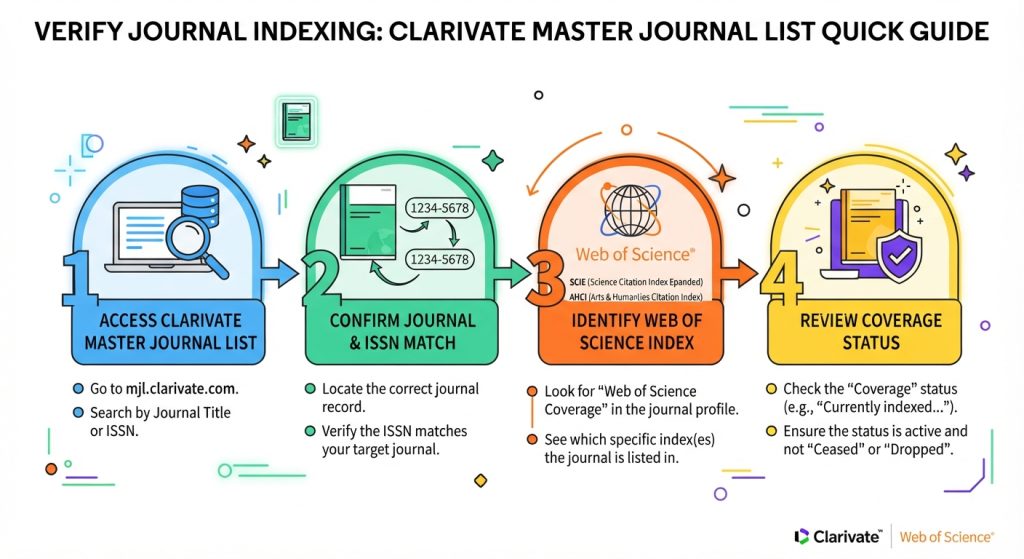
Step 1: Search by journal title or ISSN
An ISSN is generally the most reliable starting point because journal titles can be similar or can change over time.
Search using:
- Full journal title
- Journal title keywords
- Print ISSN
- Electronic ISSN
If available, verify both ISSN and eISSN against the journal’s official website.
Step 2: Open the journal’s record
Review the journal record carefully rather than stopping at the search result.
Check the publisher, ISSN/eISSN, and Web of Science coverage information.
This prevents a common problem: selecting a similarly named journal or confusing a legitimate title with a misleading or predatory publication.
Step 3: Identify the exact Web of Science index
Do not simply record “Web of Science indexed.”
Record the specific collection or index shown in the Master Journal List.
For example:
Journal → Web of Science Core Collection → Science Citation Index Expanded
is more informative than:
Journal → Web of Science indexed
This distinction can matter when institutions specify SCIE, SSCI, AHCI, or another particular collection.
Step 4: Check coverage changes
Journal indexing is not necessarily permanent. Coverage can change following editorial evaluation, title changes, publisher changes, or other developments.
Clarivate provides information about coverage changes through the Master Journal List.
For a high-stakes submission, perform your verification close to the time of submission rather than relying on an old screenshot, spreadsheet, or third-party website.
Common pitfall: confusing indexing with Journal Impact Factor
A journal’s appearance in Web of Science does not automatically mean that it has a Journal Impact Factor (JIF).
Web of Science indexing and Journal Citation Reports are related but distinct concepts.
If a journal claims to have a particular JIF, verify the claim through the appropriate Clarivate source rather than accepting the figure displayed on a journal website.
Likewise, do not assume that “Web of Science indexed” means “SCIE indexed.” Always identify the specific collection.
Also read: 10 Key Reasons Manuscripts Get Rejected Before Peer Review
What Can You Do With Web of Science Without a Subscription?
The free resources are useful, but they do not replicate the full research workflow.
Without full subscription access, you can still use resources such as the Master Journal List and create/manage a researcher profile. Clarivate also offers a Web of Science API free-trial option with limited usage, although this is not equivalent to unrestricted access to the database.
A subscription is generally relevant when you need advanced document searching, comprehensive citation analysis, cited-reference searching, and the broader Web of Science research environment.
If you are a university-affiliated researcher, first investigate institutional access.
Check your university library
University libraries frequently provide database access as part of their electronic-resource subscriptions.
Look for:
Library website → Databases → Web of Science
You may be asked to authenticate using your university credentials.
If you are a researcher outside academia, check whether your hospital, research institute, professional organization, or public library provides access.
7 Free Alternatives to Web of Science for Researchers
No free database is a perfect one-for-one replacement for Web of Science. Different platforms use different coverage policies, metadata structures, indexing criteria, and citation methodologies.
Instead of searching for a single replacement, match the database to your research task.
1. Google Scholar: Broad Scholarly Discovery
Google Scholar is useful for broad searches across disciplines. It covers articles, theses, books, abstracts, conference literature, repositories, and other scholarly material.
Its major advantage is breadth and accessibility.
Use it when you need to:
- Locate papers quickly
- Find related research
- Identify an author’s publications
- Explore “Cited by” relationships
- Locate accessible versions of papers
- Conduct an initial literature search
However, Google Scholar should not automatically be treated as equivalent to Web of Science for formal bibliometric analysis.
Its coverage is broad and heterogeneous, and Google notes that it cannot guarantee uninterrupted coverage of every source.
Best use: Broad literature discovery and citation exploration.
2. PubMed: Biomedical and Life Sciences Research
For clinicians, medical researchers, pharmacists, biomedical scientists, and life-science researchers, PubMed is one of the most important free resources.
PubMed is maintained by the U.S. National Library of Medicine and provides free searching across more than 40 million biomedical literature citations and abstracts.
It is particularly valuable for:
- Clinical research
- Medicine
- Nursing
- Public health
- Biomedical science
- Pharmacology
- Life sciences
PubMed also provides filters for finding free full-text material. However, PubMed itself is primarily a citation and abstract database; not every indexed article is available as free full text.
Best use: Biomedical literature searching and clinical research discovery.
3. Directory of Open Access Journals (DOAJ)
DOAJ is designed specifically for discovering quality open-access journals and articles.
Researchers can use it to identify journals where scholarly content is freely accessible.
DOAJ’s inclusion criteria also provide useful information about open-access publishing standards. For example, DOAJ requires accepted journals to meet defined open-access criteria, including immediate free access to the full text.
Use DOAJ when your objective is to:
- Find open-access journals
- Locate free scholarly articles
- Explore journals by subject
- Identify journals with transparent open-access policies
Do not confuse DOAJ indexing with Web of Science indexing. They answer different questions.
Best use: Open-access journal and article discovery.
4. OpenAlex: Open Scholarly Metadata
OpenAlex provides an open catalog of scholarly works, authors, institutions, sources, topics, and related entities.
Its basic API access is free, and researchers can query the data programmatically.
OpenAlex can be particularly useful for researchers performing:
- Bibliometric analysis
- Research mapping
- Institution-level analysis
- Author discovery
- Topic analysis
- Citation-related research
- Large-scale scholarly data analysis
It is especially valuable when you need structured research metadata rather than simply reading individual papers.
Best use: Open bibliometric and scholarly metadata analysis.
5. Crossref: DOI and Publication Metadata
Crossref is another powerful free resource, particularly for verifying publication metadata.
Its metadata can help researchers check:
- Article titles
- Authors
- Publication dates
- DOIs
- Journal information
- References
- Funding information
- ORCID and related identifiers
Crossref states that its metadata is openly available for reuse, and its Metadata Search provides a straightforward interface for finding scholarly records.
Best use: DOI verification, citation metadata, and publication-record checking.
6. PubMed Central: Free Biomedical Full Text
PubMed Central (PMC) is particularly useful when you need full-text biomedical and life-sciences literature rather than citation records alone.
It functions as a free digital archive of biomedical and life-sciences journal literature.
Use PMC alongside PubMed:
PubMed → discover and evaluate citations
PMC → access eligible full-text articles
This distinction matters when conducting systematic reviews or background research and you need access to the actual article rather than only its abstract.
Best use: Free full-text biomedical research.
7. Institutional Repositories and Open Research Platforms
University repositories, subject repositories, and other legitimate open-access platforms can provide access to manuscripts, accepted author versions, preprints, theses, and other research outputs.
Google Scholar can often help identify these versions, while researchers can also search repositories directly.
However, always distinguish between:
- Published version of record
- Accepted manuscript
- Preprint
- Conference version
- Repository copy
Different versions may have different publication dates, pagination, corrections, and licensing terms.
Best use: Finding legally accessible versions of research outputs.
Also read: Manuscript Editing and Formatting Services
Web of Science vs Free Alternatives: Which Tool Should You Use?
The correct tool depends on what you are trying to accomplish.
| Research task | Web of Science | Master Journal List | Google Scholar | PubMed | DOAJ | OpenAlex | Crossref |
| Check WoS journal indexing | Yes | Yes | No | No | No | No | No |
| Full citation searching | Yes | No | Yes | Yes, biomedical | Limited | Yes | Metadata-focused |
| Citation analysis | Yes | No | Yes | Limited | Limited | Yes | Limited |
| Biomedical searching | Yes | No | Limited | Yes | Yes | Yes | Yes |
| Find OA journals | Limited | No | Yes | Limited | Yes | Yes | Limited |
| DOI verification | Yes | Limited | Yes | Yes | Yes | Yes | Yes |
| Open scholarly metadata | Subscription-dependent | Limited | Limited | Yes | Yes | Yes | Yes |
| Verify Web of Science collection | Yes | Yes | No | No | No | No | No |
The table illustrates why researchers should not ask only, “What is the best free alternative?”
A better question is:
What research task do I need to complete?
If you need to verify Web of Science coverage, use the Master Journal List. If you need biomedical literature, use PubMed. If you need open-access journals, use DOAJ. If you need large-scale open metadata, consider OpenAlex or Crossref.
How to Check if a Journal Is Indexed Without a Web of Science Subscription
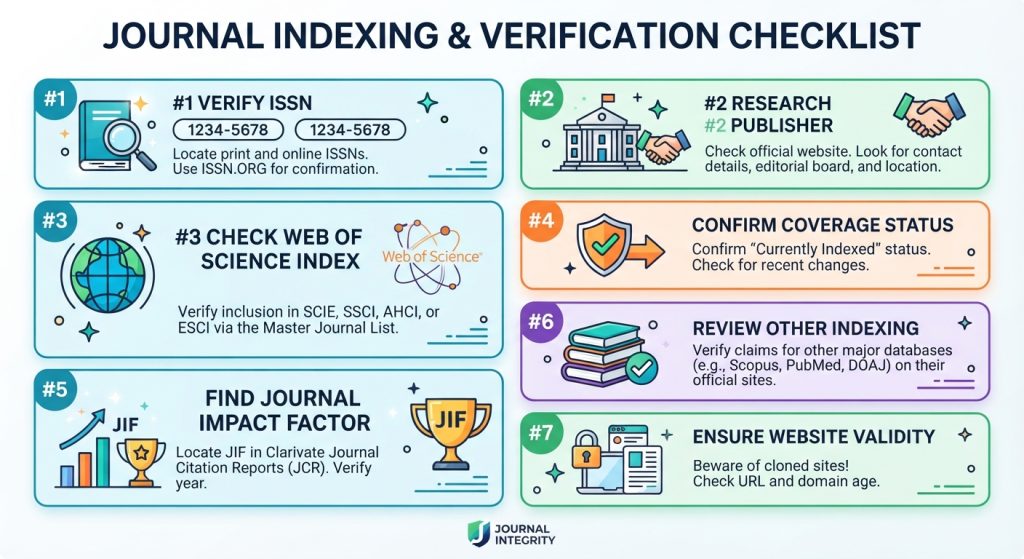
Use this verification sequence before submitting your manuscript:
1. Start with the journal’s exact title
Record the journal’s current title and ISSN/eISSN.
2. Search the Master Journal List
Use the official Clarivate directory rather than a third-party indexing claim.
3. Verify the publisher
Compare the publisher information with the journal’s official website.
4. Identify the exact index
Record whether the journal appears in SCIE, SSCI, AHCI, ESCI, or another relevant Web of Science collection.
5. Check coverage information
Review the journal’s current status and available coverage information.
6. Verify additional claims separately
If the journal advertises a Journal Impact Factor, CiteScore, Scopus indexing, DOAJ inclusion, or another metric, verify each claim using the appropriate authoritative database.
Never use one database as proof of inclusion in another.
7. Save evidence for institutional requirements
If your university, employer, funder, or promotion committee requires proof of indexing, save the journal’s current record or official verification according to your institution’s documentation requirements.
Common Mistakes Researchers Make
Mistake 1: Assuming Web of Science is entirely free
The existence of a free Master Journal List can create the impression that the entire database is freely searchable.
It is not.
Fix: Separate the free MJL from subscription-based Web of Science database access.
Mistake 2: Treating Google Scholar as proof of Web of Science indexing
A journal appearing in Google Scholar does not establish that it is indexed in Web of Science.
Fix: Use the Master Journal List for Web of Science coverage verification.
Mistake 3: Confusing indexing with impact metrics
Indexing status, Journal Impact Factor, CiteScore, h-index, and other metrics are different concepts.
Fix: Verify each claim using the organization that owns or maintains the relevant database or metric.
Mistake 4: Relying on an outdated indexing claim
Journal coverage can change.
Fix: Check current records close to submission, especially when indexing is a formal eligibility requirement.
Mistake 5: Assuming “open access” means “indexed everywhere”
A journal can be fully open access without being indexed in Web of Science, Scopus, PubMed, or DOAJ.
Fix: Evaluate each indexing service independently.
Also read: Web of Science Core Collection vs SCI: Understanding the Database Hierarchy in 2026
A Practical Free Research Workflow for 2026
You can build a robust research workflow without personally purchasing Web of Science access.
Start with Google Scholar, PubMed, DOAJ, OpenAlex, or Crossref according to your discipline and objective.
Then use the Clarivate Master Journal List whenever journal Web of Science coverage matters.
For full citation analysis or systematic bibliometric work, determine whether your institution already provides Web of Science or another licensed database.
For manuscript preparation, verify the target journal’s current author guidelines, reporting requirements, reference style, article type, word limit, figure specifications, and submission workflow before finalizing your manuscript.
This approach is more reliable than attempting to find a single database that reproduces every Web of Science feature for free.
Pre-Submission Checklist
Before submitting to a journal, complete the following checks:
- Confirm the journal’s exact title.
- Record the journal’s ISSN and eISSN.
- Verify the journal in the official Clarivate Master Journal List if Web of Science indexing is required.
- Identify the exact Web of Science collection or index.
- Check current coverage rather than relying on an old indexing claim.
- Verify any advertised Journal Impact Factor through Clarivate.
- Check Scopus or other indexing claims separately if relevant.
- Confirm the journal’s publisher and official website.
- Review the journal’s peer-review model and publication ethics policies.
- Check APCs and other publication charges.
- Confirm whether the journal is fully open access, hybrid, or subscription-based.
- Use PubMed for biomedical literature searches where appropriate.
- Use DOAJ to identify and evaluate open-access journal options.
- Use OpenAlex or Crossref for open scholarly metadata and bibliographic verification.
- Review the journal’s author guidelines before submission.
- Ensure your manuscript follows the required reference and formatting style.
- Complete discipline-specific reporting guidelines such as CONSORT, STROBE, PRISMA, or relevant equivalents when applicable.
Conclusion
So, is Web of Science free to access? The full Web of Science research platform is generally subscription-based, but researchers can use several important Clarivate resources for free. Most importantly, the Master Journal List is freely accessible and should be your primary starting point for verifying Web of Science journal coverage.
When full Web of Science access is unavailable, do not rely on a single substitute. Combine specialized resources: PubMed for biomedical literature, DOAJ for open-access journals, Google Scholar for broad scholarly discovery, OpenAlex for open research metadata, Crossref for DOI and bibliographic verification, and institutional repositories for legally accessible research outputs.
The objective is not to replicate every Web of Science function at zero cost. It is to use the right database for the right research task and verify indexing claims through authoritative sources.
For researchers preparing a manuscript for publication, accurate database verification is only one part of a successful submission. Your manuscript must also satisfy the target journal’s scope, reporting requirements, formatting specifications, reference style, ethical declarations, and submission workflow. Professional manuscript editing and formatting can help identify technical inconsistencies before peer review. For a structured pre-submission assessment, explore ManuscriptLab’s professional manuscript editing and formatting services.