Choosing the right academic journal is one of the most consequential decisions in the publication process. Researchers often compare journals using their Impact Factor, indexing status, citation performance, and reputation. However, one ranking indicator frequently creates confusion: journal quartiles.
Is a Q1 journal always better than a Q2 journal? Does publishing in Q4 indicate poor research quality? Why does the same journal sometimes appear as Q1 in one subject category and Q2 or Q3 in another? More importantly, should researchers prioritize journal quartiles when selecting a publication venue for academic promotion or grant applications?
Journal quartiles are relative ranking classifications that divide journals within a particular subject category into four groups based on their position in a selected bibliometric ranking system. Q1 represents the highest-ranked group, while Q4 represents the lowest-ranked group.
Understanding journal quartiles explained through the Web of Science Journal Citation Reports (JCR), Scopus metrics, and SCImago Journal Rank (SJR) is essential for making informed publication decisions. These rankings influence journal selection, institutional evaluation, research visibility, and publication strategy.
This guide explains what Q1, Q2, Q3, and Q4 mean, how quartiles are calculated, why ranking systems differ, and how to select an appropriate journal without compromising your manuscript’s publication prospects.
💡 Need expert help with your paper?
Transform your manuscript with ManuscriptLab's professional editing and formatting services!
1. What Are Journal Quartiles? Understanding Q1, Q2, Q3, and Q4
Journal quartiles classify academic journals into four equal ranking groups within a particular subject category. They help researchers understand a journal’s relative position compared with other publications in the same academic discipline.
The four classifications are:
- Q1 (First Quartile): The top 25% of journals in a subject category.
- Q2 (Second Quartile): Journals ranked approximately between the 25th and 50th percentiles.
- Q3 (Third Quartile): Journals ranked approximately between the 50th and 75th percentiles.
- Q4 (Fourth Quartile): The lowest-ranked 25% of journals in the category.
For example, imagine a subject category containing 200 journals. A simplified ranking distribution would look like this:
| Quartile | Approximate ranking position | Number of journals |
| Q1 | 1–50 | 50 |
| Q2 | 51–100 | 50 |
| Q3 | 101–150 | 50 |
| Q4 | 151–200 | 50 |
This example illustrates the general concept rather than the exact allocation rules of every database. Actual quartile boundaries depend on the ranking methodology, category size, ties, and database-specific calculations.
What Does Each Journal Quartile Mean for Researchers?
Q1 journals: Highest relative ranking
Q1 journals occupy the top quartile of their subject category. They often attract substantial research interest, receive competitive submissions, and maintain selective editorial standards. However, a Q1 designation does not guarantee that every published article is methodologically superior to every article in a lower-ranked journal.
Q2 journals: Strong disciplinary standing
Q2 journals fall within the second quartile. They can provide excellent publication opportunities for well-designed studies that address a clear disciplinary question. For many researchers, a reputable Q2 journal offers an appropriate balance between academic visibility, scope, and publication feasibility.
Q3 journals: Established but lower relative ranking
Q3 journals occupy the third quartile. Their suitability depends on their editorial standards, readership, indexing status, and relevance to the manuscript. A Q3 journal may be particularly appropriate for specialized research or studies addressing regional and emerging research questions.
Q4 journals: Lowest relative ranking
Q4 journals fall within the bottom quartile of their subject category. This classification does not automatically make them predatory, fraudulent, or academically worthless. Researchers must assess peer-review integrity, editorial transparency, publication ethics, and indexing independently.
The central distinction is that quartiles measure relative journal ranking, not the intrinsic quality of an individual manuscript.
2. How Are Journal Quartiles Calculated?
Understanding journal quartiles requires distinguishing between the databases and indicators used to rank academic publications. Web of Science JCR, Scopus, and SCImago do not necessarily apply identical methodologies.
A. Web of Science Journal Citation Reports (JCR) Quartiles
Clarivate’s Journal Citation Reports assigns journals rankings within their respective subject categories using indicators such as the Journal Impact Factor (JIF).
The JIF measures the average number of citations received in a particular year by eligible scholarly content published during the preceding two years.
A simplified representation is:
Journal Impact Factor = Citations in the current year to eligible content published in the previous two years ÷ Number of eligible articles and reviews published during those two years.
JCR then ranks journals within their assigned categories according to the selected metric.
For JIF quartiles, Clarivate calculates a normalized rank position:
Z = X / Y
Where:
- X = Journal’s rank position within the category.
- Y = Total number of journals in that category.
The resulting position determines the quartile:
| Normalized rank (Z) | Quartile |
| 0.00 < Z ≤ 0.25 | Q1 |
| 0.25 < Z ≤ 0.50 | Q2 |
| 0.50 < Z ≤ 0.75 | Q3 |
| 0.75 < Z ≤ 1.00 | Q4 |
For example, a journal ranked 20th among 100 journals has Z = 0.20 and falls into Q1.
Important: JCR also reports quartiles based on other indicators, including the Journal Citation Indicator (JCI). Always identify whether you are reporting the JIF quartile or JCI quartile rather than treating them as interchangeable.
B. Scopus CiteScore and Quartile Rankings
Scopus provides journal-level metrics, including CiteScore, CiteScore Percentile, and CiteScore Rank.
CiteScore uses a four-year citation window. It calculates citations received by eligible document types—including articles, reviews, conference papers, book chapters, and data papers—over the same four-year period in which those documents were published.
The basic formula is:
CiteScore = Citations received over four years ÷ Eligible documents published over those four years.
Scopus also calculates CiteScore Percentiles to show a journal’s relative position within each subject area.
For example:
- 90th percentile: The journal performs at or above approximately 90% of sources in its category.
- 75th percentile: The journal is positioned around the upper quarter of its category.
- 50th percentile: The journal is around the category midpoint.
- 20th percentile: The journal is positioned toward the lower end.
In percentile-based quartile classifications, the upper 25% corresponds to Q1, the next 25% to Q2, and so forth. However, researchers should verify which quartile methodology their institution or reporting platform uses.
Do not confuse CiteScore with SJR. Both are associated with Scopus-indexed sources, but they measure citation performance differently.
C. SCImago Journal Rank (SJR) Quartiles
SCImago uses Scopus data to calculate its journal rankings, but its SJR indicator measures citation prestige rather than simply counting citations.
SJR assigns different weights to citations depending on the prestige of the citing journal. A citation from a highly influential journal can contribute more than a citation from a less influential source.
Its methodology is conceptually similar to the PageRank algorithm used in search engines.
SCImago assigns journals to quartiles within their subject categories using its own ranking methodology. Its quartile calculation should not automatically be assumed to match Scopus CiteScore percentiles or JCR rankings.
This distinction is particularly important when researchers compare journal profiles across platforms.
3. Scopus CiteScore vs. SJR vs. Web of Science JCR: Key Differences
One of the most common mistakes in journal selection is treating all quartile rankings as equivalent.
Although these systems help researchers evaluate journal performance, they use different data sources, indicators, and calculation methods.
| Evaluation criterion | Web of Science JCR | Scopus CiteScore | SCImago SJR |
| Primary indicator | Journal Impact Factor or JCI | CiteScore | SCImago Journal Rank |
| Data source | Web of Science Core Collection | Scopus | Scopus data |
| Citation approach | JIF uses a two-year window | Four-year citation window | Prestige-weighted citation approach |
| Ranking basis | Rank within JCR subject category | CiteScore percentile and rank | SJR within subject category |
| Quartile availability | Q1–Q4 | Percentiles can be mapped to quartiles | Q1–Q4 |
| Main strength | Established JCR journal evaluation | Broader citation coverage window | Citation prestige weighting |
A journal may receive different quartiles across these platforms because:
- The databases do not necessarily index identical journal collections.
- Their citation windows differ.
- Their indicators measure different aspects of citation performance.
- Subject categories and classification systems may differ.
- Their quartile calculation methodologies are not identical.
Practical recommendation: When an institution requires a Q1 journal, confirm the accepted database, ranking indicator, subject category, and publication year before submitting your manuscript.
Also read: Impact Factor vs CiteScore vs SJR: Which Journal Metric Should You Trust in 2026?
4. Why Does a Journal Have Different Quartiles in Different Categories?
A journal can be classified under multiple subject categories because its published research may address several related disciplines.
Each category has its own journal population and ranking distribution. Consequently, the same journal can occupy different positions across categories.
Consider a hypothetical multidisciplinary medical journal:
| Subject category | Journal rank | Total journals | Quartile |
| Medicine | 18 | 100 | Q1 |
| Public Health | 42 | 120 | Q2 |
| Health Policy | 65 | 100 | Q3 |
The journal has not changed its editorial standards or publication quality. Its relative position differs because it is being compared with different groups of journals.
Why Category-Specific Rankings Matter
A journal may perform exceptionally well in a broad discipline but face stronger competition in a specialized category.
For example, a clinical research journal might rank Q1 in a general medical category but Q2 in a highly competitive specialty category.
This is why researchers should avoid reporting a journal’s quartile without mentioning its subject category.
Common pitfall: Selecting the highest quartile displayed on a journal profile without checking whether the category is relevant to the manuscript or accepted by the researcher’s institution.
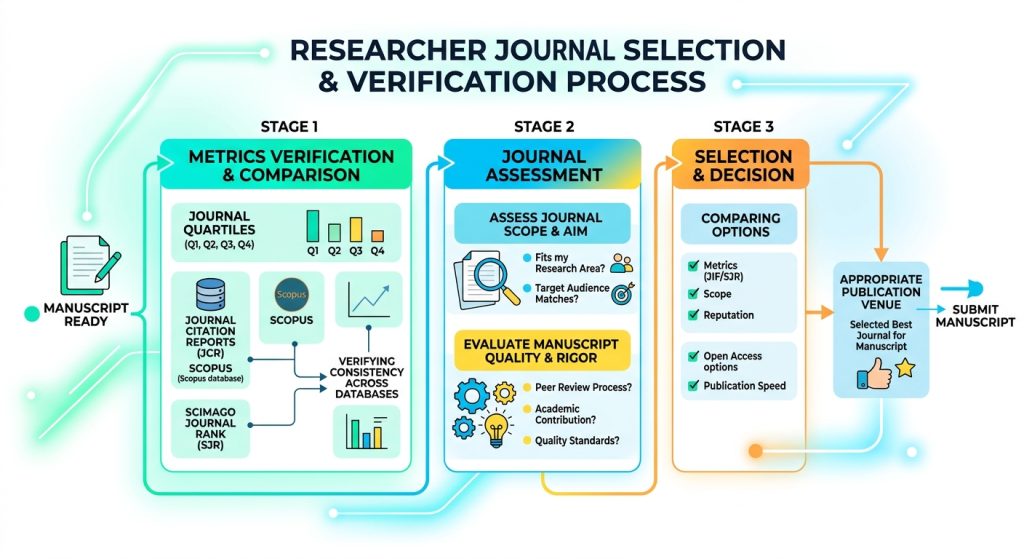
5. How to Check Journal Quartiles on SCImago and Clarivate
Researchers should verify journal rankings directly through the relevant databases rather than relying exclusively on publisher advertisements or third-party journal lists.
Step 1: Check Journal Quartiles on SCImago
Visit https://www.scimagojr.com/
- Enter the journal’s complete title or ISSN.
- Open the correct journal profile.
- Verify the journal’s subject categories.
- Review its SJR value and quartile classifications.
- Check the ranking year and historical performance.
- Confirm the journal’s publisher and Scopus coverage information.
SCImago provides publicly accessible journal profiles, making it useful for preliminary journal comparisons.
However, remember that SCImago’s annual updates and quartile methodology can produce differences from Scopus displays.
Step 2: Verify Journal Rankings Through Clarivate JCR
Visit https://jcr.clarivate.com/
- Search for the journal by title or ISSN.
- Confirm that you have selected the correct publication.
- Review its Journal Impact Factor and JCR subject categories.
- Examine the JIF rank and corresponding quartile for each category.
- Check the JCR edition year.
- Review the JCI and other available indicators when relevant.
JCR access may require an institutional subscription.
Step 3: Verify Scopus CiteScore Rankings
Use the Scopus Sources platform:
Search using the journal title or ISSN and review:
- Current CiteScore.
- CiteScore percentile.
- Subject-area ranking.
- Rank and number of sources in each category.
- Historical metric performance.
- Scopus coverage information.
Do not assume that a journal’s highest displayed percentile represents its position in every subject category.
Step 4: Cross-Check the Results
Compare the journal’s ranking across the required platforms and record the exact year, category, and indicator.
For example, a research institution may accept JCR quartiles but not SCImago quartiles for a particular promotion requirement. Another institution may recognize Scopus CiteScore percentiles.
The institution’s written evaluation policy should determine which ranking you report.
6. Are Q4 Journals Poor Quality or Predatory?
No. A Q4 classification does not automatically indicate predatory publishing.
Journal quartiles measure relative ranking within a category. Predatory publishing involves misleading or unethical practices, such as fabricated editorial boards, deceptive indexing claims, or inadequate peer review.
A legitimate Q4 journal can provide a valuable publication venue for:
- Regional research.
- Emerging research areas.
- Specialized clinical investigations.
- Replication studies.
- Negative or inconclusive findings.
- Research with a focused disciplinary audience.
However, researchers should conduct due diligence before submitting to any journal, regardless of quartile.
Warning Signs to Investigate
- Unverifiable claims of Scopus or Web of Science indexing.
- Guaranteed acceptance or implausibly short review periods.
- No identifiable editorial board.
- Unclear publication fees.
- Fake Impact Factors or misleading ranking badges.
- Inadequate peer-review and publication ethics policies.
- Publisher information that cannot be independently verified.
Consult the Directory of Open Access Journals (DOAJ) when evaluating eligible open-access journals and review the Committee on Publication Ethics (COPE) resources for guidance on responsible publishing.
Remember: A journal’s indexing status, peer-review integrity, and editorial transparency deserve independent verification. Quartile ranking alone cannot establish legitimacy.
7. How Journal Quartiles Influence Academic Promotion and Grant Funding
Journal quartiles are frequently used in research evaluation, institutional performance reports, doctoral publication requirements, and funding assessments.
Some universities award different publication credits according to journal rankings. Others establish minimum journal-ranking requirements for doctoral graduation, academic promotion, or research incentives.
For grant applications, publication records may also contribute to assessments of research productivity and visibility.
However, researchers should distinguish between institutional policy and universal academic standards.
There is no universal rule requiring every researcher to publish exclusively in Q1 journals. Requirements vary by institution, discipline, country, and funding organization.
The Declaration on Research Assessment (DORA) recommends responsible use of research indicators and cautions against evaluating individual research contributions solely through journal-level metrics.
What Should Researchers Report?
When documenting journal performance for promotion or grant applications, include:
- Journal title and ISSN.
- Database used for ranking.
- Quartile classification.
- Subject category.
- Metric type (JIF, JCI, CiteScore, or SJR).
- Ranking year.
- Relevant indexing and coverage information.
This makes your publication record transparent and easier for evaluators to verify.
Also read: How to Choose an Academic Editing Service: 9 Things to Check
8. How Targeted Journal Quartile Selection Prevents Manuscript Desk Rejection
Selecting a journal solely because it has a high quartile can increase the risk of unnecessary rejection.
A Q1 journal may receive hundreds of submissions addressing highly competitive research questions. Even scientifically sound manuscripts can be rejected if they do not meet the journal’s scope, novelty expectations, methodological standards, or readership priorities.
The solution is to align manuscript quality and journal requirements before submission.
Evaluate Five Important Factors
1. Scope alignment
Read the journal’s aims and scope, recent publications, and article categories. Determine whether your research question fits its editorial priorities.
2. Methodological rigor
Assess whether the study design, sample size, statistical methods, and reporting standards meet the journal’s expectations.
For clinical studies, check relevant reporting guidelines such as CONSORT for randomized trials and STROBE for observational studies.
3. Novelty and contribution
Identify what your research adds to the existing literature. A competitive journal generally expects a clear and defensible contribution to its field.
4. Manuscript presentation
Ensure that the abstract, introduction, methodology, results, discussion, tables, figures, and references meet the journal’s author instructions.
Consider professional academic editing and manuscript formatting services to improve language clarity, structural consistency, and submission readiness.
5. Publication requirements
Check APCs, open-access options, copyright policies, word limits, reporting guidelines, and supplementary material requirements before submission.
A strategically selected Q2 journal with excellent scope alignment may offer a more realistic and appropriate publication opportunity than an unsuitable Q1 journal.
Also read: 10 Key Reasons Manuscripts Get Rejected Before Peer Review
9. A Practical Journal Selection Framework for 2026
Use the following framework to compare potential journals before finalizing your submission.
| Selection criterion | What to examine | Why it matters |
| Quartile | Q1, Q2, Q3, or Q4 | Establishes relative ranking |
| Indexing | Scopus or Web of Science | Confirms database coverage |
| Subject category | Relevant research discipline | Ensures meaningful comparison |
| Scope | Aims, readership, article types | Reduces scope-related rejection |
| Review process | Peer-review model and policies | Establishes editorial credibility |
| APC | Current publication charges | Supports financial planning |
| Reporting standards | CONSORT, STROBE, PRISMA, etc. | Improves compliance |
| Publication history | Recent articles and coverage | Helps assess journal activity |
Recommended Submission Strategy
Rather than targeting journals based on quartile alone, develop a shortlist of three to five suitable journals.
- First choice: A journal whose ranking, scope, and editorial expectations match the manuscript’s strongest contributions.
- Second choice: A reputable alternative with a suitable readership and realistic publication requirements.
- Third choice: A legitimate journal offering an appropriate disciplinary fit and acceptable publication conditions.
This strategy creates a practical submission pathway without sacrificing academic integrity.
10. Frequently Asked Questions About Journal Quartiles
Q1. What does Q1, Q2, Q3, and Q4 mean for a journal paper?
These classifications describe the relative ranking of the journal in which a paper is published, not the quality ranking of the individual paper. Q1 represents the highest-ranked quartile, while Q4 represents the lowest-ranked quartile.
Q2. Is a Scopus quartile ranking identical to a Web of Science JCR quartile ranking?
No. Scopus-related CiteScore percentiles, SCImago SJR quartiles, and Web of Science JCR quartiles use different indicators, data sources, and ranking methodologies. A journal can have different quartiles across these systems.
Q3. Why is a journal ranked Q1 in one category but Q2 or Q3 in another?
Journals can belong to multiple subject categories. Each category has its own journal population and ranking distribution. Therefore, a journal can achieve different relative positions across disciplines.
Q4. Are Q4 journals considered poor quality or predatory?
No. Q4 indicates a lower relative ranking within a particular category. It does not automatically indicate poor peer review or unethical publishing. Researchers should independently verify indexing, editorial standards, publisher transparency, and publication ethics.
Q5. How often do journal quartiles change?
Quartiles can change when databases update citation information, journal coverage, subject categories, and ranking calculations. Researchers should verify the relevant ranking year rather than relying on outdated journal lists.
Q6. Should researchers always target Q1 journals?
No. Journal selection should reflect research quality, methodological rigor, scope alignment, readership, institutional requirements, and publication feasibility. A suitable Q2 or Q3 journal may be a better choice than an unsuitable Q1 journal.
Q7. Can a journal’s quartile improve or decline over time?
Yes. Changes in citation performance, category composition, competing journals, database coverage, and ranking methodology can influence a journal’s quartile from one reporting year to another.
11. Pre-Submission Checklist: Verify Your Target Journal
Before submitting your manuscript, complete the following checks:
- Confirm the journal’s full title and ISSN.
- Verify its indexing status directly through Scopus or Web of Science.
- Identify the required quartile database and ranking indicator.
- Check the latest available ranking year.
- Confirm the relevant subject category.
- Review the journal’s aims, scope, and recently published articles.
- Evaluate peer-review standards and editorial transparency.
- Check APCs and available open-access options.
- Follow the journal’s author guidelines and reference style.
- Apply relevant reporting guidelines, such as CONSORT or STROBE.
- Review manuscript language, structure, tables, and figures.
- Confirm that all authors approve the final submission.
Conclusion: Choose the Right Journal, Not Just the Highest Quartile
Understanding journal quartiles explained through JCR, Scopus, and SCImago helps researchers make informed decisions about where to publish. Q1, Q2, Q3, and Q4 provide useful information about a journal’s relative standing, but they should never be treated as independent measures of research quality or publishing ethics.
The most effective publication strategy combines accurate quartile verification, appropriate journal selection, methodological rigor, strong academic writing, and compliance with submission guidelines.
Prioritize journals that match your research contribution, meet your institutional requirements, and reach the intended academic audience. A carefully prepared manuscript submitted to the right journal has a stronger foundation for successful peer review.
Prepare your manuscript for publication with confidence. Explore ManuscriptLab’s professional editing and formatting services to strengthen your academic writing, improve manuscript presentation, and prepare your research for journal submission.