A literature review is one of the most intellectually demanding sections of an academic manuscript. Researchers must examine existing studies, evaluate competing findings, identify patterns, and establish how their research contributes to the existing body of knowledge. Yet, many literature reviews struggle to achieve these objectives because they read like annotated bibliographies rather than coherent academic arguments.
Understanding how to write a literature review structure is essential for producing a review that demonstrates critical thinking, establishes scholarly relevance, and provides a convincing foundation for original research.
A literature review is a critical and organized synthesis of published research on a defined topic. It evaluates what researchers already know, examines methodological and theoretical developments, identifies disagreements, and highlights unresolved questions. Its purpose extends beyond summarizing previous publications: it establishes the intellectual context and justification for a new study.
Whether you are preparing a journal article, doctoral dissertation, thesis, or independent research paper, an effective literature review can strengthen your manuscript’s academic credibility and improve its contribution to the field.
This guide explains how to organize a literature review, develop a synthesis matrix, identify theoretical frameworks, establish a defensible research gap, and avoid common academic writing mistakes.
💡 Need expert help with your paper?
Transform your manuscript with ManuscriptLab's professional editing and formatting services!
1. Understand the Purpose of a Literature Review
Before writing, establish what your literature review needs to accomplish. Its purpose determines which sources you select, how you organize evidence, and what arguments you develop.
A well-constructed literature review serves five important functions:
- Establishes research context: Explains the current state of knowledge surrounding your research problem.
- Evaluates existing evidence: Examines the reliability, relevance, and methodological quality of previous studies.
- Identifies theoretical foundations: Highlights the theories, conceptual models, and frameworks informing your research.
- Reveals knowledge gaps: Identifies unanswered questions, conflicting findings, and underexplored populations or contexts.
- Justifies original research: Demonstrates why your proposed investigation is necessary.
A literature review should ultimately answer three questions:
- What is already known about this research topic?
- What limitations, disagreements, or unanswered questions remain?
- How does the proposed study address an identifiable gap?
These questions provide the foundation for a focused and analytically rigorous review.
Literature review versus annotated bibliography
An annotated bibliography presents individual sources with summaries and evaluations. A literature review connects those sources through themes, arguments, methodological comparisons, and critical interpretation.
For example:
Descriptive approach: Smith (2022) investigated online learning effectiveness. Jones (2023) examined student engagement. Brown (2024) explored digital assessment.
Synthesis approach: Recent research suggests that online learning effectiveness depends on several interconnected factors, including student engagement, instructional design, and assessment strategies. While Smith (2022) emphasizes learning outcomes, Jones (2023) identifies engagement as an important predictor of participation. Brown (2024) further demonstrates how assessment design influences the evaluation of digital learning environments.
The second example connects individual studies to establish a broader academic argument. This is the central principle of literature review writing: synthesize evidence instead of presenting isolated summaries.
2. Choose the Right Literature Review Structure
The structure of your literature review determines how readers understand the development of knowledge within your research area.
There is no universally appropriate organizational model. Select one according to your research question, disciplinary conventions, and the relationships you identify between studies.
A. Thematic literature review structure
A thematic literature review organizes research around recurring concepts, variables, debates, or findings.
For example, a literature review investigating artificial intelligence in healthcare might contain the following sections:
- AI applications in clinical diagnosis
- Machine learning and predictive analytics
- Patient safety and diagnostic accuracy
- Ethical concerns and algorithmic bias
- Implementation barriers in healthcare systems
Each section brings together studies addressing a particular theme.
Why use it: Thematic organization makes it easier to compare findings across different studies and identify relationships between research variables.
Industry standard: There is no mandatory number of themes. Develop enough sections to represent the major dimensions of your research question without creating unnecessarily fragmented discussions.
Common pitfall: Avoid creating themes that are too broad. A section titled “Artificial Intelligence in Healthcare” may contain several unrelated discussions. Divide it into meaningful analytical categories.
B. Chronological literature review structure
A chronological literature review arranges studies according to publication dates or important historical developments.
For example:
- Early research and foundational theories (2000–2010)
- Methodological developments (2011–2018)
- Recent technological advancements (2019–2026)
This structure demonstrates how theoretical perspectives, research methods, and empirical findings have evolved.
Why use it: Chronological organization is particularly useful when examining the historical development of a concept, changes in scientific understanding, or the evolution of research methodologies.
Industry standard: Include important foundational studies alongside recent publications. Do not exclude older research simply because newer studies are available.
Common pitfall: Avoid turning the section into a year-by-year publication catalogue. Explain why particular developments changed the direction of research.
C. Methodological literature review structure
A methodological review organizes studies according to their research designs, analytical techniques, data collection procedures, or measurement instruments.
For example:
- Cross-sectional studies
- Longitudinal investigations
- Randomized controlled trials
- Qualitative interviews
- Mixed-methods research
Why use it: This approach helps researchers evaluate how methodological differences influence findings and identify limitations in existing evidence.
Common pitfall: Do not assume that studies using different methodologies are directly comparable. Consider differences in sampling, measurement, study duration, and analytical assumptions.
D. Theoretical literature review structure
A theoretical review examines the theories and conceptual frameworks relevant to a research problem.
It may compare competing theoretical explanations, evaluate their assumptions, and establish which framework provides the strongest foundation for the proposed study.
Why use it: Theoretical organization is particularly valuable in disciplines where conceptual models influence hypothesis development, variable selection, and interpretation.
Common pitfall: Avoid mentioning theories without explaining their relevance. Demonstrate how each framework explains the research phenomenon and where its explanatory limitations emerge.
Comparison of literature review structures
| Structure | Main organizing principle | Best suited for |
| Thematic | Research themes and concepts | Most research papers and dissertations |
| Chronological | Publication timeline | Historical and developmental research |
| Methodological | Research designs and methods | Methodological comparisons |
| Theoretical | Theories and conceptual frameworks | Theory-driven investigations |
For most conventional research papers, thematic organization provides a practical starting point. However, combining thematic and chronological approaches can be more effective when a research field has experienced substantial theoretical or methodological changes.
3. Develop a Strong Literature Review Introduction
The introduction establishes the boundaries and direction of your review. It should explain what you are reviewing, why the topic matters, and how the discussion is organized.
A strong introduction generally contains four components.
1. Research background
Introduce the broader research problem and explain its academic or practical significance.
2. Scope of the review
Define the concepts, populations, geographical settings, publication periods, or research approaches included in your review.
3. Research context
Summarize the existing state of knowledge and identify the main issues requiring further examination.
4. Organizational roadmap
Explain how the review is structured, including its major themes or theoretical categories.
Example of a literature review introduction
“Artificial intelligence has increasingly influenced healthcare delivery, particularly in medical imaging, clinical decision support, and predictive diagnostics. Although previous investigations have demonstrated the potential of machine learning applications to improve diagnostic efficiency, questions remain regarding algorithmic reliability, clinical implementation, and ethical accountability. This review examines existing research on AI-assisted clinical diagnosis, focusing on diagnostic accuracy, implementation challenges, and patient safety. By comparing empirical findings and theoretical perspectives, the review identifies limitations in current evidence and establishes the rationale for further investigation.”
Notice that the introduction establishes the topic, identifies important research dimensions, and prepares readers for the analytical discussion.
Common mistake: Avoid beginning with an overly broad statement that does not lead toward your specific research problem. Narrow the discussion progressively until the review’s scope becomes clear.
Also read: Building a Scholarly Argument: 7 Essential Steps from Literature Review to Polished Prose
4. Build a Literature Review Synthesis Matrix
A literature review synthesis matrix is one of the most effective tools for organizing academic sources and developing critical comparisons.
Instead of recording studies individually, the matrix organizes information according to shared themes, methodologies, findings, and limitations.
This approach helps prevent your literature review from becoming an author-by-author summary list.
Why researchers need a synthesis matrix
When researchers examine 30, 50, or even 100 publications, remembering how individual studies relate to one another becomes increasingly difficult.
A synthesis matrix provides a structured comparison system. It allows you to identify:
- Repeated findings across multiple studies.
- Contradictory empirical results.
- Differences in research methodologies.
- Frequently investigated variables.
- Underrepresented populations or research contexts.
- Opportunities for further investigation.
According to academic research guidance from Johns Hopkins University, a synthesis matrix helps researchers organize sources by theme or variable and understand how individual publications relate to one another.
Literature review synthesis matrix template
Use the following template when organizing your sources.
| Author and year | Research objective | Methodology | Main findings | Limitations | Research theme |
| Smith (2022) | Examine AI diagnostic accuracy | Quantitative | Improved diagnostic performance | Limited sample | Diagnostic accuracy |
| Jones (2023) | Evaluate clinical adoption | Qualitative | Identified implementation barriers | Single-site study | Clinical implementation |
| Brown (2024) | Investigate algorithmic bias | Mixed methods | Reported variation across populations | Limited demographic coverage | Ethical concerns |
| Wilson (2025) | Assess patient safety | Systematic review | Identified reporting inconsistencies | Heterogeneous evidence | Patient safety |
Note: These are illustrative entries, not actual research citations.
How to use the synthesis matrix effectively
Step 1: Record bibliographic information.
Include author names, publication years, article titles, journal names, and DOI information. A reference manager such as Zotero, EndNote, or Mendeley can help maintain bibliographic accuracy.
Step 2: Extract relevant research information.
Record each study’s research objectives, methodology, sample characteristics, principal findings, and limitations.
Do not copy entire abstracts into your matrix. Extract only the information relevant to your research question.
Step 3: Identify recurring themes.
Group studies according to common research concepts, variables, theoretical perspectives, or methodological approaches.
Step 4: Compare findings across publications.
Identify where studies agree, disagree, or produce different conclusions. Examine whether these differences result from sample characteristics, measurement instruments, geographical settings, or research designs.
Step 5: Develop analytical statements.
Convert your observations into arguments supported by multiple sources.
For example, instead of describing three studies independently, explain how their findings collectively support or challenge an established assumption.
Step 6: Identify research gaps.
Use the matrix to locate underexplored relationships, inconsistent evidence, methodological weaknesses, and neglected research populations.
A synthesis matrix is not simply a note-taking spreadsheet. It is an analytical instrument that helps transform collected evidence into a coherent academic argument.
5. Synthesize Academic Sources Instead of Summarizing Them
Synthesis is the most important writing skill in a strong literature review.
It involves combining evidence from multiple publications to develop a broader interpretation of the existing research.
A useful synthesis paragraph generally follows this structure:
- Topic sentence: Introduce the central theme or argument.
- Supporting evidence: Present findings from relevant studies.
- Comparison: Explain similarities and differences between publications.
- Critical evaluation: Examine methodological strengths, limitations, and possible explanations.
- Analytical conclusion: Explain what the combined evidence demonstrates.
Example of a synthesized literature review paragraph
“Research examining the relationship between sleep quality and academic performance generally indicates that insufficient sleep is associated with reduced cognitive functioning. Smith et al. (2022) reported lower academic performance among students experiencing irregular sleep patterns, while Jones et al. (2023) identified sleep duration as an important predictor of concentration and memory. However, Brown et al. (2024) found that the relationship varied according to stress levels and individual lifestyle factors. These differences suggest that sleep quality should not be examined independently of other behavioral and psychological variables. Nevertheless, the limited longitudinal evidence indicates a need for further investigation into the long-term relationship between sleep patterns and academic achievement.”
This is an illustrative writing example; replace the references with verified studies relevant to your topic.
Useful transition words for academic synthesis
| Purpose | Useful transitions |
| Agreement | Similarly, likewise, consistent with, correspondingly |
| Contrast | However, conversely, in contrast, whereas |
| Extension | Furthermore, additionally, moreover |
| Qualification | Although, despite, nevertheless, to some extent |
| Cause and effect | Consequently, therefore, as a result |
| Evidence evaluation | Notably, importantly, the findings suggest |
| Research gaps | Despite these findings, little evidence exists, remains unclear |
Use transitions to communicate relationships between ideas, not simply to make paragraphs appear more academic.
Also read: How to Prepare Tables and Figures to Meet High-Impact Journal Standards in 2026
6. Identify Theoretical Frameworks and Establish the Research Gap
A strong literature review must explain not only what previous researchers discovered but also what remains insufficiently understood.
Identifying theoretical frameworks
A theoretical framework provides the conceptual foundation for understanding relationships between research variables.
To identify relevant frameworks:
- Examine foundational studies in your research area.
- Identify theories repeatedly cited in influential publications.
- Compare how different theories explain the same phenomenon.
- Evaluate whether existing frameworks adequately address your research problem.
- Explain why a particular framework is suitable for your investigation.
For example, research examining technology adoption may draw upon the Technology Acceptance Model (TAM), the Unified Theory of Acceptance and Use of Technology (UTAUT), or other relevant conceptual approaches.
Do not select a theoretical framework simply because it appears frequently in the literature. Demonstrate its conceptual relevance to your research objectives.
Establishing a research gap in the literature review introduction
A research gap is an identifiable limitation or unresolved issue in existing knowledge that justifies further investigation.
Common types include:
- Knowledge gap: Limited understanding of a particular research phenomenon.
- Methodological gap: Overreliance on particular research designs or measurement techniques.
- Population gap: Insufficient investigation of specific demographic or professional groups.
- Contextual gap: Limited evidence from particular geographical or institutional settings.
- Theoretical gap: Existing frameworks do not adequately explain observed relationships.
- Empirical gap: Previous findings remain inconsistent or inconclusive.
How to clearly state your research gap
Use a three-part argument:
1. Establish existing knowledge: Explain what previous studies have consistently demonstrated.
2. Identify the limitation: Describe what remains unexplored, inconsistent, or methodologically restricted.
3. Connect the gap to your study: Explain how your investigation addresses the limitation.
Example:
“Although previous studies have examined the relationship between digital learning platforms and academic achievement, most investigations have focused on undergraduate populations in developed countries. Consequently, limited empirical evidence is available regarding the influence of digital learning accessibility on postgraduate academic performance in resource-constrained educational settings. This study addresses this contextual gap by investigating the relationship between digital learning accessibility and postgraduate academic outcomes in developing economies.”
A defensible research gap must be supported by your literature search. Avoid claiming that no research exists unless your search strategy provides sufficient evidence.
7. Understand Literature Review Length and Formatting Requirements
The appropriate literature review length depends on the document type, research discipline, journal instructions, and complexity of the research question.
There is no universal word-count requirement for literature reviews.
Journal article versus dissertation literature review
| Document type | Typical length | Main objective |
| Journal article | Approximately 500-1,500 words | Establish research context and justify the study |
| Master’s thesis | Approximately 3,000-8,000 words | Critically examine relevant literature |
| Doctoral dissertation | Approximately 8,000-15,000+ words | Develop comprehensive theoretical and empirical foundations |
| Standalone literature review article | Approximately 4,000-8,000+ words | Provide an extensive synthesis of existing evidence |
These figures are indicative planning ranges, not mandatory publishing standards. Actual requirements vary considerably by discipline, institution, journal, and article type.
For journal submissions, prioritize the target journal’s author instructions over general recommendations.
Academic formatting considerations
| Formatting element | Common manuscript convention |
| Font | 12-point Times New Roman, where permitted |
| Margins | 1 inch on all sides, where specified |
| Line spacing | Double spacing for many manuscript submissions |
| Paragraph alignment | Left aligned |
| Heading hierarchy | Follow the required journal or style guide |
| In-text citations | APA, Vancouver, Harvard, or journal-specific |
| Reference list | Consistent formatting and complete bibliographic details |
Formatting requirements are not universal. APA 7th edition, Vancouver, and individual journal guidelines may prescribe different heading, spacing, and citation conventions.
Additional reporting considerations
If your literature review is part of a systematic review, document the search strategy, databases, eligibility criteria, screening procedures, and synthesis methods.
For systematic reviews, consult the PRISMA 2020 reporting guideline. It provides a 27-item checklist and flow diagrams to improve the transparency and completeness of systematic review reporting.
For comprehensive evidence searches, the Cochrane Handbook offers guidance on developing search strategies, selecting studies, and documenting the review process.
Remember that PRISMA is a reporting guideline, not a substitute for appropriate systematic review methodology.
8. Seven Common Mistakes in Academic Literature Reviews
Even well-researched manuscripts can lose academic credibility when their literature reviews lack analytical depth or organizational consistency.
Avoid these seven common problems.
1. Writing author-by-author summaries
Problem: Each paragraph describes a different publication without establishing relationships between studies.
Solution: Organize evidence around themes, compare findings, and develop arguments supported by multiple publications.
2. Using outdated or irrelevant sources
Problem: Researchers rely heavily on older publications while overlooking important developments in their research area.
Solution: Include foundational studies where appropriate, but also search for recent peer-reviewed evidence. The publication period should reflect the research question and disciplinary requirements.
3. Ignoring contradictory findings
Problem: Researchers include only studies that support their hypotheses.
Solution: Examine conflicting findings objectively. Differences may reveal methodological weaknesses, contextual variation, or alternative theoretical explanations.
4. Failing to establish a research gap
Problem: The literature review summarizes existing knowledge but does not explain why another study is necessary.
Solution: Identify specific empirical, theoretical, methodological, or contextual limitations and connect them directly to your research objectives.
5. Overlooking theoretical frameworks
Problem: Relevant theories are mentioned without explaining their conceptual contribution.
Solution: Evaluate how theoretical assumptions explain the research phenomenon and justify the framework selected for your investigation.
6. Using weak search strategies
Problem: Researchers depend on a limited number of databases, vague search terms, or inconsistent inclusion criteria.
Solution: Develop a documented search strategy using relevant databases such as PubMed, Scopus, Web of Science, and discipline-specific repositories. Record search terms, publication dates, and eligibility criteria.
7. Inconsistent referencing and citation errors
Problem: Missing references, incorrect publication details, and inconsistent citation styles undermine manuscript reliability.
Solution: Use a reference management system, verify DOI information, and audit every in-text citation against the reference list.
Also read: 10 Key Reasons Manuscripts Get Rejected Before Peer Review
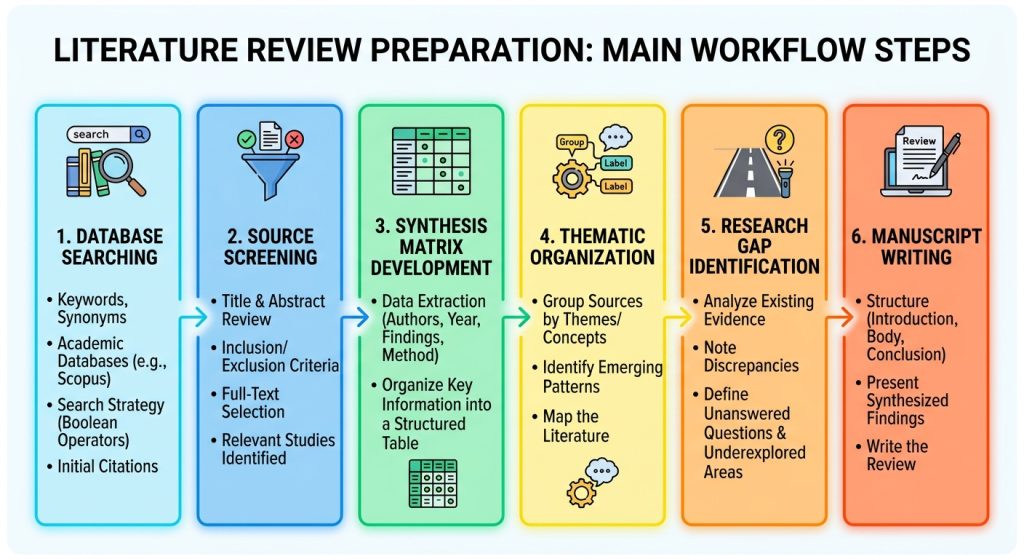
9. Literature Review Preparation Blueprint
An effective literature review follows a logical workflow that connects research planning, source evaluation, synthesis, and academic writing.
10. Pre-Submission Literature Review Checklist
Before submitting your manuscript, evaluate your literature review against the following checklist.
- The research question and review objectives are clearly defined.
- The literature review has a logical introduction, body, and conclusion.
- The selected organizational structure suits the research topic.
- Relevant foundational and recent publications are included.
- Search strategies and selection criteria are documented where required.
- Sources are evaluated critically rather than merely summarized.
- A synthesis matrix has been used to compare relevant findings.
- Contradictory evidence and alternative interpretations are acknowledged.
- Relevant theoretical frameworks are explained and justified.
- The research gap is specific, defensible, and supported by evidence.
- Every in-text citation corresponds to a complete reference.
- The required referencing style is applied consistently.
- Paragraphs are coherent and connected through appropriate transitions.
- Journal-specific formatting and submission requirements are satisfied.
- The manuscript has been proofread for grammatical and structural issues.
Conclusion
Writing a strong literature review requires more than collecting academic publications and summarizing their findings. Researchers must organize evidence strategically, compare competing perspectives, evaluate methodological limitations, and develop a defensible argument that establishes the relevance of their investigation.
A well-designed literature review structure provides clarity, while a synthesis matrix makes critical comparisons easier and helps reveal meaningful research gaps. Combining these techniques enables researchers to produce literature reviews that demonstrate scholarly understanding and establish a convincing foundation for original research.
Approach your literature review as an analytical argument rather than a collection of summaries. Evaluate every source, connect related findings, and ensure that your research gap emerges logically from the evidence.
Need professional support with your literature review? ManuscriptLab helps researchers strengthen academic manuscripts through professional editing, structural refinement, language improvement, and manuscript formatting. Explore our professional manuscript editing services and prepare your research for confident submission.