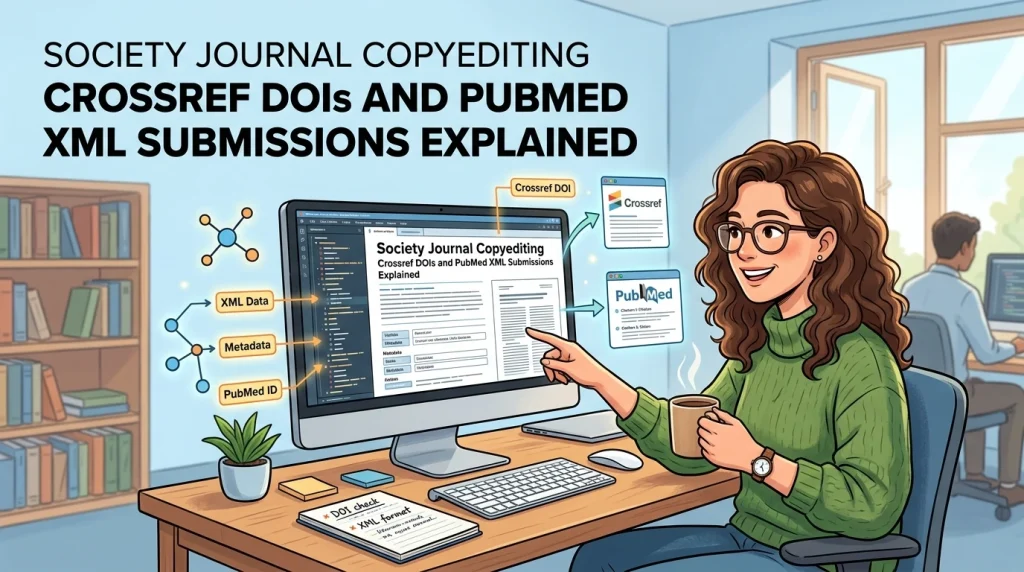
Society journal publishing requires more than accurate grammar, consistent references, and polished page layouts. To distribute scholarly content reliably, publishers must also maintain accurate article metadata, register persistent identifiers, and deliver structured XML that meets the technical requirements of their intended indexing services. Even a carefully edited article can encounter production delays if its DOI metadata is incomplete, its references are incorrectly tagged, or its XML contains invalid character encoding.
Society journal copyediting is the editorial and technical quality-control process that prepares scholarly articles for publication while preserving the integrity of their content and ensuring consistency across publishing systems. When this process includes Crossref DOI deposits and PubMed-related XML workflows, copyeditors must understand both the textual and machine-readable components of journal production.
These responsibilities are particularly important for scholarly societies that publish biomedical, clinical, and scientific journals. Their articles may need to move through editorial management systems, typesetting platforms, DOI registration services, and full-text repositories without introducing discrepancies.
This guide explains how society journal copyediting supports Crossref DOI registration, JATS XML markup, PubMed and PubMed Central workflows, metadata validation, and persistent identifier management in 2026.
💡 Need expert help with your paper?
Transform your manuscript with ManuscriptLab’s professional editing and formatting services!
1. What Is Society Journal Copyediting in XML-Based Publishing?
Society journal copyediting combines language editing, scientific consistency checks, reference verification, and production-level quality assurance. In modern publishing workflows, it also involves checking the structured data that accompanies an article.
XML, or Extensible Markup Language, represents article content and metadata through defined elements and attributes. Unlike a formatted Word document, XML identifies the meaning of individual components, including the article title, author names, affiliations, abstract, figures, references, funding statements, and publication dates.
For example, a typeset heading may visually appear as a section title, but an XML document must identify it using the appropriate structural element. This distinction enables publishing platforms and databases to interpret the content consistently.
Three interconnected processes are especially important:
- Copyediting: Correcting language, checking factual consistency, standardizing references, and resolving editorial queries.
- XML production: Converting approved article content into structured markup using a suitable schema, such as the Journal Article Tag Suite (JATS).
- Metadata registration and distribution: Depositing DOI metadata with Crossref and preparing the appropriate files or records for relevant indexing and archiving services.
The processes overlap, but they are not interchangeable. A file can be grammatically correct and still fail XML validation. A valid XML file can also contain incorrect author affiliations or an inaccurate DOI.
Why precise XML tagging matters
Accurate tagging helps downstream systems distinguish between different types of information. A reference list must be recognized as a bibliography, while each reference should preserve its authors, article title, journal title, year, volume, pages, and DOI where available.
Incorrect tagging can create incomplete database records, broken reference links, inaccurate author attribution, or discrepancies between the published article and its indexed representation.
The Journal Article Tag Suite (JATS) provides standardized XML models for scholarly journal articles. Publishers should select the appropriate JATS model and version according to their production requirements and destination specifications.
2. Crossref XML and PubMed XML: Understanding the Differences
One of the most important distinctions in journal production is that Crossref XML and PubMed-related XML workflows serve different purposes.
Crossref receives structured metadata to register and maintain DOIs. PubMed is a bibliographic database, while PubMed Central (PMC) is a full-text archive with its own technical and participation requirements. These services are related within the scholarly publishing ecosystem, but they are not interchangeable.
In particular, not every journal indexed in PubMed deposits full-text JATS XML in PMC. The required workflow depends on the journal’s indexing status, participation arrangements, content type, and distribution model.
| Criterion | Crossref XML | PubMed Central XML |
| Primary purpose | Register and update DOI metadata | Deliver structured full-text content for PMC |
| Main content | Article identifiers, titles, contributors, publication data, references, and other supported metadata | Article text, metadata, references, tables, figures, and other full-text components |
| Common format | Crossref metadata deposit schema | Supported JATS or NLM Journal Publishing XML specifications |
| Validation focus | Deposit schema compliance and metadata completeness | XML structure, tagging rules, file integrity, and PMC submission requirements |
| Identifier role | Registers Crossref DOIs and their associated metadata | Records relevant identifiers and article metadata within the archive workflow |
| Typical submission route | Crossref-supported deposit method or publishing integration | An applicable PMC submission or publisher delivery workflow |
| Common failure | Incorrect DOI, incomplete metadata, or invalid deposit structure | Invalid markup, missing assets, encoding errors, or noncompliant content structure |
Crossref’s journal and article markup guide explains the structure of journal deposits. PMC’s XML tagging guidelines describe its preferred tagging practices for supported journal publishing DTDs and JATS versions.
Production rule: Never assume that a single XML file can be submitted unchanged to every destination. Reuse validated source content where possible, but generate and validate each destination-specific output against its applicable schema and technical requirements.
3. Generate Accurate Crossref DOI Metadata
A Digital Object Identifier (DOI) provides a persistent identifier for a scholarly object. A Crossref DOI typically follows the structure 10.xxxx/suffix, where the prefix is associated with the registering member and the suffix identifies the registered object according to the publisher’s conventions.
Registering a DOI involves more than assigning the identifier to an article. The publisher must deposit the associated metadata and maintain the DOI’s resolution target.
Essential metadata elements
Crossref distinguishes required, recommended, and optional fields according to the type of record being registered. For journal articles, important elements include:
- Journal metadata: The journal’s full title and an ISSN or another permitted title-level identifier, with the required URL information.
- Article title: The approved title, including subtitles and punctuation where applicable.
- Publication date: The appropriate publication year and other date components when available and supported.
- DOI information: The DOI assigned to the article and its associated resource URL.
- Contributor information: Author surnames and other supported name components, with ORCID iDs and affiliations where available.
- Bibliographic information: Volume, issue, page range, article number, and related fields as applicable.
- Reference metadata: Citation details that enable scholarly linking and reference matching.
- Additional metadata: Funding, license information, abstracts, and other supported fields where relevant.
Consult Crossref’s required, recommended, and optional metadata guidance before building a deposit template. Requirements differ by record type, so avoid treating every field as universally mandatory.
Validate DOI and URL consistency
Copyeditors should compare the DOI in the approved manuscript, article proofs, XML, and publication landing page. The registered DOI must resolve to the intended resource, and the resource URL must point to the correct article.
A frequent mistake is to copy an existing DOI into a new article’s metadata or leave a placeholder URL in the production file. These errors can produce incorrect citation links even when the XML itself passes validation.
Also distinguish DOI registration from DOI creation. Publishers construct identifiers according to their policies, but a DOI becomes registered through the appropriate deposit process.
Maintain metadata after publication
Metadata quality assurance continues after the initial deposit. If an article’s title, publication details, author information, or landing-page URL changes, the publisher should determine whether a Crossref metadata update is necessary.
Corrections and retractions require particular care. Update metadata and related publication records according to the applicable policies while preserving a clear scholarly record.
4. Apply JATS XML Tagging Standards Correctly
JATS is a family of XML specifications for describing scholarly journal content. Its structured elements support the exchange, publication, and archiving of article information across systems.
The standard is maintained through NISO, with supporting documentation provided by the National Library of Medicine. JATS 1.4 corresponds to NISO Z39.96-2024, but publishers must use the version and model supported by their target workflow rather than automatically choosing the newest version.
Structure the front matter
Front matter generally contains article-level metadata, including the title, authors, affiliations, abstract, publication history, and relevant identifiers.
Use the correct elements for each component. For example, contributor names should be represented as structured names rather than combined into a single unparsed string when the model supports name components.
Affiliations must also be associated with the correct contributors. An author with two institutional affiliations should not be assigned another author’s institutional details because of a copy-and-paste error.
Mark up body matter semantically
Represent headings, paragraphs, lists, quotations, tables, figures, footnotes, and supplementary materials according to the selected JATS model.
Do not rely on visual appearance alone. A bold paragraph is not necessarily a heading, and a manually numbered list is not automatically a structured list.
Correct markup allows downstream systems to interpret content more reliably and supports accessible, reusable publishing outputs.
Encode references as structured citations
Reference lists deserve special attention because they support citation matching and linking. Where supported, identify the individual components of each reference, including:
- Contributor names.
- Article or chapter title.
- Journal or book title.
- Publication year.
- Volume, issue, and pagination.
- DOI or other persistent identifiers.
Preserve the source’s bibliographic meaning while correcting clear inconsistencies. Do not invent missing page numbers, publication dates, or DOIs. Verify questionable records against authoritative sources and raise editorial queries when the evidence remains inconclusive.
Also read: 10 Key Reasons Manuscripts Get Rejected Before Peer Review
5. Handle Special Characters, Formulas, and Scientific Notation
Character encoding errors can affect both the appearance of published content and the validity of its XML. They commonly arise when material moves between Word documents, typesetting applications, XML editors, and automated conversion tools.
Preserve Unicode characters
Use an appropriate encoding, typically UTF-8, and verify that the XML declaration and actual file encoding agree.
Inspect accented names, non-Latin scripts, Greek letters, mathematical symbols, superscripts, subscripts, and scientific units. Pay particular attention to author names because an incorrectly encoded character may affect attribution and database matching.
For example, the Greek letter β should not become a replacement character or an unintended sequence of bytes during conversion.
Escape reserved XML characters
In XML text, the ampersand and angle brackets require special handling when they are intended as literal characters rather than markup. Use valid entity references or another schema-compatible representation.
| Character | XML-safe representation in text |
| Ampersand (&) | & |
| Less-than sign (<) | < |
| Greater-than sign (>) | > |
| Double quotation mark (“) | " when required, especially in attributes |
| Apostrophe (‘) | ' when required, especially in attributes |
XML has specific escaping rules; not every character needs to be replaced with an entity. In particular, a literal greater-than sign is generally permitted in text except in certain prohibited sequences, but consistent escaping may be appropriate for production workflows.
Check equations and chemical expressions
Mathematical expressions and chemical formulas must retain their meaning after conversion. Confirm that superscripts, subscripts, Greek letters, operators, and equation references remain intact.
Depending on the target specification, equations may be represented through supported MathML, graphic assets, or other permitted structures. A formula that looks correct in a PDF may still be incorrectly encoded in the underlying XML.
6. Prepare and Validate PubMed Central XML Submissions
For publishers participating in PMC, XML production must meet the archive’s technical and content requirements. PubMed citation indexing and PMC full-text deposit should be treated as distinct workflows.
A journal should first confirm which service it is eligible to use and what submission route applies to its content. Submission methods and technical requirements can vary by program and publisher arrangement; do not assume that every journal uses the same SFTP process.
Validate the XML against the correct schema
Run a well-formedness check first, followed by validation against the exact supported DTD or schema version. A well-formed XML document has correctly nested elements, valid syntax, and properly closed tags. A schema-valid document also conforms to the structural rules defined by its selected model.
These checks identify different classes of problems. An unclosed element can make a file unreadable, whereas an unsupported element or missing required child can cause schema validation to fail.
Check the complete submission package
Validate more than the primary XML file. Review:
- Article XML files and associated identifiers.
- Figures, tables, and supplementary files.
- Image filenames, formats, and references from the XML.
- Internal links, cross-references, and figure callouts.
- Character encoding and special-character rendering.
- Article-level metadata and reference lists.
Follow the destination’s current requirements for image resolution, permitted formats, file naming, and package structure. A 300-DPI image may be a useful print-production target, but it is not a universal XML validation rule or a substitute for checking the specific repository’s requirements.
Use validation feedback systematically
A validator can identify missing elements, structural errors, and other technical inconsistencies. Review each error in context rather than inserting tags blindly to eliminate messages.
For an unfamiliar validation failure, identify the reported element, inspect its parent structure, consult the relevant tagging guidance, correct the source, and regenerate the output. Then rerun validation.
Important: Passing an XML validator does not guarantee acceptance into PMC or inclusion in PubMed. Eligibility, editorial policies, scientific quality, licensing, and program-specific requirements remain separate considerations.
7. Audit ORCID iDs, Author Names, and Persistent Identifiers
Author identifiers improve the disambiguation of researchers with similar names and help publishers connect scholarly outputs with the correct individuals.
An ORCID iD is a persistent digital identifier for a researcher. It complements rather than replaces a DOI: the ORCID iD identifies the researcher, while the DOI identifies the scholarly object.
During copyediting, verify that each ORCID iD belongs to the intended contributor. The familiar ORCID format contains 16 digits or characters displayed in groups separated by hyphens, with the final character serving as a check character that may be X.
Use the official ORCID website to check records when appropriate. Avoid assigning an identifier based only on a name match.
Cross-check author order, affiliations, corresponding-author details, and contribution statements against the approved manuscript. Do not silently change authorship information during copyediting; unresolved discrepancies should be escalated to the editorial office.
Also review funding identifiers, clinical trial registration numbers, and other persistent identifiers where relevant. Consistent metadata strengthens discoverability and reduces the risk of linking the wrong records.
8. Combine Automated XML Conversion With Human Quality Control
Automated XML conversion can reduce repetitive production work, especially for journals publishing multiple articles per issue. However, automation cannot reliably resolve every editorial or scientific ambiguity.
A conversion engine may identify a heading from formatting cues but mistake a bold paragraph for a section title. It may also misinterpret a table, flatten a complex equation, or merge multiple author affiliations.
Use a controlled workflow:
- Standardize the source document and resolve copyediting queries.
- Convert the approved content using a configured production tool.
- Validate the generated XML against the target schema.
- Compare the XML against the final proof and source manuscript.
- Verify metadata and persistent identifiers independently.
- Correct errors at the source where possible, then regenerate and revalidate.
- Archive the validated files and record the production version.
This approach reduces repeated manual fixes and helps prevent the same error from reappearing in later versions.
Track useful operational metrics, including XML validation pass rate, DOI deposit success rate, metadata correction frequency, and production turnaround time. A 100% first-pass validation rate is a reasonable internal quality objective, not a universal industry requirement. Establish baselines and investigate recurring failures rather than optimizing a single metric in isolation.
Also read: What Does a Journal Submission Service Include?
9. Common Metadata and XML Errors to Prevent
The most persistent errors usually occur at the boundaries between editorial content, structured metadata, and technical delivery.
| Common error | Likely consequence | Recommended control |
| Incorrect DOI or resource URL | Broken or misleading citation links | Verify the identifier and landing page before deposit |
| Inconsistent author names | Attribution and matching problems | Cross-check approved author metadata and ORCID records |
| Incorrect reference tagging | Reduced citation matching or malformed references | Validate reference structure and bibliographic fields |
| Unescaped reserved characters | XML parsing failures | Run well-formedness checks and inspect affected text |
| Incorrect JATS version | Schema validation errors | Confirm the destination’s supported model and version |
| Missing figure or supplementary asset | Incomplete article package | Check all referenced files and links |
| Outdated metadata after correction | Conflicting public records | Update relevant deposits and publication records |
| Blind reliance on automated conversion | Semantic or scientific content errors | Compare XML against the approved article and proof |
A useful quality-control principle is to assign responsibility explicitly. Copyeditors should check language and consistency; production specialists should validate structure and assets; metadata staff should verify deposits and identifiers; and editors should resolve authorial or scientific ambiguities.
These roles may overlap in smaller society publishing teams, but every check should have a named owner.
Also read: How to Publish a Research Paper in a Journal
10. Build a Repeatable Society Journal Production Workflow
Reliable journal production depends on a documented process rather than isolated technical checks.
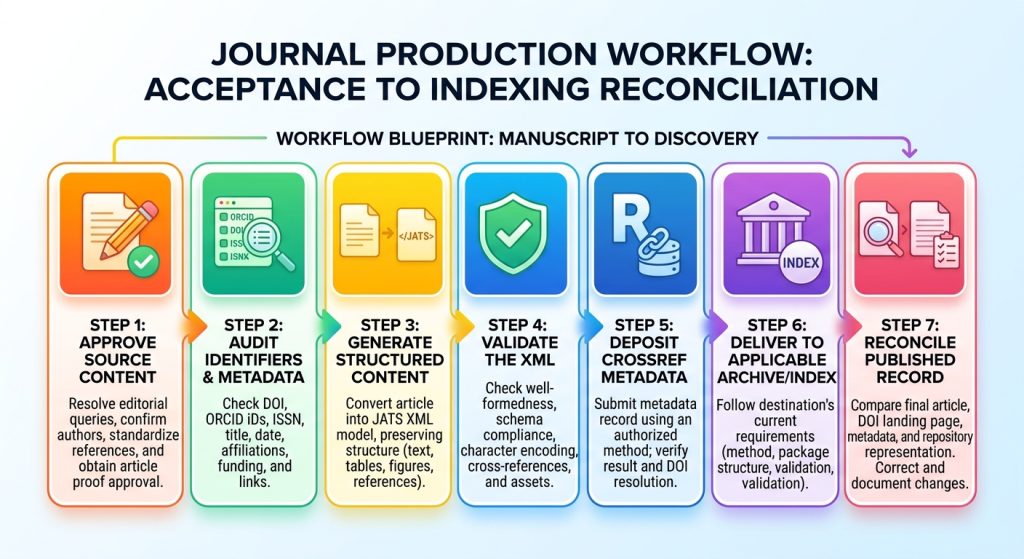
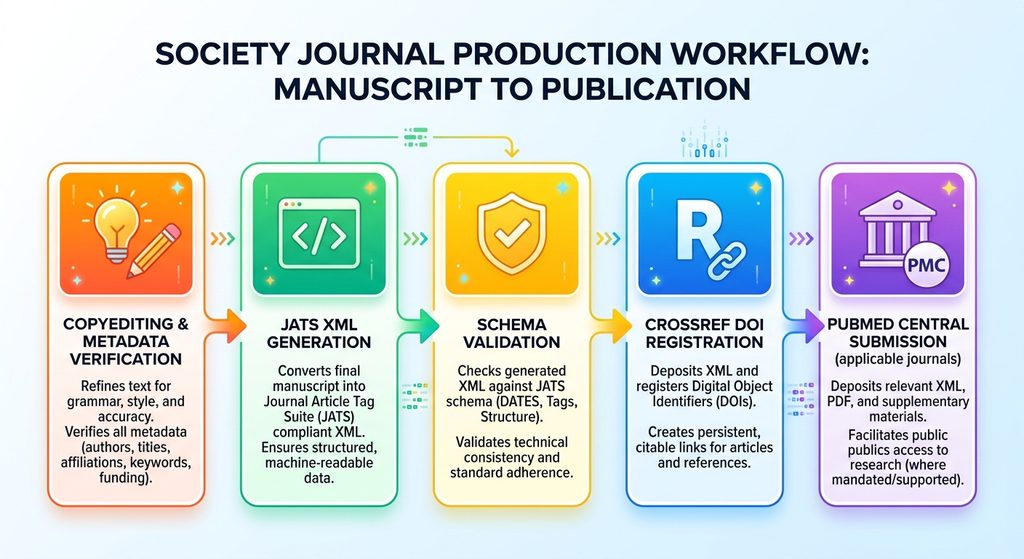
Use the following sequence as a production blueprint:
Step 1: Approve the source content. Resolve editorial queries, confirm author details, standardize references, and obtain approval of the article proof.
Step 2: Audit identifiers and metadata. Check the DOI, ORCID iDs, journal ISSN, title, publication date, affiliations, funding information, and relevant links.
Step 3: Generate structured content. Convert the approved article into the appropriate JATS XML model, preserving the semantic structure of the text, tables, figures, and references.
Step 4: Validate the XML. Check well-formedness, schema compliance, character encoding, cross-references, and associated assets.
Step 5: Deposit Crossref metadata. Submit the appropriate metadata record using an authorized method, then verify the result and DOI resolution.
Step 6: Deliver files to the applicable archive or indexing workflow. Follow the destination’s current requirements, including any prescribed submission method, package structure, and validation procedures.
Step 7: Reconcile the published record. Compare the final article, DOI landing page, deposited metadata, and repository representation. Correct discrepancies and document the changes.
A repeatable workflow makes quality assurance measurable and allows society publishers to identify where errors originate. It also provides a clear audit trail when corrections or metadata updates become necessary.
Pre-Submission and Pre-Publishing Checklist
Before releasing a society journal article, confirm the following:
- The final manuscript has been copyedited and approved.
- Author names, order, affiliations, and corresponding-author details are correct.
- ORCID iDs and other persistent identifiers have been verified where available.
- Crossref metadata includes all required fields for the relevant record type.
- The DOI and resource URL are correct and consistent across production files.
- The XML uses the appropriate JATS model and supported version.
- Special characters, formulas, superscripts, and subscripts render correctly.
- References are accurately tagged and bibliographically consistent.
- XML passes well-formedness and applicable schema validation.
- Figures, tables, supplementary materials, and internal links have been checked.
- Crossref deposits have been submitted and their results verified.
- Any PMC submission follows the journal’s applicable eligibility and technical requirements.
- Final article content and metadata agree across the published article and relevant external records.
- Corrections and post-publication metadata updates have a documented owner and process.
Conclusion
Society journal copyediting is a critical quality-control stage in scholarly publishing. Accurate language and references remain essential, but reliable dissemination also requires valid JATS XML, complete Crossref metadata, correct persistent identifiers, and destination-specific submission checks.
By separating DOI registration from full-text archiving, applying the appropriate XML schema, and combining automated validation with human review, scholarly societies can reduce preventable production errors and maintain more consistent publication records.
Build these checks into every issue’s production workflow rather than treating XML validation as a final technical formality. When editorial accuracy and metadata integrity work together, journals are better positioned to support discoverability, citation linking, and long-term scholarly communication.
Prepare your next publication with confidence. Explore ManuscriptLab’s professional editing and formatting services to strengthen manuscript quality and streamline your publishing workflow.