Open access publishing has transformed scholarly communication by making research freely available to readers worldwide. However, many researchers still hesitate before submitting their work to an open access (OA) journal. Concerns about predatory publishers, questionable peer review practices, publication fees, and institutional recognition often make it difficult to distinguish legitimate journals from unreliable ones.
So, are open access journals peer-reviewed and credible? Yes. Many open access journals follow rigorous peer review procedures, maintain qualified editorial boards, adhere to international publication ethics standards, and achieve recognition through established indexing databases. Their publication model does not inherently compromise research quality.
The real distinction is between legitimate open access publishing and predatory publishing. A journal can offer free access to research while maintaining excellent editorial standards. Conversely, a journal can advertise itself as open access while accepting manuscripts without meaningful academic evaluation.
Understanding how to tell if an open access journal is legitimate is essential for protecting your academic reputation, meeting institutional publication requirements, and ensuring your research reaches an appropriate scholarly audience.
This guide explains how open access peer review works, identifies ten practical credibility indicators, examines common warning signs, and provides a systematic framework for evaluating journals before submission.
💡 Need expert help with your paper?
Transform your manuscript with ManuscriptLab’s professional editing and formatting services!
1. Are Open Access Journals Peer-Reviewed Like Traditional Subscription Journals?
Yes. Open access and subscription-based journals can use exactly the same peer review models. The primary difference concerns how readers access published research, not how editors evaluate submitted manuscripts.
Peer review is an academic quality-control process in which independent subject specialists assess a manuscript before publication. Reviewers examine the research methodology, originality, statistical analysis, interpretation of findings, ethical compliance, and contribution to existing knowledge.
Common peer review models
- Single-blind peer review: Reviewers know the authors’ identities, but authors do not know who reviewed their work.
- Double-blind peer review: Neither authors nor reviewers know each other’s identities during evaluation.
- Open peer review: Reviewer identities, reports, or both may be disclosed, depending on the journal’s policy.
- Post-publication peer review: Researchers evaluate and discuss published work after it becomes publicly available.
A credible open access journal should clearly explain its review model, editorial decision-making process, and reviewer selection procedures.
According to the International Committee of Medical Journal Editors (ICMJE), journals should maintain transparent peer review procedures and ensure that editorial decisions are based on scholarly considerations rather than commercial interests.
Important distinction: Open access does not automatically mean that every article undergoes external peer review. Editorials, commentaries, letters, and other article categories may follow different assessment procedures. Examine the journal’s policy for the specific article type you intend to submit.
2. How to Tell If an Open Access Journal Is Legitimate: 10 Essential Checks
Evaluating open access journal credibility requires more than checking whether a journal has a professional website or charges an article processing fee. Researchers should investigate its editorial governance, indexing status, publication ethics, and review procedures.
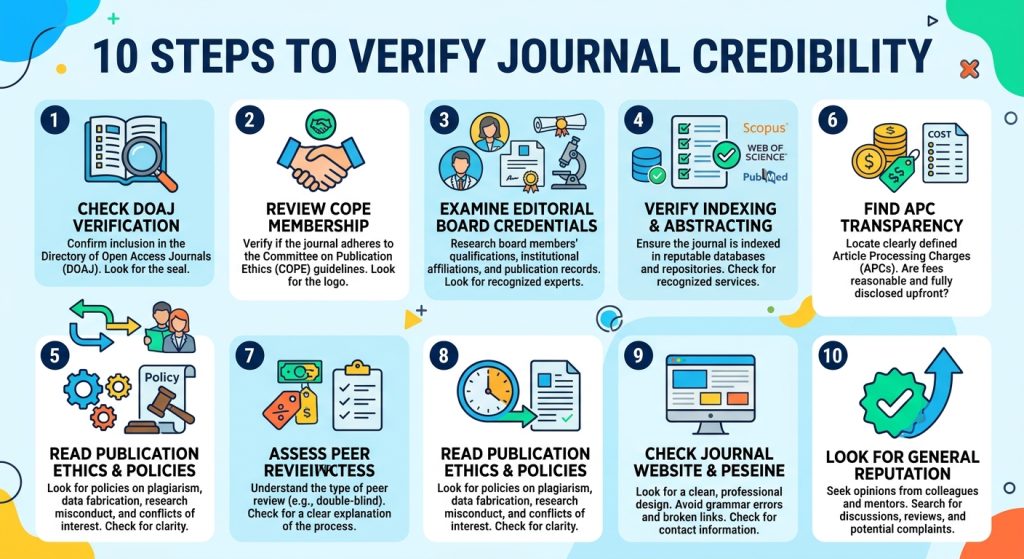
Use the following ten checks before submitting your manuscript.
1. Check the Directory of Open Access Journals (DOAJ)
The Directory of Open Access Journals (DOAJ) is one of the most useful resources for identifying established open access journals.
DOAJ evaluates journals against defined criteria involving transparency, editorial practices, open access policies, and quality control. Its inclusion requirements provide an important benchmark for evaluating journal credibility.
For example, DOAJ requires journals to:
- Maintain a clearly identifiable editor and editorial board.
- Publish accessible peer review policies.
- Disclose copyright and licensing conditions.
- Explain author charges and publication fees.
- Provide clear aims, scope, and submission instructions.
- Apply appropriate quality-control procedures.
Its standard criteria also require independent review by at least two reviewers for research articles, with specific provisions for arts and humanities journals.
How to perform the check: Search for the journal’s exact title or ISSN on DOAJ. Confirm that the publisher, website, and journal identity match the information displayed on the journal’s official website.
Industry standard: DOAJ inclusion is a valuable positive credibility indicator, but it is not a guarantee that every published article is scientifically correct or that a journal will remain listed indefinitely.
Common pitfall: Assuming that a journal is legitimate simply because its website displays a DOAJ logo. Always verify the listing directly in the official directory.
2. Verify COPE Membership and Publication Ethics
The Committee on Publication Ethics (COPE) provides guidance and resources for maintaining ethical scholarly publishing practices.
COPE membership is an important indicator that a journal or publisher has demonstrated a commitment to publication ethics and responsible editorial conduct.
Visit COPE’s official website to investigate membership and ethical guidance.
Look for policies addressing:
- Plagiarism and duplicate publication.
- Data fabrication and falsification.
- Conflicts of interest.
- Authorship disputes.
- Retractions and corrections.
- Research misconduct investigations.
- Ethical handling of complaints and appeals.
How to verify: Check the official COPE membership information rather than relying on a membership badge displayed by the publisher. Confirm whether the journal or its publisher is the actual member and whether the membership is current.
Industry standard: A credible journal should maintain documented procedures for addressing publication misconduct and correcting the scholarly record.
Common pitfall: Treating COPE membership as proof that every editorial decision is ethical. Membership is a positive signal, not an independent certification of every article or a substitute for evaluating the journal.
3. Examine the Editorial Board and Its Academic Credentials
A legitimate academic journal should identify its editor-in-chief, associate editors, and editorial board members.
These individuals should have relevant subject expertise, verifiable institutional affiliations, and credible academic or professional backgrounds.
Investigate the following:
- Do editorial board members have institutional profiles?
- Are their research interests aligned with the journal’s scope?
- Have they published relevant peer-reviewed research?
- Are their affiliations current and independently verifiable?
- Do their names appear on other legitimate academic platforms?
Where possible, check university profiles, ORCID records, institutional repositories, and established publication databases.
Industry standard: DOAJ recommends an editorial board of at least five appropriately qualified editors, with institutional diversity encouraged.
Common pitfall: A journal may list prominent researchers without their knowledge or permission. If an affiliation or editorial appointment cannot be verified, contact the institution or researcher directly.
Also read: How to Write a Systematic Meta-Analysis Following PRISMA Guidelines
4. Verify Indexing in Recognized Academic Databases
Indexing helps researchers discover scholarly publications and provides useful information about journal coverage and recognition.
Check whether the journal is indexed in databases relevant to your discipline, such as:
| Database | Primary relevance |
| Web of Science | Multidisciplinary scholarly literature and citation indexing |
| Scopus | Abstracting and citation indexing across disciplines |
| PubMed/MEDLINE | Biomedical and life sciences literature |
| DOAJ | Open access journal discovery and quality screening |
| ERIC | Education research and literature |
| IEEE Xplore | Engineering, computing, and technology |
Visit the database’s official website and search for the journal by title or ISSN.
Do not rely exclusively on the indexing logos displayed on the journal website.
Industry standard: Verify the journal’s current coverage, not simply whether it was indexed historically. Some databases discontinue coverage of journals that no longer meet their standards.
Common pitfall: Confusing Google Scholar visibility with formal indexing in Scopus or Web of Science. These services have different selection and coverage processes.
5. Investigate the Peer Review Process and Publication Timeline
A credible journal should explain how manuscripts are evaluated, how reviewers are selected, and how editorial decisions are made.
Look for specific information about:
- Initial editorial screening.
- Reviewer selection and independence.
- Number of reviewers.
- Review criteria.
- Revision procedures.
- Acceptance and rejection decisions.
- Appeals and complaints.
Pay particular attention to publication turnaround promises.
A journal advertising guaranteed acceptance within 48 hours or peer-reviewed publication within three days should raise serious concerns.
However, a short review timeline is not automatically evidence of misconduct. Editorial screening, desk rejection, invited articles, and manuscripts requiring limited revisions may legitimately move faster.
Industry standard: Evaluate whether the timeline is plausible for the journal’s discipline, article type, and stated review model. Look for transparent submission, acceptance, and publication dates in previously published articles.
Common pitfall: Assuming that a fast publication process always indicates poor peer review. Focus on the transparency and credibility of the actual editorial process rather than an arbitrary number of days.
6. Examine the Journal’s Publication Ethics and Transparency Policies
Reliable journals maintain clearly accessible publication policies aligned with recognized ethical publishing standards.
Look for policies covering:
- Human participant consent and institutional ethics approval.
- Animal research ethics.
- Clinical trial registration.
- Data availability and research reproducibility.
- Conflicts of interest.
- Funding disclosures.
- Plagiarism screening.
- Corrections, expressions of concern, and retractions.
Medical and clinical researchers should also examine whether journal requirements align with relevant ICMJE recommendations and reporting standards such as CONSORT, STROBE, and PRISMA, where applicable.
A credible journal should explain what happens when ethical concerns arise after publication.
Industry standard: Policies should be publicly accessible, consistently applied, and appropriate to the journal’s subject area.
Common pitfall: Mistaking the presence of an ethics policy for evidence that the journal actually enforces it. Review published corrections, retractions, and editorial statements when available.
Also read: How to Check if a Journal Is Predatory
7. Evaluate the Publisher’s Reputation and Website Transparency
Investigate the organization responsible for publishing and managing the journal.
A legitimate publisher should provide:
- A verifiable institutional or business address.
- Clear contact information.
- Identifiable editorial management.
- Publication and copyright policies.
- Transparent ownership information.
- Accessible manuscript submission instructions.
- A stable journal archive.
Check whether the journal’s title, ISSN, publisher name, and official website are consistent across external databases.
Be particularly careful with journals using names that closely resemble established publications.
Industry standard: A publisher should follow recognized principles of transparency and best practice in scholarly publishing.
Common pitfall: Equating professional website design with academic credibility. A sophisticated website can still belong to a predatory publisher.
8. Understand Article Processing Charges (APCs)
Article Processing Charges are fees that some open access journals collect to cover publication-related costs.
These may include editorial administration, manuscript production, copyediting, typesetting, hosting, digital preservation, and long-term access.
However, charging an APC does not automatically make a journal predatory, and publishing without an APC does not automatically make a journal credible.
Before submission, establish:
- Whether an APC is required.
- The exact amount and currency.
- When payment becomes due.
- Whether submission or review fees apply.
- Whether waivers or discounts are available.
- Whether additional charges apply to figures, supplementary materials, or other services.
Industry standard: Publication charges should be disclosed before manuscript submission and should not depend on whether reviewers recommend acceptance.
Common pitfall: Paying an unexpected fee after acceptance without checking the publisher’s original author instructions. Always retain a copy of the journal’s fee policy.
9. Review Published Articles for Research Quality
Do not evaluate a journal solely through its website, indexing claims, or editorial board.
Read several recently published articles to assess the actual quality of its scholarly content.
Examine whether published research demonstrates:
- Appropriate study design and methodology.
- Reliable statistical analysis.
- Relevant and current references.
- Transparent reporting of limitations.
- Ethical research practices.
- Logical interpretation of results.
- Appropriate conclusions supported by evidence.
For clinical research, assess whether relevant reporting guidelines have been followed. For example, randomized trials should generally follow CONSORT reporting recommendations, while observational studies should consider STROBE.
Industry standard: Published articles should demonstrate methodological rigor, transparent reporting, and relevance to the journal’s stated scope.
Common pitfall: Assuming that a journal has high scientific quality because it publishes a large number of articles. Publication volume is not a reliable substitute for editorial quality.
Also read: Is Koalaty Research Legit? A 2026 Review of Pre-Submission Checking Tools
10. Apply the Think. Check. Submit. Framework
The Think. Check. Submit. initiative provides a practical checklist to help researchers identify trustworthy journals.
It encourages authors to investigate the journal’s identity, publisher, editorial board, peer review policies, indexing, and publication ethics before submitting their research.
Use this framework as a final decision-making tool.
Ask yourself:
- Do I recognize the journal or know researchers who have published in it?
- Is the publisher clearly identified?
- Is the journal’s ISSN independently verifiable?
- Is the editorial board credible?
- Does the journal clearly explain peer review?
- Are publication charges transparent?
- Can I verify its indexing and relevant memberships?
- Does it provide clear publication ethics policies?
- Is the journal appropriate for my research?
- Can I confidently explain why I selected this publication venue?
If several answers are unclear, investigate further before submitting your manuscript.
3. Open Access Publishing: Myth vs. Reality
Misconceptions about open access publishing often prevent researchers from considering legitimate journals.
Understanding the difference between publishing models and editorial standards helps researchers make informed decisions.
| Common myth | Academic reality |
| All open access journals are predatory. | Many established OA journals maintain rigorous peer review and editorial oversight. |
| Subscription journals are always more credible. | Credibility depends on editorial quality, research integrity, and transparent publishing practices. |
| APC payment guarantees acceptance. | Legitimate journals retain editorial independence regardless of publication fees. |
| Open access articles are not peer-reviewed. | OA journals can use single-blind, double-blind, and open peer review. |
| DOAJ listing guarantees perfect quality. | DOAJ screening is valuable but does not guarantee the accuracy of every published article. |
| OA journals always have lower citation impact. | Citation performance varies by discipline, journal, article, and research visibility. |
Why Do Some Academic Institutions Discourage Certain Open Access Journals in the USA?
Academic institutions in the United States generally support open access publishing but may discourage researchers from submitting to journals that do not meet established academic quality, indexing, or research integrity standards.
Many US universities require faculty members and researchers to publish in journals recognized by reputable scholarly databases or accepted under institutional research evaluation policies.
Common concerns include:
- Predatory publishing: Journals that prioritize publication fees over rigorous peer review.
- Questionable editorial practices: Inadequate reviewer selection or unclear publication standards.
- Misleading Impact Factor claims: Publishers advertising fabricated or unrecognized journal metrics.
- Unverified indexing: Journals falsely claiming inclusion in Scopus, Web of Science, or PubMed.
- Publication ethics concerns: Failure to follow recognized standards for research integrity and editorial transparency.
- Funding and promotion requirements: Institutional policies may require publications to meet specific indexing, quality, or open access conditions.
Researchers at US universities should review their institution’s open access policy, faculty promotion criteria, and research funding requirements before selecting a journal.
For federally funded research, authors should also consider applicable public access requirements from agencies such as the National Institutes of Health (NIH) and the National Science Foundation (NSF).
Remember: Open access publishing is not inherently discouraged by US academic institutions. The primary concern is whether a journal demonstrates credible peer review, transparent editorial practices, and recognized academic standards.he relevant Higher Education Commission (HEC) journal recognition and accreditation requirements.
4. Warning Signs of Predatory Open Access Journals
Predatory journals exploit the demand for academic publication by prioritizing publication revenue over responsible editorial evaluation.
They may advertise legitimate-sounding credentials while failing to provide meaningful peer review.
Watch for these warning signs:
- Guaranteed acceptance: Promises of publication regardless of research quality.
- Unrealistic turnaround: Claims of complete peer review and publication within an implausibly short period.
- Fake indexing: Displaying fabricated Impact Factors or misleading database logos.
- Unverified editorial members: Listing academics without their knowledge or consent.
- Hidden APCs: Revealing mandatory charges only after acceptance.
- Unsolicited invitations: Sending generic emails offering rapid publication in unrelated disciplines.
- Broad or incoherent scope: Accepting manuscripts across unrelated fields without appropriate subject expertise.
- Poorly maintained archives: Missing articles, broken links, or inconsistent publication records.
- Weak ethics policies: No meaningful information about misconduct, corrections, or retractions.
- Misleading journal identity: Using a name similar to a recognized academic publication.
Remember that one warning sign does not necessarily establish that a journal is predatory. Evaluate the complete publishing operation and investigate inconsistencies before making a decision.
5. Are Open Access Journals as Frequently Cited as Subscription Journals?
Citation performance is an important consideration for researchers seeking academic visibility, but open access status alone does not determine citation impact.
Open access articles are available to readers without subscription barriers. This can increase accessibility, downloads, and opportunities for scholarly engagement.
However, greater accessibility does not automatically produce more citations.
Research comparing open access and subscription journals has reported mixed findings. A randomized controlled trial published in the BMJ found increased full-text readership for open access articles but no significant citation advantage during its first-year observation period.
A separate comparative study examining journals indexed in Web of Science and Scopus found that differences in citation rates were substantially reduced after accounting for factors such as discipline, journal age, and publisher location.
More recent research has also identified citation advantages for certain open access articles, although these findings vary across disciplines and publication models.
Consequently, researchers should evaluate citation performance using several indicators:
- Journal-level Impact Factor, where applicable.
- Scopus CiteScore.
- Article-level citation counts.
- Field-weighted citation impact.
- Publication year and disciplinary context.
- Research relevance and discoverability.
The key takeaway: A credible open access journal can achieve substantial academic influence. Evaluate the quality and relevance of its published research rather than assuming that its access model determines citation performance.
6. DOAJ vs. COPE vs. Think. Check. Submit.: Which Should Researchers Use?
These resources serve complementary purposes rather than replacing one another.
| Resource | Primary purpose | What it helps verify |
| DOAJ | Open access journal directory | Journal eligibility, transparency, and quality-control criteria |
| COPE | Publication ethics organization | Ethical publishing principles and membership |
| Think. Check. Submit. | Researcher evaluation framework | Practical journal selection and credibility checks |
| ICMJE | Medical journal recommendations | Editorial responsibilities, peer review, and publication ethics |
Use DOAJ to investigate open access journal credentials, COPE to examine publication ethics commitments, and Think. Check. Submit. to organize your final evaluation.
For medical and clinical research, supplement these checks with the latest ICMJE Recommendations.
No single directory, membership, or indexing database can independently establish the complete credibility of a journal.
7. Practical Pre-Submission Checklist for Researchers
Before submitting your manuscript to an open access journal, complete the following checks:
- Confirm that the journal’s aims and scope match your research.
- Verify its ISSN and official publisher information.
- Search for the journal in DOAJ, where applicable.
- Verify any claimed COPE membership.
- Independently confirm Scopus, Web of Science, or other relevant indexing.
- Examine the qualifications and affiliations of editorial board members.
- Read the journal’s peer review and editorial decision policies.
- Check whether its review timelines are reasonable and transparent.
- Review its publication ethics and research integrity policies.
- Examine several recently published research articles.
- Confirm APCs, payment conditions, and waiver policies.
- Check copyright retention, licensing, and reuse conditions.
- Review your institution’s journal recognition requirements.
- Confirm that your manuscript meets the journal’s author guidelines.
- Retain records of journal verification and submission correspondence.
If your manuscript requires language refinement, structural improvements, or journal-specific formatting, consider professional manuscript editing and formatting support before submission.
Conclusion: Choose Open Access Journals Based on Evidence, Not Assumptions
Open access journals can be just as credible and academically rigorous as traditional subscription-based journals. Their legitimacy depends on transparent editorial practices, independent peer review, qualified editorial boards, recognized indexing, and responsible publication ethics.
The most effective way to avoid predatory publishers is to investigate a journal before submitting your research. Verify its DOAJ listing, examine COPE membership claims, review editorial credentials, and assess the quality of its published articles.
Do not allow misconceptions about open access publishing to limit your publication opportunities. Choose a journal based on evidence, academic suitability, and transparent publishing standards.
Preparing your next journal submission? Visit ManuscriptLab for professional manuscript editing, academic formatting, and publication preparation support. Give your research the clarity and presentation it deserves.