Writing a systematic review and meta-analysis is not simply a matter of collecting papers, calculating a pooled effect, and adding a PRISMA flowchart. The credibility of the final manuscript depends on whether readers can determine what question you asked, how you searched, why studies were included or excluded, how risk of bias was assessed, how data were synthesized, and how uncertainty was handled.
PRISMA 2020 the Preferred Reporting Items for Systematic Reviews and Meta-Analyses guideline provides a structured framework for reporting this process transparently. The updated guideline contains a 27-item checklist, an expanded explanation-and-elaboration document, an abstract checklist, and revised flow-diagram templates. PRISMA 2020 replaced the 2009 PRISMA statement and remains the key reporting framework for systematic reviews in 2026.
A crucial distinction comes first: PRISMA is a reporting guideline, not a protocol for conducting a systematic review and not a statistical method for performing a meta-analysis. Your review must use appropriate methodological standards in addition to reporting the study according to PRISMA.
This guide explains how to plan, conduct, analyze, and report a systematic meta-analysis from developing the research question and documenting database searches to assessing risk of bias, evaluating heterogeneity, presenting the PRISMA flow diagram, and preparing the final manuscript for journal submission.
💡 Need expert help with your paper?
Transform your manuscript with ManuscriptLab’s professional editing & formatting services!
1. Understand What PRISMA 2020 Actually Requires
PRISMA stands for Preferred Reporting Items for Systematic Reviews and Meta-Analyses. Its purpose is to improve the transparency and completeness of systematic-review reporting.
The PRISMA 2020 checklist organizes reporting requirements across the major components of a review, including:
- Title
- Abstract
- Introduction
- Methods
- Results
- Discussion
- Registration and protocol
- Funding and competing interests
- Availability of data, code, and other materials
The checklist contains 27 items and associated sub-items. The PRISMA 2020 abstract extension contains 12 items specifically designed for reporting systematic reviews in abstracts.
PRISMA is not the same as a systematic-review methodology
A standard literature review may summarize existing studies using a narrative approach. A systematic review uses predefined eligibility criteria, a reproducible search strategy, systematic study selection, structured data extraction, and explicit appraisal of methodological limitations.
A meta-analysis goes one step further by using statistical methods to quantitatively combine results from multiple studies.
Therefore:
Literature review → Systematic review → Systematic review + meta-analysis
These categories are related but not interchangeable.
| Feature | Standard Literature Review | PRISMA-Compliant Systematic Review | Systematic Review + Meta-Analysis |
| Research question | Often broad | Explicit and structured | Explicit and structured |
| Search strategy | May be informal | Prespecified and reproducible | Prespecified and reproducible |
| Eligibility criteria | Variable | Defined in advance | Defined in advance |
| Study screening | Often narrative | Systematic | Systematic |
| Risk-of-bias assessment | Not always performed | Required when appropriate | Required |
| Quantitative synthesis | Usually absent | May be absent | Statistical pooling performed when appropriate |
| PRISMA flow diagram | Not normally required | Expected | Expected |
| Heterogeneity assessment | No | Not necessarily applicable | Essential when pooling studies |
| Statistical model | None | Depends on synthesis | Must be specified and justified |
| Data/code transparency | Variable | Increasingly expected | Particularly important |
Common pitfall: Calling a narrative review a “systematic review” simply because several databases were searched. A systematic review requires a transparent and reproducible methodology, not merely a broad literature search.
Also read: 10 Key Reasons Manuscripts Get Rejected Before Peer Review
2. Define a Focused Research Question Before Searching
A defensible meta-analysis begins with a narrowly defined research question.
For intervention questions, the PICO framework is widely used:
- P — Population or participants
- I — Intervention
- C — Comparator
- O — Outcome
For exposure or observational questions, you may use PECO:
- P — Population
- E — Exposure
- C — Comparator
- O — Outcome
Your research question should determine the eligibility criteria, search strategy, data extraction form, primary outcome, effect measure, and planned statistical analysis.
Why this matters
If you define the question after seeing the available studies, you increase the risk of outcome switching, selective inclusion, and post hoc analytical decisions.
A strong protocol should specify:
- Primary and secondary outcomes
- Eligible study designs
- Population characteristics
- Intervention/exposure definitions
- Comparator definitions
- Follow-up periods
- Effect measures
- Planned subgroup analyses
- Risk-of-bias tool
- Meta-analysis model
- Sensitivity analyses
Where appropriate, register the review protocol before completing the review. PRISMA 2020 asks authors to report registration information and provide access to the protocol or explicitly state that no protocol was prepared.
For health-related systematic reviews, prospective registration may be available through platforms such as PROSPERO, subject to the registry’s eligibility criteria.
Common pitfall: Adding a subgroup analysis because an interesting pattern appeared after the main analysis. Exploratory analyses should be clearly distinguished from prespecified analyses.
Also read: ICMJE Guidelines 2026: How to Format a Medical Manuscript
3. Build a Reproducible Literature Search Strategy
The literature search is the foundation of the systematic review. If the search is incomplete or irreproducible, the statistical sophistication of the meta-analysis cannot compensate for missing evidence.
Search multiple appropriate information sources rather than relying on a single database.
Depending on the discipline, these may include:
- PubMed/MEDLINE
- Embase
- Web of Science
- Scopus
- Cochrane CENTRAL
- PsycINFO
- CINAHL
- Clinical trial registries
- Dissertation and thesis databases
- Conference proceedings
- Government or institutional repositories
Document the search in sufficient detail
For every database, record:
- Database name
- Platform/interface
- Date searched
- Complete search string
- Controlled vocabulary
- Keywords
- Boolean operators
- Filters and limits
- Language restrictions
- Date restrictions
- Number of records retrieved
PRISMA-S, an extension developed specifically for reporting literature searches, contains 16 reporting items intended to improve the reproducibility of systematic-review searches.
For example, do not report:
“PubMed was searched for studies about hypertension and exercise.”
Instead, preserve the complete executable search strategy, including field tags, Boolean operators, subject headings, truncation, filters, and search date.
How to document grey literature
Grey literature may include:
- Conference abstracts
- Theses and dissertations
- Government reports
- Clinical study reports
- Trial registries
- Institutional reports
- Preprints
- Unpublished studies
Document how each source was searched and how potentially eligible records were handled.
Common pitfall: Reporting only the final keywords while omitting the actual database syntax. Search strategies are not interchangeable across platforms because controlled vocabularies and field codes differ.
4. Establish Transparent Screening and Study-Selection Procedures
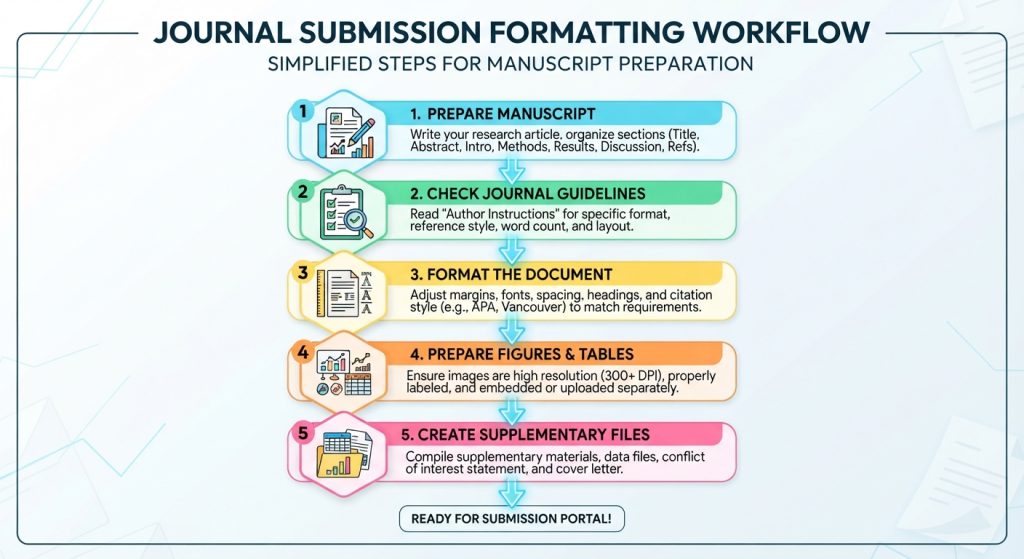
After importing search results into reference-management or systematic-review software, remove duplicate records before screening.
A robust workflow normally separates:
Identification → Deduplication → Title/abstract screening → Full-text assessment → Inclusion
Ideally, at least two reviewers independently screen records at the appropriate stages, with a predefined process for resolving disagreements.
At the full-text stage, record specific exclusion reasons. “Not relevant” is usually too vague.
Better reasons include:
- Wrong population
- Wrong intervention
- Wrong comparator
- Wrong outcome
- Ineligible study design
- Duplicate publication
- Insufficient data
- Protocol rather than completed study
These decisions eventually populate the PRISMA flow diagram.
Why the distinction between records, reports, and studies matters
A single study may produce multiple publications or reports. PRISMA 2020 distinguishes between records and reports and the underlying studies they represent.
This prevents a common analytical error: treating several publications from one study as independent studies and inadvertently counting the same participants more than once.
Also read: How to Cite a Master’s Thesis and PhD Dissertation in MLA 9 Style
5. Conduct Risk-of-Bias Assessment
Risk-of-bias assessment is different from simply assigning a study a vague “quality score.”
Assess the specific sources of bias relevant to the study design and outcome.
For randomized controlled trials, the Cochrane RoB 2 framework evaluates domains such as:
- Bias arising from the randomization process
- Bias due to deviations from intended interventions
- Bias due to missing outcome data
- Bias in outcome measurement
- Bias in selection of the reported result
For non-randomized studies of interventions, ROBINS-I is a major methodological framework. Cochrane also maintains other tools for specific study designs, such as diagnostic accuracy and prediction-model studies.
Why risk of bias matters to the synthesis
Risk of bias should not become a decorative table placed in the Methods section.
Use the assessment to inform interpretation and, where prespecified and methodologically justified, sensitivity or subgroup analyses.
For example, you might conduct a sensitivity analysis excluding studies judged to have high risk of bias and compare the resulting pooled estimate with the primary analysis.
Common pitfall: Using a generic checklist designed for one study type on a completely different study design.
Also read: Professional Manuscript Editing and Formatting Services
6. Extract Data Using a Prespecified Structure
Create a standardized data-extraction form before extracting the final dataset.
At minimum, capture:
Study characteristics
- First author
- Publication year
- Country
- Study design
- Recruitment setting
- Sample size
- Follow-up period
Participant characteristics
- Age
- Sex/gender variables as relevant
- Disease status
- Inclusion/exclusion criteria
- Baseline characteristics
Intervention or exposure
- Dose
- Duration
- Frequency
- Delivery method
- Comparator
Outcome information
- Outcome definition
- Measurement instrument
- Time point
- Number analyzed
- Effect estimate
- Standard error or confidence interval
- Events and denominators where applicable
Meta-analytic variables
Record the exact information required to reconstruct the selected effect measure.
For example, an odds-ratio meta-analysis may require event counts for treatment and control groups, while a continuous-outcome synthesis may require means, standard deviations, and sample sizes.
Common pitfall: Extracting only the published headline result without recording the denominator, time point, analysis population, or adjustment variables that determine its interpretation.
7. Select the Appropriate Effect Measure
Your effect measure must match the outcome and study design.
Common measures include:
- Risk Ratio (RR): ratio of risks between groups
- Odds Ratio (OR): ratio of odds between groups
- Risk Difference (RD): absolute difference in risk
- Mean Difference (MD): difference between means measured on the same scale
- Standardized Mean Difference (SMD): standardized difference when studies measure the same construct using different scales
- Hazard Ratio (HR): relative difference in instantaneous event rates over time
Do not combine incompatible measures simply because they describe the same broad outcome.
For continuous outcomes, MD is appropriate when studies use the same measurement scale. SMD is often used when conceptually similar outcomes are measured using different instruments.
Industry-standard reporting practice: Present the pooled effect estimate with a 95% confidence interval, not merely a P value. The confidence interval communicates both direction and precision.
8. Choose and Justify the Meta-Analysis Model
One of the most important decisions in quantitative synthesis is whether to use a fixed-effect or random-effects model.
A fixed-effect model assumes that all studies estimate one common underlying effect, with observed differences attributable primarily to sampling error.
A random-effects model assumes that the underlying effects may differ among studies and estimates an average effect across a distribution of true effects.
Do not choose between these models solely because a heterogeneity test is statistically significant.
Cochrane guidance emphasizes that the choice should reflect the scientific question and expected diversity among studies. A random-effects model is not a substitute for investigating why studies differ.
Common statistical approaches
| Method | Typical use | Key consideration |
| Fixed-effect inverse variance | Common-effect assumption | Does not model between-study heterogeneity |
| Random-effects inverse variance | Different underlying effects | Requires estimation of between-study variance |
| Mantel-Haenszel | Common binary and some other effect measures | Particularly established for certain intervention syntheses |
| Generic inverse variance | Study-level estimates with standard errors | Flexible for adjusted estimates and HRs |
| Meta-regression | Investigating study-level effect modifiers | Requires sufficient studies and careful interpretation |
| Subgroup analysis | Prespecified comparisons | Should use formal tests of subgroup differences |
Modern implementations may use methods such as restricted maximum likelihood (REML) to estimate between-study variance.
Common software includes Cochrane RevMan, R-based packages such as metafor and meta, and statistical environments such as Stata.
Cochrane RevMan currently supports common effect measures including OR, RR, RD, MD, and SMD, as well as fixed- and random-effects models and subgroup analyses.
Always report the software
Specify:
- Software name
- Version
- Package name where applicable
- Statistical method
- Important settings or estimation methods
This supports reproducibility and aligns with broader biomedical reporting expectations.
9. Assess Statistical Heterogeneity Correctly
Heterogeneity describes variation between study results.
Do not treat heterogeneity as a single number.
Consider:
- Clinical heterogeneity — differences in participants, interventions, comparators, outcomes, or settings.
- Methodological heterogeneity — differences in study design, measurement, follow-up, or risk of bias.
- Statistical heterogeneity — observed variation in effect estimates beyond what would be expected from sampling error alone.
I²
The I² statistic estimates the proportion of variability in observed effects attributable to between-study heterogeneity rather than sampling error.
A frequently cited rough guide is:
- 0–40%: might not be important
- 30–60%: may represent moderate heterogeneity
- 50–90%: may represent substantial heterogeneity
- 75–100%: may represent considerable heterogeneity
These ranges overlap intentionally. They should not be treated as rigid diagnostic thresholds.
Also consider τ² (tau-squared), which represents the estimated between-study variance, and, where appropriate, a prediction interval, which can help communicate the range in which the true effect of a future comparable study might plausibly lie.
Common pitfall: Reporting “I² = 72%, therefore the studies are too heterogeneous.” The clinical meaning depends on the magnitude and direction of effects, study characteristics, outcome definitions, and uncertainty around the heterogeneity estimate.
10. Present the PRISMA Flow Diagram Correctly
The PRISMA flow diagram summarizes the movement of evidence through the review.
For a new review, the diagram generally tracks:
Records identified → Records screened → Reports sought for retrieval → Reports assessed for eligibility → Studies included
It should also document exclusions at the appropriate stages and give reasons for full-text exclusions.
PRISMA 2020 provides different templates depending on whether the review used databases and registers alone or also incorporated other sources. Separate templates are available for new and updated reviews.
Formatting the PRISMA flow diagram for academic journals
Follow the target journal’s figure specifications first.
Common technical considerations include:
- Use a readable sans-serif font.
- Keep text large enough to remain legible after journal reduction.
- Maintain consistent box dimensions and alignment.
- Use vector output where possible.
- Export figures according to the journal’s accepted format.
- Avoid excessive decorative elements.
- Number and cite the figure in the manuscript.
- Ensure all record counts reconcile mathematically.
For example:
Records identified − duplicates removed = records screened
and
Reports assessed − reports excluded = reports contributing to the included-study set, with the underlying study/report relationships clearly represented.
Common pitfall: Updating the manuscript after the flow diagram was created but failing to update the numerical counts. Every number in the flow diagram must reconcile with the screening database and Results section.
11. Report the Meta-Analysis Results Transparently
A strong Results section should allow readers to reconstruct what happened without searching through multiple paragraphs.
Report:
- Number of included studies
- Number of participants
- Study characteristics
- Risk-of-bias findings
- Effect measure
- Statistical model
- Pooled effect estimate
- 95% confidence interval
- Heterogeneity statistics
- Subgroup analyses
- Sensitivity analyses
- Publication or missing-evidence assessments where appropriate
Use forest plots effectively
A forest plot should identify each contributing study and display its study-specific effect estimate and confidence interval.
The pooled estimate should be visually distinct.
The figure or caption should make clear:
- Effect measure
- Model used
- Confidence interval
- Weighting approach where relevant
- Direction of benefit/harm
- Subgroup structure, if applicable
Do not include a forest plot merely because the journal expects one. If quantitative pooling is methodologically inappropriate, a misleading forest plot is worse than no forest plot.
12. Address Publication Bias and Missing Evidence
A meta-analysis can be distorted when studies or results are systematically missing from the evidence base.
Consider:
- Publication bias
- Selective outcome reporting
- Selective analysis reporting
- Small-study effects
- Unavailable unpublished results
Funnel plots and statistical tests for asymmetry can be useful in appropriate circumstances, but they should not be treated as definitive proof of publication bias.
As with every secondary analysis, interpretation should consider the number of studies and alternative explanations for asymmetry.
For example, funnel-plot asymmetry can result from genuine heterogeneity, methodological differences, or small-study effects rather than publication bias alone.
Also read: How to Write a Journal Submission Cover Letter That Gets Accepted
13. Structure the Manuscript Around PRISMA 2020
A practical manuscript architecture is:
Title
Identify the report as a systematic review and meta-analysis when applicable.
Abstract
Use the PRISMA 2020 abstract checklist. Include the objective, eligibility criteria, information sources, risk-of-bias methods, synthesis methods, main results, limitations, and implications as appropriate.
Introduction
Explain:
- What is already known?
- What evidence gap remains?
- Why is this systematic review necessary?
- What is the precise objective?
Methods
This is the reproducibility core of the paper.
Include:
- Protocol and registration
- Eligibility criteria
- Information sources
- Search strategy
- Study-selection process
- Data collection
- Data items
- Risk-of-bias assessment
- Effect measures
- Synthesis methods
- Heterogeneity assessment
- Sensitivity analyses
- Reporting-bias assessment
Results
Present:
- Search results
- Study-selection process
- Study characteristics
- Risk of bias
- Individual study results
- Meta-analysis
- Heterogeneity
- Additional analyses
Discussion
Interpret rather than simply repeat the results.
Address:
- Principal findings
- Comparison with previous evidence
- Clinical or scientific implications
- Strengths
- Limitations
- Implications for future research
Other information
Report:
- Registration
- Protocol access
- Amendments
- Funding
- Competing interests
- Data and code availability
PRISMA 2020 specifically includes reporting of publicly available extracted data, analytic code, and other review materials where applicable.
14. Audit the Manuscript Before Journal Submission
PRISMA compliance should be audited before submission not after an editor requests corrections.
Use the official PRISMA 2020 checklist as a line-by-line quality-control document.
Then perform a second audit against the target journal’s instructions.
Check:
- Word count
- Abstract structure
- Reference style
- Figure resolution
- Table formatting
- Supplementary files
- Reporting guideline checklist
- Data/code statements
- Protocol registration
- Funding disclosure
- Conflict-of-interest statement
- Author contributions
- Ethical requirements where applicable
The ICMJE Recommendations also emphasize describing statistical methods with enough detail to judge their appropriateness, specifying statistical software and versions, and distinguishing prespecified from exploratory analyses.
Common pitfall: Assuming that PRISMA compliance overrides journal-specific formatting requirements. It does not. PRISMA establishes reporting expectations; the journal determines submission and presentation requirements.
PRISMA 2020 Submission Checklist
Before submitting your systematic review and meta-analysis, confirm that you have:
- Defined a focused research question using PICO, PECO, or an appropriate framework.
- Established explicit inclusion and exclusion criteria.
- Prepared or registered a protocol where appropriate.
- Searched all relevant databases and information sources.
- Preserved complete database-specific search strings.
- Documented search dates, platforms, limits, and grey literature sources.
- Removed duplicates systematically.
- Documented title/abstract and full-text screening.
- Recorded specific reasons for full-text exclusions.
- Identified multiple reports from the same underlying study.
- Used an appropriate risk-of-bias assessment tool.
- Created a standardized data-extraction form.
- Prespecified primary and secondary outcomes.
- Selected and justified appropriate effect measures.
- Selected and justified the statistical model.
- Reported the software and version used.
- Assessed and interpreted statistical heterogeneity.
- Conducted prespecified sensitivity or subgroup analyses where appropriate.
- Evaluated missing evidence or reporting bias where applicable.
- Prepared an accurate PRISMA 2020 flow diagram.
- Presented pooled estimates with appropriate confidence intervals.
- Included forest plots where quantitative synthesis is appropriate.
- Reported limitations of both the evidence and review process.
- Completed the PRISMA 2020 checklist.
- Checked the manuscript against the target journal’s author guidelines.
- Verified references, DOIs, and retraction status where relevant.
- Reported funding and competing interests.
- Provided data, code, and other material availability statements where applicable.
Conclusion
A high-quality systematic meta-analysis is built on methodological discipline long before the first pooled estimate appears in a forest plot. PRISMA 2020 gives authors a structured reporting framework, but rigorous evidence synthesis also requires a reproducible literature search, predefined eligibility criteria, transparent screening, appropriate risk-of-bias assessment, defensible statistical synthesis, and careful interpretation of heterogeneity.
The strongest manuscripts make every major decision traceable from the initial search string to the final pooled effect. Treat the PRISMA checklist as a reporting audit, not a box-ticking exercise, and align the review with the methodological expectations of your target journal.
If you need specialist support with methodological presentation, academic language, tables, figures, references, or journal-ready formatting,ManuscriptLab can help prepare your systematic review for submission.