
A comprehensive literature review does not automatically produce a compelling research argument. Many researchers invest considerable time identifying relevant studies, documenting findings, and organizing references, yet struggle to transform this material into a coherent scholarly narrative. The result is often a descriptive literature review that reports what previous researchers discovered without explaining how those findings collectively establish a research problem, justify a new investigation, or support an original contribution.
Building a scholarly argument requires more than summarizing published evidence. It involves identifying relationships between studies, evaluating methodological strengths and limitations, locating unresolved questions, developing a defensible research thesis, and communicating claims with appropriate academic precision.
This distinction matters throughout the academic publishing process. Editors and peer reviewers expect manuscripts to demonstrate intellectual contribution, logical progression, methodological awareness, and evidence-based reasoning. A manuscript that lacks a clear argument may struggle to establish its novelty, even when the underlying research is methodologically sound.
This guide explains seven essential stages of transforming literature review findings into a persuasive scholarly argument, from identifying research gaps and constructing synthesis matrices to developing claim-driven paragraphs, calibrating epistemic stance, and polishing academic prose for publication readiness.
💡 Need expert help with your paper?
Transform your manuscript with ManuscriptLab’s professional editing and formatting services. Strengthen your academic argument, improve clarity, and prepare your research for journal submission.
1. Understand the Difference Between Literature Description and Scholarly Synthesis
The first step toward building a scholarly argument is recognizing that literature description and literature synthesis serve different intellectual purposes.
A descriptive literature review presents information about individual studies. It may explain their research objectives, methodologies, samples, and findings, often in chronological or thematic order. Although this approach establishes familiarity with existing scholarship, it does not necessarily demonstrate how the evidence relates to the researcher’s central question.
A synthesized scholarly argument goes further. It compares findings, evaluates methodological differences, identifies theoretical relationships, and interprets inconsistencies across the literature.
Descriptive versus synthesized literature reviews
Consider the following examples:
Descriptive approach:
“Smith (2021) investigated digital learning environments and reported improvements in student engagement. Jones (2022) examined online assessment and identified challenges associated with feedback delivery. Brown (2023) explored student motivation in technology-supported classrooms.”
This paragraph summarizes three studies but does not establish a relationship between their findings.
Synthesized approach:
“Existing research consistently associates digital learning environments with improved student engagement; however, evidence concerning their effectiveness in supporting sustained motivation remains less consistent. While studies emphasize the accessibility of technology-supported instruction, differences in assessment design and feedback mechanisms may explain variations in reported outcomes. Consequently, the relationship between digital learning infrastructure and long-term student motivation requires further investigation.”
The second example establishes a scholarly position by connecting evidence, identifying an unresolved issue, and indicating a research direction.
Why synthesis matters
Academic readers expect researchers to demonstrate intellectual engagement with their sources rather than reproduce existing findings. Effective synthesis helps authors:
- Establish patterns across multiple studies.
- Identify contradictory or inconclusive evidence.
- Evaluate theoretical and methodological differences.
- Demonstrate the significance of unresolved questions.
- Build a logical foundation for their research contribution.
Industry standard: A strong literature review should be organized around research questions, concepts, theoretical relationships, or emerging themes rather than functioning as a sequence of independent article summaries.
Common pitfall: Avoid beginning every paragraph with an author’s surname. Repeated constructions such as “Smith (2021) found…” and “Jones (2022) reported…” make the review author-centered rather than argument-centered.
Instead, begin with the intellectual issue and integrate citations as supporting evidence.
2. Identify Research Gaps Through Critical Literature Analysis
A research gap represents an unresolved question, limitation, inconsistency, or underexplored dimension within existing scholarship. Identifying research gaps in academic literature is essential because it establishes why another investigation is necessary.
However, not every limitation mentioned in a published article constitutes a meaningful research opportunity. A defensible research gap must have intellectual significance and a clear relationship with the proposed study.
Four types of research gaps
1. Empirical gaps
Empirical gaps emerge when insufficient evidence exists for a particular population, setting, intervention, or relationship.
Example: Existing studies investigate telemedicine adoption among urban populations, but evidence concerning implementation in rural healthcare facilities remains limited.
2. Methodological gaps
These occur when existing research relies on methods that cannot adequately address certain dimensions of a research problem.
Example: Previous studies use cross-sectional surveys to investigate clinician burnout, creating an opportunity for longitudinal research examining changes over time.
3. Theoretical gaps
Theoretical gaps arise when established frameworks fail to explain emerging phenomena or when competing theories produce different interpretations.
Example: Existing technology acceptance models may not adequately explain the influence of algorithmic transparency on professional decision-making.
4. Contextual gaps
Contextual gaps concern populations, geographical locations, institutional environments, or historical circumstances that remain insufficiently investigated.
Example: Findings from high-income healthcare systems may not transfer directly to resource-constrained clinical environments.
How to identify research gaps systematically
Follow this process:
- Define the central research problem and establish relevant search concepts.
- Search multidisciplinary databases such as PubMed, Scopus, Web of Science, and discipline-specific repositories.
- Evaluate recent systematic reviews and influential primary studies.
- Compare research objectives, populations, methodologies, and findings.
- Record limitations and inconsistencies across studies.
- Determine whether unresolved issues have meaningful theoretical or practical implications.
- Formulate a gap statement supported by multiple relevant sources.
Do not equate the absence of research in a particular location with a significant knowledge gap automatically. Explain why the missing evidence matters.
Industry standard: Use transparent search strategies and appropriate reporting guidance. For systematic reviews, consult PRISMA; for observational studies, consider STROBE; and for randomized controlled trials, consult CONSORT.
Common pitfall: Avoid unsupported claims such as “No previous research has examined this topic.” A more defensible statement is “Although several studies have examined this relationship, evidence concerning its long-term effects in resource-constrained settings remains limited.”
3. Build a Literature Synthesis Matrix to Organize Evidence
A literature synthesis matrix is a structured analytical tool that helps researchers compare studies and identify relationships across published evidence.
Rather than organizing references solely by publication date, a synthesis matrix categorizes research according to variables relevant to the research question.
What should a synthesis matrix contain?
Include the following columns:
- Author and publication year.
- Research objective.
- Theoretical framework.
- Study design and methodology.
- Sample characteristics.
- Principal findings.
- Methodological limitations.
- Relevance to the proposed research.
- Emerging themes or contradictions.
Example of a literature synthesis matrix
| Study | Methodology | Main Finding | Identified Limitation |
| Study A (2022) | Cross-sectional survey | Positive association between digital access and engagement | Limited geographical coverage |
| Study B (2023) | Qualitative interviews | Institutional support influences technology adoption | Small participant sample |
| Study C (2024) | Mixed-methods design | Training improves perceived technology confidence | Short follow-up period |
Illustrative data for demonstrating synthesis methodology.
How does a literature synthesis matrix help identify research gaps?
The matrix makes similarities and differences visible. For example, if several studies report positive associations but rely exclusively on cross-sectional designs, the researcher may identify a methodological opportunity for longitudinal investigation.
Similarly, if qualitative studies identify institutional barriers while quantitative studies emphasize individual-level variables, the researcher can investigate how organizational and individual factors interact.
The matrix therefore supports three analytical activities:
- Pattern identification: Determine which findings appear consistently across studies.
- Evidence comparison: Evaluate differences in populations, measurement instruments, and research designs.
- Gap development: Identify questions that remain unanswered despite existing scholarship.
Industry standard: Maintain a consistent evidence-extraction framework and verify every entry against the original publication. Use reference-management tools such as Zotero, EndNote, or Mendeley to maintain accurate bibliographic records.
Common pitfall: Do not confuse a large number of references with strong synthesis. A matrix is valuable because it supports interpretation, not because it accumulates citations.
Also read: Are Open Access Journals Peer-Reviewed and Credible?
4. Convert Literature Findings into a Defensible Research Thesis Statement
After identifying recurring themes and unresolved questions, translate the findings into a focused research thesis statement.
In academic writing, a thesis statement communicates the central intellectual position that guides the manuscript. In empirical research, it may take the form of a central research claim, proposition, hypothesis, or clearly articulated research purpose, depending on the discipline and study design.
A strong thesis statement should establish:
- The research problem.
- The relationship or phenomenon under investigation.
- The proposed intellectual contribution.
- The scope of the argument.
- The evidence required to support the claim.
A practical framework for developing a thesis
Use the following progression:
Existing knowledge: What does current scholarship establish?
Unresolved issue: What remains uncertain, inconsistent, or insufficiently investigated?
Research position: What question, explanation, or proposition will your study address?
Contribution: How will the investigation advance existing knowledge?
For example:
“Although digital learning interventions have been associated with improved student engagement, the influence of institutional support on sustained participation remains insufficiently understood. This study examines how organizational resources and instructional design interact to influence long-term engagement in technology-supported higher education.”
This statement establishes the research context, identifies an unresolved issue, and defines the study’s direction.
Align the thesis with research objectives
A thesis statement must remain consistent with the research questions, methodology, results, and discussion.
For quantitative studies, verify that the central claim corresponds to measurable variables and testable relationships. For qualitative studies, ensure that the research position reflects the exploratory nature of the investigation rather than imposing an unsupported causal explanation.
Common pitfall: Avoid introducing claims in the thesis statement that the research design cannot adequately investigate. A cross-sectional observational study, for instance, generally cannot establish causation independently.
5. Structure Claim-Driven Paragraphs Using the MEAL Plan
A scholarly argument becomes persuasive when individual paragraphs contribute directly to the manuscript’s central position.
The MEAL Plan is a useful framework for academic paragraph structuring. It organizes paragraphs around four components: Main idea, Evidence, Analysis, and Link.
Understanding the MEAL framework
M – Main Idea
Begin with a topic sentence that communicates the paragraph’s central claim.
E – Evidence
Introduce relevant findings, data, citations, or theoretical support.
A – Analysis
Interpret the evidence. Explain its significance, limitations, relationships, or implications.
L – Link
Connect the paragraph to the broader research argument or transition toward the next analytical point.
Example of MEAL paragraph structure
Main idea: Institutional support plays an important role in determining the effectiveness of digital learning interventions.
Evidence: Previous studies have associated faculty training, technical infrastructure, and administrative support with higher levels of technology adoption.
Analysis: These findings suggest that successful implementation depends on organizational conditions rather than technology availability alone. However, differences in institutional resources may influence the strength of this relationship.
Link: Consequently, examining institutional support alongside individual technology readiness may provide a more comprehensive explanation of digital learning engagement.
Why claim-driven paragraphs improve academic writing
A well-structured paragraph performs an analytical function. It does not simply introduce another reference; it advances the researcher’s interpretation.
Use these principles:
- Introduce one dominant claim per paragraph.
- Support the claim with appropriate evidence.
- Explain what the evidence demonstrates.
- Acknowledge contradictory findings when relevant.
- Connect the paragraph to the central thesis.
Common pitfall: Avoid citation stacking, where several references appear together without explanation. Multiple citations do not automatically strengthen an argument. Explain what the sources collectively establish and where their conclusions differ.
Also read: AI Disclosure in Academic Writing: 2026 Guide to Compliant AI Use
6. Calibrate Epistemic Stance Using Academic Hedging and Boosting
Academic arguments require precision in the way researchers communicate certainty. Epistemic stance refers to how authors position themselves in relation to the strength, reliability, and limitations of their claims.
Two important linguistic resources are hedging and boosting.
Academic hedging versus boosting verbs
Hedging expresses appropriate caution when evidence is incomplete, context-dependent, or open to alternative interpretations.
Common hedging expressions include:
- May suggest.
- Appears to indicate.
- Could be associated with.
- Potentially contributes to.
- Is consistent with.
- The findings imply.
Boosting communicates confidence when findings provide sufficient evidence for a particular conclusion.
Examples include:
- Demonstrates.
- Establishes.
- Confirms.
- Clearly indicates.
- Provides strong evidence for.
Choosing the appropriate epistemic stance
| Evidence Situation | Recommended Language | Avoid |
| Preliminary findings | May suggest | Proves |
| Observational association | Is associated with | Causes |
| Consistent evidence across studies | Provides strong evidence for | Absolutely proves |
| Statistically supported result | Demonstrates an association | Guarantees |
| Exploratory qualitative findings | Indicates or suggests | Establishes universally |
The appropriate wording depends on the research design, evidence quality, statistical uncertainty, and scope of the claim.
For example, consider the difference:
Overstated: “The intervention proves that digital training eliminates clinician burnout.”
Calibrated: “The findings suggest that structured digital training may contribute to reduced burnout symptoms among participating clinicians.”
The second statement avoids implying universal effectiveness or causation without adequate evidence.
Why epistemic calibration matters
Inappropriate certainty can undermine research credibility. Conversely, excessive hedging may weaken otherwise well-supported findings.
Use the strength of the evidence to determine the strength of the language. Consider confidence intervals, effect sizes, study limitations, risk of bias, and consistency across independent investigations.
Common pitfall: Do not use hedging as a substitute for analytical precision. Words such as “possibly” and “perhaps” cannot compensate for unclear reasoning or insufficient evidence.
7. Polish Academic Prose for Publication Readiness
The final stage involves transforming a logically sound argument into clear, precise, and professionally presented scholarly prose.
Publication-ready writing requires more than grammatical accuracy. Researchers must ensure that terminology, sentence structure, paragraph transitions, citations, and claims remain consistent throughout the manuscript.
A. Improve sentence-level clarity
Remove unnecessary complexity and prioritize direct academic expression.
For example:
Before: “It is important to note that the findings of the investigation appear to potentially suggest that institutional factors might have an influence on the observed outcomes.”
After: “The findings suggest that institutional factors may influence the observed outcomes.”
The revised sentence preserves appropriate caution while eliminating redundant language.
B. Strengthen transitions between ideas
Use transitions to communicate logical relationships rather than simply connect sentences.
Examples include:
- Contrast: Nevertheless, Conversely, In contrast.
- Addition: Furthermore, Similarly, Additionally.
- Causality: Consequently, Therefore, As a result.
- Qualification: Although, Despite, To some extent.
- Interpretation: These findings suggest, Taken together, This pattern indicates.
Avoid repeating the same transition throughout the manuscript.
C. Maintain terminology consistency
Use technical terms consistently across the abstract, introduction, methods, results, and discussion.
If a study investigates “treatment adherence,” do not alternate indiscriminately between “medication compliance,” “patient cooperation,” and “therapeutic participation” unless these terms represent distinct constructs.
D. Audit citations and references
Check that every in-text citation corresponds to a complete reference-list entry. Verify author names, publication years, article titles, journal names, page ranges, and DOI information.
Apply the target journal’s required citation style, such as APA, Vancouver, Chicago, or AMA.
E. Check journal-specific formatting requirements
Before submission, verify:
- Manuscript word limits.
- Abstract structure and length.
- Heading hierarchy.
- Figure and table specifications.
- Reference formatting.
- Supplementary material requirements.
- Ethical approval and informed consent statements.
- Data availability and funding declarations.
- Conflict-of-interest disclosures.
For biomedical publications, consult ICMJE Recommendations to review established standards for manuscript preparation, authorship, disclosure, and publication ethics.
For publication ethics and editorial responsibilities, consult the Committee on Publication Ethics (COPE).
Common pitfall: Do not assume that a grammatically polished manuscript is submission-ready. Editorial quality, methodological transparency, reporting compliance, and journal-specific formatting must be evaluated separately.
For comprehensive support, explore ManuscriptLab’s professional academic editing services.
The Complete Workflow: From Literature Review to Scholarly Argument
A coherent scholarly argument develops through an interconnected sequence of analytical and editorial activities.
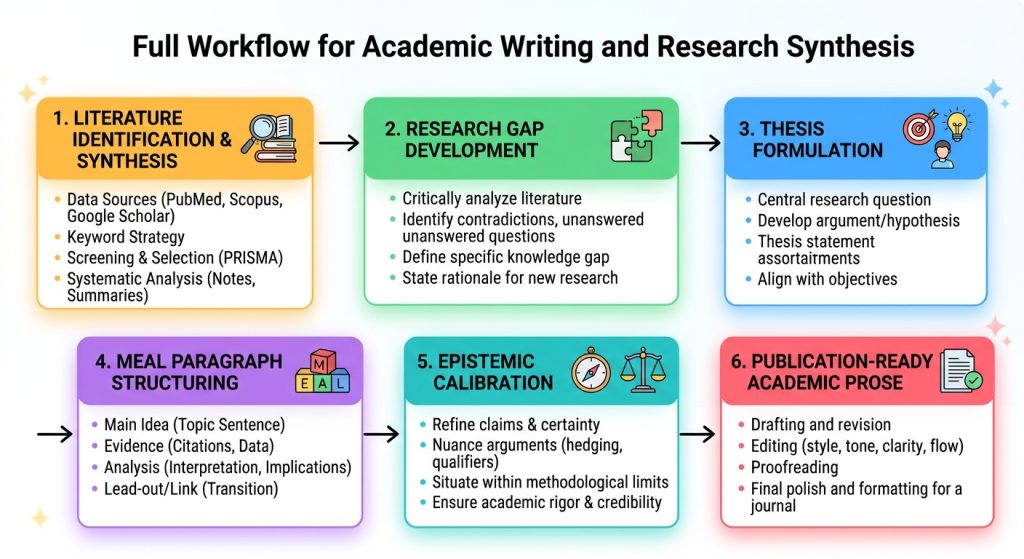
Each stage informs the next. Skipping evidence evaluation or gap validation can weaken the entire argument, regardless of how effectively the final manuscript is edited.
Also read: 10 Key Reasons Manuscripts Get Rejected Before Peer Review
Pre-Submission Checklist: Is Your Scholarly Argument Ready?
Use this checklist before submitting your manuscript to a target journal.
Literature review and synthesis
- Have you evaluated relevant and current scholarly sources?
- Does your literature review synthesize findings rather than summarize individual studies?
- Have you identified agreements, contradictions, and methodological limitations?
- Have you used a literature synthesis matrix to organize evidence?
Research gap and thesis
- Is the research gap supported by published evidence?
- Have you explained the theoretical, empirical, methodological, or practical significance of the gap?
- Does your thesis statement clearly communicate the research direction?
- Are your research questions aligned with your central argument?
Paragraph architecture and academic language
- Does each paragraph advance a specific claim?
- Have you applied the MEAL framework where appropriate?
- Does every major claim have adequate supporting evidence?
- Is your epistemic stance appropriate to the strength of the evidence?
- Have you removed unnecessary repetition and descriptive filler?
Publication readiness
- Are citations and references accurate and consistent?
- Does the manuscript comply with the target journal’s formatting instructions?
- Have you checked relevant reporting guidelines, including CONSORT, STROBE, or PRISMA where applicable?
- Are ethical declarations and disclosure statements complete?
- Has the manuscript undergone professional language and technical editing?
Conclusion: Transform Evidence into a Persuasive Scholarly Contribution
Building a scholarly argument requires researchers to move beyond collecting references and reporting published findings. A persuasive manuscript emerges when authors critically synthesize evidence, identify meaningful research gaps, formulate defensible claims, and organize their reasoning into coherent academic prose.
The literature synthesis matrix, thesis statement, MEAL paragraph framework, and calibrated epistemic stance provide practical tools for achieving this transformation. Together, these approaches strengthen the intellectual structure of a manuscript and help readers understand not only what previous research has established, but also why the present investigation matters.
Remember that publication-ready scholarship depends on both research quality and communication quality. Develop your argument systematically, support every claim with appropriate evidence, and refine your prose before submission.
Ready to strengthen your research manuscript? Visit ManuscriptLab for professional academic editing, manuscript refinement, and formatting support. Give your research the clarity, precision, and presentation it deserves.