Publishing your first research paper creates a difficult metrics problem: you are expected to demonstrate scholarly impact before you have accumulated the publication history that conventional citation indicators were designed to measure.
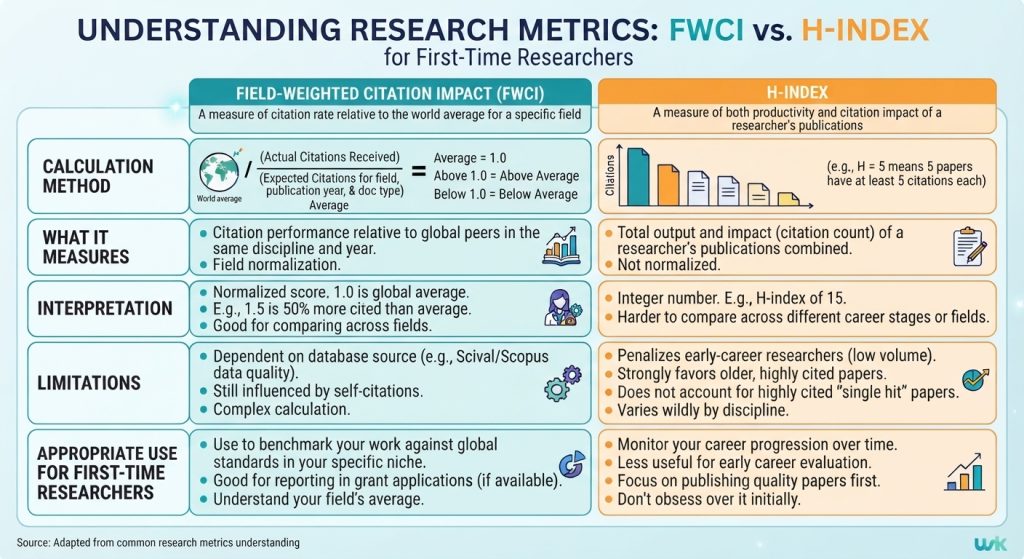
The Field-Weighted Citation Impact (FWCI) and the traditional h-index address different questions. FWCI asks how a publication or group of publications performs relative to comparable research, accounting for factors such as subject field, publication year, and document type. The h-index measures a researcher’s cumulative publication-and-citation record by identifying the largest number h for which h publications have received at least h citations each.
For a first-time author, that distinction matters. A researcher with one recently published paper may have no meaningful h-index yet, while the same paper can eventually contribute to a field-normalized citation impact measure. Conversely, FWCI should not be treated as a definitive measure of an individual’s research quality, particularly when the underlying publication set is very small. Elsevier specifically cautions that a few highly cited publications can substantially skew FWCI for entities with small publication counts.
This guide explains FWCI vs H-index for first-time authors, how each metric is calculated, when each becomes informative, how to interpret normalized citation impact, and what to look for when choosing publication support for a first manuscript.
💡 Need expert help with your paper?
Transform your manuscript with ManuscriptLab’s professional editing & formatting services.
1. What Is Field-Weighted Citation Impact (FWCI)?
Field-Weighted Citation Impact (FWCI) is a normalized citation indicator that compares the citations actually received by a publication or set of publications with the number of citations expected for similar publications.
In Scopus, the comparison considers subject field, publication year, and document type. An FWCI of 1.00 represents performance at the expected global average for comparable outputs. An FWCI above 1.00 indicates more citations than expected, while an FWCI below 1.00 indicates fewer citations than expected. For example, an FWCI of 1.48 means the output has received 48% more citations than expected for comparable publications.
A simplified representation is:
FWCI = Actual citations received ÷ Expected citations for comparable publications
The important word is expected. FWCI is not simply a citation count.
Why normalization matters
Citation practices vary substantially between disciplines. A paper in a field with a large, active research community may accumulate citations much faster than a paper in a smaller specialty. Publication type and publication year also affect the citation environment.
Raw citation counts therefore cannot always provide an appropriate cross-field comparison. FWCI attempts to control for these differences by comparing research with similar outputs.
Industry-standard interpretation
| FWCI value | General interpretation |
| 1.00 | At the expected global average |
| >1.00 | More cited than expected |
| <1.00 | Less cited than expected |
| 1.48 | 48% more citations than expected |
| 2.00 | Twice the expected citation impact |
These interpretations follow Elsevier’s current Scopus definition of FWCI.
Common pitfall
Do not interpret FWCI as a direct score of research quality.
Citation impact is influenced by visibility, research topic, publication timing, collaboration patterns, field-specific citation behavior, and many other factors. The Declaration on Research Assessment (DORA) recommends that quantitative indicators be used clearly, transparently, specifically, contextually, and fairly rather than as substitutes for qualitative assessment.
2. Traditional H-Index: Meaning and Formula
The h-index is an author-level citation metric introduced by physicist Jorge E. Hirsch in 2005.
A researcher has an h-index of h when h publications have each received at least h citations, while the remaining publications have no more than h citations under the conventional definition.
For example, imagine a researcher has five publications with citation counts of:
12, 9, 7, 4, 2
The h-index is 4 because four papers have at least four citations each. The fifth paper has only two citations.
The metric combines publication productivity and citation accumulation into a single number. That simplicity explains why the h-index has become widely used in scholarly evaluation.
Why the h-index is difficult for first-time authors
The h-index is cumulative. It depends partly on having enough publications and enough time for those publications to receive citations.
A researcher with:
- 1 publication and 20 citations
- 5 publications with 4 citations each
can have very different citation profiles despite having meaningful scholarly activity.
For a first-time author, the h-index therefore has limited discriminatory power at the beginning of a research career. A newly published paper may simply not have had enough time to accumulate the citation record required to raise the index.
Common pitfall
Do not chase an arbitrary h-index target by maximizing publication volume or manipulating citation behavior.
DORA notes that no single indicator captures the complexity of research quality. COPE also identifies inappropriate citation practices, including citations added primarily for self-promotional purposes, as a publication-ethics concern.
Also read: 10 Key Reasons Manuscripts Get Rejected Before Peer Review
3. FWCI vs H-Index: What Is the Difference?
The fundamental distinction is unit of analysis and normalization.
FWCI is designed to compare citation performance against an expected benchmark for comparable research. The h-index summarizes an author’s cumulative citation record.
| Criterion | FWCI | Traditional H-Index |
| Primary purpose | Measures citation impact relative to comparable research | Summarizes cumulative publication/citation performance |
| Main unit | Publication or publication set/entity | Researcher |
| Field normalization | Yes | No |
| Publication year considered | Yes, in the comparison baseline | No direct normalization |
| Document type considered | Yes, in Scopus FWCI methodology | No |
| Strongly affected by publication age | Less directly | Yes |
| Requires multiple publications | Not necessarily | Practically important for meaningful growth |
| Useful for a first paper | Potentially informative, with caution | Usually limited |
| Measures research quality directly | No | No |
| Best interpretation | Relative citation performance | Cumulative citation profile |
Elsevier defines FWCI as a comparison between actual and expected citations for similar outputs, whereas the h-index is based on the number of publications reaching a corresponding citation threshold.
The metrics should therefore not be treated as competing versions of the same measurement.
4. Which Metric Is More Informative for a First-Time Author?
The answer depends on what you are trying to demonstrate.
If you have one recently published paper
Your h-index may be 0 or 1, depending on whether the paper has been indexed and cited. That number says very little about the eventual trajectory of the work.
FWCI can provide a normalized view of citation performance when sufficient citation data exist. However, the metric needs cautious interpretation because a small number of publications can produce unstable or skewed results. Elsevier explicitly warns that a few highly cited outputs can skew FWCI for entities with small publication sets.
If you have several publications
The h-index becomes more informative because it begins to describe a broader publication-and-citation record.
FWCI can simultaneously help contextualize whether those publications are receiving more or fewer citations than expected for comparable outputs.
Practical rule
Use FWCI to contextualize citation performance. Use the h-index to describe cumulative author-level citation history. Do not use either metric alone to establish research quality.
That distinction is particularly important when preparing an academic CV, grant application, promotion dossier, institutional profile, or researcher’s online biography.
5. How Is FWCI Calculated in Scopus?
Scopus describes FWCI as a ratio between the citations actually received and the citations expected for similar outputs. Similarity is determined using factors including subject field, publication year, and document type.
Consider a simplified example.
Suppose a first-time researcher publishes a clinical research article. Comparable publications in the relevant field, year, and document category receive an average of 5 citations.
If the article receives:
- 5 citations → FWCI ≈ 1.00
- 7.5 citations → FWCI ≈ 1.50
- 10 citations → FWCI ≈ 2.00
- 2.5 citations → FWCI ≈ 0.50
This is a conceptual illustration rather than a substitute for Scopus’s underlying database calculations.
Also read: What is a Citation Booster? Ethical Ways to Scale Research Visibility in 2026
Why you should not manually calculate your Scopus FWCI
The expected-citation baseline depends on the database’s classification and comparison set. Simply dividing your citation count by an informal “average” from Google Scholar or another database will not reproduce an official Scopus FWCI.
Elsevier also notes that FWCI data are sourced from SciVal and that the data are updated regularly, meaning the value can change as citation and indexing data change.
6. Research Metrics for Early-Career Researchers: What Should You Track?
First-time authors should build a metrics portfolio, not a single-number profile.
Track at least:
- Publication count — establishes the size of the scholarly record.
- Citation count — shows how frequently published work has been cited.
- FWCI or another field-normalized indicator — adds disciplinary and temporal context.
- H-index — becomes more useful as the publication record develops.
- Article-level visibility — monitor downloads, views, and legitimate engagement where available.
- Research outputs beyond journal articles — such as datasets, protocols, software, and other scholarly contributions when relevant.
DORA’s guidance explicitly includes citation counts, h-index, field-normalized citation indicators, and altmetrics among quantitative indicators that require contextual interpretation. Its central position is that no single metric can represent the full complexity of research quality.
For clinicians and biomedical researchers, also verify that the manuscript complies with relevant reporting standards. The ICMJE recommends appropriate reporting guidelines for different study designs, including CONSORT for randomized trials, STROBE for observational studies, PRISMA for systematic reviews and meta-analyses, and STARD for diagnostic-accuracy studies.
Also read: How to Benchmark Your Citation Rate Against Industry Competitors
7. How Can New Researchers Improve Their Field-Weighted Citation Impact?
Do not optimize for the metric directly. Optimize for research discoverability, methodological rigor, relevance, and responsible dissemination.
Choose a clearly defined research question
A focused research question improves the manuscript’s conceptual coherence and makes the contribution easier for readers to identify.
Follow the target journal’s reporting requirements
Before submission, audit the manuscript against the journal’s author instructions and the relevant reporting guideline.
The ICMJE recommends that Methods sections provide sufficient detail for others with access to the data to understand and reproduce how the study was conducted.
Improve title and abstract discoverability
The title and abstract are critical discovery points. Use precise terminology that accurately represents the study design, population, intervention or exposure, and primary outcome where appropriate.
Avoid keyword stuffing. Search visibility should never come at the expense of scientific accuracy.
Build a rigorous reference network
Cite the original and most relevant research rather than adding references simply to increase citation counts. ICMJE recommends direct references to original research whenever possible and warns against using references to promote self-interest.
Share legitimate research outputs
Where appropriate, use institutional repositories, recognized subject repositories, persistent identifiers, and other journal-compliant channels to improve the discoverability of your work.
Avoid citation manipulation
Never add irrelevant citations merely because an editor, reviewer, colleague, or publication-support provider suggests that additional citations will improve acceptance or metrics.
COPE’s guidance distinguishes legitimate citation recommendations from citation additions driven primarily by self-promotion.
Publication Support for Novice Authors: What Should You Evaluate?
For a first-time researcher, publication support should address the entire manuscript submission workflow, not merely grammar correction.
When evaluating a publication-support provider, examine whether the service covers:
- Academic language editing
- Manuscript structure and organization
- Journal formatting
- Reference-style compliance
- Tables and figure consistency
- Reporting-guideline checks
- Submission-readiness review
- Cover-letter preparation
- Response-to-reviewers support
- Journal selection guidance
- Publication-ethics compliance
This distinction matters because a technically polished manuscript can still encounter editorial problems if it violates journal formatting requirements, omits required disclosures, uses an unsuitable reporting structure, or fails to address submission-specific requirements.
The ICMJE’s current recommendations, updated in January 2026, emphasize manuscript preparation, authorship, disclosures, reporting guidelines, submission requirements, and responsible use of AI-assisted technologies.
Researchers using AI tools should also check the target journal’s policy. ICMJE states that authors remain responsible for submitted material and should disclose relevant AI-assisted use according to applicable requirements.
For researchers seeking structured assistance with these requirements, explore ManuscriptLab’s research publication support services.
FWCI vs H-Index: The Practical Decision Framework
Use this framework when reviewing your own metrics:
Step 1 — Identify the question.
Are you measuring the performance of a specific publication, or describing your cumulative author record?
Step 2 — Check the publication age.
A recently published article has had less time to accumulate citations. Avoid comparing it directly with mature publications without considering time.
Step 3 — Identify the field.
Use field-normalized indicators when cross-disciplinary citation environments make raw counts difficult to interpret.
Step 4 — Check database coverage.
Scopus, Web of Science, Google Scholar, and other platforms can produce different citation counts and h-index values because their coverage and indexing methods differ.
Step 5 — Report the metric with context.
State the database, date accessed, publication set, and relevant time period when presenting citation indicators.
Step 6 — Add qualitative evidence.
Explain the research contribution, methodological rigor, societal or clinical relevance, datasets, software, collaborations, or other outputs rather than relying on a single number.
This approach aligns with DORA’s emphasis on clear, transparent, specific, contextual, and fair use of research indicators.
Common Mistakes First-Time Authors Make With Citation Metrics
Mistake 1: Treating h-index as a quality score
An h-index is a citation-profile indicator, not a direct assessment of methodological quality.
Mistake 2: Comparing raw citations across unrelated disciplines
Citation density differs between fields. Use normalized indicators when the comparison requires field context.
Mistake 3: Assuming FWCI above 1 guarantees high-quality research
FWCI describes citation performance relative to a comparison baseline. It does not independently establish validity, originality, reproducibility, or clinical significance.
Mistake 4: Comparing databases without stating the source
A citation count is meaningful only when readers know which database produced it and when it was retrieved.
Mistake 5: Optimizing the manuscript for citations instead of readers
Citation potential should follow from useful, rigorous research. It should not drive irrelevant references, exaggerated claims, or artificial citation activity.
Mistake 6: Ignoring manuscript quality because the research idea is strong
Editorial screening still depends on clarity, reporting completeness, journal fit, formatting, ethics, and submission compliance.
Pre-Submission Citation-Metrics Checklist
Before presenting your publication record or submitting a manuscript, verify:
- I know whether I am reporting an article-level or author-level metric.
- I have identified the database used to calculate the metric.
- I have recorded the date on which the metric was retrieved.
- I understand whether the indicator is field-normalized.
- I have considered publication age.
- I am not comparing unrelated disciplines using raw citation counts.
- I am not presenting FWCI or h-index as a direct measure of research quality.
- My references are relevant and scientifically justified.
- I have avoided citation manipulation or unnecessary self-citation.
- My manuscript follows the target journal’s author instructions.
- I have checked the relevant reporting guideline.
- Authorship, contributor roles, funding, conflicts of interest, and required disclosures are complete.
- I have checked the journal’s policy on AI-assisted technologies.
- My title and abstract accurately communicate the study.
- My manuscript has undergone an independent publication-readiness review.
Frequently Asked Questions
What is the difference between FWCI and the h-index?
FWCI compares actual citations with expected citations for similar publications, accounting for factors such as subject field, publication year, and document type. The h-index measures an author’s cumulative citation record by identifying the largest number h of publications with at least h citations each.
Is FWCI better than the h-index for first-time authors?
They measure different dimensions and should not be treated as interchangeable or as a universal hierarchy. FWCI can provide field-normalized context for citation performance, while the h-index describes an author’s cumulative citation record. For a first-time author with very few publications, both metrics require cautious interpretation.
What does an FWCI of 1.0 mean?
An FWCI of 1.00 means that the publication or publication set has received the number of citations expected for comparable research in the relevant Scopus comparison framework.
Can a first-time author have an h-index of 0?
Yes. An author can have a publication but still have an h-index of 0 if none of the publications has accumulated at least one citation in the database being used.
How can new researchers improve citation impact?
Focus on rigorous research, clear reporting, accurate titles and abstracts, appropriate journal selection, discoverability, responsible dissemination, and meaningful scholarly engagement. Do not manipulate citations to improve a metric.
Conclusion
For first-time authors, FWCI vs H-index is not a choice between two competing scores. The two indicators answer different questions.
FWCI provides normalized context around citation performance, while the h-index summarizes a researcher’s cumulative publication-and-citation record. Neither should be interpreted in isolation, and neither can substitute for qualitative assessment of originality, methodological rigor, research integrity, or scholarly contribution.
Build your publication record deliberately. Track citation metrics with their database, date, field, and publication-age context. Most importantly, strengthen the manuscript itself: reporting quality, journal fit, references, formatting, ethics, and submission compliance all contribute to a credible publication workflow.
For first-time researchers who need structured help moving from manuscript completion to submission readiness, explore ManuscriptLab’s research publication support.