Choosing between Harvard referencing style and MLA citation format can seem straightforward until you begin formatting an actual research paper. Both systems use in-text citations to connect scholarly claims with full bibliographic information, but they organize that information differently and serve different disciplinary traditions.
The central distinction is simple: Harvard is fundamentally an author-date system, while MLA is primarily an author-page system. However, the practical differences extend to reference-list organization, treatment of publication dates, page references, source titles, online materials, and disciplinary expectations.
Using the wrong system or combining elements of both can create inconsistent citations, obscure your source trail, and lead to avoidable formatting corrections during manuscript review or submission.
This guide explains Harvard vs MLA, demonstrates the difference between author-date and author-page citation, and provides a practical framework for selecting and applying the appropriate style in 2026.
💡 Need expert help with your paper?
Transform your manuscript with ManuscriptLab’s professional editing & formatting services!
Harvard vs MLA: What Is the Fundamental Difference?
Harvard and MLA are both author-based citation systems, but they prioritize different information.
Harvard referencing style generally emphasizes the author and year of publication. The publication date is therefore highly visible in both the in-text citation and the reference list.
For example:
(Smith, 2024, p. 37)
The year helps readers determine the currency of the source, which is particularly useful in disciplines where research develops rapidly.
MLA citation format, by contrast, generally emphasizes the author and location within the source, most commonly the page number:
(Smith 37)
The publication year is normally handled in the Works Cited entry rather than the standard parenthetical citation.
The MLA Style Center explains that an MLA in-text citation begins with the information that keys the reader to the corresponding Works Cited entry and, where relevant, includes a location marker such as a page number.
Harvard vs MLA at a Glance
| Criterion | Harvard Referencing | MLA 9 |
| Core citation principle | Author + date | Author + page/location |
| Typical in-text citation | (Smith, 2024, p. 37) | (Smith 37) |
| Reference-list name | References / Reference List | Works Cited |
| Publication date | Prominent | Usually in Works Cited entry |
| Page number | Common where relevant | Common for print sources |
| Typical disciplinary use | Sciences, social sciences, business | Humanities, literature, language |
| Citation emphasis | Currency and authorship | Source identity and precise location |
| Main authority | Institution/journal-specific guide | MLA Handbook / MLA Style Center |
Industry-standard metric: There is no universal “Harvard style” controlled by a single organization in the same way MLA is governed by the Modern Language Association. Universities and publishers can implement different Harvard variants.
Common pitfall: Do not assume that every institution calling its system “Harvard” uses identical punctuation, capitalization, or reference-entry conventions.
1. Understand the Author-Date vs Author-Page Citation Model
The most important difference between Harvard and MLA appears inside the manuscript itself.
Harvard in-text citation
Harvard typically uses:
(Author, Year)
When a specific page is relevant:
(Author, Year, p. 25)
For multiple pages:
(Author, Year, pp. 25–28)
For example:
Recent studies indicate that interdisciplinary collaboration can improve research reproducibility (Taylor, 2024, pp. 25–28).
The citation immediately tells the reader who published the work and when.
MLA in-text citation
MLA typically uses:
(Author Page)
For example:
Interdisciplinary collaboration can improve research reproducibility (Taylor 25–28).
If the author’s name is already included in the sentence, MLA can omit it from the parentheses:
Taylor argues that interdisciplinary collaboration can improve research reproducibility (25–28).
The MLA system therefore places greater emphasis on directing readers to the precise location of the cited material.
Why this distinction matters
Do not mechanically convert:
(Taylor, 2024, p. 25)
into:
(Taylor 2024)
and call the citation “MLA.”
That simply transfers Harvard’s year into an MLA structure incorrectly.
Likewise, changing:
(Taylor 25)
to:
(Taylor, p. 25)
does not automatically produce Harvard formatting.
Audit the citation logic, not merely its punctuation.
2. Compare Harvard Reference Lists With MLA Works Cited
The second major distinction appears at the end of the paper.
Harvard normally concludes with a References or Reference List section containing the sources cited in the text.
A simplified book example might look like:
Taylor, J. (2024) Research Methods in Practice. London: Academic Press.
MLA uses a Works Cited list. Its entries are constructed around a set of core elements, including the author, title, container, publication details, and other information applicable to the source. The MLA Style Center provides format-specific examples for books, journal articles, online works, and other source types.
A simplified MLA book entry might look like:
Taylor, James. Research Methods in Practice. Academic Press, 2024.
Notice that these are not merely two punctuation variations. The systems organize bibliographic information according to different principles.
Industry-standard metric: Every in-text citation should have a corresponding entry in the appropriate reference list, and every cited source should be represented consistently.
Common pitfall: Creating a reference list from memory after completing the paper. This increases the risk of missing sources, mismatched publication dates, duplicate entries, and citations that appear in the bibliography but nowhere in the manuscript.
Also read: 10 Key Reasons Manuscripts Get Rejected Before Peer Review
3. Understand How Publication Dates Function
Publication dates are especially important when comparing Harvard referencing style with MLA.
Harvard makes the year highly visible because it forms part of the standard in-text citation:
(Garcia, 2025)
This makes Harvard particularly useful when researchers need to distinguish between different editions or emphasize the chronological development of scholarship.
MLA does not normally place the publication year in a standard parenthetical citation:
(Garcia 112)
The date remains part of the Works Cited entry and can be mentioned in prose when relevant.
The MLA Style Center notes that writers may provide additional information such as dates in prose, but the information used to key the citation to the Works Cited entry remains the primary concern.
Practical implication for researchers
When writing a literature review, Harvard allows the chronology of research to remain highly visible:
Garcia (2021) proposed the initial model, while subsequent research expanded the framework (Lee, 2024).
MLA can also communicate chronology, but the publication date is not normally the defining component of the parenthetical citation.
4. Apply MLA Works Cited Rules Correctly
The MLA Works Cited rules are especially important for researchers working with digital scholarship.
MLA’s current approach uses a template of core elements rather than requiring writers to memorize an entirely separate formula for every possible source type. These elements can include the author, title of source, title of container, contributors, version, number, publisher, publication date, location, and other applicable details.
For online sources, the exact entry depends on what you are citing and where you accessed it. The MLA Style Center’s guidance illustrates how an online work can include the author, title, website or container, publication information, and URL or other location information when applicable.
Common MLA mistakes
Avoid these errors:
- Treating every website as a single generic citation type.
- Omitting the container when it is relevant.
- Adding information that MLA does not require simply because another style does.
- Copying citation-generator output without checking the original source.
- Mixing MLA 8 conventions with MLA 9 guidance.
The MLA Style Center specifically points readers toward the ninth edition of the MLA Handbook for current guidance.
Also read: Professional Manuscript Editing Services
5. Do Not Assume “Harvard” Means One Universal Format
One of the most important technical issues in Harvard vs MLA comparisons is that Harvard is not a single universally standardized citation specification.
Different universities and publishers may provide their own Harvard variants. Differences can include:
- Whether commas appear between author and year.
- How multiple authors are presented.
- Whether “et al.” is used after a particular number of authors.
- How URLs and access dates are displayed.
- How editions are recorded.
- Whether journal volume and issue information are punctuated in particular ways.
- How organizational authors are treated.
Therefore, the correct question is not simply:
“What is Harvard style?”
It is:
“Which Harvard variant does my university, journal, publisher, or department require?”
Industry-standard metric: The journal’s Instructions for Authors or institution’s official referencing guide takes precedence over a generic online Harvard template.
Common pitfall: Combining a university’s Harvard in-text format with a different university’s reference-list rules.
Also read: APA vs MLA vs Chicago: Which Citation Style to Use and When (2026 Guide)
6. Match the Citation Style to the Discipline and Assignment
Citation styles exist because different scholarly communities prioritize different information.
MLA is strongly associated with humanities disciplines, including literature, languages, cultural studies, and related fields.
Harvard is widely encountered across social sciences, business, education, and some scientific disciplines, although exact institutional requirements vary.
For researchers preparing journal manuscripts, however, the target publication’s author guidelines override general disciplinary assumptions.
A medical researcher should not select Harvard merely because it is familiar. Many biomedical journals instead use numbered reference systems based on NLM/ICMJE conventions.
The current ICMJE Recommendations state that references should generally be numbered consecutively in the order they first appear, with Arabic numerals used to identify references in the text, tables, and legends. ICMJE also directs authors to journal-specific instructions.
This is an important reminder:
Harvard vs MLA is not the same question as “Which citation style is best?”
The appropriate style depends on the requirements governing your specific research output.
Also read: MLA 8 vs MLA 9: Key Differences & How to Cite a Master’s Thesis or Dissertation in 2026
7. Audit Citations for Accuracy Not Just Formatting
A citation can be perfectly formatted and still be academically defective.
Before submission, verify:
- The cited source actually supports the statement.
- The author name is spelled correctly.
- The publication year is accurate where required.
- Page numbers correspond to the cited passage.
- Every in-text citation has a matching bibliography entry.
- Every listed source is actually cited.
- Titles and publication details match the original source.
- URLs, DOIs, or other identifiers are accurate where required.
- Retracted or unreliable sources have been identified.
- The required citation system has been applied consistently.
The ICMJE specifically emphasizes authors’ responsibility for citation accuracy and recommends verifying references against bibliographic databases or original sources. For MEDLINE-indexed publications, it identifies PubMed as the authoritative source for information about retractions.
For researchers working across international publishing systems, this verification stage is critical. A citation manager can automate formatting, but it cannot guarantee that the underlying bibliographic metadata is correct.
Citation managers: useful but not infallible
Tools such as reference-management software can reduce repetitive formatting work. However, imported metadata may contain:
- Incorrect capitalization.
- Missing author information.
- Incorrect publication dates.
- Incomplete journal details.
- Duplicate records.
- Incorrect page ranges.
- Inconsistent DOI or URL data.
Use automation for efficiency, then perform a human quality-control audit.
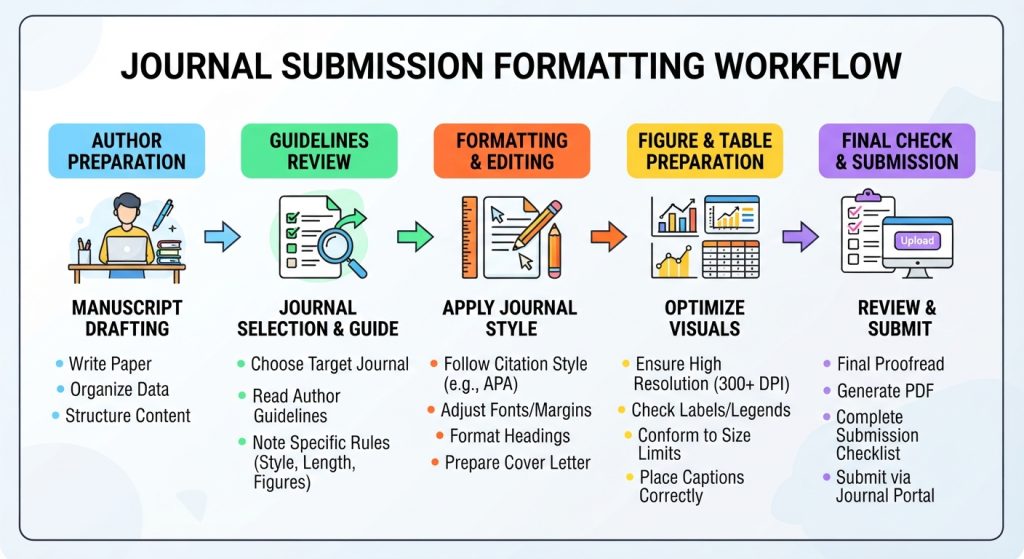
8. Build a Citation Workflow Before Final Formatting
The most efficient approach is to establish your citation system before the final manuscript-editing stage.
Step 1: Identify the governing style
Check:
- Journal author guidelines.
- University thesis regulations.
- Departmental style guides.
- Publisher instructions.
- Supervisor or editor requirements.
Step 2: Establish the correct variant
If Harvard is required, obtain the exact institutional guide rather than relying on a generic website.
If MLA is required, use current MLA 9 guidance and verify unusual source types against authoritative resources.
Step 3: Configure your reference manager
Set the citation style before inserting references. This minimizes later conversion problems.
Step 4: Cite while writing
Do not leave citations until the final day. Insert the source at the point where you make the claim.
Step 5: Perform a consistency audit
Search the manuscript for:
- Parentheses.
- Author names.
- “et al.”
- Page numbers.
- Citation clusters.
- Reference headings.
Then compare those citations against the final reference list.
Step 6: Perform a source audit
Check each bibliographic record against the original publication.
Step 7: Complete the formatting pass
Only after the citation logic is correct should you finalize spacing, indentation, headings, tables, figures, and manuscript presentation.
This workflow reduces the risk of formatting a paper correctly in the wrong citation system.
Harvard vs MLA: Which One Should You Use?
The practical answer is use the system required by the academic or publishing context.
If your assignment specifies Harvard, follow the precise Harvard guide supplied by your institution.
If your humanities paper specifies MLA, follow MLA 9 and use the Works Cited structure consistently.
If you are preparing a journal manuscript, check the journal’s submission instructions before making either assumption. Citation requirements can differ substantially even between journals in the same discipline.
For example, ICMJE’s current recommendations explicitly state that authors should use its recommendations alongside the individual journal’s instructions to authors.
A useful decision framework
| Your situation | What to check first | Citation priority |
| University essay | Assignment/style guide | Institution’s required style |
| Humanities research paper | Department/journal requirements | MLA 9 if specified |
| Social science dissertation | University thesis guide | Required Harvard variant if specified |
| Journal manuscript | Author guidelines | Journal-specific style |
| Biomedical manuscript | Journal + ICMJE/NLM guidance | Usually journal-required system |
| Multidisciplinary research | Target journal | Publisher requirements override assumptions |
The objective is not to choose the style that appears simpler. The objective is to meet the governing publication standard without introducing inconsistencies.
Harvard vs MLA: Final Pre-Submission Checklist
Before submitting a research paper, dissertation, thesis, or manuscript, complete this audit:
- Confirm the required citation style.
- Identify the exact Harvard variant if Harvard is required.
- Use MLA 9 guidance when MLA is specified.
- Check every author name against the original source.
- Verify publication years and editions.
- Verify page numbers for quotations and location-specific references.
- Match every in-text citation to a reference or Works Cited entry.
- Remove uncited entries from the final bibliography where the applicable style requires only cited works.
- Check capitalization, italics, punctuation, and ordering.
- Verify DOI, URL, and other persistent identifiers where required.
- Check online sources individually rather than applying one generic template.
- Inspect citations imported from reference-management software.
- Check the target journal’s latest author instructions.
- Conduct a final consistency and bibliographic accuracy audit.
Conclusion
Understanding Harvard vs MLA requires more than memorizing whether a comma appears inside parentheses. Harvard generally foregrounds author and publication date, while MLA foregrounds author and location, commonly the page number. Their reference-list structures also differ, with Harvard typically using a References/Reference List section and MLA using a Works Cited list.
For researchers, the most important principle is consistency. Identify the governing style, obtain the authoritative version of its requirements, apply the rules systematically, and verify every reference against the original source.
When preparing a manuscript for publication, treat citation formatting as part of the research-quality control process not as a cosmetic task performed immediately before submission.
For additional support with manuscript preparation, editing, formatting, and publication readiness, explore ManuscriptLab’s professional editing services.