Writing the Methods section of a clinical trial manuscript requires more than describing the procedures researchers followed. Authors must demonstrate how the trial was designed, how participants were selected and allocated, how interventions were administered, and how outcomes were measured and analyzed. Incomplete reporting can prevent peer reviewers from evaluating the validity of a study, even when the underlying research is rigorous.
The Consolidated Standards of Reporting Trials (CONSORT) provide an evidence-based framework for reporting randomized controlled trials (RCTs). The current CONSORT 2025 statement supersedes the 2010 version and includes a 30-item checklist, a participant flow diagram, and an expanded checklist explaining the information required for transparent reporting. The BMJ’s CONSORT 2025 statement provides the primary reference for authors preparing randomized trial reports.
Learning how to write the Methods section of a clinical paper using the CONSORT checklist helps researchers communicate methodological decisions, support reproducibility, and reduce avoidable editorial queries. This guide explains how to structure each component, document randomization and blinding, justify sample size, report statistical methods, and prepare a submission that meets biomedical journal requirements.
💡 Need expert help with your paper?
Transform your manuscript with ManuscriptLab’s professional editing and formatting services!
1. Understand the CONSORT Checklist Before Writing
CONSORT is a reporting guideline, not a substitute for a trial protocol or a methodological quality assessment tool. Its purpose is to ensure that authors report the information readers need to understand and evaluate a randomized trial.
The CONSORT 2025 checklist covers essential reporting elements across the manuscript, including trial identification, methods, results, open science, and interpretation. Not every checklist item belongs exclusively in the Methods section. Authors should therefore use the complete checklist to audit the manuscript rather than treating it as a Methods-only template.
Why CONSORT compliance matters
A trial may be competently designed and conducted but inadequately reported. For example, stating that participants were randomized does not explain how the allocation sequence was generated or whether recruiters could predict the next assignment.
Such omissions create uncertainty about selection bias and the reliability of the findings. Transparent reporting allows reviewers to distinguish methodological limitations from reporting gaps.
Before drafting, consult the official CONSORT reporting resources and the CONSORT 2025 explanation and elaboration document. Check the target journal’s instructions for authors and any design-specific extensions that apply to your trial.
2. Describe the Trial Design and Study Setting
Begin the Methods section by identifying the trial design and the setting in which the research was conducted.
Specify the design precisely
State whether the study used a parallel-group, cluster-randomized, crossover, factorial, or another randomized design. Identify the number of study groups, allocation ratio, and superiority, non-inferiority, or equivalence framework where applicable.
For example:
“The study was a multicenter, two-arm, parallel-group randomized controlled trial with a 1:1 allocation ratio, designed to evaluate the superiority of the intervention over standard care.”
This statement provides a useful overview, but it does not replace the detailed methodological descriptions that follow.
Report the setting and study period
Identify the hospitals, clinics, community settings, or research centers involved. Include relevant geographic and clinical characteristics, recruitment dates, and follow-up periods.
For multicenter studies, explain how sites were selected and whether recruitment, intervention delivery, or outcome assessment procedures differed across centers.
Common pitfall: Writing “patients were recruited from participating hospitals” without specifying the number or type of sites, the recruitment period, or the clinical context. Such descriptions make it difficult to assess the study’s applicability to other populations.
3. Define Participant Eligibility and Recruitment Procedures
Eligibility criteria determine which individuals can enter a trial and help readers assess external validity.
Establish inclusion and exclusion criteria
List the clinical, demographic, diagnostic, and other eligibility criteria used during screening. Specify diagnostic thresholds, disease severity, required laboratory findings, age limits, and relevant comorbidities where applicable.
Distinguish between criteria used to determine eligibility and reasons for excluding an otherwise eligible participant after enrollment.
For example:
“Eligible participants were adults aged 18–65 years with a confirmed diagnosis of [condition] according to [specified diagnostic criteria]. Individuals with [prespecified exclusion criteria] were excluded.”
Replace placeholders with the actual protocol-defined criteria. Do not introduce criteria retrospectively to make the study population appear more consistent.
Explain recruitment, consent, and screening
Describe how potential participants were identified, approached, screened, and enrolled. State who obtained informed consent and identify the research ethics committee or institutional review board that approved the study, including the approval reference where required.
Report the consent process in accordance with applicable ethical requirements, including additional safeguards for vulnerable populations when relevant.
The participant flow diagram should subsequently document the numbers assessed for eligibility, excluded with reasons, randomized, allocated, followed up, and included in the analyses.
Common pitfall: Reporting only the number randomized. Without screening and exclusion information, reviewers cannot evaluate recruitment efficiency, selection patterns, or possible differences between enrolled and eligible populations.
4. Explain Randomization and Allocation Concealment
Randomization and allocation concealment are related but distinct methodological procedures. Both require explicit reporting.
Describe sequence generation
Explain how the random allocation sequence was generated. Identify the method, software or random-number generator where applicable, and any restrictions used.
For example, if accurate for your study:
“An independent statistician generated the allocation sequence using computer-generated permuted blocks of varying sizes.”
If stratification was used, specify the stratification variables. For cluster-randomized trials, identify the unit of randomization and explain how clusters were allocated.
Do not describe alternation, date of birth, medical record numbers, or other predictable allocation procedures as randomization.
Report allocation concealment
Explain how the assignment sequence was protected from those recruiting or enrolling participants before allocation occurred.
Possible approaches include a secure centralized randomization system or sequentially numbered, opaque, sealed envelopes prepared and administered under controlled procedures.
If envelopes were used, report who prepared them, how they were secured, and who opened them. If centralized allocation was used, identify the system and the personnel authorized to access it.
Distinguish concealment from blinding
Allocation concealment prevents foreknowledge of upcoming assignments before randomization. Blinding concerns whether participants, clinicians, outcome assessors, or analysts know the assigned intervention after allocation.
State who was blinded, how blinding was maintained, and whether any unblinding occurred or was permitted for safety reasons.
Common pitfall: Writing “the study was double-blind” without identifying the blinded groups or explaining the procedures used to maintain masking. If blinding was not feasible, explain why and describe measures used to limit detection or performance bias.
Also read: Do You Still Need a Human Editor If You Use ChatGPT?
5. Describe Interventions and Comparators in Reproducible Detail
A Methods section must enable readers to understand what participants actually received, not merely what the investigators intended to deliver.
For each intervention and comparator, specify:
- Intervention identity: Drug name, device, procedure, behavioral program, or other treatment.
- Dose and administration: Dosage, route, frequency, duration, and timing, where applicable.
- Delivery procedures: Personnel responsible, training requirements, equipment, and relevant treatment protocols.
- Comparator details: Placebo composition, standard-care procedures, active treatment, or usual-care arrangements.
- Adherence and modifications: Methods used to monitor compliance, document deviations, and record changes or discontinuations.
For non-pharmacological interventions, include sufficient detail about treatment materials, provider expertise, setting, and implementation to support replication.
Where actual delivery differed from the protocol, report the relevant differences transparently rather than describing only the planned intervention.
For example, “participants received standard care” is insufficient if standard care varied across sites. Describe its essential components and explain any permitted variations.
Common pitfall: Providing a detailed description of the experimental treatment while leaving the comparator poorly defined. Reviewers need both to assess the intervention contrast and interpret the estimated treatment effect.
6. Justify Sample Size and Statistical Power
Sample size determination establishes whether a trial was designed to address its primary research question with adequate precision.
Report the calculation assumptions
Describe the sample size calculation, including:
- The primary outcome and planned comparison.
- The assumed effect size or clinically meaningful difference.
- The expected outcome variability or event rate.
- The significance level, commonly a two-sided alpha of 0.05 where appropriate.
- The desired statistical power, often 80% or 90%.
- The anticipated attrition rate and any inflation for clustering or other design effects.
Identify the statistical method, software, and relevant assumptions. Explain whether the calculation was based on superiority, non-inferiority, equivalence, or another prespecified objective.
For example:
“The planned sample size was calculated to detect a prespecified difference of [value] in the primary outcome, assuming a standard deviation of [value], a two-sided significance level of 0.05, and 90% power. The target enrollment was increased by [percentage] to account for anticipated loss to follow-up.”
The values must come from the actual study design and protocol.
Avoid common power-calculation errors
Do not justify the sample size solely by stating that it was comparable to previous studies or that recruitment was feasible. Explain the statistical rationale.
Also distinguish the planned sample size from the number ultimately recruited. If enrollment fell short of the target, report the shortfall and its implications without using post hoc observed power as a substitute for transparent effect estimates and confidence intervals.
For cluster-randomized studies, account for within-cluster correlation. For non-inferiority trials, explain the clinical rationale for the non-inferiority margin.
7. Define Primary and Secondary Outcomes Clearly
Outcomes must be sufficiently precise to establish what the trial was designed to measure and when those measurements were made.
Specify the primary outcome
Identify the primary outcome, measurement instrument or diagnostic method, assessment time point, and method of quantification. If the outcome is a composite, define each component and explain how the composite is calculated.
For example:
“The primary outcome was the change in [validated scale] score from baseline to week 12, assessed using the prespecified scoring procedure.”
The actual outcome should match the registered trial and protocol. If the primary outcome changed, explain the change, its timing, and the rationale.
Document secondary outcomes and harms
List secondary outcomes and their assessment time points. Define clinically important adverse events and explain how harms were identified, monitored, classified, and recorded.
Where relevant, describe who assessed outcomes and whether assessors were blinded to treatment assignment.
Common pitfall: Defining outcomes vaguely, such as “clinical improvement,” without identifying the instrument, threshold, measurement time, or analytical definition. This creates ambiguity and can raise concerns about selective outcome reporting.
8. Detail Data Collection, Follow-Up, and Missing Data
Explain how data were collected, managed, and verified throughout the trial.
Identify the data sources, assessment schedules, measurement instruments, and relevant equipment. Include manufacturer information where required for specialized devices or assays. Describe any calibration, training, or quality-control procedures needed to interpret measurements reliably.
Report the planned follow-up schedule and procedures for participants who missed visits, withdrew consent, discontinued treatment, or could not be contacted.
Differentiate withdrawal from the intervention from withdrawal from outcome follow-up. Participants may discontinue treatment but still contribute outcome data, depending on consent and the study protocol.
Describe how missing data will be or were handled in the statistical analysis, including any imputation methods, assumptions, and sensitivity analyses.
The CONSORT 2025 framework gives explicit attention to missing-data reporting and intervention administration. Authors should ensure that these details are consistent across the Methods, Results, protocol, and statistical analysis plan.
Also read: How to Write a Systematic Meta-Analysis Following PRISMA Guidelines
9. Specify the Statistical Analysis Plan
The statistical methods should allow a knowledgeable reader to judge whether the analysis is appropriate and, where possible, reproduce the reported findings.
Identify the analysis population
State whether the primary analysis followed the intention-to-treat principle, a modified intention-to-treat definition, a per-protocol approach, or another prespecified population.
Define the analysis population precisely. If participants were excluded after randomization, report the criteria and rationale and explain the implications for interpretation.
Describe statistical tests and models
Identify the methods used for the primary and secondary outcomes, including any regression models, covariate adjustments, stratification factors, or clustering corrections.
Specify how effect estimates and uncertainty will be presented. Depending on the outcome, these may include mean differences, risk ratios, odds ratios, hazard ratios, and corresponding 95% confidence intervals.
Report the significance threshold and explain how multiplicity was addressed where relevant. Describe procedures for handling missing data, assessing model assumptions, and conducting sensitivity or subgroup analyses.
Distinguish prespecified analyses from exploratory analyses. Identify the statistical software and version used.
| Statistical component | What to report | Common reporting weakness |
| Primary analysis | Model, outcome, effect measure, and analysis population | Naming a test without explaining its application |
| Covariate adjustment | Prespecified covariates and rationale | Reporting unexplained adjustments |
| Missing data | Extent, handling method, and assumptions | Ignoring missing observations |
| Subgroup analysis | Prespecified subgroups and interaction approach | Treating within-group significance as evidence of interaction |
| Uncertainty | Effect estimates and confidence intervals | Reporting only P values |
| Software | Package name and version | Omitting reproducibility details |
Statistical reporting should reflect the design and data structure. For example, repeated measurements may require models that account for within-participant correlation, while cluster-randomized trials require methods that account for clustering.
Refer to the ICMJE Recommendations for manuscript preparation for broader guidance on reporting methods and statistics.
10. Report Trial Registration, Ethics, and Open Science
Clinical trial transparency extends beyond the description of procedures.
Include prospective registration
Provide the public trial registry name, registration number, and registration date. The International Committee of Medical Journal Editors (ICMJE) recommends registration at or before the first participant’s consent for enrollment as a condition of consideration by its journals.
If registration was delayed, disclose the timing and circumstances. Do not present retrospective registration as prospective registration.
Consult the ICMJE clinical trial registration policy and verify the target journal’s specific requirements.
Document ethics and data sharing
Identify the approving ethics committee or institutional review board, approval reference, and informed-consent procedures. Report any applicable regulatory approvals.
CONSORT 2025 also emphasizes open-science information, including access to the trial protocol and statistical analysis plan, data-sharing arrangements, funding, and conflicts of interest. State whether de-identified participant-level data and statistical code will be available, under what conditions, and where applicable materials can be accessed.
A statement that data are “available upon request” should accurately reflect the study’s sharing policy and applicable privacy, consent, and legal restrictions.
11. Prepare the Manuscript for Editorial Screening
Editorial screening often begins before external peer review. Editors and editorial staff may check whether required reporting guidelines, trial registration details, ethical approvals, and supporting documents have been supplied.
There is no universal CONSORT compliance score or single screening procedure used by every journal. Requirements vary by publisher, journal policy, study design, and submission system.
Before submission:
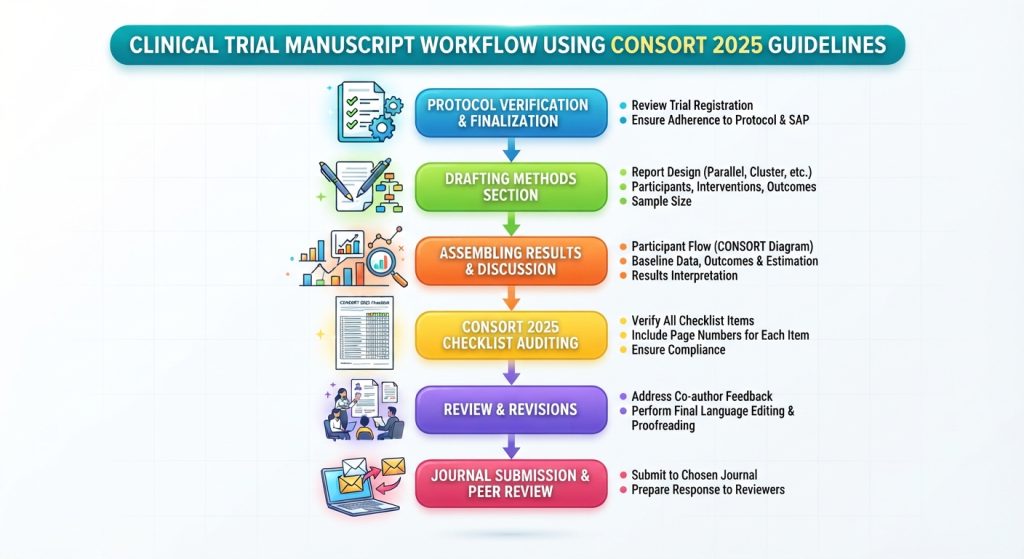
- Download the CONSORT 2025 checklist and complete it against the manuscript.
- Add page or section references that direct reviewers to each applicable item.
- Include the CONSORT flow diagram and ensure its counts agree with the Results section.
- Verify consistency among the manuscript, trial registry, protocol, and statistical analysis plan.
- Check the journal’s requirements for supplementary files, ethics statements, and data availability.
- Confirm that all requested reporting extensions have been addressed.
For additional support, explore ManuscriptLab’s editing and formatting services to improve clarity, consistency, and submission readiness.
Also read: 10 Key Reasons Manuscripts Get Rejected Before Peer Review
12. Common Methods Reporting Errors That Can Delay Publication
Several recurring problems undermine otherwise promising clinical trial submissions.
Incomplete randomization reporting: Authors state that randomization occurred but omit sequence generation or allocation concealment. Correct this by describing both processes separately and identifying the responsible personnel.
Insufficient intervention detail: Treatment dosage, duration, delivery, or comparator procedures are missing. Provide enough information for readers to understand and reproduce the intervention.
Unclear outcome definitions: Outcomes lack measurement instruments, assessment times, or prespecified definitions. Align the manuscript with the protocol and registry.
Inadequate sample size justification: The manuscript omits assumptions, the target effect, or the statistical power calculation. Supply the original calculation and disclose material deviations from planned enrollment.
Incomplete statistical methods: The analysis population, handling of missing data, or covariate adjustments are not explained. Describe the analytical approach with sufficient precision to evaluate its appropriateness.
Inconsistencies across documents: Recruitment dates, outcome definitions, enrollment counts, or analysis plans conflict across the manuscript and supporting records. Reconcile discrepancies and explain legitimate protocol amendments.
Outdated reporting guidance: Authors rely on CONSORT 2010 without checking the updated framework. Use CONSORT 2025 unless the journal explicitly directs otherwise, and consult any applicable extensions.
These problems can trigger editorial queries, requests for revision, or rejection. A complete checklist helps identify omissions, but it cannot compensate for methodological flaws or undocumented research procedures.
Pre-Submission Checklist: Is Your Clinical Methods Section Ready?
Use this checklist before uploading your manuscript:
- Identify the trial design, study setting, sites, and recruitment period.
- Define inclusion and exclusion criteria and explain participant recruitment.
- Describe sequence generation, allocation concealment, and blinding separately.
- Specify interventions, comparators, doses, schedules, and delivery procedures.
- Document the sample size calculation, assumptions, effect size, and statistical power.
- Define primary and secondary outcomes, instruments, and assessment time points.
- Explain data collection, follow-up, withdrawals, and missing-data handling.
- Specify the analysis population, statistical models, effect estimates, and confidence intervals.
- Report ethics approval, informed consent, and prospective trial registration.
- Address protocol access, data sharing, funding, and conflicts of interest.
- Complete the CONSORT 2025 checklist and include the participant flow diagram.
- Cross-check the manuscript against the protocol, registry, statistical analysis plan, and journal instructions.
Conclusion
Writing a strong Methods section for a clinical paper requires precision, methodological transparency, and alignment with established reporting standards. CONSORT 2025 provides a practical framework for documenting trial design, participant eligibility, randomization, interventions, outcomes, statistical analyses, and open-science commitments.
Do not treat checklist completion as a last-minute administrative task. Integrate CONSORT into manuscript planning, verify every methodological statement against the original study records, and resolve inconsistencies before submission. These steps help reviewers assess the reliability of the evidence and give readers the information needed to interpret and reproduce the research.
Prepare your clinical manuscript for its next publication milestone. Visit ManuscriptLab for professional editing and formatting support tailored to academic and clinical research manuscripts.