
Identifying a meaningful research gap is one of the most challenging stages of academic research. You may have reviewed dozens of journal articles, compared established theories, and examined recent findings, yet still struggle to explain what remains unknown and why another study is necessary.
This challenge matters because a research gap provides the intellectual justification for your study. Without a clearly established gap, even a well-designed research project may appear repetitive, insufficiently original, or disconnected from current scholarly debates. For journal submissions, an unclear research gap can also weaken the manuscript introduction and make it harder for editors and reviewers to recognize the study’s contribution.
A research gap is an unresolved question, limitation, inconsistency, or underexplored area in existing academic literature that provides a defensible rationale for further investigation.
Learning how to identify a research gap requires more than finding a topic that has received limited attention. You must critically evaluate existing evidence, distinguish genuine knowledge limitations from superficial omissions, and connect those limitations to a feasible research question.
This guide explains how to identify a research gap, recognize its different types, construct a literature synthesis matrix, and write a persuasive research gap statement using practical formulas and examples.
💡 Need expert help with your paper?
Transform your manuscript with ManuscriptLab’s professional editing and formatting services!
1. Understand What a Research Gap Is
A research gap represents something important that existing scholarship has not adequately explained, investigated, tested, or resolved.
It emerges from a critical assessment of published research rather than from an assumption that a particular subject has never been studied.
For example, suppose several studies investigate the relationship between remote work and employee productivity. However, most examine technology companies in high-income countries, while evidence from public-sector organizations in developing economies remains limited.
The underrepresented organizational and geographical contexts may indicate a contextual research gap.
A strong research gap should satisfy three conditions:
- Evidence-based: Existing studies demonstrate that the limitation genuinely exists.
- Significant: Addressing the limitation could improve theoretical understanding, empirical knowledge, methodology, or professional practice.
- Researchable: The proposed investigation can address the gap using appropriate data, methods, and resources.
Research gap vs. research problem: What is the difference?
These terms are related but serve different purposes.
A research gap identifies what existing knowledge does not adequately explain. A research problem describes the specific issue or question that your proposed investigation intends to address.
| Criterion | Research gap | Research problem |
| Primary purpose | Establishes missing or insufficient knowledge | Defines the issue requiring investigation |
| Main focus | Limitations in existing literature | A specific researchable concern |
| Evidence | Previous studies and literature synthesis | Literature, observations, and practical evidence |
| Function | Justifies originality and contribution | Directs research objectives and questions |
| Example | Limited evidence on AI adoption among rural healthcare providers | How do rural healthcare providers perceive and adopt AI-assisted diagnostic tools? |
Practical distinction: The research gap explains why additional research is necessary; the research problem explains what your study will investigate.
2. Identify the Main Types of Research Gaps
Understanding the types of research gaps helps you organize your literature review and recognize opportunities for original contributions.
Not every gap is equally valuable. Select the category that best reflects the limitations in your evidence base.
2.1 Empirical research gap
An empirical gap exists when insufficient observational or experimental evidence is available to answer an important research question.
For example, researchers may have extensively investigated the relationship between social media use and adolescent mental health using cross-sectional surveys. However, longitudinal evidence examining long-term psychological outcomes may remain limited.
How to identify it: Compare sample sizes, populations, research settings, study periods, and empirical findings across published studies.
Why it matters: Additional empirical evidence can establish whether existing conclusions are consistent across different populations and circumstances.
Common pitfall: Do not assume that a small number of studies automatically establishes an important empirical gap. Demonstrate why additional evidence would change or strengthen current understanding.
2.2 Theoretical research gap
A theoretical gap occurs when existing theories fail to explain a phenomenon adequately, conflict with one another, or have not been sufficiently integrated.
For instance, two established organizational theories may offer different explanations for employee resistance to technological change. Research examining how these theoretical perspectives interact could address the gap.
How to identify it: Examine conceptual frameworks, theoretical assumptions, contradictory propositions, and unexplained relationships.
Why it matters: Theoretical contributions can refine existing frameworks, challenge assumptions, or establish new conceptual relationships.
Common pitfall: Merely applying an established theory to a new dataset does not necessarily constitute a theoretical contribution. Explain what the application reveals that previous research could not establish.
2.3 Methodological research gap
A methodological gap arises when existing studies rely on methods that restrict the depth, reliability, or generalizability of their findings.
For example, a research area may rely heavily on self-reported questionnaires, leaving researchers with limited observational evidence about actual behavioral patterns.
How to identify it: Compare research designs, measurement instruments, sampling strategies, statistical models, and data collection procedures.
Why it matters: Improved methods can reduce measurement error, strengthen causal inference where appropriate, and produce more reliable findings.
Common pitfall: Using a different statistical technique is not automatically innovative. Explain how the alternative method addresses a demonstrated limitation.
2.4 Contextual research gap
A contextual gap exists when existing findings have not been adequately examined in a particular geographical, institutional, cultural, or professional setting.
For example, digital health interventions may be well studied in urban hospitals, but their implementation in rural primary healthcare facilities may be poorly understood.
How to identify it: Examine where previous studies were conducted and whether their findings can reasonably be generalized to other settings.
Why it matters: Contextual research can establish whether established relationships remain valid under different social, economic, or institutional conditions.
Common pitfall: Avoid presenting a change of geographical location as sufficient novelty. Explain why the context introduces theoretically or practically meaningful differences.
2.5 Population-specific research gap
A population gap emerges when particular demographic or professional groups are underrepresented in existing research.
For example, studies of workplace burnout may primarily examine physicians while providing limited evidence about nurses working in resource-constrained hospitals.
How to identify it: Review participant characteristics, recruitment procedures, inclusion criteria, and demographic distributions.
Why it matters: Underrepresented populations may experience different exposures, barriers, and outcomes.
Common pitfall: Identify the scientific or practical implications of studying the population rather than relying exclusively on its limited representation in previous publications.
2.6 Practical or application gap
A practical gap exists when established knowledge has not been adequately translated into professional practice, policy, or implementation.
For example, evidence may support a particular infection-prevention intervention, but healthcare facilities may lack research examining barriers to its implementation.
How to identify it: Compare established recommendations with real-world implementation evidence.
Why it matters: Addressing practical gaps can improve clinical workflows, institutional policies, and evidence-based decision-making.
Common pitfall: Distinguish a genuine knowledge gap from a simple operational problem that may be resolved without additional research.
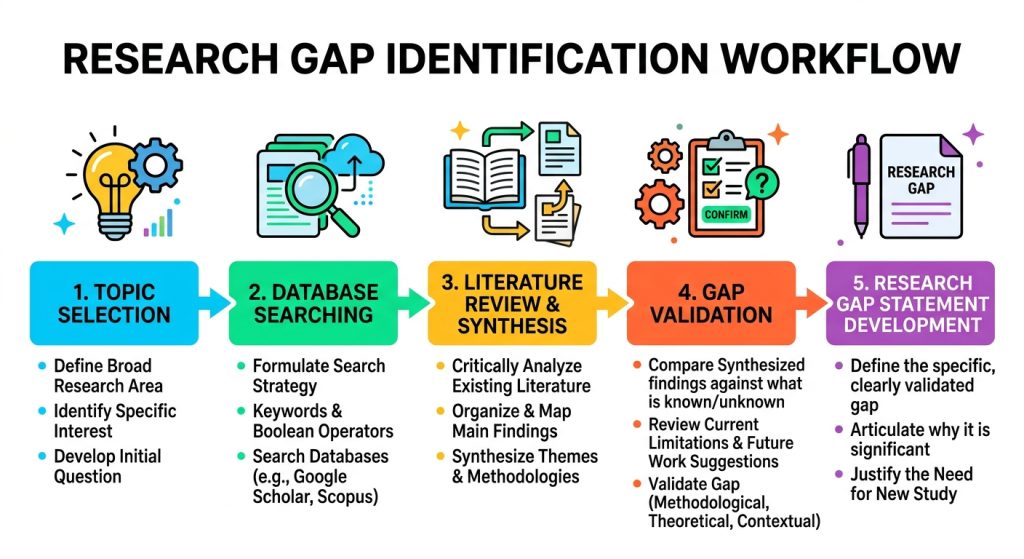
3. How to Identify a Research Gap: A Step-by-Step Process
A systematic literature review process provides a stronger foundation for identifying research gaps than unstructured reading.
Follow these steps to move from a broad research interest to a defensible knowledge limitation.
Step 1: Define and narrow your research topic
Start with a manageable research area. Broad topics often produce overwhelming literature and make it difficult to recognize a specific contribution.
For example:
- Broad topic: Artificial intelligence in healthcare.
- Narrower topic: AI-assisted diagnostic decision-making in primary healthcare.
- More focused topic: Factors influencing the adoption of AI-assisted diagnostic systems among primary healthcare professionals in rural hospitals.
A useful approach is to identify your principal population, phenomenon, context, and potential outcome.
For clinical research, the PICO framework can help structure a focused question:
- P: Population or patient group.
- I: Intervention or exposure.
- C: Comparison or control.
- O: Outcome.
For qualitative studies, frameworks such as PICo (Population, phenomenon of Interest, Context) may be more appropriate.
Industry-standard metric: Record the inclusion and exclusion criteria for your literature search before screening. A transparent search protocol improves reproducibility.
Common pitfall: Do not narrow the topic so aggressively that relevant foundational literature disappears. Maintain a balance between specificity and sufficient evidence.
Step 2: Conduct a structured literature search
Search relevant academic databases rather than relying exclusively on general search engines.
Useful databases include:
- PubMed/MEDLINE for biomedical and clinical literature.
- Scopus for multidisciplinary citation coverage.
- Web of Science for citation indexing.
- IEEE Xplore for engineering and computing.
- ERIC for education research.
- PsycINFO for psychology and behavioral sciences.
- Google Scholar for supplementary discovery.
Combine keywords with Boolean operators.
For example:
(“artificial intelligence” OR “machine learning”) AND (“primary healthcare” OR “primary care”) AND (adoption OR implementation)
Use quotation marks for exact phrases and truncation where supported by the database.
Apply suitable publication-date, language, document-type, and population filters. However, do not automatically exclude older foundational studies.
What to examine: Search strategies, publication dates, study designs, populations, sample sizes, findings, and limitations.
Why it matters: A comprehensive search reduces the risk of overlooking studies that already address your proposed gap.
Common pitfall: Searching only for your exact research question may produce an artificially narrow evidence base. Search for synonyms, related concepts, and alternative terminology.
Step 3: Evaluate the quality and relevance of published studies
Not every published article provides equally reliable evidence.
Evaluate the methodological quality of each study before using its conclusions to establish a research gap.
Consider:
- Study design and appropriateness.
- Sample size and statistical power.
- Sampling and recruitment procedures.
- Validity and reliability of measurement instruments.
- Missing data and potential bias.
- Confounding variables.
- Reproducibility and transparency.
- Generalizability and external validity.
For clinical and observational research, use appropriate reporting guidance. The STROBE checklist supports reporting of observational studies, while CONSORT provides guidance for randomized trials.
Consult the EQUATOR Network for reporting guidelines relevant to your study design.
Industry-standard metric: Report sample sizes, effect estimates, confidence intervals, and relevant methodological quality assessments where appropriate. Do not use a journal’s Impact Factor as a substitute for evaluating the quality of an individual study.
Common pitfall: Treating every limitation mentioned in an article’s discussion section as an established research gap. Verify whether subsequent publications have already addressed it.
Step 4: Build a literature synthesis matrix
A literature synthesis matrix is a structured tool for comparing studies and identifying patterns across an evidence base.
Unlike isolated article summaries, a synthesis matrix helps reveal recurring limitations, contradictory results, methodological weaknesses, and underrepresented populations.
Use the following structure:
| Author/year | Research focus | Methodology | Key findings | Limitations | Potential gap |
| Study A (2022) | AI adoption in hospitals | Cross-sectional survey | Positive association with digital readiness | Urban hospitals only | Rural healthcare settings |
| Study B (2023) | Clinical AI acceptance | Qualitative interviews | Trust influences adoption | Small professional sample | Broader professional representation |
| Study C (2024) | AI implementation | Mixed methods | Organizational support predicts adoption | Limited longitudinal evidence | Long-term adoption patterns |
| Study D (2025) | Healthcare technology use | Cross-sectional analysis | Training influences acceptance | Single-country sample | Cross-cultural comparison |
Illustrative entries only; replace them with verified studies from your actual literature search.
To use the matrix effectively:
- Record complete bibliographic details.
- Extract each study’s research question and theoretical framework.
- Document its design, sample, instruments, and analytical methods.
- Summarize findings without copying the authors’ wording.
- Record limitations and unresolved questions.
- Compare patterns across studies.
- Group recurring limitations into potential gap categories.
Why it matters: A synthesis matrix shifts your approach from describing individual studies to evaluating the collective state of knowledge.
Common pitfall: Creating a matrix that simply reproduces article abstracts. Extract comparable information and interpret relationships between studies.
Step 5: Identify contradictions, omissions, and unresolved questions
After synthesizing the literature, look for patterns that indicate where knowledge remains incomplete.
Ask these questions:
- Do published studies report conflicting findings?
- Are certain populations consistently excluded?
- Are most studies based on cross-sectional designs?
- Have researchers relied on the same theoretical framework?
- Are findings concentrated in a limited geographical region?
- Have established interventions been insufficiently evaluated in practice?
- Are important variables or relationships rarely investigated?
A particularly valuable approach is to compare the conclusions of multiple studies rather than relying on a single author’s recommendations for future research.
For example, three studies may report that digital training improves clinical technology adoption. However, their findings may differ regarding the influence of organizational support.
This inconsistency could justify further research examining whether organizational context moderates the relationship between training and technology adoption.
Common pitfall: Confusing contradictory results with poor-quality research. Differences may arise from populations, measurement approaches, settings, or study designs. Investigate these explanations before declaring a gap.
Step 6: Validate the gap against recent literature
Before finalizing your proposed gap, conduct an updated search to determine whether another study has already addressed it.
Search using different combinations of your main concepts, proposed population, context, and methodology.
Check:
- Recently published journal articles.
- Online-first publications.
- Relevant systematic reviews and meta-analyses.
- Conference proceedings where appropriate.
- Clinical trial registries for clinical research.
- Preprints, clearly distinguishing them from peer-reviewed publications.
For systematic reviews, examine the search end date and assess whether newer evidence has emerged.
Why it matters: A gap identified several years ago may no longer represent an unresolved knowledge limitation.
Common pitfall: Writing that no research exists without conducting a sufficiently broad search. Prefer qualified statements such as “limited evidence is available” when the evidence base is incomplete rather than demonstrably absent.
Also read: How to Write a Literature Review: Structure, Synthesis Matrix, and 7 Common Mistakes to Avoid in 2026
4. How to Write a Research Gap Statement
Once you have identified and validated a gap, convert it into a concise academic argument.
A research gap statement should establish three connected points:
- What previous research has already established.
- What remains insufficiently understood.
- Why addressing this limitation is important.
A practical research gap statement formula
Use this structure:
Existing knowledge + demonstrated limitation + research significance + proposed contribution.
For example:
“Previous studies have established the role of digital training in improving healthcare professionals’ acceptance of clinical technologies. However, limited longitudinal evidence explains how organizational support influences the sustained adoption of AI-assisted diagnostic systems in rural primary healthcare facilities. Addressing this limitation could clarify the organizational factors associated with long-term implementation and inform context-specific healthcare technology policies.”
This formula provides a logical transition from the literature review to your research objectives.
Academic sentence stems for research gap statements
Use these sentence starters to develop a precise and evidence-based argument.
To introduce established knowledge:
- Previous research has demonstrated that…
- Existing literature consistently indicates that…
- Several empirical studies have examined…
- Recent investigations have established an association between…
To identify limitations:
- However, limited empirical evidence is available regarding…
- Despite considerable research on…, little attention has been given to…
- Existing studies have primarily focused on…, leaving … insufficiently examined.
- The current evidence base remains inconclusive concerning…
- Few studies have investigated the relationship between…
To identify methodological gaps:
- Previous investigations have predominantly relied on…
- The limited use of longitudinal research designs restricts…
- Existing measurement approaches provide insufficient insight into…
To establish significance:
- Addressing this limitation is important because…
- Further investigation is necessary to determine whether…
- A clearer understanding of this relationship could contribute to…
To introduce your study:
- To address this gap, the present study investigates…
- Accordingly, this research examines…
- The current study seeks to extend existing knowledge by…
Use these stems selectively. Avoid combining multiple generic phrases without providing specific evidence.
Research gap statement examples with formulas
Example 1: Empirical gap
“Although previous studies have examined the relationship between physical activity and cardiovascular health, limited longitudinal evidence is available on how variations in exercise intensity influence cardiovascular outcomes among older adults with multiple chronic conditions. This study addresses the limitation by examining longitudinal associations between exercise intensity and cardiovascular health in this population.”
Example 2: Methodological gap
“Existing studies investigating employee engagement have predominantly used cross-sectional self-report questionnaires. Consequently, limited evidence explains how engagement changes over time and how these changes relate to workplace performance. The present study uses a longitudinal research design to examine these relationships.”
Example 3: Contextual gap
“Research on digital learning adoption has largely concentrated on higher education institutions in developed economies. However, limited evidence explains how infrastructure constraints and institutional support influence digital learning adoption in resource-constrained universities. This study examines these contextual factors within the selected higher education setting.”
Example 4: Theoretical gap
“Although established leadership theories explain several dimensions of employee motivation, the relationship between transformational leadership and employee responses to AI-driven workplace changes remains insufficiently integrated into existing conceptual models. This study examines these relationships to extend current theoretical understanding.”
Note: These are illustrative examples, not claims that the stated gaps have been independently verified. Support every gap in your manuscript with actual scholarly references.
5. Where Should the Research Gap Statement Appear in a Research Paper?
In most empirical journal manuscripts, the research gap appears in the introduction, usually after the relevant literature has established the current state of knowledge.
A typical introduction follows this sequence:
- Introduce the broader research topic.
- Explain its scientific, clinical, or practical significance.
- Synthesize the most relevant existing literature.
- Identify limitations or unresolved questions.
- Present the research gap statement.
- Explain the study’s objectives, research questions, or hypotheses.
- Summarize the intended contribution.
The gap statement should create a logical connection between the literature review and the study’s purpose.
For a dissertation, the gap may receive a dedicated subsection within the literature review or research rationale, depending on institutional requirements.
For a journal manuscript, avoid creating a standalone heading unless the target journal’s structure permits it.
Submission tip: Review the journal’s author instructions before finalizing your introduction. Different disciplines and journals have different expectations regarding introduction length, literature synthesis, and research rationale.
Also read: 10 Key Reasons Manuscripts Get Rejected Before Peer Review
6. Common Mistakes to Avoid When Writing a Research Gap Statement
Even well-researched manuscripts can present weak gap statements. Avoid these recurring problems.
1. Claiming that no research exists
An absolute statement such as “No previous study has examined this topic” is difficult to defend.
Instead, specify the databases, literature scope, population, or methodological limitations that support your claim.
2. Confusing research novelty with a research gap
Introducing a new variable or changing the study location does not automatically establish an important contribution.
Explain what the new investigation will reveal and why that knowledge matters.
3. Relying on outdated references
A gap supported only by older publications may have already been addressed.
Use recent evidence alongside foundational studies and verify the status of the literature before submission.
4. Listing limitations without synthesizing them
A paragraph that repeats the limitations of five studies is not a convincing research gap.
Compare their limitations, identify recurring patterns, and explain the resulting knowledge deficit.
5. Failing to connect the gap with research objectives
The proposed study must directly address the limitation it identifies.
A mismatch between the gap statement, objectives, research questions, and methodology weakens the manuscript’s internal coherence.
6. Exaggerating the significance of the gap
Not every unanswered question warrants a new study.
Establish its scientific, clinical, theoretical, or practical importance using credible evidence.
7. Ignoring reporting and ethical standards
A persuasive gap cannot compensate for weak research design or inadequate reporting.
Follow appropriate discipline-specific guidance, including STROBE, CONSORT, or other relevant EQUATOR Network recommendations. For clinical manuscripts, also review applicable ICMJE recommendations and institutional ethical requirements.
Also read: Technical Specs of a Manuscript: The Complete Guide to Formatting Standards
7. How a Strong Research Gap Can Strengthen Journal Submission
Editors and reviewers assess manuscripts according to originality, scientific rigor, relevance, and contribution to the field.
A well-developed research gap helps establish these elements before readers reach the methods and results sections.
Consider the following comparison:
| Manuscript element | Weak approach | Strong approach |
| Literature review | Summarizes studies individually | Synthesizes findings across studies |
| Research gap | States that limited research exists | Identifies a specific, evidenced limitation |
| Significance | Claims the topic is important | Explains the consequences of the knowledge deficit |
| Research objective | Introduces a loosely related objective | Directly addresses the identified gap |
| Methodology | Selects methods without justification | Aligns methods with the unresolved question |
| Contribution | Claims broad novelty | Specifies the expected theoretical or empirical contribution |
A clear research gap can improve the logic of your manuscript introduction and help reviewers evaluate its contribution.
However, it does not guarantee acceptance. Journal selection, methodological rigor, ethical compliance, statistical validity, reporting quality, and relevance to the journal’s scope remain essential.
For additional guidance, consult the ICMJE Recommendations, the COPE Core Practices, and the EQUATOR Network.
8. Pre-Submission Checklist: Is Your Research Gap Statement Ready?
Before submitting your manuscript, audit the following elements:
- The research topic is clearly defined and appropriately narrowed.
- Relevant academic databases have been searched systematically.
- Recent and foundational studies have been considered.
- The literature synthesis identifies patterns rather than merely summarizing articles.
- The proposed gap is supported by verifiable scholarly evidence.
- The gap is classified appropriately as empirical, theoretical, methodological, contextual, population-specific, or practical.
- The research significance is clearly explained.
- The gap statement is aligned with the research objectives and questions.
- The selected methodology can realistically address the identified limitation.
- Relevant reporting guidelines and ethical requirements have been considered.
- All references are accurate and formatted according to the target journal’s requirements.
- The introduction has been checked for clarity, coherence, academic tone, and logical progression.
Conclusion
Identifying a research gap is a critical step in developing a meaningful and publishable academic study. It requires systematic searching, critical literature evaluation, methodological awareness, and careful synthesis of existing evidence.
To write an effective research gap statement, establish what scholars already know, identify what remains unresolved, explain why the limitation matters, and demonstrate how your proposed investigation will contribute to the field.
Avoid unsupported novelty claims and generic statements about limited research. Instead, build your argument around verifiable evidence and align the gap with your research objectives and methodology.
A clearly articulated research gap strengthens your manuscript’s rationale, improves its scholarly positioning, and gives editors and reviewers a more convincing explanation of why your research deserves attention.
Need professional support with your research manuscript? ManuscriptLab helps researchers improve academic clarity, manuscript structure, language quality, and journal-ready presentation. Explore ManuscriptLab’s professional editing and formatting services and prepare your manuscript for a stronger submission.