Researchers often encounter a confusing question when evaluating journals: Is Web of Science peer reviewed? The short answer requires an important distinction. Web of Science (WoS) is not a journal and does not peer-review individual manuscripts. It is a publisher-independent research and citation database operated by Clarivate that evaluates scholarly publications for inclusion in its collections.
For journals seeking inclusion in the Web of Science Core Collection, however, peer review is an explicit quality criterion. Clarivate requires journals to provide a clear, accessible statement about their peer-review or editorial-oversight policy, and primary research articles must undergo external peer review. Clarivate also evaluates editorial rigor, scholarly content, editorial-board composition, publication ethics, accessibility, and other characteristics before accepting a journal.
This distinction matters when choosing a journal, assessing a publication’s credibility, or verifying whether a journal genuinely holds Web of Science coverage. This guide explains how Web of Science indexing works, what peer-review compliance means, which quality criteria Clarivate applies, and how researchers can verify a journal’s status in 2026.
💡 Need expert help with your paper?
Transform your manuscript with ManuscriptLab’s professional editing & formatting services!
Is Web of Science Peer-Reviewed?
Web of Science itself is not peer-reviewed in the way an academic journal is. Rather, Web of Science Core Collection is a curated bibliographic and citation database that selects journals, books, and conference proceedings according to defined editorial and quality criteria.
The distinction can be expressed simply:
Peer review evaluates scholarly content. Web of Science evaluates publications for database coverage.
A journal may be indexed in Web of Science because it has passed Clarivate’s editorial evaluation, but that does not mean Clarivate’s editors reviewed every individual article. The journal’s own editorial system remains responsible for manuscript assessment and peer review.
Clarivate states that Web of Science Core Collection uses 28 journal evaluation criteria: 24 quality criteria and four impact criteria. The quality criteria assess editorial rigor and publishing best practices, while the impact criteria use citation activity to identify journals with sufficient influence for the flagship indexes.
The distinction becomes particularly important because Web of Science Core Collection contains different journal indexes, including:
- Emerging Sources Citation Index (ESCI)
- Science Citation Index Expanded (SCIE)
- Social Sciences Citation Index (SSCI)
- Arts & Humanities Citation Index (AHCI)
Journals meeting the quality criteria can enter ESCI. Journals that subsequently meet the applicable impact criteria can be selected for SCIE, SSCI, or AHCI.
Does Web of Science require peer review?
Yes, for journals evaluated for Core Collection coverage, Clarivate has an explicit presence of peer-review policy criterion.
The journal must provide an accessible statement explaining its commitment to peer review and/or editorial oversight. For primary research articles, Clarivate specifies that external peer review is required. Review practices that are appropriate to particular scholarly communities, including some arts and law contexts, can be considered within the evaluation framework.
Therefore, a more precise answer to the question “Is Web of Science peer reviewed?” is:
Web of Science is not a peer-review service, but journals selected for Web of Science Core Collection are evaluated for peer-review and editorial-quality practices.
How Does Clarivate Ensure Quality Assurance and Peer-Review Compliance?
Clarivate’s model combines editorial selection, technical evaluation, ongoing monitoring, and re-evaluation.
The process is designed around three principles:
- Objectivity
- Selectivity
- Collection dynamics
Clarivate says its Web of Science editorial decisions are made by expert in-house editors who have no affiliations with publishing houses or research institutes. Editors specialize in subject categories, allowing them to assess journals within their disciplinary context.
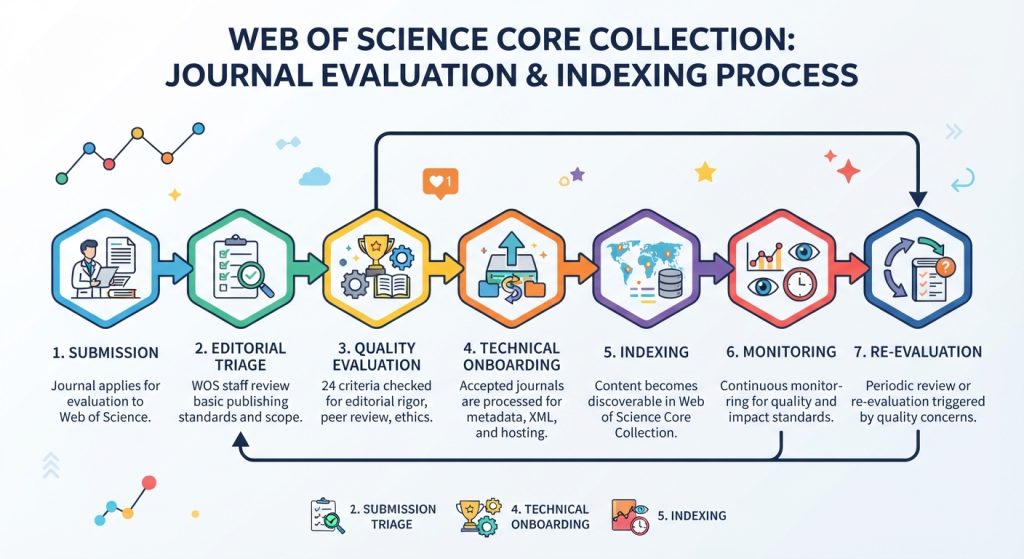
1. Editorial triage
The first stage determines whether a journal merits a full editorial evaluation.
This prevents the evaluation system from treating every submitted title as automatically eligible for comprehensive assessment. If a journal fails editorial triage, Clarivate’s current policy provides specific conditions governing subsequent submissions.
Why it matters: A journal’s existence, ISSN, website, or publisher identity does not automatically qualify it for Web of Science coverage.
Common pitfall: Assuming that a journal can claim Web of Science indexing simply because it has submitted an application.
2. Quality evaluation
During editorial evaluation, Web of Science editors examine whether the journal demonstrates editorial rigor and follows recognized scholarly publishing practices.
Clarivate assesses the relationship among:
- Journal title
- Aims and scope
- Editorial board
- Author composition
- Published content
- Editorial policies
- Scholarly significance
- Publishing practices
The publisher and editorial board remain responsible for the quality of the journal’s published content, including special issues.
3. Technical evaluation
Passing editorial evaluation is not the end of the process.
Clarivate’s onboarding process includes a technical evaluation to determine whether the publisher can provide journal content in a format compatible with Web of Science indexing. This includes checking whether article PDFs contain the metadata necessary for accurate indexing.
Industry-standard metric: Accurate bibliographic metadata is essential for discoverability, citation linking, author identification, and database indexing.
Common pitfall: Treating editorial acceptance and technical onboarding as the same process. They are separate quality-control stages.
Also read: Web of Science Core Collection vs SCI: Understanding the Database Hierarchy in 2026
What Are the Strict Editorial and Peer-Review Criteria for Web of Science Indexing?
Clarivate’s 24 quality criteria are broader than peer review alone. A journal must demonstrate an overall publishing infrastructure capable of supporting reliable scholarly communication.
1. Clear peer-review policy
A journal should make its review model easy to locate and understand.
Researchers should be able to determine:
- Whether research articles undergo peer review
- Whether reviewers are external
- Which article types are reviewed
- Whether special issues follow the same process
- How editorial decisions are made
This transparency is consistent with broader scholarly-publishing practice. The Principles of Transparency and Best Practice in Scholarly Publishing recommend that journals clearly explain who conducts peer review, the review model, masking of identities, exceptions, and decision-making procedures.
2. External review of primary research
This is one of the most important distinctions for researchers.
Clarivate’s criterion does not merely ask whether a journal has an editorial board. Primary research articles must be subject to external peer review.
Editorial review and peer review are therefore not automatically interchangeable.
An editor may conduct an initial assessment for scope, methodological fit, plagiarism, ethics, or basic suitability. Peer review then provides independent subject-matter assessment before publication.
3. Qualified editorial board
Clarivate evaluates editorial-board composition, including affiliations, geographic diversity, publication records, and consistency with the journal’s scope and output. The size and composition of the board should also correspond to the volume and breadth of publications.
Common pitfall: A journal displaying dozens of names does not automatically demonstrate strong editorial governance. The relevant question is whether the board’s expertise and affiliations correspond credibly to the journal’s subject area and publishing activity.
4. Scholarly content
A Web of Science journal should primarily contain original scholarly material appropriate for a graduate, postdoctoral, or professional research audience.
This requirement helps distinguish research journals from publications that primarily contain:
- General-interest material
- Trade content
- Promotional articles
- News
- Non-scholarly commentary
5. Editorial accountability
The journal’s publisher and editorial leadership are responsible for the quality of published material.
This becomes particularly important for special issues. A journal cannot treat guest-edited collections as a separate quality regime; editorial responsibility for the journal’s content remains with its established governance structure.
Also read: 10 Key Reasons Manuscripts Get Rejected Before Peer Review
Are All Journals Indexed in Web of Science Peer-Reviewed?
No not every publication appearing somewhere within the broader Web of Science ecosystem should be interpreted as a conventional peer-reviewed journal.
Web of Science Core Collection covers multiple publication types, including journals, conference proceedings, and scholarly books. Clarivate uses separate evaluation criteria for these content categories. For journals specifically, the selection criteria include peer-review requirements for primary research articles.
This is why researchers should identify the exact Web of Science index and publication type rather than relying on a publisher’s generic “Web of Science indexed” statement.
Web of Science coverage versus peer-review status
| Question | What to verify | Why it matters |
| Is the journal in Web of Science? | Current Master Journal List record | Confirms database coverage |
| Which index? | ESCI, SCIE, SSCI, or AHCI | Indicates the specific Core Collection index |
| Is primary research peer-reviewed? | Journal’s peer-review policy | Establishes the journal’s review model |
| Is external review used? | Instructions/policy for reviewers | Distinguishes external peer review from internal editorial review |
| Is the journal currently covered? | Current Clarivate coverage information | Indexing status can change |
| Is the journal technically onboarded? | Active coverage and indexed content | Confirms operational coverage |
| Does the journal maintain standards? | Current policies and publication practices | Indexing is subject to ongoing curation |
Clarivate states that its Master Journal List is the authoritative source for Web of Science coverage information and provides information about journal coverage and changes.
How to Check Whether a Web of Science Journal Uses Peer Review
Do not rely solely on a journal homepage badge.
Use a two-part verification process.
Step 1: Verify Web of Science coverage
Search the journal by its title or ISSN in Clarivate’s Master Journal List.
Web of Science provides title lists and journal information through this resource, including coverage information for individual indexes.
Search the Web of Science Master Journal List
Step 2: Audit the journal’s peer-review policy
Go directly to the journal website and locate its:
- Peer-review policy
- Instructions for authors
- Editorial policies
- Reviewer guidelines
- Ethics statement
- Special-issue policy
A credible policy should identify what is reviewed, who conducts the review, the review model, and any exceptions.
For comparison, DOAJ’s journal-quality criteria require journals to state their peer-review process clearly and require research articles to pass through a quality-control system before publication. DOAJ generally requires at least two independent reviewers per article, subject to its discipline-specific exceptions.
This does not mean that DOAJ’s criteria are identical to Clarivate’s criteria. They are separate indexing systems with different evaluation frameworks. Use them as complementary quality signals rather than interchangeable certifications.
Step 3: Inspect article-level evidence
Open several recently published research articles.
Look for:
- Submission date
- Revision date
- Acceptance date
- Publication date
- Peer-review statements
- Editorial-history information
- Reviewer acknowledgments where applicable
Dates do not prove that peer review was rigorous, but transparent editorial histories can provide useful evidence about the journal’s workflow.
Step 4: Examine special issues separately
Special issues can create additional editorial complexity.
Check whether the journal states that special-issue papers follow the same peer-review and editorial-oversight procedures as regular submissions.
This is especially important when a journal uses guest editors, because editorial responsibility should remain clearly defined.
How Web of Science Indexing Differs From Journal Quality
A Web of Science listing is a meaningful indexing signal, but researchers should not treat database inclusion as an absolute guarantee of the quality of every individual article.
Clarivate describes its collections as dynamic. Journals are periodically evaluated, and a journal can move between collections or be removed if it no longer satisfies quality criteria. ESCI journals may move into SCIE, SSCI, or AHCI if they subsequently meet relevant impact criteria. Conversely, journals in flagship indexes can move to ESCI if their impact changes, while failure to meet quality criteria can result in removal from Core Collection coverage.
This is an important quality-assurance mechanism.
Indexing is not a permanent certificate.
Clarivate also monitors indexed journals. If valid concerns are raised by users or identified through internal monitoring, the journal may be re-evaluated according to the selection criteria.
Also read: ManuscriptLab Editing Services
Web of Science, Peer Review, and Predatory Journal Screening
Researchers sometimes assume that a Web of Science listing makes predatory publishing impossible. That is too broad a conclusion.
Clarivate’s editorial selection and ongoing curation are designed to identify journals that meet its criteria, and it can remove publications that fail to maintain required standards or comply with ethical standards.
However, researchers should still perform independent due diligence.
Check for warning signs such as:
- False or unverifiable indexing claims
- Unclear peer-review procedures
- Implausibly short review-to-publication timelines
- Unverified editorial-board members
- Fake or misleading metrics
- Poorly defined publication ethics policies
- Unclear APCs
- Scope that is excessively broad or inconsistent
- Inconsistent journal metadata
- Suspicious special-issue practices
COPE’s ethical guidance emphasizes that peer review depends on responsible conduct, transparency, fairness, confidentiality, and appropriate reviewer behavior.
Likewise, DOAJ’s quality-assurance process examines issues including journal websites, editorial-board composition, signs of poor peer review, journal reputation, and journal management.
Does Web of Science Indexing Guarantee a High-Impact Journal?
No.
Web of Science indexing and journal impact are related but distinct concepts.
The Core Collection includes journals selected through quality and, for some indexes, impact criteria. Clarivate states that its 28 journal criteria comprise 24 quality criteria and four impact criteria. Quality evaluation comes first; impact evaluation is applicable to journals being considered for the flagship indexes.
Do not confuse:
- Web of Science indexing
- Web of Science Core Collection coverage
- ESCI coverage
- SCIE coverage
- SSCI coverage
- AHCI coverage
- Journal Impact Factor
- Journal Citation Indicator
- Article-level citations
These are different concepts.
For example, a journal can have Web of Science Core Collection coverage without the researcher being justified in assuming that every article is highly cited or that the journal has a Journal Impact Factor.
Clarivate also notes that journals eligible for Journal Citation Reports depend on their coverage and timing within the annual JCR production cycle.
Also read: Is Web of Science Free to Access? Master Journal List & 7 Free Alternatives in 2026
What Authors Should Verify Before Submitting to a Web of Science Journal
Treat journal selection as an evidence-based due-diligence exercise.
1. Confirm the exact journal
Check:
- Full journal title
- ISSN/eISSN
- Publisher
- Journal website
- Web of Science coverage
An ISSN mismatch can be an important warning sign.
2. Verify the exact index
Do not stop at the phrase “Web of Science indexed.”
Determine whether the journal appears in:
- ESCI
- SCIE
- SSCI
- AHCI
This gives you substantially more precise information about its Core Collection status.
3. Audit peer review
Confirm that the journal explicitly explains:
- Review type
- External reviewers
- Editorial decision process
- Exceptions
- Special-issue procedures
4. Inspect editorial governance
Check whether board members have identifiable institutional affiliations and expertise appropriate to the journal.
5. Verify publication ethics
Look for policies covering:
- Conflicts of interest
- Research misconduct
- Corrections
- Retractions
- Authorship
- Plagiarism
- Complaints and appeals
- Data and reproducibility
These policies are consistent with broader transparency and publication-ethics expectations.
6. Check current status immediately before submission
Journal coverage can change. Clarivate explicitly describes Web of Science Core Collection as a dynamic collection subject to re-evaluation.
Do not rely on an old screenshot, archived publisher claim, or third-party indexing list.
Frequently Asked Questions
Is Web of Science itself a peer-reviewed database?
No. Web of Science is a curated citation and bibliographic database rather than a journal that publishes manuscripts through peer review. Its journal-selection process does, however, evaluate peer-review practices as part of its quality criteria.
Are all Web of Science journals peer-reviewed?
For journals evaluated for Web of Science Core Collection, Clarivate requires a clear peer-review and/or editorial-oversight policy and specifies that primary research articles must undergo external peer review. Researchers should still verify the journal’s current policy and coverage rather than assuming that a database listing replaces article-level due diligence.
Does Web of Science review every paper?
No. The journal’s editors and reviewers conduct manuscript-level review. Clarivate evaluates publications for inclusion and continued coverage in its database.
How can I verify a journal’s Web of Science indexing?
Search the journal title or ISSN in the Clarivate Master Journal List. Clarivate identifies this resource as the authoritative source for coverage information.
Does Web of Science indexing mean a journal has an Impact Factor?
No. Indexing and Journal Impact Factor are not synonymous. Determine the journal’s exact Web of Science collection and separately verify any claimed journal-level metrics.
Pre-Submission Checklist: Verify a Web of Science Journal in 10 Steps
Before submitting your manuscript, confirm that you have:
- Checked the journal title and ISSN in the Web of Science Master Journal List.
- Identified the exact Web of Science index covering the journal.
- Confirmed that the coverage is current.
- Read the journal’s peer-review policy.
- Confirmed whether primary research receives external peer review.
- Reviewed the editorial-board composition.
- Checked the journal’s publication-ethics policies.
- Examined recent articles for transparent editorial information.
- Verified APCs and other publication charges.
- Confirmed that your manuscript fits the journal’s aims, scope, article type, and reporting requirements.
Conclusion
So, is Web of Science peer reviewed? Not in the sense that Web of Science itself reviews and accepts individual research manuscripts. Web of Science is an indexing and citation platform. The important quality distinction is that Clarivate evaluates journals for Web of Science Core Collection coverage using explicit editorial, peer-review, quality, and in applicable indexes impact criteria.
For authors, the practical approach is straightforward: verify the journal’s current Web of Science coverage, identify its exact Core Collection index, read its peer-review policy, inspect editorial governance, and assess publication-ethics practices before submission.
A carefully prepared manuscript still needs to meet the journal’s own methodological, reporting, formatting, and editorial requirements. Get professional manuscript editing and formatting support from ManuscriptLab before you submit.